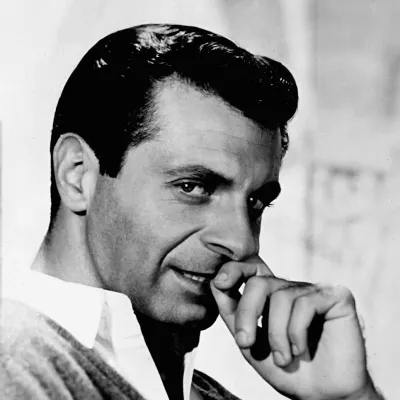
Mort Sahl
Human Design Chart
Biography
Sahl's father was an embittered unsuccessful playwright who took a job as a government clerk to feed the family. Sahl was enchanted by the entertainment world and at age two began to imitate news broadcasts from the radio. His father warned his son about the hardships and disappointments in show business, telling him, "They don't want anything good."
Sahl applied and was accepted at West Point but he turned down his appointment, enlisting instead in the Army when he was promptly sent to Alaska. His attitude toward the discipline of the military immediately earned him 83 days of K.P. duty. In 1950, Sahl earned his B.A. in public administration. For the next two years, he hung around the University of California at Berkeley going to the coffeehouses. He moved to San Francisco and was hired by Enrico Banducci, manager of the "hungry i" nightclub, Christmas 1953. Sahl became a hit at the club with his anti-establishment jokes and commentaries. The FBI leaned on Banducci to fire Sahl but the cash register receipts were going through the roof. Down the street from Sahl, Lenny Bruce was packing the crowd in at the Purple Onion.
Human Design Analysis: Mort Sahl as Generator 2/4
Generator 2/4 — Design at a Glance
Mort Sahl revealed himself as someone with remarkable inner endurance. His design as a Generator laid a tendency towards excessive sacral energy – comparable to a strong workhorse that provides power as long as it burns for its task. This configuration did not mark him by spontaneous initiative but rather by the ability to react to impulses from his environment. The motto was clear: Not taking the first step himself, but waiting until life sends a signal.
For Mort Sahl, this meant that his energy primarily became free when he responded with an authentic 'yes' from the gut. If he followed this strategy and reacted to genuine incentives, his design rewarded him with deep satisfaction and a sense of fulfillment. Conversely, ignoring this principle – such as by constantly initiating without inner confirmation or through compulsive actions that found no resonance – led to frustration and energy loss. The danger always lay in either wasting energy on unwanted tasks or being held back from the heart project despite still having power available. Mort Sahl's path thus consisted of skillfully navigating between these poles: waiting for the right impulse, then acting with full force.
Emotional Authority
Mort Sahl showed an inner decision-making structure that did not rely on immediate clarity but rather on a rhythmic process of emotional waves. His inner authority was Emotional Authority carried by the defined Solar Plexus Center. In Human Design mechanics, this authority always takes precedence over all other defined centers; it is the primary compass for decisions, regardless of further configurations in the chart.
This design meant that Mort Sahl's perception and judgments were always filtered through the lens of his current mood state. His feelings underwent a permanent up-and-down: A topic could appear absolutely right at one moment while seeming negative or irrelevant the next. This emotional fluctuation was not a weakness but rather a mechanical filter. A spontaneous decision made in the heat of an emotional wave would often lead to misjudgments, as the feeling only represented a momentary snapshot, not the deeper truth.
Therefore, his design's strategy lay in waiting. Mort Sahl needed time for decisions to mature. Through multiple nights' sleep and hesitation, he gained emotional distance from initial intensity. Only when intense feelings subsided and calmness set in did clear insight emerge for him. This process of delay was essential to make long-term life decisions correctly without being steered by temporary mood swings.
The 2/4 Profile — Hermit / Opportunist
Mort Sahl revealed himself as someone who oscillated between a deep need for withdrawal and the desire to connect with his closest community. His Human Design Profile 2/4 shaped this dynamic: Line 2 demanded solitude to create inner clarity, while line 4 sought exchange with familiar people. For him, it was crucial to establish a safe environment where he could clearly communicate when he needed company and when he wanted to be left alone. In his solitary time, he reflected on the knowledge from his network and developed new insights.
This ability for individual positioning was strengthened by specific energetic configurations. An aspect of his design emphasized self-defense of individuality: Where Mort Sahl was unique, he tolerated no interference. This served to protect his personal truth from external interference, especially in early life phases. Parallel to this, another configuration carried revolutionary principles outward. It aimed to find support for human rights issues and implement changes. The challenge lay in living these visions authentically rather than making empty promises. Mort Sahl used his withdrawal periods to evaluate these societal impulses before bringing them into his community. Thus, he combined personal integrity with engagement for the common good.
Split Definition — Defined & Open Centers
Mort Sahl revealed himself as someone with a steadfast inner identity and a clear personal direction. His defined G Center provided him with a firm self-image that allowed him to give others guidance without being dependent on their expectations. This stable foundation worked in conjunction with his constant mental activity: The defined Ajna Center ensured that his mind was always active, generating concepts and theories. He tended to interpret answers as opinions and consistently express his thoughts, supported by the also defined Throat Center, which served as a focal point for his communication.
His energy source came from the defined Sacral Center, giving him vital endurance. Mort Sahl relied on reacting to questions or situations to gain access to his strength; initiating independently without prior invitation risked frustration and exhaustion. This responsiveness was filtered through the emotional depth of his defined Solar Plexus Center. He needed time for his feelings to subside before gaining clarity rather than impulsively acting on the first impulse. The constant pressure of his defined Root Center propelled him forward and helped him cope with stress in the material world.
At the same time, Mort Sahl was vulnerable to specific pitfalls through his open centers. His open Head Center occasionally left him under mental strain or preoccupied with questions not originating from himself, which could distract him. His open Heart Center made him sensitive to the need to prove his worth; he tended to make promises to gain recognition despite lacking consistent willpower to fulfill them. Additionally, his open Spleen Center was vulnerable to fears and clinging to unhealthy situations due to a false sense of security. This configuration marked him as someone who based himself on inner truth but had to learn to free himself from external validations and spontaneous fears.
Channels for focus, structure, self-acceptance and emotional clarity.
Mort Sahl demonstrated an intense, almost meditative focus on details. This attitude stemmed from the Channel of Concentration 52-9 in his design, a format energy between Root and Sacral Centers. It gave him a calm inner pressure to remain still and ward off distractions, penetrating logical patterns and perfecting them. His energy only worked precisely when he focused on one thing; multitasking drained this power.
Parallel to this, he carried the personality of the Channel of Exploration 34-10. This channel connected Sacral with G Center, fostering deep trust in personal convictions as well as self-love. Mort Sahl lived this individuality authentically without imposing it but by demonstrating through his reactions. This encouraged others to embrace their unique qualities.
His thinking was shaped by the Structure 23-43, a channel between Ajna and Throat. He received spontaneous insights (Gate 43) and processed them through assimilation (Gate 23), clearly articulating innovative perspectives. His knowledge often felt ahead of its time; it took time for these new concepts to be accepted by the collective.
Emotionally, he moved within the wave of the Channel Release Emotions 39-55 (Juxta). This channel between Root and Solar Plexus generated a mood wave from joy to melancholy. Mort Sahl used this provocation to explore others' minds and find the right mood for interactions.
Additionally, Gates like 49 (Transformation/Principles), 4 (Formulation/Future Security) and 15 (Collective Behavior) influenced him. Gate 47 helped him recognize collective meaning from past experiences while Gate 24 promoted mental mutations. The mystical innocence of Gate 25 supported his centering. Further influences came from Gate 58 (Experiment/Pressure), Gate 12 (Restraint/Creativity) and Gate 37 (Friendship/Community). Gate 8 encouraged his individual contribution, while Gate 29 fostered persistent saying yes to challenges. Finally, he experienced the cyclical crises of Gate 36, which released emotional energy and enabled development.
Individual Circuitry — Circuit Signature
Mort Sahl's design inclined towards inner firmness and structured knowledge, but this tendency manifested in two separate energetic blocks. As a person with Split Definition, he lacked an uninterrupted connection between these areas; instead, they operated as parallel independent power fields.
The Knowledge Circuit presented itself in him as two isolated segments. On one hand, the Channel 43-23 connected Ajna Center to Throat Center, enabling the ability for logical structuring and precise expression of thoughts. On the other hand, the Channel 55-39 between Solar Plexus and Root Center directly converted emotional waves into physical energy. These two groups were not interconnected; thus, intellect and emotion did not provide a shared experience but existed alongside each other.
The Centering Circuit connected Identity with Sacral Center through the Channel 10-34. This created a stable foundation for self-worth and the strength to explore and live one's individuality without necessarily communicating it outwardly – as there was no Throat Center involved.
Finally, the Understanding Circuit linked Sacral with Root Center via the Channel 9-52. This provided focused endurance and the ability to immerse oneself in tasks concentratedly. Together, these separate circuits formed a profile where rational structure, emotional impulses, and inner identity stood as separate but equally valuable resources.
Right Angle Cross of Explanation 2
Mort Sahl demonstrated a fundamental attitude aimed at clarity and uncovering connections. His design was marked by the right cross of explanation, which described an inner drive to understand things and formulate insights precisely. This configuration suggests that he sought not just information but also ordered it in ways that others could follow. It wasn't about mere accumulation of knowledge but rather reducing complexity and distilling the essence of issues.
This mechanism influenced how he interacted with his environment: He tended to replace confusion with clear structures. The right cross of explanation often grants the ability to reconcile seemingly contradictory information into a coherent whole. For Mort Sahl, this meant that his strength lay in providing answers or framing questions so they led to solutions. He was programmed to shed light on darkness, driven by a deep need not just to find truth but also make it understandable. This trait characterized his entire expression and actions throughout life.
Saturn Return · Uranus Opposition · Chiron Return · 2nd Saturn Return — Life Cycles
Mort Sahl's design set a tendency towards strategic turning points that crystallized through concrete public affirmation. His first Saturn return marked the transition from preparation to established presence. In 1953, at age 26, he broke through in the nightclub 'the hungry i'. This success was no coincidence but rather the logical consequence of years of inner alignment with his strategy and authority; the Saturn return served as a catalyst that made this internal structure visible and stabilized it.
Later, his design showed a phase of deeper meaning-seeking. The Chiron return, a cycle of fulfillment between ages 49 and 51, offered the chance to unfold his incarnation cross – if lived according to strategy. For Mort Sahl, this process became tangible in 1976 at age 49 with the publication of his autobiography 'Heartland'. This work was less an act of healing than a confirmation of his life's purpose; it documented maturity and meaning that emerged from a life following inner guidelines. The autobiography thus stood for the flowering period of his design, where his individual mission became clearly recognizable.
Generator · Emotional Authority — Synthesis
Mort Sahl was a Generator whose life was marked by a deep tension between internal drive and emotional process. Sacral energy (from the Generator type and Channel of Concentration) gave him endurance and the ability to create formats through focused attention – a quality evident in his breakthrough (1953). Simultaneously, he was subject to an emotional wave (emotional authority), which allowed decisions to mature but also made him oscillate between enthusiasm and skepticism. This interplay of steady drive and fleeting emotion shaped his path, where transforming personal knowledge and initiating change were key (Knowledge Circuit).
A central paradox lay in Mort Sahl carrying both a need for inner peace and concentration (Line 2) as well as social interaction and expression (Line 4). He drew strength from the possibility of diving into internal processes alone to gain clarity, but always returned to community to express his insights. This interplay between withdrawal and exchange accompanied him through career phases (1976) and revealed a personality that was both profound and communicative.
4 Defined Channels
Incarnation Cross - Right Angle Cross of Explanation 2
Solar Return
The Solar Return shows the moment when the sun returns to its exact birth position - your personal solar year.
Life Cycles
Discover the life cycles with a detailed triple view (birth chart, cycle chart, composite).
Human Design Profile
- Type
- Generator
- Strategy
- To respond - wait for something to respond to
- Authority
- Emotional Authority
- Profile
- 2/4 - Hermit / Opportunist
- Definition
- Split Definition
- Incarnation Cross
- Right Angle Cross of Explanation 2
- Date of Birth
- 11.05.1927 08:30
- Place of Birth
- Montréal, CAN
Frequently Asked Questions
What was Mort Sahl's Human Design type?
Which Profile did Mort Sahl have?
What Authority did Mort Sahl have?
What incarnation cross did Mort Sahl have?
When was Mort Sahl born?
Discover your own Human Design
Are you also a Generator? Find out in a personal reading how to use your sacral energy correctly and discover deep satisfaction.
More Personalities
Back to overviewSissy Spacek
Aaliyah

Alexia

Anémone
Angèle

Ann-Margret