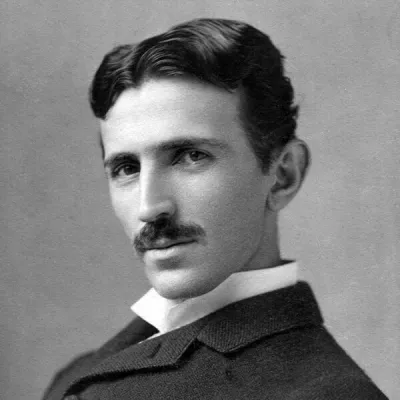
Nikola Tesla
Human Design Chart
Biography
Born and raised in the Austrian Empire, Tesla first studied engineering and physics in the 1870s without receiving a degree. He then gained practical experience in the early 1880s working in telephony and at Continental Edison in the new electric power industry. In 1884, he migrated to the United States, where he became a naturalized citizen. He worked for a short time at the Edison Machine Works in New York City before he struck out on his own. With the help of partners to finance and market his ideas, Tesla set up laboratories and companies in New York to develop a range of electrical and mechanical devices. His AC induction motor and related polyphase AC patents, licensed by Westinghouse Electric in 1888, earned him a considerable amount of money and became the cornerstone of the polyphase system, which Westinghouse marketed.
Tesla conducted a range of experiments with mechanical oscillators/generators, electrical discharge tubes, and early X-ray imaging among other things, in an attempt to develop inventions he could patent and market. He built a wirelessly controlled boat, one of the first wirelessly controlled vehicles ever produced. Tesla became well known as an inventor and demonstrated his achievements to celebrities and wealthy patrons at his lab.
Nikola Tesla as a Manifesting Generator 3/6 in Human Design
Manifesting Generator 3/6 — Design at a Glance
Nikola Tesla's design inclined him towards lightning-fast action based on hybrid energy sources. As an Manifesting Generator, he possessed the constant power of the sacral center combined with the ability to skip steps and quickly pull things into his life. This configuration linked the endurance of a generator with the dynamism of a manifestor.
However, this speed carried specific risks: Often acting too fast, he skipped necessary intermediate steps, leading him later to return to fill gaps. Such detours generated frustration, the central non-self theme of this type. Moreover, his design tended to pick up multiple impulses simultaneously and start diverse projects in parallel. Without inner consent, creativity quickly waned into exhaustion.
The key lay in reacting rather than initiating. Success occurred when he responded to life impulses and acted only when his sacral center clearly agreed. Regular checks of this internal resonance were essential to ensure the energy was still flowing. When these conditions were met, Nikola Tesla drew deep satisfaction from his work. In this state, multitasking was no barrier but a strength. His design functioned optimally in 'play mode', characterized by variety and fun rather than rigid linear processes.
Emotional Authority
Nikola Tesla's design inclined him to not make decisions based on the first impulse but to let them mature through the filter of time and recurring sleep cycles. Spontaneous reactions appeared unreliable; instead, his inner authority required patience to move from momentary clarity to true insight.
This mechanism stemmed from his emotional authority. With a defined emotional center, he was subject to permanent waves of ups and downs in emotions. The world always seemed colored by the current mood: one moment full of enthusiasm, the next marked by deep skepticism. This immediate feeling was only an initial impression, not yet his truth. Quick decisions made amid this emotional heat risked negative repercussions.
The strategy of his design involved taking time to rethink decisions multiple times. Through awareness of this emotional wave, he gained distance over time. Intense feelings subsided, allowing him to find calm and deeper insight. This process was crucial for long-term realignments in his life. By hesitating and letting questions arise rather than acting immediately, he followed the logic of his emotional authority. This ensured that his choice was guided by clear, mature understanding rather than a passing mood.
The 3/6 Profile — Martyr / Role Model
Nikola Tesla's design inclined him towards inner conflict: He carried both a desire for playful experimentation and an urge for reflective distance within himself. Until his first Saturn return, around 29.5 years old, he primarily acted under the influence of Line 3. During this phase, he learned through trial and error, actively sought harmony, and avoided conflicts since development was only possible in a conflict-free space.
Only at about 30 did Line 6 activate, fundamentally changing his dynamics: Nikola Tesla now showed a strong desire for withdrawal to integrate accumulated experiences and develop wisdom. The previously playful energy gained wise guidance seeking an overview of the whole. This created internal tension between the 'inner child' wanting play and immediacy and the 'wise elder' needing separation and reflection.
Line 6 stood for separation and willpower to overcome shocks. Nikola Tesla had to learn to face these challenges alone. Although he appeared outwardly in control, he often felt torn internally between space for play and the necessity of thoughtfulness. Around age 50, this synthesis of charm and wisdom should lead him to act as a role model for others by uniting perspectives from both lines.
Triple Split Definition — Defined & Open Centers
Nikola Tesla's design points to a tendency towards constant, willful presence anchored in clear identity and direction. His defined G-Center gave him a firm sense of self-understanding and purpose for his life mission, while the also defined Heart Center equipped him with persistent willpower. He could keep promises and determine his own resources, but this carried the risk of pushing others or setting unrealistic expectations about their capacities if he didn't listen to his inner authority.
These internal forces flowed through his defined Sacral Center, the motor of his vital energy. This power was only available with correct reactions; initiating actions without prior questioning often led to resistance and exhaustion. His communication, steered by the defined Throat Center, served as a steady anchor point that transferred these energies – whether from will, identity, or sacral response – into the world. This was complemented by the defined Solar Plexus Center, which required emotional clarity: decisions needed time to condense in the emotional wave cycle rather than being made impulsively. Intuition (Spleen) and stress management (Root) rounded out this stable foundation.
In contrast, his open Head and Ajna Centers showed areas of mental flexibility but also vulnerability to conditioning. Without constant mental inspiration, he tended to be overwhelmed by doubts or the questions of others. The pressure to find answers could distract him from the correct decision-making process, as his mind was not a steady source of truth but an open space for external impulses. Here lay the trap of identifying with foreign confusion or misinterpreting his own mental monologue as absolute reality instead of trusting his defined energetic and emotional authorities.
Channels for emotional depth, pioneering spirit, ambition and maturation.
Nikola Tesla's design points to a tendency towards cyclical meaning-making, where he had to fully experience and reflect on experiences to develop depth. This process was shaped by the Maturity Channel 53-42, which connects Gate of Beginnings (53) with Gate of Growth (42). Here it showed that expectations often led to frustration; instead, entering new cycles without fixed guidelines promoted wisdom and intellectual development.
Additionally, the Openness Channel 22-12 worked, translating emotional waves into social articulation. By connecting the Solar Plexus Center with the Throat Center, Tesla expressed moodiness, passion, and romance. Gate 12 exercised a cautious regulation so that his openness only became effective when the mood was right. This created an embracing environment for mutative potentials in others while forcing isolation could result.
The Initiation Channel 51-25 connected the Heart Center through Shock Gate (51) and Self Spirit Gate (25). Here lay a competitive ego-energy aimed at being first. This energy served initiation through shock, promoting individuation. Tesla awakened competitiveness in others and used this to expand creative boundaries, while true initiation only occurred as a mystical process in the heart of mutation.
Finally, the Transformation Channel 54-32 drove ambition and social ascent. By connecting Root Center with Spleen Center, this channel motivated persistent efforts to improve life position. Gate 54 represented ambition, while Gate 32 sought talents to ensure clan continuation. This created a drive for recognition and support from the clan, driving Tesla to work harder than others and prove his worth.
Individual Circuitry — Circuit Signature
Nikola Tesla showed through a separated, triply defined structure: two isolated energetic poles existed alongside a third, connected power. The Knowledge Circuit linked Throat and Solar Plexus Centers via the Openness Channel in him. This created a pulsing expression of emotional waves that carried his unique identity acoustically and creatively into the world without flowing with other chart areas.
Parallel to this, the Centering Circuit worked through the Initiation Channel between Heart and Identity Centers. This connection fostered solid convictions and strong self-worth, presenting him as a bold, individualistic personality. Since there was no connection to Throat Center here, these inner convictions often remained unspoken or difficult to communicate.
The third block united three circuits in one group: Spleen, Root, and Sacral Centers were directly linked. The Ego Circuit used the Transformation Channel between Spleen and Root, hinting at traditional, resource-oriented cooperation that required pauses. Simultaneously, the channels of Maturity (Sacral-Root) in the Sense-Making Circuit as well as further connections within this group activated a cyclical process of emotional processing. The Sun in Gate 53 emphasized reflecting past experiences as a path to identity strengthening. This entire lower energy worked wave-like and visually, separated from upper expressive and centering forces. Nikola Tesla thus carried two independent, highly focused systems along with an all-encompassing, physically rooted foundation within him.
Right Angle Cross of Penetration 2
Nikola Teslas Design showed a tendency towards profound and often painful insights. He was someone who reached new understanding through intense inner processes and the experience of crises or conflicts. This structure, the right cross of penetration 2, describes a path where external obstacles or internal tensions could not be ignored but served as catalysts for fundamental change.
In Human-Design, this configuration represents the ability to find clarifying insight by penetrating resistance – whether emotional, intellectual, or situational. It was not about superficial adaptation but transformation often associated with the feeling of having to let something old die so that new could emerge. Nikola Tesla lived this dynamic as a process of purification and deepening: Where others might have failed at obstacles or turned away, in his system it became material for a stronger, more authentic alignment.
This mechanism shaped his way of dealing with challenges. It was no coincidence but a structural feature of his design that drove him to break through the surface and seek underlying truth – even if this path was arduous. The penetration ultimately led to greater integrity and deeper understanding of his own nature and the world around him.
Saturn Return · Uranus Opposition · Chiron Return · 2nd Saturn Return — Life Cycles
Nikola Teslas professional journey was marked by sharp turning points ranging from a search for recognition to existential crises. His first Saturn return in 1884 saw his move to New York and work with Thomas Alva Edison. This cycle condensed years of groundwork into a concrete career step, which ended already in the same December – an early signal of unstable structures.
Ten years later, in 1896, he faced the Uranus opposition. At forty, he delved deeply into researching X-rays. This phase fostered experimental curiosity and a drive for new insights, often independent of established paths or financial security.
The Chiron return around 1905 did not bring healing but confrontation with his life's purpose under extreme pressure. The Wardenclyffe Tower project stalled; his financial problems became precarious. Here the shadow side of the incarnation task was revealed: If strategy and authority are not lived, meaning becomes experiential through material deprivation.
His second Saturn return in 1913 brought no professional stabilization but inner consolidation. At fifty-seven years old, he had himself portrayed by Elisabeth Vilma Lwoff-Parlaghy. This act reflects typical Saturn energy: creating structure and solidifying identity even if external circumstances remain uncertain. Teslas design demanded recognition, yet his cycles showed that this often came with instability and crises threatening his financial existence.
Manifesting Generator · Emotional Authority — Synthesis
He was a Generator who through the connection of sacral energy and a manifesting component (Design View) possessed an unusual dynamic. This constellation led to quickly setting ideas in motion but with a tendency to skip essential steps (Authority & Design View). Emotional authority required time for decision-making, while body energy urged immediate action – an inner rhythm amplified by open Gate 22/12 (Channels/Gates) making him prone to moodiness. This combination shaped a lifestyle where experimenting (Profile Role Line 3) dominated until the maturity phase around thirty years old, followed by a period of reflection and wisdom (Profile Role Line 6).
A central paradox lay in the tension between the drive to create new things and transform – fueled by the knowledge circuit – and the necessity for these processes to emotionally mature. The ability to release mutative energy through voice (Throat Center) impacted his professional ventures (Cycles), where both career successes and crisis phases correlated with the expression of this inner dynamic. The right cross of penetration 2 suggests he viewed the world through a unique lens, standing in creative exchange with it.
4 Defined Channels
Incarnation Cross - Right Angle Cross of Penetration 2
Solar Return
The Solar Return shows the moment when the sun returns to its exact birth position - your personal solar year.
Life Cycles
Discover the life cycles with a detailed triple view (birth chart, cycle chart, composite).
Human Design Profile
- Strategy
- To respond - wait for something to respond to
- Authority
- Emotional Authority
- Profile
- 3/6 - Martyr / Role Model
- Definition
- Triple Split
- Incarnation Cross
- Right Angle Cross of Penetration 2
- Date of Birth
- 10.07.1856 00:00
- Place of Birth
- Smiljan, Croatia
Frequently Asked Questions
What was Nikola Tesla's Human Design type?
What Profile did Nikola Tesla have in Human Design?
What Authority did Nikola Tesla possess?
What incarnation cross did Nikola Tesla have?
When was Nikola Tesla born?
Discover your own Human Design
Are you also a Manifesting Generator? Find out in a personal reading how to unfold your multi-talents and direct your energy wisely.
More Personalities
Back to overviewAldair

Alizée

Angeli

Arletty

Artus
Balthus