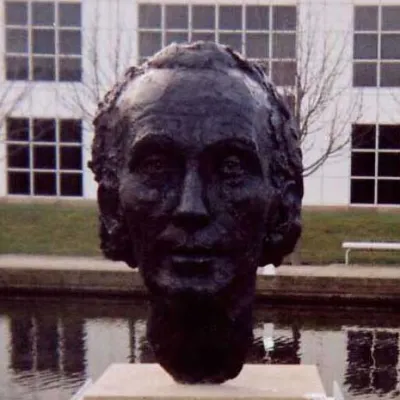
Norman MacCaig
Human Design Chart
Biography
Human Design Analysis: Norman MacCaig as Generator 3/5
Generator 3/5 — Design at a Glance
Norman MacCaig possessed immense inner endurance and functioned as a powerful engine for his endeavors. As a Generator, he had abundant sacral energy, which made him strong and resilient like an workhorse – provided this power was used for tasks that truly mattered to him. His life force did not ignite through self-initiative but exclusively in response to external signals. The motto of his design was clear: react, do not initiate.
This mechanism carried two essential risks. If he engaged with things that did not internally resonate with him over the long term, he wasted his resources and tended towards exhaustion. Conversely, he suffered greatly when prevented from working on his heart projects, even though his inner self still brimmed with enthusiasm.
The key to his effectiveness lay in the strategy of waiting for a life signal and then acting upon it once the sacral center responded with a clear "yes." Living in harmony with this gut reaction rewarded him with deep satisfaction. If he tried to go against his natural rhythm or constantly take the initiative, sooner or later he encountered persistent frustration and a noticeable lack of energy. His fulfillment thus did not come from compulsion but through consistently following his inner impulses.
Sacral Authority
Norman MacCaig was a Generator whose design featured a direct connection between Strategy and Inner Authority. This configuration greatly simplified his decision-making process: His sacral authority also served as his action strategy. His inner guidance came from the defined Sacral Center, which responded to external stimuli with an immediate physical reaction.
This response did not manifest through intellectual analysis but rather as a physical signal – a grunt, hum, or spontaneous "mm-hm." Such sounds marked the moment when his internal engine kicked in. When he felt this confirmation, he was filled with vitality and inexhaustible energy. He then acted not out of duty, but with great enthusiasm and deep satisfaction. His activities became a source of joy, free from compulsive purposefulness.
Additionally, his activated Spleen Center served as a supportive force. It gave him quick, spontaneous reaction capabilities and reliable access to instinctual awareness of his physical well-being. Norman MacCaig could trust this intuitive assessment. Through the combination of sacral confirmation and spleen-supported intuition, he navigated life with natural, physically grounded confidence. He engaged in what enlivened him and followed the immediate signals of his design.
The 3/5 Profile — Martyr / Heretic
Norman MacCaig showed himself as someone who did not acquire knowledge merely by listening but gained it exclusively through his own experimentation and experience. His design inclined him to be initially skeptical of pre-fabricated truths; he had to learn things firsthand in order to understand them. This attitude stemmed from his position in the third line of Profile 3/5, which emphasizes the process of trial and error. Here, he learned from his own experiments and even from failures, which gave him a high degree of adaptability.
This practically acquired knowledge became attractive to other people. Norman MacCaig often found himself in a role where he passed on his experiences to help others or solve problems. This aligned with the fifth line of his profile, described as the Hero Line. Others sought his advice or confirmation from him, placing him in a position of responsibility for understanding others. However, this role could also be painful, especially when his public experiments failed before others. His design thus promoted a cycle: first, his own often arduous learning through doing, followed by passing on this knowledge to an audience that waited for his answers and logical analysis of situations.
Split Definition — Defined & Open Centers
Norman MacCaig's design inclined towards constant, structured thinking that was expressed through clear communication. His defined Ajna Center ensured consistent mental processes and specific concepts which he could reliably articulate through his also defined Throat Center. This connection allowed him to translate his thoughts directly into words or actions without them being distorted by emotional fluctuations. His energy source came from the defined Sacral Center, providing a vital force that was only activated in response to external stimuli. This shaped him as someone who found satisfaction in answering questions with yes or no and taking on tasks only when his inner resonance agreed. Additionally, his defined Spleen Center endowed him with spontaneous intuition for the present moment, helping him make health-promoting decisions intuitively.
At the same time, Norman MacCaig was vulnerable to mental confusion due to his open Head Center, which did not have its own constant stream of inspiration and could therefore easily be overwhelmed by external questions or doubts. He tended to get caught up in thoughts that were not his own, which could distract him. His open G Center meant he did not carry a fixed identity or life direction from within himself; instead, he often adapted to the environment and sought directions through interaction with others, making him vulnerable to borrowed identities. Furthermore, his open Heart Center led him to lack consistent willpower or ego pressure, causing him to easily fall into the cycle of wanting to prove his worth by promises he later could not keep. His open Solar Plexus absorbed foreign emotions, which made him appear emotionally unstable if he did not recognize them as non-self. Finally, his open Root Center took on external stress, making him susceptible to being driven by environmental pressure rather than acting in his own rhythm.
Channels for logical order, spontaneous insight and caring values.
Norman MacCaig was someone whose mind aimed to translate complex visual patterns into precise language. This ability resulted from the Accepting Channel 17-62, which connected the Ajna Center with the Throat Center. Through Gate 17, he visualized structures while Gate 62 named and organized these details; anything he could not integrate into his mental system remained incomprehensible to him. This created an inner pressure to communicate his logically ordered opinions, where timing was crucial for the receptiveness of listeners.
Parallel to this, the Structuring Channel 23-43 worked as a juxta-configuration. Here, Gate 43 received spontaneous insights which were assimilated and expressed through Gate 23. This allowed Norman MacCaig to formulate innovative perspectives that could change collective thinking. His knowledge often felt ahead of its time; recognition only came when he waited for an invitation to speak rather than imposing his ideas uninvited. Without this waiting, he risked rejection and alienation.
On the level of life energy, the Preservation Channel 27-50 shaped his actions. Gate 27 in the Sacral Center provided selfless care while Gate 50 in the Spleen guarded traditional values. Norman MacCaig thus naturally attracted trust and took responsibility for the "Stamm". His aura signaled a capacity to provide, yet he had to learn to give only when his Sacral Center responded – a form of enlightened selfishness that ensured he was healthy enough himself to nourish others.
Collective Circuitry — Circuit Signature
Norman MacCaig's design revealed itself through a split structure featuring two independent energetic poles. One pole connected the Ajna with the Throat Center and encompassed the Knowing and Understanding Circuits. Here, the Structuring Channel (43-23) and Accepting Channel (17-62) were active. This configuration promoted a tendency to translate inner visions and logical strategies into clear, structured words. It was less about emotional outpouring than precise communication of insights and new perspectives free from disruptive conditioning.
The second, completely separate pole connected the Sacral with the Spleen Center through the Archer Circuit (Channel 27-50 Preservation). This area provided a timeless, instinctive life force oriented towards preservation and protection. Since these two groups were not interconnected, cognitive clarity on one side and deep, bodily survival instincts on the other existed as parallel, non-directly merging forces in Norman MacCaig. His expression thus relied on his ability to formulate mental concepts precisely while his inner drive was shaped by a calm, instinctive concern for what is essential.
Right Angle Cross of Explanation 4
Norman MacCaig's Human Design profile bore the signature of the right cross of the Manifestation. This configuration established a specific inner dynamics that aimed less at external validation and more towards deep, often silent clarity. In Human Design, this pattern represents a process where understanding does not arise through loud declarations but rather through an internal sorting and organizing of information.
For Norman MacCaig, this meant a tendency to recognize connections without necessarily needing to carry them outwardly. The energy of this cross supported the ability to penetrate complex situations while maintaining a certain distance or objectivity. It was not about imposing truth on others but about the urge to reach certainty for oneself.
This mechanism shaped his way of perception: he sought out the essential, filtered out the superfluous, and thus arrived at a clear, if perhaps restrained position. The Manifestation in his design is here not an act of self-assertion against the world, but rather an act of self-evidence. Norman MacCaig lived this structure as someone who first validated his insights for himself before they – if at all – entered the outer world. It was a stance of inner security based on personal insight, not external approval.
Saturn Return · Uranus Opposition · Chiron Return · 2nd Saturn Return — Life Cycles
Norman MacCaig's Human Design profile indicated a tendency towards deep internal structure and consistent dedication to his life purpose. He showed himself as someone who gained strength not through external validation but through the consequent exercise of his own authority. This inner firmness was particularly effective around his second Saturn return, at about 57 years old. During this phase, years of experience condensed into a solid foundation for the next stage of life.
In 1967, at age 57, Norman MacCaig was appointed Fellow in Creative Writing at the University of Edinburgh. This event marked the peak of his Saturn phase: long-term work on his literary identity now found institutional anchorage. It was not a sudden shift but rather the logical consequence of living according to his inner strategy. The second Saturn return often confirms that the chosen path is not only subjectively right but also objectively sustainable. For Norman MacCaig, this meant that his artistic voice was now recognized and respected as established and instructive. The appointment reflected how his design possessed the ability to transform complex internal perceptions into a form that others could receive and learn from. It was the moment when private discipline in writing transformed into public responsibility and recognition without losing its original impulse.
Generator · Sacral Authority — Synthesis
Norman MacCaig was a Generator whose life was marked by deep sacral energy. This showed itself in his ability to feel joy through work and activity as long as it sprang from inner consent (sacral authority). The Profile of the Explorer and Hero (3/5) points towards someone who gathered experiences to draw knowledge from them and pass this on. His defined mental circuit allowed him to continuously develop concepts and organize information through Channel 17-62 – an ongoing internal process of finding meaning. This correlated with the Cross of Manifestation 4, indicating a tendency to explain complex matters clearly.
A central paradox lay in the connection between energetic endurance and the need for freedom. Sacral energy supplied him with power for his projects, yet Line 3 demanded constant experimentation and variety. This led to a tension between the urge to delve deeply into topics (sacral center) and the necessity to explore new paths and question conventions (knowledge circuit). A notable event at age 57 illustrated this expression: being appointed Fellow in Creative Writing – an acknowledgment of his earned knowledge.
3 Defined Channels
Incarnation Cross - Right Angle Cross of Explanation 4
Solar Return
The Solar Return shows the moment when the sun returns to its exact birth position - your personal solar year.
Life Cycles
Discover the life cycles with a detailed triple view (birth chart, cycle chart, composite).
Human Design Profile
- Type
- Generator
- Strategy
- To respond - wait for something to respond to
- Authority
- Sacral Authority
- Profile
- 3/5 - Martyr / Heretic
- Definition
- Split Definition
- Incarnation Cross
- Right Angle Cross of Explanation 4
- Date of Birth
- 14.11.1910 01:30
- Place of Birth
- Edinburgh, United Kingdom
Frequently Asked Questions
What was Norman MacCaig's Human Design type?
What Profiles did Norman MacCaig have?
Which Authority guided Norman MacCaig?
What incarnation cross did Norman MacCaig have?
When was Norman MacCaig born?
Discover your own Human Design
Are you also a Generator? Find out in a personal reading how to use your sacral energy correctly and discover deep satisfaction.
More Personalities
Back to overviewAaliyah

Alain-Fournier

Alexia

Angèle

Angeli

Anne-Marie