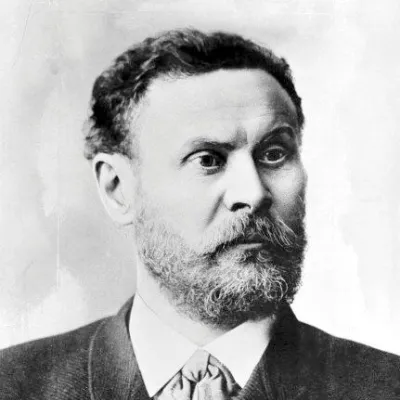
Otto Lilienthal
Human Design Chart
Biography
Lilienthal's work led to his developing the concept of the modern wing. His flight attempts in 1891 are seen as the beginning of human flight and the "Lilienthal Normalsegelapparat" is considered the first airplane in series production, making the Maschinenfabrik Otto Lilienthal in Berlin the first airplane production company in the world. He has been referred to as the "father of aviation" and "father of flight".
On 9 August 1896, Lilienthal's glider stalled and he was unable to regain control. Falling from about 15 metres (49 ft), he broke his neck and died the next day.
The Human Design of Otto Lilienthal: Manifesting Generator 3/5
Manifesting Generator 3/5 — Design at a Glance
Otto Lilienthal revealed himself as a person with a hybrid energy configuration: He possessed the constant power of a Generator and also had the ability to skip steps and quickly draw results into his life. This structure shaped an attitude that waited for internal impulses while containing potential for rapid implementation. His design suggested that he found deep satisfaction when responding to life impulses, and his sacral center confirmed these activities with a clear 'yes'. In this state, he could pursue several projects simultaneously without becoming frustrated; the variety then acted like a play mode that nourished rather than exhausted his creative power.
However, his design also carried specific risks. The tendency towards speed could lead to overlooking important intermediate steps. When this happened, he often had to return and make up for missing foundations – a process that quickly led to frustration as it went against his natural dynamics. Additionally, there was the danger of splitting his own energy by reacting simultaneously to too many impulses. Only when strategy (reaction instead of initiation) and inner authority were in sync could he use this speed without overloading himself or getting into conflict with his life force.
Emotional Authority
Otto Lilienthal showed a decision-making stance that did not solidify in the first impulse but was marked by consciously waiting for emotional waves. His design carried emotional authority, meaning that the defined Solar Plexus Center took over his inner guidance – regardless of which other centers were also defined in his chart. This configuration subjected him to constant fluctuations of feelings: The world appeared either full of potential or dominated by obstacles depending on his current mood. An initial enthusiastic impression was not yet truth but merely a snapshot. Spontaneous reactions to these transient affects could lead to wrong decisions as they missed the deeper, stable insight. Instead, his system required patience and time. By letting decisions rest, often overnight, emotional noise would subside. Only when these intense feelings had subsided and an emotional distance was gained did true clarity emerge. This process of calmness was crucial for long-term orientation settings. Otto Lilienthal had to learn to give himself this space to ensure that his choice did not come from a transient excitement but rested on a well-considered, calm insight.
The 3/5 Profile — Martyr / Heretic
Otto Lilienthal revealed himself as someone who first tried everything out for himself before believing it. His design indicated a tendency to gain practical knowledge through self-experimentation – including failures – which he then offered others to solve their problems. This attitude matched the Profile 3/5: The Adventurer and Hero combined the line of experimenting with the role of rescuer.
The third line in his chart promoted constant self-analysis and strong self-confidence, but could sometimes lead to not fully perceiving the here and now. Excessive self-centeredness threatened to hinder development while the fifth line of Gate 55 showed unusual abilities in accepting advice. In positions of power, his mental stance was only effective when socially recognized. Emotional openness carried the risk of influencing the mind; practical solutions were also dependent on the right timing.
This knowledge from personal experience worked attractively on others. People wanted to learn from his experiences, which flattered his heroic role but could also be painful if attempts in public failed. His design presented a rich treasure trove of practical life experiences that he made accessible to others – always connected with the necessity of testing and reflecting himself.
Split Definition — Defined & Open Centers
Otto Lilienthal's design inclined him towards constant, resolute action that spoke of a clear inner direction. His defined G Center provided a reliable self-image and a sense of his life mission; he knew where he was going without being dependent on others. This identity was reinforced by the defined Heart Center with concrete willpower: He determined his own resources and kept promises, which gave him authority to act as his own boss and drive his projects through to completion.
His energy source lay in the defined Sacral Center, a motor of constant vitality. For Otto Lilienthal, it was essential to react to questions or circumstances from the world rather than initiating himself to avoid frustration. Only through this reactive agreement did the necessary strength for persistence become available, even during phases of stagnation. This physical endurance was linked by the defined Root Center with a steady pressure to move forward and master existential challenges.
At the same time, he showed himself as someone whose mind was flexible but did not consistently generate its own concepts through an open Head and Ajna Centers. He tended to absorb inspirations from his environment and engage with foreign ideas rather than being trapped in a rigid mental monologue. This required vigilance: The open Spleen Center made him vulnerable to conditioned fears of survival or unhealthy dependencies on people who radiated a sense of security. Rather than following spontaneous decisions, he had to learn to use these intuitive signals as mirrors of the environment without interpreting them as his own truth. Thus, he understood the difference between true intuition and absorbed fears.
Channels for charisma, change, intimacy, love, emotions & maturation.
Otto Lilienthal's design inclined him towards evolutionary change paired with an intense search for intimacy. The Channel of Mutation 60-3 connected the Root Center to the Sacral Center through Gate of Limitation (60) and Gate of Order (3). This configuration generated a pulsating energy that brought melancholy when the inner pulse ceased. Otto Lilienthal had to learn to accept this limitation and patiently wait for the reaction from his Sacral Center, rather than forcing change by arguments. This process was not linear development but a cyclical play of chaos and order requiring innovation.
Parallel to this, the Channel of Union 59-6 connected the Sacral Center with the Solar Plexus Center through Gate of Sexuality (59) and Gate of Friction (6). Otto Lilienthal sought fusion and intimacy. This energy was deeply rooted in emotional waves that united pleasure and pain. It required waiting for this emotional wave to create clarity to fruitfully shape relationships or projects. Premature action would have caused confusion; patience allowed him to enter deep connections beyond superficial interactions.
Additionally, the Channel of Charisma 34-20 shaped his way into the world. This channel connected the Sacral Center through Gate of Power (34) with the Throat Center through Gate of Now (20). Here a drive for immediate manifestation was shown, but it only worked correctly when guided by sacral reaction. Without this inner guidance, energy tended to break out chaotically. Otto Lilienthal lived in a tension field between wanting to act immediately and needing to wait for the right impulse to effectively use his charismatic power.
The Channel of Initiation 51-25 fostered competitive nature. Through Gate of Shock (51) in Heart Center and Gate of Spirit of Self (25), he sought initiation through challenges. This process served individualization by crossing boundaries and reaching new levels of consciousness. It was important that this initiation did not force itself but arose from authentic action to avoid bitterness.
The Channel of Emotion Release 39-55 connected the Root Center with the Solar Plexus Center through Gate of Provocation (39) and Gate of Mind (55). This configuration generated a moodiness fluctuating between joy and melancholy. Otto Lilienthal used this emotional wave to provoke and perceive the mind of others. It was crucial not to fight against these moods but accept them as an authentic expression of his inner truth.
The Channel of Maturation 53-42 connected the Root Center with the Sacral Center through Gate of Beginnings (53) and Gate of Growth (42). This channel emphasized the importance of fully experiencing cycles to gain wisdom. Otto Lilienthal learned not to prematurely break off cycles but carry them through to develop deeper understanding.
Individual Gates like Gate 36 (Crisis), Gate 16 (Experimenting) and Gate 2 (Receptivity) in personality as well as Gate 46 (Devotion), Gate 22 (Openness) and Gate 8 (Contribution) in the design complemented this picture by promoting crises as learning processes, experimental action, and social openness.
Individual Circuitry — Circuit Signature
Otto Lilienthal showed himself to be someone whose design featured two separate energetic poles: a complex flow of life force and emotion alongside an isolated inner stability. This Split Definition meant that these areas did not directly communicate with each other but existed parallel.
The Knowledge Circuit connected his Sacral, Root, and Solar Plexus Centers. This created a pulsating energy for the transformation of new knowledge, supported by the Mutation Channel 3-60 and the release of emotions (Channel 55-39). Parallel to this, the Centering Circuit provided inner stability. Here, the channel 25-51 connected Identity and Heart Centers, promoting solidified convictions and self-worth without direct outward expression.
The Meaning-Finding Circuit linked Sacral and Root Centers through the Maturation Channel (42-53). This directed attention to reflecting on past experiences and finding meaning in history driven by cyclical emotional waves. The Protector Circuit connected Sacral and Solar Plexus Centers via Union Channel (6-59). This activated primal instincts for protection and preservation of one's genetics and family.
Finally, the Integration Circuit integrated Throat and Sacral Centers through the Charisma Channel (20-34). This allowed drawing strength from reacting to life and expressing it acoustically or through action in the present moment. Overall, these separate systems shaped a profile that fluctuated between intense inner processing, emotional reflection, and the drive for protective as well as transformative action without all energies forming one continuous flow.
Right Angle Cross of the Sleeping Phoenix 2
Otto Lilienthal's Human Design profile carried the signature of the right cross of the sleeping Phoenix. This configuration signaled a deep, often unconscious connection to collective knowledge and a mission that extended beyond pure individualism. It was not an active, loud search for meaning but rather a passive reception of impulses from a greater whole. The energy of this cross acted like an inner compass guiding him towards tasks serving the well-being of all without needing to intellectually deduce their necessity.
In Human Design, the right cross of the sleeping Phoenix represents a specific kind of authority and influence. It combines the ability to integrate deep understanding with the power to convey this knowledge through inspiration or healing. The term 'sleeping' indicates that these potentials were not always consciously steered but often revealed themselves through intuitive insights or sudden clarities. Otto Lilienthal thus acted from a source less based on logical argumentation and more on a resonant feeling for what was necessary. This structure promoted an attitude of humility and trust in his own inner process, even if it did not appear comprehensible to others from the outside. The challenge lay in recognizing these subtle signals and giving them space rather than suppressing them through rational deliberation. His path was marked by this quiet but persistent alignment with a higher purpose.
Saturn Return · Uranus Opposition — Life Cycles
Otto Lilienthal's design indicated a tendency towards stable anchoring and building solid structures, especially during the life phase where inner maturity met outer responsibility. This became evident in 1878 when he married Agnes Fischer at age 30 on June 11th – the daughter of a miner. For his system, this marked the first Saturn return, a cycle often condensing years of groundwork and experimentation into a clear, binding step towards the future. The marriage was more than just a biographical fact; it expressed a mechanism aimed at durability and laying the foundation for future ventures. In this phase, the abstract search for stability became concrete reality; his connection to Agnes Fischer served as an anchor point allowing him greater certainty in his subsequent steps. The Saturn return thus acted as a catalyst for stability: what was previously fluid gained form and weight through this bond, which Otto Lilienthal could carry into the following years.
Manifesting Generator · Emotional Authority — Synthesis
He was a Generator type with emotional authority and the Profile of the Experimenter/Hero. This combination shaped a life path characterized by constant experimentation and the accumulation of practical experience. His defined Sacral Center provided a constant energy source but this was always filtered through an emotional wave – a process requiring time and patience before decisions could be made. Through the connection between his Sacral Center and Throat Center (Channel of Mutation), he could quickly initiate changes, yet this speed also carried the risk of skipping important steps and falling into melancholy.
A central paradox lay in the tension between his need for experimentation and the necessity of emotional maturity. He acted impulsively and initiatively (Manifestor aspect), but true insights emerged only through deeply experiencing his emotions and reflecting on his experiences. This inner conflict between quick action and slow decision-making created a dynamic process driving him to continually explore new paths and make his knowledge accessible.
6 Defined Channels
Incarnation Cross - Right Angle Cross of the Sleeping Phoenix 2
Solar Return
The Solar Return shows the moment when the sun returns to its exact birth position - your personal solar year.
Life Cycles
Discover the life cycles with a detailed triple view (birth chart, cycle chart, composite).
Human Design Profile
- Strategy
- To respond - wait for something to respond to
- Authority
- Emotional Authority
- Profile
- 3/5 - Martyr / Heretic
- Definition
- Split Definition
- Incarnation Cross
- Right Angle Cross of the Sleeping Phoenix 2
- Date of Birth
- 23.05.1848 11:30
- Place of Birth
- Anklam, Germany
Frequently Asked Questions
What was Otto Lilienthal's Human Design type?
What Profile did Otto Lilienthal have in Human Design?
What Authority did Otto Lilienthal have?
What incarnation cross was assigned to Otto Lilienthal?
When was Otto Lilienthal born?
Discover your own Human Design
Are you also a Manifesting Generator? Find out in a personal reading how to unfold your multi-talents and direct your energy wisely.
More Personalities
Back to overviewAldair

Alizée

Angeli

Arletty

Artus

Balthus