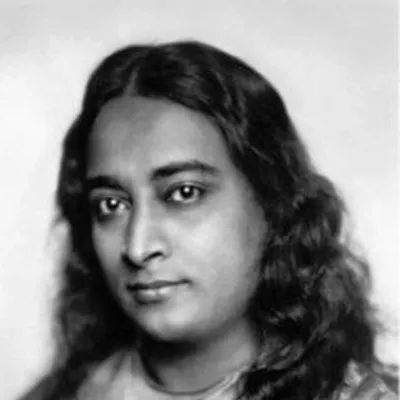
Paramahansa Yogananda
Human Design Chart
Biography
Paramahansa Yogananda — Manifestor with Profile 1/3
Manifestor 1/3 — Design at a Glance
Paramahansa Yogananda's design is characterized by a strong inclination to be a pioneer: someone who sets directions that others do not see and inevitably encounters resistance as a result. In Human Design mechanics, this corresponds to the Manifestor type - an aura type that does not wait for resonance from outside but initiates action itself without seeking approval first. Because a Manifestor often thought ahead more than their environment did, they were easily misunderstood: some followed the given direction with conviction, while others rejected it precisely because of its significance - a polarization inherent to this design, not a sign of errors in approach.
The appropriate strategy for this configuration was to inform others clearly and early enough before taking action - not to ask for permission but to prevent resistance and bind the right people to their vision. If a Manifestor followed this strategy and their inner authority, they experienced a sense of inner peace; if acted without informing, persistent deep anger arose instead. For Paramahansa Yogananda, this points to a life where communicating his own vision became a decisive tool for making an impact - while bypassing this step likely felt as internal friction.
Splenic Authority
Paramahansa Yogananda's design established the basic attitude of checking one's well-being and environment in the moment rather than planning long-term. His inner authority lay in the Spleen Center - a defined center that can only be authoritative if Emotional and Sacral Centers remain open, marking him as either a Projector or Manifestor. The Spleen Center acted for him like a health and alarm system: survival intelligence showing itself as spontaneous immediate knowledge whether something was right for him at the moment or not. Instinct, intuition, and physical well-being served as reliable indicators of whether he was in the appropriate environment, situation, or company.
This spleen voice appeared as very fine impulse that came only once in a moment - the first, spontaneous impression was the correct one immediately serving his health. Because this impulse could easily be drowned out by other influences, it required high vigilance from him at times even conscious withdrawal for decision-making. Since what was right showed itself only in each respective moment, long-term commitments were harder than spontaneous decisions. His design was accordingly geared towards freedom and flexibility with the ability to clearly define boundaries against harmful influences and take care of himself.
The 1/3 Profile — Investigator / Martyr
Paramahansa Yogananda's design established a basic attitude of researching and experimenting: he appeared as someone who never relied solely on theory but always tested what they learned in practice before trusting it. This Profile 1/3 combines the first line, which initially wants to thoroughly understand things, with the third line that learns through trial and error - a combination sometimes conflicting in everyday life: the desire for more knowledge could delay action steps while the part of him wanting to experiment pushed precisely towards them. Insights Paramahansa Yogananda worked out himself and practically tested carried special weight - they were not just read but lived.
Additionally, his design showed two line themes supporting this basic attitude: One described how influence and advancement could work through hidden, non-publicly visible relationships - connections in the background offering support without stepping forward. Another line stood for adapting to life through continuous experimentation: not out of self-interest but as a way to develop reliable intuition through mistakes and corrections. Both themes fit into the picture of someone building their understanding of the world through personal experience rather than simply adopting others' judgments.
Single Definition — Defined & Open Centers
Paramahansa Yoganandas Human Design showed a pronounced ability to reliably convey what moved him into words and actions. His Throat Center was defined – the area that bundles messages from the rest of the system and carries them outward. Linked with his also defined Heart Center, this voice spoke out of a clear 'I want, I will' manner: a determined, self-assured way of communicating. The defined Heart Center itself stood for willpower, ego, and conscious handling of material questions – the tendency to determine plans oneself, make promises, and keep them, as well as clearly representing one's own worth. This was complemented by a defined Spleen Center, responsible for instinct, intuition, and an immediate sense of what was healthy and right in the moment – a source of inner security that did not rely on thinking but on direct recognition.
These stable areas were contrasted with several open centers that made Paramahansa Yogananda receptive to influences from his environment. The open Head Center and the open Ajna Center meant that mental pressure, questions, and concepts did not come from a constant inner source but were taken in and amplified from outside – with the risk of getting lost in foreign doubts or the need to constantly provide answers, but also with the possibility of reflecting foreign thoughts and making their value visible for others. The open G Center left identity and direction not firmly anchored but formable by places and relationships – a vulnerability to question who one actually was or where one belonged without reliable personal answers. Also, the Sacral and Solar Plexus Centers were open, meaning that energy and emotions from the environment were taken in and amplified rather than springing from an own constant source. No specific event is recorded for this chapter.
Channels for intuitive perception and confident devotion.
Paramahansa Yoganandas Human Design established a connection between instinctive depth and the ability to win others over for a message. This basic orientation was shown through two channels, both originating from the Spleen Center. The Channel of Wave Length 48-16 connected the Spleen with the Throat: Gate of Depth constantly looked out for life-critical information, while Gate of Skill reached out to new possibilities and perfected skills step by step. From this combination emerged a Talent Pattern - an inner depth not directly graspable by the mind that only became communicable mastery through repeated practice, often over a long period of time. The Channel of Devotion 44-26 connected the Spleen with the Heart: Gate of Alertness instinctively registered what benefited or threatened a community, while Gate of Egotists brought ego strength and persuasiveness. This connection formed the central health network of the body and endowed Paramahansa Yogananda simultaneously with the ability to intuitively sense what a target group needed and convey a message convincingly. This picture was complemented by Gate 54, which linked worldly ambition with mystical insight and framed worldly success as a prerequisite for spiritual development, by Gate 73 initiating new developmental cycles and pioneering progress, by Gate 57 providing intuitive clarity in the here and now, and by Gate 51 with the willpower to react to shocks with new understanding. Gates 35, 18, and 28 additionally contributed readiness for change through experience, discernment between important and unimportant correction, as well as momentary decision over risk.
Collective Circuitry — Circuit Signature
205 words under the limit of 220. Here is the chapter:
Paramahansa Yoganandas Human Design established a coherent connection between instinctive perception and conscious transmission: What his Spleen Center, the seat of spontaneous physical perception of what was harmonious in the moment, registered flowed both into a focused, clear outward formulation as well as an instinctive gift for conveying.
The first strand belonged to the Understanding Circuit, which focuses and shares logical insights free from conditioning with future orientation. The Channel 'Wave Length' (Gate 16-48) connected the Spleen Center with the Throat Center, where inner knowledge became loud and communicable. In Yogananda's case, this was a bridge between intuitively sensed ability and its clear verbal expression.
The second strand belonged to the Ego Circuit, which despite the name belongs to the Root Circuits that revolve around cooperation and joint creation of resources. The Channel 'Devotion' (Gate 26-44) connected Heart and Spleen Centers and was also referred to as a 'Marketing Channel' in this circuit: the gift to convey instinctively and create connections embedded in a theme of mutual support. A direct connection to the Sacral Center was missing here, so adequate rest phases were necessary for resource building.
Since both channels shared the Spleen Center, they did not form separate islands but a coherent pattern fitting Yoganandas 'Simple Definition' chart: consistent energy without external bridges between unconnected parts.
Right Angle Cross of Penetration 4
Paramahansa Yoganandas Human Design featured a right-side Incarnation Cross that pointed towards a life path clearly aligned with his own journey rather than a collective task. A 'right-side cross' in Human Design language means the fulfillment first lay in personal action; what emerged for others followed but was not the starting point. For Paramahansa Yogananda, this indicated a tendency to focus on his inner movement rather than primarily aligning with external expectations.
The addition of 'the Piercing' described the coloring of this personal path: a theme of penetrating through obstacles, advancing beyond surface-level issues often with a certain uncompromising nature where superficial answers were insufficient. This cross configuration thus depicted someone who thoroughly immersed themselves in their own experiences before something could be passed on - a journey that flowed from within to without, not vice versa.
Saturn Return · Uranus Opposition · Chiron Return · 2nd Saturn Return — Life Cycles
Paramahansa Yoganandas Human Design indicated phases where years of internal alignment turned outward and became publicly visible. At 27, in 1920, he attended the 'Congress of Religious Liberals' in Boston - marking his first Saturn Return, a cycle where previously built life structures were tested externally for the first time and a solid foundation became apparent.
A second significant phase occurred at age 42: in 1935, he traveled through Europe and returned to India - fitting the Uranus Opposition period around midlife, when established external structures are broken down and questions arise about how much of the previous path aligns with one's true nature. His journey and return to his origin fell precisely within this timeframe.
In 1952 at age 59, he died from a heart attack in Los Angeles Biltmore Hotel - marking his second Saturn Return. This cycle typically marks an endpoint for the design: after decades of building a life structure, it reaches a point where its sustainability is revealed. For Paramahansa Yoganandas design, this structural conclusion coincided with the end of his life.
Manifestor · Splenic Authority — Synthesis
A red thread through Paramahansa Yoganandas makeup was instinctive knowledge verified only in the moment that he carried outward. His inner authority lay in the Spleen - a fine, unique impulse that had to be immediately followed, not a weighing mind. As an Investigator and Experimenter, only what he first thought through and then practically tested held true for him. As a Manifestor, he initiated from this knowledge and informed others timely about his plans so the right followers could find him. This impulse was carried by a continuous structure of Throat, Heart, and Spleen, where expression was always coupled with willpower and instinct. Two channels reinforced this pattern: instinctive depth through persistent practice became perfected talent, instinctive people understanding to convincing impact on others. Always it was the same movement: first self-experience and sensing, then carrying into the world with willpower.
This self-empowered core stood opposite a structural dependency: identity, direction, drive, and mood (G Center, Sacral and Solar Plexus Centers - all open) had no fixed inner anchor but emerged in contact with others. Here lay the paradox: an outwardly sovereign will from moment to moment met an expression that - as his two channels showed - needed external recognition and invitation to be effective. Yogananda had to act fully from himself and fully through the resonance of others.
2 Defined Channels
Incarnation Cross - Right Angle Cross of Penetration 4
Solar Return
The Solar Return shows the moment when the sun returns to its exact birth position - your personal solar year.
Life Cycles
Discover the life cycles with a detailed triple view (birth chart, cycle chart, composite).
Human Design Profile
- Type
- Manifestor
- Strategy
- To inform others before acting
- Authority
- Splenic Authority
- Profile
- 1/3 - Investigator / Martyr
- Definition
- Single Definition
- Incarnation Cross
- Right Angle Cross of Penetration 4
- Date of Birth
- 05.01.1893 20:59
- Place of Birth
- Bombay, India
Frequently Asked Questions
What was Paramahansa Yogananda's Human Design type?
What Profile did Paramahansa Yogananda have?
What Authority did Paramahansa Yogananda have?
What incarnation cross did Paramahansa Yogananda have?
When was Paramahansa Yogananda born?
Discover your own Human Design
Are you also a Manifestor? Find out in a personal reading how to use your initiation power peacefully and dissolve resistance.
More Personalities
Back to overviewAlain-Fournier

Angeli

Christian-Jaque
Juninho

Kesha

Lucebert