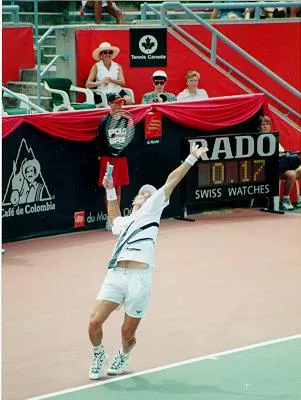
Pat Rafter
Human Design Chart
Biography
He was born and raised in the Australian Outback in an area as dry as the Moon, the third youngest of nine kids with five brothers and three sisters. His father, Jim, was an accountant and his mother, Jocelyn, a homemaker. Rafter was a polite and well-mannered child who opened car doors for his mother. On his first day at preschool, he bravely said he wanted to walk in by himself, without his mother at his side, and so he did. He began playing tennis with his father and three older brothers when he was only five years old. He was a late bloomer who admits he was afraid of girls while he was in school, all his attention went to tennis. After graduation, he and his brother Geoff took off for Europe where they competed in tournaments and slept anywhere they could, including inside automatic teller enclosures. His natural talent for the game continued to assert itself, so his brother quit playing and became his coach. He turned pro at age 19.
Rafter’s good looks and exuberance added some much-needed flair to men’s tennis, but despite his razzle-dazzle performances on the court, his samurai-style ponytail bouncing, those who know him best say he’s just a regular guy with good sense. He once returned his five-figure appearance fee after what he considered a poor performance on the court, and he gets around town on a moped. His family, the largest on the ATP tour, is heavily involved with his career; his brother Stephen is his agent, sister Louise handles publicity and brother Peter does scheduling. A good-looking man, Rafter was voted People Magazine’s Sexiest Athlete of the Year in 1997.
Human Design Analysis: Pat Rafter as Generator 3/5
Generator 3/5 — Design at a Glance
Pat Raftérs design points to a tendency towards great endurance and high energy potential, comparable to a workhorse that generates power as soon as it is fueled for its task. As a Generator, he had a lot of sacral energy, which was released not through self-initiation but by responding to impulses from the environment. His strategy was to wait for signals and then respond from the gut when his inner center signaled a clear “yes”.
This mechanism brought two specific stumbling blocks. If Pat Raftér was prevented from continuing to work on his heart project, even though he was still full of power, or forced himself to do things he didn’t want to do, there was a risk of burnout through energy waste. If he did not live according to his design and instead tried to initiate things rather than react, this led sooner or later to persistent frustration and a lack of energy. In harmony with his nature, that is through reactive action rather than proactive forcing, no one could stop him. The reward for balancing energy and reaction was a deep feeling of satisfaction and fulfillment that showed when he used his power where life picked him up.
Sacral Authority
Pat Raftérs design points to a tendency towards direct, physical reactivity. As a Generator, he had the sacral authority that also served as his strategy and simplified the decision-making process. This inner guidance is not in the head but as an immediate physical response to external stimuli – a “belly feeling” or a surge of energy that can express itself through sounds like grunting or a confirming “mhm”.
When his sacral motor engaged with a topic, he felt vital and alive. It seemed that he had an inexhaustible supply of energy that allowed him to immerse himself in activities with great enthusiasm. This happened without compulsion or purposefulness; he was born to go through life with joy and satisfaction, fully immersed in his actions.
Additionally, an activated spleen center acted as a supporting authority. As it may have been directly connected to the sacral center, this allowed particularly quick and spontaneous reactions. Pat Raftér had immediate access to his physical well-being and instinctive perception. He could reliably guide himself from this deep, physical intuition, which strengthened his ability to make quick, accurate decisions in the moment of encountering the outside world.
The 3/5 Profile — Martyr / Heretic
Pat Raftérs design points to a tendency towards experimental independence, paired with the role of the hero who finds solutions for others through personal experiences. As a 3/5 profile “Explorer/Hero and Rescuer”, he must first try everything himself before he believes. This self-acquired knowledge makes him attractive to his environment, which wants to learn from his successes and failures. The third line in his chart emphasizes this independence: it acts energized and allows him to stimulate himself without being dependent on external confirmation. This promotes independent experiments, but can also lead to him rejecting others’ support because he recognizes his dependence early and wants to compensate for it.
At the same time, his configuration shows a need for collective exchange. The described themes of therapy and relationships indicate that Pat Raftér gains psychological stability through the mirror of other people. Isolation would lead to instability here; instead, correction and growth arise through exchange with the collective. The hero role may flatter him, but public failure in experiments can be painful, as he learns in the eyes of others. His path is thus characterized by the balance between the urge for independent experience and the necessity of processing and passing on these experiences within the web of relationships.
Split Definition — Defined & Open Centers
Pat Rafters design points towards a tendency towards consequent and enduring action, supported by a clear inner identity. His defined G Center gives him a reliable self-perception and a sense of direction, while his defined Sacral Center provides a continuous source of vital energy. This combination allows him to fulfill commitments with persistence as long as he responds to his inner authority rather than being mentally initiated. His defined mind (Ajna) and defined throat ensure that he clearly articulates concepts and carries his mental structure outward, making him a stable but stubborn reference person.
At the same time, Pat Rafters openness to external conditioning through his open centers is evident. His open Head Center leaves him prone to mental confusion when trying to find answers to questions that are not his own. His open Heart Center drives him to prove his worth through promises and competition, even though he does not possess the consistent willpower for it. Additionally, his open Solar Plexus absorbs the emotions of his surroundings, causing him to personalize emotional waves of others and avoid confrontation to maintain peace. This mechanism shows that his strength lies in reacting to what is correct for him, while his non-self stress stems from the attempt to fill mental, emotional, or will-based gaps through effort.
Channels for focused intuition, logical clarity and powerful self-assertion.
Pat Rafters design points towards a tendency towards extreme, almost static concentration. Channel of Concentration 52-9 connects the Root Center with the Sacral Center, supporting a passive drive (Gate 52) to focus on details (Gate 9) by keeping distractions at bay. This formative energy shapes his entire design: logic requires here to remain still to perfect patterns. He lived like Buddha under the lotus tree, collecting energy and waiting for the reaction of the Sacral before acting. Without a focus that corresponds to his authority, this energy can appear restless.
Parallel to this, a deep connection to his own body and its direction is evident. Channel of Discovery 29-46 connects the Sacral Center with the G Center. Gate 29 offers the endurance to lose oneself in experiences, while Gate 46 establishes the connection to the life path. Pat Rafters had to let go of expectations to make discoveries that only made sense at the end of a long-term process. His persistence allowed him to succeed where others failed by fully committing to the experience.
His behavior was also strongly influenced by a strong intuitive basis. Channel of Perfect Form 57-10 connects the Spleen Center with the G Center. Gate 57 provides acoustic sensitivity and intuitive insight that guides behavior (Gate 10). This allowed him to act spontaneously and appropriately to secure his survival in the present, free from future fears. Additionally, Channel of Exploration 34-10 promotes self-love. Gate 34 provides the inner strength to hold onto personal convictions, while Gate 10 initiates authentic behavior. Through his reaction, he demonstrated to others the benefits of self-acceptance.
In interpersonal relationships, Channel of Acceptance 17-62 is at work. It connects the Ajna Center with the Throat Center to translate visual patterns (Gate 17) into detailed language (Gate 62). This creates a foundation to logically organize and convey information, provided the timing is right. Channel of Judgment 18-58 connects Root and Spleen Centers to correct patterns (Gate 18) and maintain vitality (Gate 58). This channel urges to perfect what is out of balance, but only if invited to do so.
Additionally, Channel of Transformation 54-32 carries ambition (Gate 54) and continuity (Gate 32) to rise through talent and support of the tribe. Channel of Power 34-57 connects Sacral and Spleen Centers to strengthen intuitive survival intelligence through sacral life force. Individual Gates like 53 (Freedom), 48 (Depth), 14 (Power), 35 (Change), 56 (Inspiration), and 45 (Tribe Level) round out the profile, with channels representing the primary mechanisms.
Collective Circuitry — Circuit Signature
Pat Rafters design points towards a tendency towards solid individuality, yet structured by separate energetic poles. As a Split Definition, his chart consists of two non-directly connected groups: a large unit of Sacral, Root, Spleen, and G Centers, and a separate connection of Ajna and Throat Centers. This separation means that inner strength and outer expression exist as parallel but non-flowing systems.
The Centering Circuit connects his Identity and Sacral Centers through the Channel of Exploration. This promotes a strong, brave character with firm convictions, yet often difficult to verbalize without a direct connection to the Throat Center. Parallel to this, the Understanding Circuit connects Ajna and Throat Centers (Channel Acceptance) as well as Sacral, Root, and Spleen Centers (Channels Concentration, Judgment). Here, the ability for logical, emotionless ratio and strategic future consideration is evident, separate from emotional processing.
The Meaning Circuit uses the Channel Discovery to reconnect Identity and Sacral Centers, focusing on reflecting on past experiences. The Ego Circuit connects Spleen and Root Centers (Channel Transformation), hinting at cooperative resource creation, yet without a direct Sacral connection, requiring regular rest periods for regeneration. Finally, the Integration Circuit integrates Identity, Spleen, and Sacral Centers (Channels Perfect Form, Power), gaining strength from reacting to life and guiding in the present. Overall, these separate but internally dense networks shape a picture of individual strength playing out in logical strategy and emotional reflection, without these areas seamlessly blending together.
Right Angle Cross of Service 4
Pat Rafters design points towards a deep, often quiet dedication to the well-being of others. This configuration, known as the right service cross 4, does not describe a loud demand for recognition but rather an inner orientation that lies in acting through concrete deeds and support for the environment. It is about a form of service that does not stand in the foreground but stabilizes the structures in the background on which communities or families can build.
This energy manifests as someone who takes responsibility without putting their own identity at the center. The focus is on the practical implementation of care, on maintaining connections and providing security for others. It is a force that works through reliability and constancy, less through spectacular gestures. The challenge of this configuration lies in not experiencing this dedication as self-exploitation, but as a natural expression of one's own nature, which finds fulfillment in giving and supporting. Pat Rafter thus acted as a stabilizing presence, creating the framework through his actions in which others could unfold, without standing in the spotlight themselves.
Saturn Return · Uranus Opposition · Chiron Return — Life Cycles
Pat Rafters design points towards strategic endurance and the building of stable structures. This configuration often manifests as someone who does not rely on spontaneous impulses but on long-term planning and the ability to transform resistance into productive energy. In Human Design, the first Saturn return marks the condensation of years of groundwork into a stable foundation. It is a moment when one's life direction becomes clear and significant milestones are reached, based on previous, often invisible work.
Pat Rafter reached the final of the Davis Cup in 2000 at the age of 28. This was a typical moment for his design: The first Saturn return marks the transition from preparation to visible realization. The energy of this cycle supports the ability to assert oneself in challenging situations and to achieve results through consistent action that stand the test of time. It is not about sudden success but about the confirmation that the chosen path is viable and the invested effort pays off. This phase often shapes the further career by showing which areas truly hold strength and potential.
Generator · Sacral Authority — Synthesis
Pat Rafters design is marked by a deeply rooted drive to generate energy and transform it into concrete results. The sacral authority, coupled with the Generator type, points to a natural aptitude for enduring work and the ability to experience joy in life through action – as long as the activity feels right from the gut (Sacral Center). The profile of the experimenter and hero (3/5) reinforces this aspect by emphasizing the urge to gather knowledge through personal experimentation and then make it accessible to others. The channel of concentration (52/9) underscores the ability to focus on details, while the Centering circuit highlights the strength of inner convictions and individuality.
A central paradox lies in the combination of the need for continuous, sacral-driven activity and the potential stumbling block of being held back by external expectations or the suppression of heart projects. The right service cross 4 points to a commitment to serve others, which, however, can collide with the need to direct one's energy towards truly satisfying activities. A documented event, the achievement of the final, shows how the energy, when properly aligned, can lead to peak performance.
8 Defined Channels
Incarnation Cross - Right Angle Cross of Service 4
Solar Return
The Solar Return shows the moment when the sun returns to its exact birth position - your personal solar year.
Life Cycles
Discover the life cycles with a detailed triple view (birth chart, cycle chart, composite).
Human Design Profile
- Type
- Generator
- Strategy
- To respond - wait for something to respond to
- Authority
- Sacral Authority
- Profile
- 3/5 - Martyr / Heretic
- Definition
- Split Definition
- Incarnation Cross
- Right Angle Cross of Service 4
- Date of Birth
- 28.12.1972 07:15
- Place of Birth
- Mount Isa, AUSTL
Frequently Asked Questions
What is Pat Rafter's Human Design type?
What Profile does Pat Rafter have in Human Design?
What authority determines Pat Rafters' decisions?
Which incarnation cross is Pat Rafter assigned to?
When was Pat Rafter born?
Discover your own Human Design
Are you also a Generator? Find out in a personal reading how to use your sacral energy correctly and discover deep satisfaction.
More Personalities
Back to overviewAaliyah

Alexia

Angèle

Anne-Marie

Arcángel

Arno