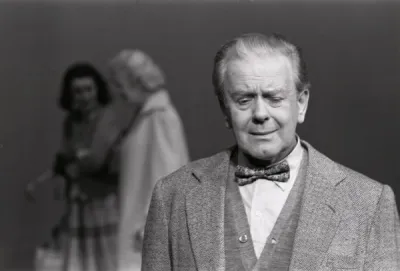
Per Aabel
Human Design Chart
Biography
He got his education as an illustrator in Paris, and as a ballet dancer in London. He had his debut as a ballet dancer at the theatre Mayol in 1921 and after working as a dance teacher for several years he got his first job as an instructor at the National Theatre in 1926. Not until 1931 did he debut as an actor, at Det Nye Teater.
Aabel was head of Carl Johan Teatret from 1933 to 1938, and worked as an actor at Centralteatret from 1938 to 1940, and at the National Theatre from 1940 to 1972.
After he retired he worked freelance and was part of the National Theatre's 100 year anniversary celebrations in 1999, just a few weeks before he died. He was a frequent entertainer on television as a storyteller and is well remembered as an esteemed raconteur. A statue of him by sculptor Nina Emilie Sundbye placed outside of the stage entrance of the National Theatre was unveiled by Queen Sonja on 11 May 1999.
In 1976 he was awarded the Medal of St. Hallvard, the highest award of the city of Oslo. He was appointed Commander of the Royal Norwegian Order of St. Olav in 1969, was promoted to Commander with Star in 1978, and was elevated once more in 1988 when he received the Grand Cross, which is almost exclusively only given to royals and heads of state.
Aabel died on 22 December 1999 in Oslo, Norway, at the age of 97. He was buried at state expense.
What does Generator 3/5 mean for Per Aabel?
Generator 3/5 — Design at a Glance
Per Aabel's design showed a tendency towards great endurance and inner strength, which was not achieved through constant initiation but rather by reacting to external impulses. As a Generator, he had a defined Sacral Center that provided him with a high, sustainable energy source – comparable to an workhorse whose strength only comes into play when it is used for the right task.
The central mechanics of his design lay in not taking the first step himself but waiting for signals from the environment and responding to them. This strategy of 'reacting instead of initiating' was crucial for his energy balance. When Per Aabel listened to such a signal and received an inner confirmation from his Sacral Center – that feeling often described as knowing something 'from the gut', he could act with full power, leading to deep satisfaction and a sense of fulfillment.
However, if he ignored these internal signals or forced himself into activities without resonance, he would waste energy unnecessarily. His design warned against two main pitfalls: either forcing work on things without inner desire, which led to frustration and burnout, or interrupting his Heart project when there was still full energy available. Therefore, his path to effectiveness lay in the discipline of waiting for the right impulse and then persistently maintaining that action as long as the internal confirmation held.
Sacral Authority
Per Aabel's decision-making did not rely on intellectual analysis but rather on an immediate, physical resonance. As a Generator, he possessed Sacral Authority, which simplified his process: strategy and inner guidance were one and the same. He waited for external stimuli and responded with spontaneous, vital reactions – often felt as 'gut feeling', a grunt or sudden surge of energy. These physical signals served him as reliable orientation.
When his Sacral Center was engaged, he felt alive and acted with great enthusiasm. His energy was inexhaustible as long as the activity itself brought joy; external purposefulness was not necessary for this. Additionally, his activated Spleen Center functioned as a supportive instance, giving him quick, instinctive perception and enabling spontaneous reactions based on physical well-being. This combination of sacral vitality and spleen-based intuition shaped his way of moving through life: authentically, energy-charged, and firmly rooted in the moment without having to take the detour via thinking.
The 3/5 Profile — Martyr / Heretic
Per Aabel's design was characterized by Profile 3/5, the Experimenter and Hero. This configuration defined a lifestyle based on personal experimentation: Per Aabel had to experience and fail himself to generate practical knowledge that he later offered others for solving their problems. Line 3 challenged him to break old bonds and adapt through trial and error – often accompanied by the compulsion to possess or know more than necessary, in order to gain secret information for the care of others.
At the same time, he was subject to the dynamics of Line 5, the Hero's line. Others projected onto him an image of a competent rescuer and cool storyteller. This attractiveness flattered him but also created high expectations. As he experimented publicly, failures were inevitable and visible to all. This could be painful, especially since Line 5 carried a deep aversion to limitations. The empowerment by others forced him to choose one fantasy or role while his nature yearned for freedom in experimentation. Thus, he lived in the tension between the necessity of private learning and adaptation and public expectations to always act as a hero.
Triple Split Definition — Defined & Open Centers
Per Aabel lived with a constant inner drive and persistent mental background noise. His design showed a clear structure: Head, Ajna, Heart, Sacral, Spleen, and Root centers were defined, while Throat, G Center, and Solar Plexus remained open.
The connection between the Head and Ajna Centers created in him a permanent pressure to ask questions and find answers. This mental process was always active; he thought continuously without being able to control or stop this stream of thoughts. Instead of fighting against this restlessness, he used it as an inspiration source for others. His defined Heart Center gave him stable willpower and the need to shape his life self-determinedly. He could make promises and keep them, which strengthened his self-esteem. The power of his Sacral Center provided vital energy for his expression; he did not have to take initiatives but responded to requests with a clear yes or no to avoid exhaustion. His defined Spleen Center ensured spontaneous intuition and physical well-being in the present moment, while the Root Center delivered the necessary pressure to move forward in the world and cope with stress.
At the same time, Per Aabel was strongly dependent on his environment due to his open centers. His open G Center meant that he did not have a fixed identity or direction but took these from relationships and places. He tended to question who he actually was or what kind of love would find him if he were not in correct environments. The open Solar Plexus Center allowed him to absorb the emotions of the environment; he learned to distinguish between his own feelings and foreign moods to avoid emotional turbulence. Finally, his open Throat Center attracted attention without him actively seeking it. He spoke spontaneously when invited, rather than trying to dominate or force attention. This openness enabled him to be flexible in various situations as long as he did not identify with the absorbed energies.
Channels for change, clear insight and instinctive devotion.
Per Aabel's design was characterized by a deeply rooted genetic care that overshadowed all other mechanisms. As a Personality Sun Gate with 70% energy, Gate 27 shaped his essence: altruistic warmth and the urge to preserve life acted like a magical force enriching the quality and content of his activities. This caring foundation softened the melancholic aspects of Channel 60-3. This channel connected the Root Center with the Sacral Center through the Gate of Limitation (60) and the Gate of Order (3). It brought evolutionary change as pulsating, on-and-off energy often accompanied by melancholy. Per Aabel learned to accept this limitation and patiently wait for the next impulse instead of rationalizing moods.
His thinking followed Channel 61-24 of Awareness, connecting Head Center with Ajna Center through the Gate of Secrets (61) and the Gate of Rationalization (24). He did not receive logical knowledge but spontaneous insights – a Satori. His mind sought silence to absorb inspirations beyond linear logic and enable new perspectives.
In interpersonal relationships, Channel 44-26 of Devotion was at work. It connected the Spleen Center with the Heart Center through the Gate of Alertness (44) and the Gate of Egotists (26). This gave him instinctive intelligence to recognize tribal needs and advocate them convincingly. His willpower served not only himself but became an instrument of care, offering improvements for the collective. The combination of genetic concern (Gate 27), mutative pulse (Channel 60-3) and instinctive distribution (Channel 44-26) created a profile that not only endured change but actively used it for the benefit of the community.
Individual Circuitry — Circuit Signature
Per Aabel's design showed a tension between pulsating, individual creativity and traditional, communal cooperation. These separate forces emerged through his Triple Definition: three independent energy groups existed parallel without direct exchange among each other.
The Knowledge Circuit in him connected two separate parts. On one hand, Head and Ajna Centers flowed together; on the other hand, Sacral and Root Centers were linked. Through Channel 61-24 of Awareness, innovative creativity emerged while Channel 3-60 of Mutation promoted deviations from the known. This shaped a pulsating identity search that wanted to express new knowledge through emotional waves.
The Ego Circuit worked differently, belonging to the Tribal Group and lacking connection to the Sacral Center. Here, Channel 26-44 of Devotion connected Heart and Spleen Centers. This promoted mediation skills and cooperation in resource utilization. As the constant life force of the Sacral Center was missing, this traditional give-and-take-based cooperation required necessary rest periods for recovery.
Per Aabel thus lived with these three isolated energy fields: creative, mutating individuality, tribal cooperative resource orientation, and a third area not described here. The challenge lay in distinguishing the pulsating creativity of the Knowledge Circuit from the timeless, conservative structure of the Ego Circuit since they did not flow energetically directly.
Right Angle Cross of the Unexpected 1
According to Per Aabel's design, he exhibited a specific dynamic characterized by the right cross of the Unexpected 1. This configuration suggested that his life was marked by sudden turns and unexpected developments, often experienced as challenges or shocks. Instead of a linear progression, there was a tendency towards abrupt changes that tested his inner structure.
In Human Design, this cross describes a life task to deal with unpredictability and draw strength from it. It's not about exerting control over external circumstances but developing the ability to remain clear in moments of uncertainty. Those who carry this configuration often learn through experience that stability does not come from outside but must be anchored within.
For Per Aabel, this meant repeatedly confronting situations that questioned his previous assumptions. These experiences served not only as obstacles but also as catalysts for personal growth. By navigating uncertain times, he built a deep resilience that allowed him to remain capable of action even under pressure. The mechanics of this cross thus underscore the value of flexibility and adaptability as central life competencies.
Saturn Return · Uranus Opposition · Chiron Return · 2nd Saturn Return — Life Cycles
Per Aabel's design was marked by a clear cyclical development with two prominent transitions. The first Saturn Return around his 29th year served as a phase of professional anchoring and identity consolidation. At this age, years of groundwork often crystallized into a solid result. This was evident in 1931 when Per Aabel made his debut as an actor at Det Nye Teater at the age of 29 – a milestone marking his professional positioning and confirming the structural nature of this cycle.
The second crucial phase was the Uranus Opposition around his 38th year. This transition represented a necessary break with old structures, detachment, and transformation. It wasn't just change but a deep rethinking that broke through old patterns. In 1940, at age 38, Per Aabel worked at the National Theatre – this step reflected the dynamic power of the Uranus Opposition: leaving known paths for new forms of expression and further development of his artistic practice beyond earlier constraints. Both cycles shaped his career through clear phases of stabilization and necessary transformation.
Generator · Sacral Authority — Synthesis
Per Aabel lived a life deeply marked by the ability to respond to external impulses and transform them into creative energy. As a Generator with sacral authority, he found fulfillment in being guided by his inner reaction and responding through action – a work method that gave him deep satisfaction. His profile as an experimenter/hero and rescuer points to someone who learned from life experiences and shared this knowledge generously. The combination of open Head and Ajna Centers with defined Heart and Sacral Centers created a unique dynamic where inspiration and instinctive reactions formed the basis for his actions.
A central paradox in Per Aabel's design lies in the interplay between spontaneity and the need for authenticity. On one hand, he was geared towards immediate reaction to life (sacral center), on the other, he had a strong ego and defined direction that drove him to express his own inner truth. This tension between absorbing impulses and maintaining clear identity created a dynamic process in which he continually found new ways to unfold himself and his creativity.
3 Defined Channels
Incarnation Cross - Right Angle Cross of the Unexpected 1
Solar Return
The Solar Return shows the moment when the sun returns to its exact birth position - your personal solar year.
Life Cycles
Discover the life cycles with a detailed triple view (birth chart, cycle chart, composite).
Human Design Profile
- Type
- Generator
- Strategy
- To respond - wait for something to respond to
- Authority
- Sacral Authority
- Profile
- 3/5 - Martyr / Heretic
- Definition
- Triple Split
- Incarnation Cross
- Right Angle Cross of the Unexpected 1
- Date of Birth
- 25.04.1902 07:15
- Place of Birth
- Oslo, Norway
Frequently Asked Questions
What was Per Aabel's Human Design type?
What profile did Per Aabel have?
Which authority guided Per Aabel?
What incarnation cross did Per Aabel have?
When was Per Aabel born?
Discover your own Human Design
Are you also a Generator? Find out in a personal reading how to use your sacral energy correctly and discover deep satisfaction.
More Personalities
Back to overviewSissy Spacek
Aaliyah

Alexia

Anémone
Angèle

Ann-Margret