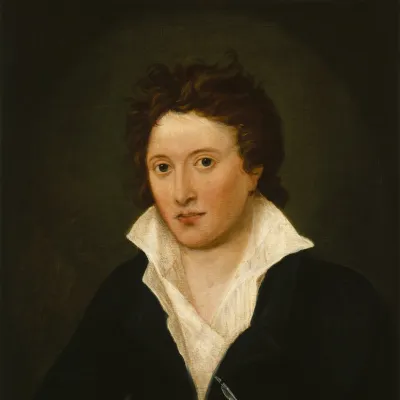
Percy Bysshe Shelley
Human Design Chart
Biography
The son of a country gentleman, Shelley entered Eton College in 1804. He was a good student but socially a nonconformist, he rebelled against a system which made the younger boys do the menial work. Throughout his life, he despised tyranny. By the time he entered Oxford, 1811, he had already published two bad horror novels. After five months in Oxford, he was expelled for writing a pamphlet, "The Necessity of Atheism." His dad had not recovered from this shock when Shelley eloped with Harriet Westbrook, the daughter of a former coffeehouse-keeper.
For the next two years, Shelley and his wife lived a wandering life, living on a small family allowance. Harriet was not Shelley's intellectual equal and affection waned. Shelley believed that the law against divorce of a loveless couple was "intolerable tyranny" and on 28 July 1814, left his wife and eloped with Mary Wollstonecraft Godwin. He had met the 16-year-old girl several years prior when attending discussions at the home of her parents, who were both social reformers and well ahead of their time. In the company of his friend Lord Byron and Mary's stepsister, Claire, they traveled across Europe, settling in Italy.
He and Mary had three children, none of whom survived.
In 1816, his first wife committed suicide; he was denied custody of their children because he was an atheist; however, he and Mary were married immediately.
Shelley regarded social reform as his life's work, believing that man could aim for perfection and that love had the power to transform society. An idealist, he felt that earthly beauty was only the shadow of spiritual beauty. During the last five years of his life he produced his finest work.
On 8 July 1822, he and a friend, Edward Williams were out boating when a sudden squall came up.
What does Manifesting Generator 6/2 mean for Percy Bysshe Shelley?
Manifesting Generator 6/2 — Design at a Glance
Percy Bysshe Shelley was someone who quickly brought things into his life and pursued several projects simultaneously. As an Manifesting Generator, he had constant sacral energy, which gave him the power to act swiftly, similar to a Manifestor. However, this speed sometimes led him to skip important steps. When that happened, he had to go back and make up for missed stages, often leading to frustration – the typical non-self theme of his type.
His strategy was not to initiate himself but to react to impulses from the environment. Only when his sacral center responded with a clear 'yes' should he start acting. This reaction to inner confirmation was crucial to stabilizing his creative power. Without this alignment, Shelley tended to lose himself in many different projects, quickly turning initial enthusiasm into exhaustion.
However, if he learned to regularly check whether his authority and his sacral center still approved of the paths they had started, he could draw deep satisfaction from his work. In this state, it was no problem for him to seek variety and fall into a playful mode. The demand to complete only one thing at a time did not suit his nature; rather, he thrived through parallel action as long as inner resonance remained in tune. Thus, his potential frustration transformed into sustained satisfaction and creative vitality.
Emotional Authority
Percy Bysshe Shelley displayed a fundamental attitude where emotional waves and mood swings heavily colored his view of the world. His design featured Emotional Authority triggered by a defined Emotional Center. This mechanism operated independently of other defined centers in the chart; the emotional truth always took precedence over any other inner voice.
His perception was subject to constant ups and downs: In one moment, he could be totally enthusiastic about an idea, only to negatively evaluate it in the next. However, this feeling was often just a temporary reaction, not his deeper truth. Quick, spontaneous decisions made from this emotional heat proved risky and could have negative consequences.
His design's strategy required patience. Percy Bysshe Shelley had to take time for decisions to mature. This entailed sleeping on important questions multiple times and allowing hesitation. Only when the intense feelings subsided and emotional distance was gained did clarity set in. This process of distancing was crucial for long-term life decisions, as it allowed him to penetrate through the emotional noise to reach his true inner truth rather than relying on fleeting mood reactions.
The 6/2 Profile — Role Model / Hermit
Percy Bysshe Shelley showed a tendency towards intense experimentation and learning by trial and error during his youth. As Profile 6/2, before Saturn's return (until around age thirty), Line 3 energy was prominent. This phase was marked by many personal life experiences where mistakes were made and lessons learned, followed by necessary setbacks or withdrawals. It was a time of active engagement with the world without yet possessing the later distance.
After his thirtieth year, the mechanics of Line 6 kicked in. Percy Bysshe Shelley now metaphorically retreated into a 'cave' to gain distance and look back at his earlier experiments. This phase served deep reflection, healing, and self-discovery. The sixth line from Gate 33 demanded this withdrawal to achieve an all-encompassing overview of the human experience. It was not about external pressure but inner renewal and letting go of old patterns.
At the same time, as a Natural Talent (Line 2), he possessed a natural ability for the right direction without having to consciously steer it. A defined ego supported this gift. When he finally emerged from his withdrawal phase, others saw him as a wise counselor. People sought his contact to partake in the wisdom gained through introspection and learn the skill of deep self-reflection. His role was to be correctly called upon rather than taking active steps himself.
Triple Split Definition — Defined & Open Centers
Percy Bysshe Shelley showed himself to be someone who was under constant mental pressure to question and form concepts. His defined Head and Ajna Centers generated a continuous inspiration, but lacked the direct energy for implementation. This state often led to inner concern or confusion as his thought world could not immediately translate into action without motoric connection. At the same time, Shelley possessed a defined G Center, which gave him a firm sense of self-identity and clear direction. He knew who he was and radiated this magnetic presence without being dependent on others' confirmation.
His willpower was marked by a defined Heart Center; he controlled his resources himself and kept promises, strengthening his self-esteem. Yet, this ego pressure met the complex dynamics of his emotional nature. With a defined Solar Plexus Center as inner authority, Shelley had to learn to trust the emotional wave. Truth revealed itself to him not in the moment but only after going through the feeling cycle. Impulsive decisions at the highs or lows of his emotions often led to chaos; patience was the key to clarity.
Additionally, he possessed a defined Sacral Center, which provided him with immense vital energy. This power was available only through reaction, not initiation. When he tried to force mental ideas directly with sacral energy without being asked, he encountered resistance and frustration. His defined Throat Center served as a pivot for communication; it transformed impulses from his various centers—whether intellect, emotion, or will—into speech and action. The challenge lay in not expressing these diverse inner streams impulsively but waiting until emotional clarity and the correct sacral response were present to convey his message with ease and honesty.
Channels for logic, intimacy, expression, mysticism, love and care.
Percy Bysshe Shelley revealed himself as someone who drew public attention not through words alone, but through the living example of his individual identity. This inclination resulted from Channel 1-8 in his design, which connected the G Center with the Throat Center. He was designed to express a creative and transformative perspective and inspire others to live their unique qualities—similar to how a pianist's performance might encourage listeners to play the piano themselves. His impact rested on an authentic authority; he had to learn to cultivate patience until recognition of his individuality arrived, as this channel did not come with built-in social adaptability.
Parallel to this, Channel 51-25 in his design ran through the Heart Center and linked competitive drive with universal love. This channel pushed him to transcend boundaries and initiate a deeper self-awareness through shocking experiences. He awakened individuation in others by delivering the "shock" that led to an expansion of consciousness—a process that only worked if he lived authentically and did not seek initiation.
Furthermore, his personality carried Channel 59-6, which connected the Sacral with Solar Plexus Center, creating a drive for merging and intimacy guided by an emotional wave of pleasure and pain. Percy Bysshe Shelley had to wait until this wave brought clarity to determine if a relationship was sustainable or repelling. Without this patience, confusion and misinterpretations of his intensity were likely.
Channel 63-4 in his personality fostered an active, skeptical mind. It constantly filtered patterns for consistency; doubt was essential to avoid logical errors. His questions served the collective by seeking verifiable patterns rather than following blind faith. When his mind found no answer, this could trigger mental pressure and anxiety, so it helped him focus on problems of others instead of his own future.
Additionally, juxtaposed channels were at work: Channel 19-49 connected Root with Solar Plexus Center, creating sensitivity to tribal bonds and loyalty, while Channel 27-50 linked Sacral with Spleen Center. The latter gave him the ability to take responsibility and provide for others—yet only if he trusted his sacral response and did not assume what was expected of him. Prioritized Gates like Gate 33 (Reflection) and Gate 2 (Receptivity to New Directions) underscored the need for withdrawal and openness to evolutionary changes in his life.
Tribal Circuitry — Circuit Signature
Percy Bysshe Shelley's Design showed a complex, tripartite structure. In the Knowledge Circuit, Channel Inspiration connected the Throat Center with the Identity Center, fostering the urge to express unique thoughts acoustically and creatively. Parallel to this, in the Projector Circuit, Channel Initiation linked the Heart Center directly to the Identity Center, giving him firm convictions and self-worth, though the missing connection to the Throat Center made it difficult to outwardly manifest this inner strength.
A third, isolated strand existed within the Understanding Circuit: Channel Logic connected the Head Center with the Ajna Center. Here focused rational analysis and strategic future vision emerged, completely separate from the emotional or identity-forming energies of the other groups.
In the Ego Circuit, Channel Synthesis acted between the Solar Plexus and Root Centers. This created rhythmic emotional waves that periodically required pauses to collect resources for cooperation, lacking a direct life force from the Sacral Center.
Finally, the Sharpshooter Circuit connected through Channels Preservation and Partnership the Sacral, Solar Plexus, and Spleen Centers. This group drove primal instincts: protecting genetics, nurturing, and preservation through intuitive perception and emotional bonding. Percy Bysshe Shelley thus lived with three parallel yet energetically unmerged power fields – expression and identity, rational strategy, as well as instinctive protection – each shaping its own dynamics.
Left Angle Cross of Refinement 1
Percy Bysshe Shelley's design showed a tendency towards precise differentiation. He was someone who broke down the general into its finest nuances to separate the essence of something from its mere shell. This attitude resulted from the influence of the left Refinement Cross 1. In Human Design mechanics, this configuration describes a process of subtle distinction. It is not about broad categories but rather the ability to perceive and name minute differences. Percy Bysshe Shelley lived with an inner driving force that helped him reduce complex connections to their essentials. He sought the pure form behind chaos. For him, superficial impressions often did not suffice; he had to dig deeper to grasp the specific quality of a moment or idea. His perception was geared towards uncovering details hidden from others. Through this refinement, he could create clarity where others saw only fuzziness. It was an ongoing process of sharpening and selecting. Percy Bysshe Shelley used this mechanical equipment to observe his environment with high resolution. The mechanics promoted a stance of precision and love for detail. He carefully distinguished between the important and the trivial. This ability to refine shaped his way of structuring and understanding the world.
Saturn Return — Life Cycles
Percy Bysshe Shelley showed deep care in 1820, at age 28: he invited John Keats to Pisa after hearing about his poor health condition. This step marked his first Saturn Return. In Human Design mechanics, this often marks a condensation of years of inner work into a solid result. The relationship with Keats was not mere chance but an expression of a maturing structure now taking concrete form. Shelley acted not impulsively but from a grown insight typical for this phase: the foundation of self is strengthened, and connections are chosen more consciously. The invitation to Pisa symbolized this transition from search to anchoring. It was about more than just hospice; it was an act of affirming what Shelley had found for himself in this life stage. The Saturn Return acts like a test and blessing: what isn't stable breaks away, what is truly so remains standing. Shelleys actions showed this stability. He used the energy of this cycle to anchor his values in a relationship with another artist. This underscores how the first Saturn Return often serves to solidify one's identity through meaningful bonds without losing inner peace.
Manifesting Generator · Emotional Authority — Synthesis
Percy Bysshe Shelley lived a life path shaped by the dynamics between inner perception and external expression. His design as an Manifesting Generator (MG) with defined sacral energy indicated a constant readiness to react to impulses and quickly set things in motion – a process, however, slowed down by his emotional authority. The need for decisions to ripen and the associated internal wave created an inner rhythm contrasting the quick energy of the MG. This combination of sacral reaction and emotional waiting formed a personality both impulsive and profound.
A central paradox in Shelley's design lay in the tension between the desire for self-expression (Channel 1-8) and the need for reflection. The defined Head Center created constant mental pressure to question and seek inspiration, while his Profile as a role model with natural talent pointed towards an intense phase of experiments followed by wisdom. Thus, there was a dance between the urge to create and radiate new things and the inner duty to process experiences and gain insights – a dynamic reflected in relationships later in life.
6 Defined Channels
Incarnation Cross - Left Angle Cross of Refinement 1
Solar Return
The Solar Return shows the moment when the sun returns to its exact birth position - your personal solar year.
Life Cycles
Discover the life cycles with a detailed triple view (birth chart, cycle chart, composite).
Human Design Profile
- Strategy
- To respond - wait for something to respond to
- Authority
- Emotional Authority
- Profile
- 6/2 - Role Model / Hermit
- Definition
- Triple Split
- Incarnation Cross
- Left Angle Cross of Refinement 1
- Date of Birth
- 04.08.1792 22:00
- Place of Birth
- Horsham, UK
Frequently Asked Questions
What was Percy Bysshe Shelley's Human Design type?
Which Profile did Percy Bysshe Shelley have?
What Authority guided Percy Bysshe Shelley?
What incarnation cross did Percy Bysshe Shelley have?
When was Percy Bysshe Shelley born?
Discover your own Human Design
Are you also a Manifesting Generator? Find out in a personal reading how to unfold your multi-talents and direct your energy wisely.
More Personalities
Back to overviewAlain-Fournier
Aldair

Alizée

Angeli
Arletty
Artus