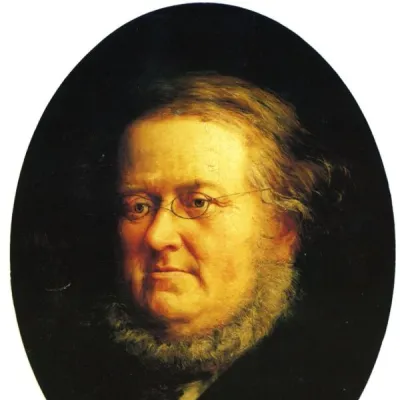
Peter Christian Asbjørnsen
Human Design Chart
Biography
The Human Design of Peter Christian Asbjørnsen: Generator 4/6
Generator 4/6 — Design at a Glance
Peter Christian Asbjørnsen possessed remarkable endurance and a high degree of inner strength. His design suggested that he was most successful when he did not initiate actions himself but instead responded to impulses from his environment. This approach aligned with the Generator's strategy: waiting for a clear signal – the internal 'yes' – and then acting on it.
This mechanism allowed him to use his energy efficiently. When he engaged in activities that matched this inner call, he experienced deep satisfaction and a sense of fulfillment. In contrast, ignoring this signal or forcing himself to stop when still enthusiastic led to frustration and energy loss. Similarly, constantly taking initiative without an external cause had negative effects, as it unnecessarily depleted his resources and could lead to long-term exhaustion.
Peter Christian Asbjørnsen thus demonstrated that he maximized his potential through reactive action rather than premature initiation. His strength lay in responding to life when called upon, rather than fighting against the current or forcing things for which he felt no intrinsic motivation. This harmony with his design was key to his endurance and well-being.
Emotional Authority
Peter Christian Asbjørnsen's design indicated a tendency towards emotional clarity that required time as an essential factor. Spontaneous reactions were unreliable in his system; his inner truth did not show itself in the first impulse but only after the initial waves subsided.
This configuration stemmed from his Emotional Authority. The defined Emotions Center carried this authority – a mechanism that took precedence over all other defined centers for every type except Reflectors. Peter Christian Asbjørnsen was subject to constant emotional waves, an up and down of feelings. The world appeared colored by the current mood: one moment full of enthusiasm, the next marked by negative coloring. This immediate feeling was only a snapshot, not a reliable compass for long-term steps. Quick decisions made in this emotional heat often had negative consequences as they were based on transient coloring.
The strategy of his design involved letting decisions ripen. He needed to exercise patience and take time to reflect multiple times. By 'sleeping on it,' the intense feelings gradually subsided, allowing him to gain necessary emotional distance. In this calmness, true clarity and serenity set in. This process was crucial for steps with significant impact on his life course; only then could he separate his deeper, comprehensive understanding from superficial mood swings and become action-ready.
The 4/6 Profile — Opportunist / Role Model
Peter Christian Asbjørnsen's design established a life dynamic characterized by a constant balance between the deep desire for community and the urge to distant reflection. In his first half of life, before Saturn returned, his Line 6 still appeared as a Line 3. This was evident in experimental behavior, especially in the realm of relationships and friendships where he learned and experimented extensively.
Over time, the full characteristics of Line 6 were activated. Peter Christian Asbjørnsen then frequently experienced an internal conflict between the desire to belong to a group (Line 4) and the impulse to withdraw to ponder the meaning of life (Line 6). His life thus revolved around the tension between heart and head.
In his later years, he was expected to take on the role of a wise role model and stand out through cooperation with others. Throughout this period, his large heart, marked by Gate 61 of Line 4, remained cautious, opening only partially to avoid injuries from 'false' people. Simultaneously, Line 6, especially through Gate 32, emphasized an inner tranquility towards impermanence and transformation, which helped him accept changes in the context of preservation, even when fear of material failure was present.
Split Definition — Defined & Open Centers
Peter Christian Asbjørnsen's design inclined towards a profound, authentic presence guided by inner resonance rather than mental pressure. As a Generator, he had a fully defined energy system: His Sacral Center provided constant vital energy, but it was only available upon correct response to invitations. Initiating actions without prior questioning led to resistance and exhaustion. His emotional authority in the Solar Plexus Center required patience; spontaneous decisions were unreliable as truth revealed itself only after experiencing an emotional wave – often after a night of waiting. The defined Spleen Center gave him intuitive certainty in the present, with unique warning signals that could not be rationalized.
Additionally, his defined G Center shaped his firm identity and direction, while his Heart Center fostered willpower and reliability in promises. This combination created a stable internal structure. At the same time, Head, Ajna, and Throat Centers were open. This made him vulnerable to mental confusion, the pressure of needing answers, or the desire for attention through speaking. Instead of interpreting these open centers as his own truth, he tended to be distracted by such mental unrest when not trusting his inner authority. The tension between necessary waiting and the internal pressure from the defined Root Center was central: Only through waiting and reacting could he effectively utilize his energy without falling into conditioning by the open centers.
Channel 15-5: The Rhythm — Channels & Gates
Peter Christian Asbjørnsen's design created a tension between universal life flow and deep detail concentration. He exhibited this through Channel of Rhythm 5-15 in personality type, which connected Sacral with G Center. Gate 5 held onto fixed habits while Gate 15 integrated the diversity of society into the flow. This gave him magnetic timing; he drew others into his natural energy flow as long as he remained on his sacral reaction.
Simultaneously, Channel of Concentration 52-9 in design linked Root with Sacral Center. Gate 9 focused on details and facts supported by Gate 52's passive drive towards silence. This formative energy required patience: Peter Christian Asbjørnsen paused to perfect patterns without interrupting the rhythm channel's flow. The challenge was finding necessary stillness for this logical analysis without disconnecting from natural timing.
As a juxtapositioned Channel of Exploration 34-10 complemented his individual reinforcement. Gate 34 provided inner strength for self-beliefs, while Gate 10 initiated behavior aimed at self-acceptance. This promoted an independent stance that allowed him to remain authentic and inspire others towards self-love through example without imposition.
Additionally, Channel of Transformation 54-32 in design as well as Channel of Community 37-40 in personality type shaped his profile. The first linked ambition (Gate 54) with continuity (Gate 32), driven by a desire for social improvement and tribal support. The second connected friendship (Gate 37) with the need for pauses (Gate 40), requiring carefully balanced relationships based on mutual benefit.
Individual Gates like Gate 61 (inner truth/silence) and Gate 62 (logic/details) supported this structure through focus on inner clarity and precise pattern recognition. Together, they created a profile that swung between being swept along by the collective in rhythm and the calm, intense work of perfecting details.
Collective Circuitry — Circuit Signature
Peter Christian Asbjørnsen's design inclined towards unshakable inner centering and individuality. This energy was strengthening to the environment but often remained implicit or reserved in verbal expression. The Centering Circuit connected his Identity with Sacral Centers directly, creating firm internal certainty ("I am who I am") and strong self-esteem. Since Throat Center was missing, these deep convictions were hard to articulate; power remained inwardly focused and individualistic.
Parallel to this, the Understanding Circuit linked Identity, Sacral, and Root Centers. This added rational structure, strategic focus, and logical insight – free from emotional coloring of Solar Plexus. It was about sharing clear, future-oriented connections.
The Ego Circuit consisted of two separate parts: Heart with Solar Plexus Center on one side, Spleen with Root Center on the other. This configuration promoted social cooperation and resource management through mutual support ("Giving and Taking"). Since there was no direct connection to Sacral Center here, constant life force was lacking; this required necessary rest pauses for energy regeneration for the tribe.
Overall, Peter Christian Asbjørnsen appeared as someone with a deep inner compass and strategic mind whose strong individuality was complemented by cooperative elements that needed breaks to sustainably function. The shared definition clearly separated these energetic blocks from each other.
Right Angle Cross of Maya 4
Peter Christian Asbjørnsen's design carried the energetic signature of the Right Cross of the Maya 4. This configuration acted as a structural foundation for his inner alignment and shaped his life energy on a deep, often unconscious level. Since no specific Gates, Channels or Centers are detailed in the provided material, the interpretation is limited to this pure cross-specific identity.
The Right Cross of the Maya 4 represents an overarching formative energy that expresses itself less through external actions than through a certain quality of being. It refers to archetypal patterns that permeate the individual and shape their response to the world without necessarily manifesting in concrete biographical events. For Peter Christian Asbjørnsen, this meant that this energetic imprint was a constant undercurrent that defined his essence, even if external circumstances or specific mechanical details such as open Centers are not further elaborated here. The emphasis thus lies solely on this fundamental identity as the driving force in the background of his design.
Saturn Return · Uranus Opposition · Chiron Return · 2nd Saturn Return — Life Cycles
Peter Christian Asbjørnsen's design did not offer any specific energetic signatures reflected in the provided astrological cycles. Since no Human-Design mechanics data such as Gates, Channels or defined Centers were linked to these phases, no characteristic pattern for these life stages could be derived from the chart. The first and second Saturn returns marked traditional milestones of maturity and consolidation, yet within the context of his Human Design, there was a lack of specific energetic charging that typically characterizes such periods. Similarly, the Uranus opposition showed no defined trigger for sudden changes or liberation processes within his inner structure. The Chiron return, a cycle often associated with the unfolding of personal purpose, carried in his design no specific charge to energetically support a particular bloom period or sense-making. His life paths through these phases were thus not marked by a unique internal drive as observed in other configurations. Instead, he moved through these time periods without the specific resonance that would arise from the interaction between astrological events and his individual Human Design architecture. This does not mean an absence of development but rather the lack of a chart-based explanation for particular intensity or direction during these years.
Generator · Emotional Authority — Synthesis
Peter Christian Asbjørnsen lived a life deeply marked by an inner dynamic: the constant interplay between the need for authentic self-actualization and the desire to connect with community. His defined Sacral Center endowed him with a sustained energy source, which however was only activated through reaction to external impulses – a life thus manifesting not in initiation but in response to the flow of life. This sacral foundation combined with a strong G Center made him a natural authority and guide for others, always guided by a deep sense of direction and connection. Through the combination of defined willpower and the defined Root Center, he possessed an impressive ability to take on challenges and mobilize resources to pursue his goals – a steady drive that was nevertheless always oriented towards the needs of the tribe.
Despite these strengths, Peter Christian Asbjørnsen revealed a central paradox: the tension between his need for individual exploration and the desire for belonging. His profile as Networker/Role Model points to a lifestyle in which he sought deep connections while also needing some withdrawal for self-discovery. The open Centers for mental awareness and communication strengthened this ambivalence, as he received and processed information without necessarily binding himself to rigid opinions – a person who could both inspire and confuse, always searching for truth and authenticity.
5 Defined Channels
Incarnation Cross - Right Angle Cross of Maya 4
Solar Return
The Solar Return shows the moment when the sun returns to its exact birth position - your personal solar year.
Life Cycles
Discover the life cycles with a detailed triple view (birth chart, cycle chart, composite).
Human Design Profile
- Type
- Generator
- Strategy
- To respond - wait for something to respond to
- Authority
- Emotional Authority
- Profile
- 4/6 - Opportunist / Role Model
- Definition
- Split Definition
- Incarnation Cross
- Right Angle Cross of Maya 4
- Date of Birth
- 15.01.1812 12:00
- Place of Birth
- Oslo, Norway
Frequently Asked Questions
What was Peter Christian Asbjørnsen's Human Design type?
Which Profile did Peter Christian Asbjørnsen have?
What Authority did Peter Christian Asbjørnsen possess?
What incarnation cross did Peter Christian Asbjørnsen have?
When was Peter Christian Asbjørnsen born?
Discover your own Human Design
Are you also a Generator? Find out in a personal reading how to use your sacral energy correctly and discover deep satisfaction.
More Personalities
Back to overviewAaliyah

Alain-Fournier

Alexia

Angèle

Angeli

Anne-Marie