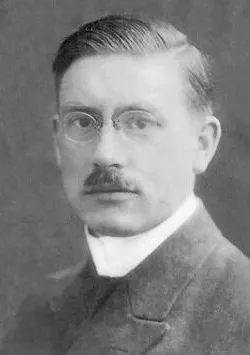
Peter Debye
Human Design Chart
Biography
Died on 2 February 1966, Ithaca, NY.
What does Generator 1/3 mean for Peter Debye?
Generator 1/3 — Design at a Glance
Peter Debye revealed himself as someone with immense endurance and an inner reservoir of strength. His Generator design established a foundational stance that was based on reaction rather than initiative. The energy in his sacral center did not release through constant pushing forward but unfolded fully when he responded to clear signals from his environment. This mechanism meant for him: Not initiating, but reacting was the key to effective work.
When Peter Debye received impulses and his inner self reacted with a 'Yes', he could consistently translate this energy into actions. In these moments of resonance, he found deep satisfaction and a sense of fulfillment. Conversely, ignoring these internal signals or forcing activities without inner consent led to frustration and a lack of energy. His greatest challenge was not getting involved in things that did not resonate, which would have wasted his strength. Similarly, it was difficult for him to be held back when he was in the flow of his heart's affairs. Therefore, his strength lay in responding instinctively to life, thereby activating his full potential for endurance and creative power.
Sacral Authority
Peter Debye was a Generator whose decision-making was shaped by sacral authority. This inner guidance worked as a direct response to external stimuli and manifested in physical signals like a surge of energy or an internal confirmation. His design allowed him to act vital and energized when his sacral motor was engaged. He lived with the potential to perform tasks with great enthusiasm without needing rigid purposefulness in the form of compulsion. The prerequisite for this clear guidance was an open emotional center, meaning he did not have to react to short-term emotional waves but could trust the stable, physical resonance of his sacrum. When his spleen center was activated and connected with the sacral center, it supported his ability to make quick and spontaneous decisions. This immediate access to instinctive perception helped him reliably guide himself from his bodily well-being. His strategy consisted in waiting for these inner signals and then responding, which simplified his process and allowed him to immerse himself joyfully and contentedly in his activities.
The 1/3 Profile — Investigator / Martyr
Peter Debye's design inclined towards exploratory experimentation. As a person with Profile 1/3, he was naturally a scientist who combined theoretical learning (Line 1) with practical application. His path followed the principle of trial and error: He initially gathered various opinions and theories openly to grasp reality thoroughly. However, this preparatory phase could conflict with the urgent need to simply try things out. The energy of Line 3 drove him to independently experience and learn from mistakes without relying on external validation.
This configuration meant that his judgments were particularly trustworthy. When he deemed a method or theory valid, he had both intellectually scrutinized it and practically validated it beforehand. Line 1 provided the foundation for openness and discerning thought, while Line 3 gave him independence to conduct his own experiments. Thus, Peter Debye was someone who did not merely passively absorb knowledge but actively confirmed it through personal action. His strength lay in the ability to solidify theoretical concepts through concrete practice and generate self-discovered insights that were steadfast.
Split Definition — Defined & Open Centers
Peter Debyes Human Design profile revealed a tendency towards consequent, conceptual clarity. His defined Ajna Center created a consistent mental process; he always thought in specific concepts and theories that he interpreted as trustworthy answers. This mental structure flowed directly into his defined Throat Center: He spoke out what his mind conceptualized, making his communication a reliable yet limited form of manifestation through interaction.
His energy source was located in the defined Sacral Center. As a Generator, he had a daily supply of vital force that became available only through reaction. Initiation led to resistance; waiting for a question or opportunity allowed the Sacral Tone 'Yes' or 'No', enabling him to use his energy productively and without frustration. This sacral persistence was supported by his defined Root Center, which provided steady pressure towards material maintenance and propelled him forward in the world. Additionally, his defined Spleen Center facilitated spontaneous, intuitive judgments in the present moment, helping him make health-promoting decisions.
In contrast, his vulnerability became apparent through several undefined centers. His open Head Center tended to interpret foreign inspiration or doubt as personal mental pressure; he could easily get entangled in questions that were not his own problem and sought answers for others' problems, which confused him. His open G Center meant he had no fixed identity or direction. He was dependent on the environment: At the wrong place, he felt lost and desperately searched for love or confirmation of his existence; at the right place, however, he reflected the correct energy of those around him and flourished without needing to present a rigid identity.
His open Heart Center made him vulnerable to the pressure of proving his worth through promises. Lacking consistent willpower, he easily fell into spirals of self-doubt when failing to meet expectations instead of trusting his inner authority. Finally, his open Solar Plexus absorbed the emotions of his surroundings. He took on foreign moods and intensified them, often confusing them with his own, making him emotionally vulnerable and prone to avoiding confrontation out of fear of rejection rather than expressing his own truth.
Channels for acceptance, evolutionary change and critical judgment.
Peter Debyes Human Design profile revealed a tendency towards evolutionary change paired with strict logical structure. The Channel of Mutation 60-3 connected the Root Center with the Sacral Center. This generated a pulsating rhythm between chaos and order, accompanied by melancholy in pauses. Peter Debye had to accept limitations (Gate 60) and move beyond the confusion of a new beginning (Gate 3) to make innovative impulses effective. This energy conditioned his environment, demanding adaptation.
Parallel to this, his mind organized information rigorously. The Channel of Acceptance 17-62 connected the Ajna Center with the Throat Center. Here, Gate 17 visualized patterns while Gate 62 translated them into language and details. Peter Debye sought logical coherence; what he could not integrate into his mental system remained incomprehensible to him. This channel endowed him with the ability to formulate complex theories precisely and explain them to others, provided he received an invitation to speak.
Another aspect was a constant striving for correction. The Channel of Judgment 58-18 connected the Root Center with the Spleen Center. Driven by vitality (Gate 58) and the urge towards perfection (Gate 18), Peter Debye questioned existing patterns to improve them. This was not a personal attack but a mechanical process to make life in the collective more cheerful and efficient. He found fulfillment when asked specifically for solutions.
Additionally, individual gates influenced his perception. Gate 52 demanded concentrated silence for pattern correction while Gate 32 sought continuity and material success. Gate 42 emphasized the need to complete processes before taking on new commitments. Gate 23 enabled him to explain differences and bring mutations into the world. Gate 50 preserved traditional values as a protective reflex. Gate 4 developed formulas for future security. Gate 31 transferred leadership, Gate 20 promoted authentic action in the present moment, and Gate 8 contributed to individually stepping up for group goals. These configurations shaped Peter Debyes way of initiating change and structuring knowledge.
Collective Circuitry — Circuit Signature
Peter Debyes Human Design profile revealed a tendency towards structured logical thinking that manifested in clear expressions. As a person with split definition, he possessed two independent energetic poles: one for rational analysis and another for vital impulses that did not directly overlap.
The Understanding Circuit connected his Ajna (Mind) with the Throat Center (Expression). This allowed him to articulate strategic insights and judgment free from emotional coloring. Parallel to this, a connection between Spleen (Survival/Intuition) and Root-Zentrum (Pressure/Energy) supported focused visual perception of the future. However, these two parts of the circuit did not form a cohesive unit but existed as separate functional areas.
The Knowledge Circuit connected his Sacral with the Root Center. Here, the energy of mutation—a deviation from the known—directly emerged from life force. This marked him as someone who embarked on new paths and initiated change through personal initiative. However, this vital pulsating power stood energetically separate from his rational expressive capacity in the Understanding Circuit. Peter Debye thus utilized two parallel systems: one for logical structuring and communication, the other for intuitive transformative action.
Right Angle Cross of Service 1
Peter Debyes design indicates a tendency towards selfless dedication to a higher goal or community. This configuration, known as the right cross of service, shaped his inner attitude with a deep impulse to help others and work for the common good, often without putting personal interest first.
In Human Design mechanics, this pattern describes a specific energetic alignment where the power of service is not felt as a burden but as a natural life task. It's about the ability to serve others and experience profound satisfaction when contributing to groups or ideas. This energy supports immersing oneself in tasks that go beyond pure self-interest and establish a connection with something greater.
For Peter Debye, this meant that his actions were often motivated by the desire to contribute to improving other people's situations. His energy flowed where it was needed to offer support and stability. This aspect of his design promoted an attitude of empathy and solidarity, enabling him to effectively engage in collective contexts and thus sustain positive changes.
Saturn Return · Uranus Opposition · Chiron Return · 2nd Saturn Return — Life Cycles
Peter Debyes design showed a structure where inner maturity and external recognition condensed into clear phases. In 1910, at the age of 26, he achieved Habilitation, marking his first Saturn return on his chart, a time when years of groundwork often solidify into a stable professional foundation. The energy of this cycle supported him in firmly establishing his professional base.
Later, in 1936, at the age of 52, his Chiron return occurred as he received the Nobel Prize for Chemistry. This fulfillment cycle marked the blooming phase in his design where his life purpose and deeper destiny increasingly unfolded and became meaningful experiences. It was not a healing but rather the realization of what he was.
His second Saturn return followed in 1940 with his move to the USA, together with wife and son. At the age of 56, this phase again showed the typical condensing power of Saturn: it created a new stable basis for his further life and relationships. Peter Debye thus moved through cycles that each set specific tasks of stabilization and unfolding.
Generator · Sacral Authority — Synthesis
Peter Debye lived a path marked by a deep-rooted drive towards knowledge. As a Generator with sacral authority (Sacral Center), he followed an inner driving force triggered by external stimuli, which put him into states of high energy. This fundamental need to act driven by his life energy was combined with the profile of a researcher and experimenter (Line 1/3), leading him not only to explore knowledge theoretically but also to test it practically on heart and conscience. The defined Ajna Center indicates that he continuously developed concepts and possessed clear mental functions, which helped him process data and generate new ideas – a process further fueled by the Channel of Mutation (3-60).
At the same time, his design showed a paradox between the need for continuous exploration and the melancholy associated with it (Channel 3-60). The energy of the Knowledge Circuit drove him to create new things and initiate transformation, yet accepting limitations and letting go of old patterns seemed to leave a melancholic undertone in his work. This was reflected at key moments of his career (Habilitation) and success (Nobel Prize), but also in personal changes as he sought a new environment with his family.
3 Defined Channels
Incarnation Cross - Right Angle Cross of Service 1
Solar Return
The Solar Return shows the moment when the sun returns to its exact birth position - your personal solar year.
Life Cycles
Discover the life cycles with a detailed triple view (birth chart, cycle chart, composite).
Human Design Profile
- Type
- Generator
- Strategy
- To respond - wait for something to respond to
- Authority
- Sacral Authority
- Profile
- 1/3 - Investigator / Martyr
- Definition
- Split Definition
- Incarnation Cross
- Right Angle Cross of Service 1
- Date of Birth
- 24.03.1884 12:00
- Place of Birth
- Maastricht, Netherlands
Frequently Asked Questions
What was Peter Debye's Human Design type?
What Profile did Peter Debye have in Human Design?
What Authority guided Peter Debye?
What incarnation cross did Peter Debye have?
When was Peter Debye born?
Discover your own Human Design
Are you also a Generator? Find out in a personal reading how to use your sacral energy correctly and discover deep satisfaction.
More Personalities
Back to overviewAaliyah

Alexia

Angèle

Anne-Marie

Arcángel

Arno