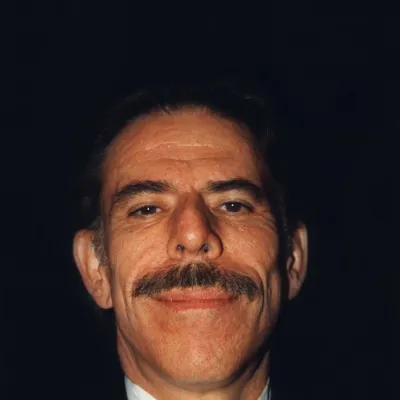
Peter Max
Human Design Chart
Biography
In the '90s, he did serious work on a series of paintings of expressionistic and figurative floral pieces. In 1992, he painted two 175-foot murals for the U.S. Pavilion for the Summer's World Fair in Seville, Spain. Being heavily into ecology and the movement to save the rain forests, in 1992 he also completed a series of 12 environmental stamps for the U.S. to raise awareness about the Earth Summit in Rio de Janeiro.
Since age 30, Max's New York based business has been a success. Currently the business grosses over one million dollars a year and encompasses five other companies which employ over 30 artists.
On 2 June 1998 Max was sentenced to two months in prison, $30,000 fine and 800 hours of community service for cheating on his income taxes. He is scheduled to begin his sentence in August 1998.
Human Design Analysis: Peter Max as Projector 5/1
Projector 5/1 — Design at a Glance
Peter Max's design tends towards a focused, penetrating presence. As a Projector, his aura acted like a bright flashlight, directing its beam specifically at weaknesses in his environment. This configuration allowed him to immediately recognize where systems or people were 'in the dark' and where errors in the process were occurring.
The challenge of this type lies in the nature of communication. A direct pointer to deficits is often perceived by the environment as aggressive or unpleasant, similar to a light beam directly in the face. Therefore, Peter Max's elegant strategy was not to actively exercise criticism but to exemplify harmony and clarity himself. By living these qualities, he naturally attracted others who then asked for his insights.
His energy was not constantly available, as his Sacral Center was undefined. This meant that he had to alternate phases of high productivity with necessary rest periods to prevent burnout. The conventional societal structure with its continuous pace ignored this need for recovery. His central life task was to wait for an honest invitation before sharing his knowledge. If this strategy was followed, he was rewarded with success; if ignored, the non-self theme of bitterness would arise. His success therefore directly depended on whether he embraced his role as a Leader rather than acting as a Doer.
Splenic Authority
Peter Max's design tends towards spontaneous, instinct-driven decision-making. His inner authority resides in the defined Spleen Center, which presupposes that both the Emotional and the Sacral Centers are open. This configuration is specific to Projectors or Manifestors. The Spleen Center functions as a health and alarm system, providing a pronounced survival intelligence. This was evident in Peter Max as spontaneous inner knowledge that immediately signaled whether a situation, environment, or society was right for him. His instinct and physical well-being served as reliable indicators.
Decisions had to be made in the moment; the first, spontaneous impulse was the correct one and served his immediate health directly. This allowed him to rigorously shield against harmful influences and take good care of himself. However, since this Spleen impulse is very subtle and occurs only once in the moment, there was a risk that it could be overshadowed by other influences. This required high vigilance. A retreat to decision-making could be helpful. Since knowledge of the right course of action was only available in the moment, plans could change short-term. Long-term commitments were therefore difficult. Peter Max needed a lot of space and flexibility to avoid unnecessary commitments and act spontaneously.
The 5/1 Profile — Heretic / Investigator
Peter Max's design tends towards acting as a Hero who uses deep, personally acquired knowledge to offer solutions to others. As a 5/1 (Hero/Researcher), he combined Line 1, which means intensive research and the accumulation of experiential values for himself, with Line 5, which means carrying these treasures outward. Other people often instinctively sought him out for solutions, attracted by the magnetic aura typical of this profile. However, this could lead to overloading if clear boundaries were not set – similar to an expert who is exhausted after hours of consultation because he has not learned to say no. His Line 5 (Gate 32) promoted flexibility and effortless adaptation to changes, while Line 1 (Gate 56) aimed at quality and valuable stimulation. He needed feedback to understand whether his ideas were effective and had to learn not to misuse his gifts for trivial purposes. The balance between the private research process and public problem-solving was crucial for him to maintain his energy and effectively convey his unique insights without exhausting himself.
Split Definition — Defined & Open Centers
Peter Max's design tends towards a constant mental pressure to ask questions and form concepts. The definition between the Head Center and the Ajna Center created a trustworthy, specific mental function, but it lacked direct energy for implementation. This required patience: The mind inspired, while others put the ideas into action. At the same time, he had a defined Spleen Center, which allowed intuitive, spontaneous judgments in the present, as well as a defined Root Center, which provided physical pressure for survival and material well-being.
In contrast, his openness was evident in several areas. The open Throat Center tended to suffer under the pressure to demand attention, rather than waiting for natural invitations to speak. The open G Center meant living without a fixed identity; Peter Max tended to question who he really was and took directions from the environment rather than determining them himself. The open Heart Center lacked consistent willpower, leading to the risk of wanting to prove himself through promises to demonstrate value. Additionally, the open Sacral Center made him vulnerable to borrowed energy; he tended to work until exhaustion set in, rather than listening to his inner authority for boundaries. Finally, the open Solar Plexus Center absorbed the emotions of the environment, which could lead to personalizing foreign moods and feeling emotionally out of control, rather than remaining an objective observer.
Channels for ambition, inner truth and mental imagery.
Peter Max's design tends towards sudden, inspiring insights that occur not through logical deduction but through a kind of mental mutation. This was marked by the Awareness Channel 61-24, which connects the Head Center with the Ajna Center. Here, the spontaneous inspiration of Gate 61 meets the rational processing of Gate 24. This mechanism does not produce a continuous thought flow but moments of
Tribal Circuitry — Circuit Signature
Peter Max's design tends towards pulsating creativity and visual reflection, flanked by a deep, instinctive transformative power. These separate energetic poles shaped his expression as parallel existing, not directly connected streams.
In the Knowledge Circuit, the Awareness Channel (24-61) connects the Head Center with the Ajna Center. This promoted innovative flashes of insight and the ability to transform new knowledge. The energy worked acoustically and in the present, driving the creation of unique identity through deviation from the known.
Parallel to this, the Sensemaking Circuit was active. Here, the Abstraction Channel (47-64) also connected the Head Center with the Ajna Center. This stream focused on the past to find meaning in past events. The energy flowed cyclically and visually, with the aim of sharing felt insights with the collective and learning from them.
A third, independent stream formed in the Ego Circuit. The Transformation Channel (32-54) connected the Spleen Center with the Root Center. This gave an instinctive ability for renewal and adaptation. Since this circuit does not connect to the Sacral Center, this configuration required necessary rest periods to regenerate resources for communal creation.
Together, these three circuits formed a profile that emphasized creative innovation, emotional sense-making, and instinctive renewal as separate but equally important life domains.
Left Angle Cross of Limitation 2
Peter Max's design points towards a tendency towards clear demarcation and the definition of personal boundaries. This structure, the left cross of limitation 2, describes an inner attitude that is characterized by the ability to realistically assess one's own needs and capacities. This is not about isolation, but about the conscious creation of protective spaces where energy is not unnecessarily scattered.
In Human Design, this configuration represents the need to be able to say 'No' in order to authentically shape a 'Yes' to what is truly important. Those who carry this mechanism often learn that boundaries are not barriers against others, but the prerequisite for a real connection. Without this clear demarcation, there is a risk of being overwhelmed by the expectations of the environment.
The challenge lies in setting these boundaries not rigidly or defensively, but rather as a living, adaptive protective layer. It is a process of finding the right balance: enough openness for exchange, enough distance for the preservation of one's own substance. This balance allows one to stand clear in relationships and projects without losing oneself. The energy of this configuration acts stabilizing when it is accepted and lived. It calls for taking responsibility for one's own energy and not leaving it to others to respect one's limits.
Saturn Return · Uranus Opposition · Chiron Return · 2nd Saturn Return — Life Cycles
Peter Max's design points towards a tendency towards visible, colorful expressive strength that condenses in striking career turning points. This structure often manifests in phases of Saturn returns, where inner maturity and outer responsibility come together.
In 1964, at the age of 27, his studio work ended and he began with colorful screen-printed drawings. This marked his first Saturn return, a time when years of groundwork often condenses into a meaningful new life purpose. The change was not only stylistic but structural: a step towards greater visual presence.
His second Saturn return occurred in 1992 when he was 55 years old. In that year, he painted two 53-meter-long wall paintings for the US Pavilion at the World Expo in Seville. This showcased the mechanism of the second Saturn return: the confirmation and expansion of the direction found in the first return. The enormous size of the works underscores the maturity of the expression form, which now no longer just experimental but as an established, monumental language. Both events illustrate how Peter Max's design led to concrete, visible results in these specific cycles, shaping his artistic identity.
Projector · Splenic Authority — Synthesis
A central red thread runs through the design: the ability to recognize patterns and bring light into the darkness (Projector Type, Gate 61/24). This gift is closely intertwined with a deep inner drive to understand and rationalize (defined Head and Ajna Centers), leading to sudden insights and a steady flow of inspiration. The Profile as Hero/Researcher strengthens this process by channeling the need for knowledge deepening and problem-solving to make it accessible to others. The Spleen Authority underscores the ability to instinctively grasp what is beneficial for one's own well-being, thereby setting the direction for the dissemination of insights.
The design reveals a central paradox between the need for deep, individual exploration (Knowledge Circuit, Line 1) and the magnetic attraction that seems to solve other people's problems (Line 5). This tension is reinforced by the Projector strategy, which requires waiting for an invitation while simultaneously maintaining the inner urgency to share knowledge. The Saturn return events, which coincide with creative peak performances, suggest that this inner conflict is resolved through expression and transformation in the outside world.
3 Defined Channels
Incarnation Cross - Left Angle Cross of Limitation 2
Solar Return
The Solar Return shows the moment when the sun returns to its exact birth position - your personal solar year.
Life Cycles
Discover the life cycles with a detailed triple view (birth chart, cycle chart, composite).
Human Design Profile
- Type
- Projector
- Strategy
- Wait for the respectful invitation
- Authority
- Splenic Authority
- Profile
- 5/1 - Heretic / Investigator
- Definition
- Split Definition
- Incarnation Cross
- Left Angle Cross of Limitation 2
- Date of Birth
- 19.10.1937 02:30
- Place of Birth
- Berlin-Reichstag, Germany
Frequently Asked Questions
What is Peter Max's Human Design type?
What Profile does Peter Max have?
What Authority does Peter Max have?
What is Peter Max's incarnation cross?
When was Peter Max born?
Discover your own Human Design
Are you also a Projector? Find out in a personal reading how to unfold your leadership qualities and recognize the right invitations.
More Personalities
Back to overviewSissy Spacek

Alain-Fournier

Anémone

Ann-Margret

Bourvil

Christian-Jaque