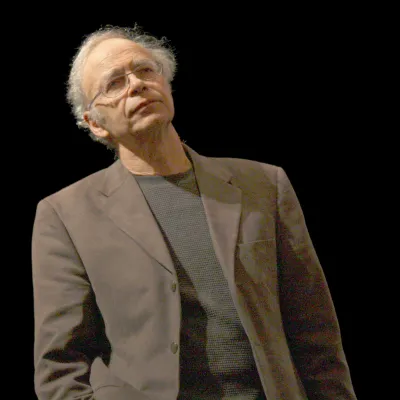
Peter Singer
Human Design Chart
Biography
On two occasions, Singer served as chair of the philosophy department at Monash University, where he founded its Centre for Human Bioethics. In 1996 he stood unsuccessfully as a Greens candidate for the Australian Senate. In 2004 Singer was recognised as the Australian Humanist of the Year by the Council of Australian Humanist Societies, and in 2006 he was voted one of Australia's ten most influential public intellectuals. Singer is a cofounder of Animals Australia and the founder of The Life You Can Save.
The Human Design of Peter Singer: Manifestor 5/1
Manifestor 5/1 — Design at a Glance
Peter Singer revealed himself as someone driven by a strong inner vision that he wanted to bring into the world. His design as a Manifestor inclined him towards a pioneering stance, similar to an Emperor who plans an empire without ever engaging in battle himself. This configuration brings an energy that paves new paths and actively shapes the future.
Such visions, however, did not always meet with immediate understanding. As his thoughts often reached further than those around him, he inevitably polarized: Some followed him enthusiastically, while others rejected his grand plans or even rejected them. This pain point of being misunderstood is typical for this type who wants to change the world but encounters resistance.
To minimize this friction and win the right people over, the strategy of informing was crucial. By clearly communicating his intentions and visions before acting, he could find the right followers. Living by this strategy and his inner authority brought him a sense of inner peace. Deviating from it, however, led to lasting anger. His path, therefore, was to bridge his vision with the outside world through clear information.
Emotional Authority
Peter Singer's design inclined him to avoid making decisions in the heat of the moment, instead letting them mature over a longer period. His inner authority is Emotional Authority, carried by the defined Emotional Center. This mechanism means that his feelings flow in waves – a permanent up and down that colors the perception of the world according to current mood. What appears inspiring in one moment can seem negative in the next. This emotional snapshot, however, is not yet the final truth.
Quick, spontaneous decisions based on such emotions could be negative for him, as the first impression is often misleading. His design's strategy requires patience: He should take time to “sleep on” a decision multiple times. Only when the intense feelings subside and emotional distance is gained, true clarity and calmness set in. This process is especially crucial for long-term, life-changing decisions. By waiting, he gains the necessary depth and overview to distinguish his true inner truth from temporary mood swings.
The 5/1 Profile — Heretic / Investigator
Peter Singer's design inclined him towards a specific dynamic: the deep, slow assimilation of knowledge, coupled with a nearly magnetic aura that urged others to use precisely this knowledge for their own problems. As a 5/1er, the Hero-Researcher, he showed himself as someone who loved the process of learning and diving into new challenges. The Line 1 of his profile described a developmental line that required time and experience to overcome shocks and build willpower – a slow, genetic change over long periods of time.
At the same time, Line 5 projected a capability to change rules and circumvent obstacles, especially in crisis times. This projection, however, created a tension field: Others sought solutions from him, which could quickly overwhelm him if no clear boundaries were set. The design described the danger of being like a scientist who, after hours of conferences, is drained while his inbox is flooded with new questions. The challenge lay in maintaining the balance between private research (Line 1) and public problem-solving (Line 5). Only by learning to also say no could this beneficial balance be preserved and the potential optimally utilized without falling into exhaustion.
Single Definition — Defined & Open Centers
Peter Singer's Human Design shows a tendency towards consequent, conceptual clarity that directly manifests in his way of expression. His defined Ajna Center ensures a consistent mental function that generates concepts and theories in a trustworthy manner. These thoughts flow directly into his defined Throat Center, allowing him to express what he thinks – a mechanism that shapes his communication as a direct manifestation of his intellectual structure.
Simultaneously, a complex emotional dynamics is revealed through his defined Solar Plexus Center. This center acts as an inner authority guiding him to make decisions not impulsively but to wait for emotional clarity. This patience contrasts with his open G-Center definition, which does not offer a fixed, predetermined identity or direction. Instead, he tends to reflect in his environment and find his identity through correct places and relationships rather than constructing it from within himself.
His open Heart Center makes him vulnerable to the pressure of proving his worth through willpower or promises. The typical trap of this open center is to overcompensate, leading to a cycle of self-doubt if expectations are not met. Additionally, his open Sacral Center is sensitive to the energy of his environment, meaning he does not have a constant generative energy but rather absorbs and amplifies it from outside. This requires conscious management of his vitality to avoid exhaustion, as he is not programmed to work continuously but to trust his inner authority to know when he has energy and when he needs to withdraw.
Channels for seeking, intuitive clarity and emotional change.
Peter Singer shows a tendency to stimulate his environment through storytelling and sharing experiences. This tendency is rooted in the Channel of Curiosity 11-56, which connects the Ajna Center with the Throat Center. Here, abstract information is not conveyed as dry facts but as narrative parables that engage imagination and feelings. The energy of this channel serves to explore new ideas and perspectives and to formulate them in a way that others can take in and reflect upon.
At the same time, Peter Singer has the ability to verbally articulate intuitive insights in the immediate present. The Channel of Brainwave 57-20 connects the Spleen with the Throat Center and allows deep, instinctive knowledge to be directly translated into words. This is not logical analysis but a spontaneous, existential truth that can strengthen others to use their own inner survival intelligence.
Another defining aspect is the emotional quest for new experiences. The Channel of Transience 36-35 connects the Solar Plexus Center with the Throat Center. It drives the use of the emotional wave to move and gain wisdom through direct experience. This channel resists restrictive patterns and seeks change, often through the awareness that feelings and situations are transient.
Additionally, Gates like Gate 39 (Provocation/Mutation) and Gate 38 (Resistance/Integrity) as well as Gate 51 (Willpower/Shock Reaction) were active in his design. In the personality aspect, Gates 45 (Clan Energy), Gate 48 (Depth/Correction) and Gate 4 (Formulation/Future Security) were present. These configurations underscore an attitude that navigates between intuitive expression, narrative mediation, and emotional confrontation with transience.
Collective Circuitry — Circuit Signature
Peter Singer's design shows a tendency towards impulsive, creative insights that flow directly into communication. This configuration is seen through the Eureka Circuit (20-57), which connects the Spleen Center with the Throat Center. Here, the intuitive, quick perception of the Spleen meets the expression in the throat. It creates an energy that immediately articulates new, often unexpected ideas without hesitation. This channel stands for innovation and the courage to say what is felt to be true at the moment.
Parallel to this, there was a strong need to emotionally process past experiences and find their meaning. The Meaning Finding Circuit connected Peter Singer's Ajna Center (Thinking/Understanding), Solar Plexus Center (Emotions), and Throat Center (Expression). This connection created a cyclical flow: emotions from the past were structured through thinking and then expressed. It was not about cold logic but about sharing felt insights to learn from the past. Curiosity (Channel 11-56) drove the intellectual search, while the theme of transience (Channel 35-36) shaped the emotional depth and the desire for meaning in communication. Both circuits worked independently: one for spontaneous creativity, the other for emotional reflection and the exchange of life experience.
Left Angle Cross of Individualism 1
Peter Singer's Human Design reveals a tendency towards deep, often painful, confrontations with his own identity. He is depicted as someone who does not see the path of individual destiny as a linear progression but rather as a process of continuous testing and purification.
This configuration is known in Human Design as the left cross of individualism. It describes a life task where the search for the true self is often associated with isolation or the feeling of being different. The path does not lead through external recognition but through inner clarity, which is often only achieved after overcoming confusion or disappointment.
For Peter Singer, this meant that his drive was less about adapting to societal norms and more about the necessity of finding his own authentic voice. This process is often marked by a certain harshness, as it requires breaking free from predefined roles and fully taking responsibility for his own existence. The mechanics of this cross show that true individuality is experienced not as a privilege but as a duty, fulfilled through consistent self-reflection and the willingness to walk one's own path.
Saturn Return · Uranus Opposition · Chiron Return · 2nd Saturn Return — Life Cycles
Peter Singer's Human Design points towards a tendency towards structural consolidation and public visibility, which manifested in clear phases of life development. This dynamic was marked by the first Saturn return around the age of 29, a cycle that often marks the condensation of long-term inner work into a tangible, external result. In 1975, at the age of 29, his book 'Animal Liberation' was published. This success was no coincidence but rather aligned with the mechanical logic of this time point: the accumulated energy found expression in a concrete, tangible form and established a new foundation for his further development.
Later, around the age of 50, the Chiron return came into effect. This cycle is a fulfillment process in which the individual's incarnation cross unfolds and personal meaning increasingly becomes tangible, provided that the life path follows one's strategy and authority. In 1996, at the age of 50, Peter Singer ran for the Australian Senate. Although this candidacy was unsuccessful, it fit into the context of this bloom cycle: it was about the concrete exercise and making visible his own purpose in the social space, regardless of the immediate outcome.
The second Saturn return around the age of 58 further solidified this position. In 2004, at the age of 58, he received the 'Emperor Has No Clothes Award' from the Freedom From Religion Foundation. This success underscored the sustained effectiveness of his structural alignment and the recognition of his role in a broader context, which is typical of the stabilizing power of this second Saturn cycle.
Manifestor · Emotional Authority — Synthesis
A central red thread runs through the design: the connection between visionary pioneering role and the drive to deepen and disseminate knowledge. As a Manifestor (Type) with a defined Mental Center (Ajna) and the Channel of Curiosity (Gate 11/56), a pattern emerges where ideas are generated, explored, and then shared – a continuous search and communication of insights (Knowledge Circuit). The profile as Hero/Researcher (5/1) reinforces this aspect by emphasizing the ability to collect complex information and be available as a problem solver. The repeated successes that come with the dissemination of ideas (documented event 1975, 2004) confirm this natural orientation towards knowledge dissemination and influence.
At the same time, the chart reveals a paradox between the drive for innovation and the emotional wave (Emotional Authority). The need to tread new paths and question the status quo collides with the necessity to not rush decisions but to let them emotionally mature. The Line 5 in the profile points to a magnetic attraction that generates expectations and requests, while the emotional authority requires time for inner clarification. This creates a tension between the desire to act quickly and change the world and the inner commitment to make decisions from a deep, emotionally grounded basis.
3 Defined Channels
Incarnation Cross - Left Angle Cross of Individualism 1
Solar Return
The Solar Return shows the moment when the sun returns to its exact birth position - your personal solar year.
Life Cycles
Discover the life cycles with a detailed triple view (birth chart, cycle chart, composite).
Human Design Profile
- Type
- Manifestor
- Strategy
- To inform others before acting
- Authority
- Emotional Authority
- Profile
- 5/1 - Heretic / Investigator
- Definition
- Single Definition
- Incarnation Cross
- Left Angle Cross of Individualism 1
- Date of Birth
- 06.07.1946 09:00
- Place of Birth
- Melbourne, AUSTL
Frequently Asked Questions
What is Peter Singer's Human Design type?
What Profile does Peter Singer have in Human Design?
What authority does Peter Singer have?
What incarnation cross is active for Peter Singer?
When was Peter Singer born?
Discover your own Human Design
Are you also a Manifestor? Find out in a personal reading how to use your initiation power peacefully and dissolve resistance.
More Personalities
Back to overviewChristian-Jaque
Kesha

Lucebert
Masaccio
Nadar
Papus