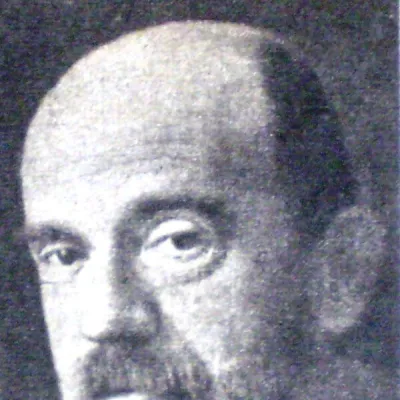
Pío Baroja
Human Design Chart
Biography
The young Baroja studied medicine at Valencia and took a medical degree at the Complutense University in Madrid at the age of 21. Although educated as a physician, Baroja practised this profession only briefly. As a matter of fact, he would use his student's memories – some of them he would consider terrible – as the raw material for The Tree of Knowledge. He also managed the family bakery for a short time and ran unsuccessfully on two occasions for a seat at the Cortes (Spanish parliament) as a Radical Republican. Baroja's true calling, however, was always writing, which he began seriously at the age of 13.
Ernest Hemingway was greatly influenced by Baroja, and told him when he visited him in October 1956, "Allow me to pay this small tribute to you who taught so much to those of us who wanted to be writers when we were young. I deplore the fact that you have not yet received a Nobel Prize, especially when it was given to so many who deserved it less, like me, who am only an adventurer"
What does Manifesting Generator 4/6 mean for Pío Baroja?
Manifesting Generator 4/6 — Design at a Glance
Pío Baroja was someone who could achieve results quickly but risked skipping important steps in the process. His Manifesting Generator design combined constant sacral energy with the ability to draw things into his life rapidly. This meant that while he had plenty of power, he could only use it effectively by responding to impulses rather than initiating them.
The challenge lay in balancing his speed with the need for thoroughness. When Pío Baroja pursued multiple things at once or started projects without inner confirmation, frustration quickly set in. His system required constant validation from the Sacral Center; only when this center gave a clear “yes” could his creative power lead to deep satisfaction.
Parallelism was not a weakness but a strength for him, provided it occurred within the right context. The pressure to finish one thing before starting another would have hindered his potential more than helped. Instead, he needed variety and a playful approach to his tasks. Only in this “play mode,” where strategy and inner authority aligned, could his hybrid energy—a mix of Generator patience and Manifestor speed—function without friction. Thus, potential overextension turned into productive flow as long as he perceived and responded to life’s impulses.
Sacral Authority
Pío Baroja demonstrated decision-making that was rooted not in the mind but deep within the body’s core. His design established that his inner authority—the sacral authority—served as the primary instance. This was specific to his type, the Generator, where strategy and authority are identical: waiting for a response.
This mechanism meant that Pío Baroja did not rationally plan but reacted to external stimuli. The correct decision was signaled through immediate physical cues: a grunt, a hum or a clear “mmh” from the abdominal region. When this resonance occurred, he felt an energy surge and vital force. In these moments, he acted with great enthusiasm and immersed himself in the task at hand without needing an external purpose. Joy in the act itself was the indicator of proper alignment.
His open Emotional Center prevented quick emotional judgments, allowing the sacral response to emerge clearly. When his Spleen Center was activated and connected with the Sacral Center, Pío Baroja had an additional ability: rapid, spontaneous reactions based on instinctive perception and physical well-being. This allowed him to make decisions quickly as long as they were carried by this deep, physical confirmation. Thus, his life followed the rhythm of these inner signals, creating vitality when he adhered to them.
The 4/6 Profile — Opportunist / Role Model
Pío Baroja revealed a fundamental internal conflict between the need for emotional belonging and the desire for detached meaning-seeking. His design as Profile 4/6 established a development marked by experimental joy in the first three decades of life. During this phase, his sixth line still acted like a third; he actively sought ways through relationships and friendships, often leading to instability.
This early period served necessary experience gathering. The fourth line required focus to release external pressure and maintain healthy specialized energy. Simultaneously, it made him receptive to many impressions, keeping his heart cautious—opening only partially to avoid injury from “false” people.
With the activation of the sixth line, his perspective shifted fundamentally. The internal tension space between Heart and Head became the driving force. While the fourth line carried a need for community, the sixth sought a broad, corrective viewpoint akin to looking from a mountaintop. Pío Baroja had to learn to integrate these opposites. In later years, his design expected him to find the role of wise exemplar. This did not happen through isolation but through cooperation with others. The sixth line gave him the ability to see solutions for the next step and experience correction as a pleasant process. He became an intermediary of a certain kind of order, publicizing his insights while using the Buddha nature of eternal childhood to reveal new horizons. His life task was to focus this specialized energy and serve as an example to others.
Single Definition — Defined & Open Centers
Pío Baroja had a mechanical consistency in his communication and identity. His defined Throat Center, connected to the G Center, allowed him to speak from a firm inner direction; his words were an expression of his higher self, not mere thought. This reliable voice contrasted with his open Head and Ajna Centers. Here there was no consistent mental inspiration; he was open to ideas from the environment but tended to personalize foreign confusion or doubt as personal problems rather than observing them as transient mental waves.
Vitality came from his defined Sacral Center. This energy source required reaction instead of initiation. Pío Baroja found satisfaction when he responded to life, not by actively steering it. His defined Spleen Center provided intuitive, momentary judgments about health and well-being that he could not rationalize but had to trust blindly. Additionally, his defined Root Center supplied a constant pressure for survival and movement.
These inner constants clashed with the vulnerability of his open emotional centers. His open Solar Plexus absorbed and amplified foreign emotions. Pío Baroja tended to be influenced by others' moods and interpret them as his own whims or instability, leading to confusion about whether a feeling was truly his. Similarly, his Heart Center was open; he lacked consistent willpower for competition or promises. He easily fell into the trap of wanting to prove his worth through performance only to fall into failure and self-doubt when expectations were unmet. The challenge lay in not accepting external emotional and volitional pressures as personal truth but instead regarding his defined sacral response and spleen-based intuition as sole authority.
Channels for focus, logic, charisma, intuition, endurance and power.
Pío Baroja was someone whose inner drive was marked by an insatiable urge for logical perfectionism. His design inclined him to constantly question and correct patterns to elevate life to a higher level. This attitude primarily stemmed from the Sun in Gate 58 (Line 4), which sent out an impulsive call for 'better and more' – a life energy that persistently sought to identify errors and optimize systems.
This energy flowed through the Judgment Channel 58-18. This channel connected the vital impulse of Gate 58 with the correcting intuition of Gate 18 in the Spleen Center. It was a watchtower function: Pío Baroja instinctively assessed whether something was healthy or balanced and challenged patterns that no longer worked. His judgment served to keep the collective moving by ensuring only what appeared correct and feasible remained.
Simultaneously, Pío Baroja had the Focus Channel 52-9. This channel linked the Root Center with the Sacral Center and created a potential for calm, focused pressure. Gate 52 promoted non-action and stillness while Gate 9 directed focus on details and facts. This combination allowed him to screen out distractions and intensely concentrate on a task to perfect it step by step. It was a process of logical review where he remained quiet enough to assess all relevant aspects before acting.
Additionally, other channels like the Charisma Channel 34-20 and the Discovery Channel 29-46 also played roles. The channel 34-20 endowed him with the strength for self-reinforced activity in the present moment while the channel 29-46 guided him through persistence and positive affirmation on his path. Also, the Flash of Insight Channel 57-20 contributed by immediately putting intuitive insights into words. Overall, this configuration shaped a person who structured and improved their environment through focused analysis and critical judgment.
Collective Circuitry — Circuit Signature
Pío Baroja's design inclined towards strategic, forward-looking analysis. He was someone who used logical insights to improve structures and share them free from emotional conditioning. This attitude stemmed from the Understanding Circuit, which in him connected the Sacral, Root, and Spleen Centers. Here, the Focus (9-52) and Judgment (18-58) Channels generated a focused visual energy aimed at rational future visions.
Parallel to this, Pío Baroja had the Knowledge Circuit with the Flash of Insight Channel (20-57). This linked the Throat Center with the Spleen and promoted innovative, creative impulses as well as the expression of new ideas in the present moment. The energy was pulsing and acoustic, driven by the search for individual identity through deviation from the known.
Additionally, the Meaning Circuit with the Discovery Channel (46-29) connected the Identity Center with the Sacral Center. This brought cyclical emotional waves from the past to reflect on past experiences and make their meaning tangible for the collective.
Finally, the Integration Channels Charisma (20-34) and Power (34-57) linked Throat, Sacral, and Spleen Centers. They enabled him to channel and express power from reacting to life through intuitive knowledge and correct behavior in the present moment. As Pío Baroja had a Simple Definition, these energies – from strategic rationality to emotional reflection cycles – flowed as one continuous stream without separate isolated energy fields. This shaped his way of connecting rational future visions with intuitive insights and emotional depth.
Right Angle Cross of Service 4
Pío Barojas Human-Design profile established a foundational stance that was not based on ego-driven success. Instead, it revealed a profound motivation to serve others. His focus was on the feeling of usefulness and carrying responsibility for the well-being or progress of his fellow humans. This orientation was shaped by the right Service Cross (4).
This archetypal configuration acted as a background structure that determined how energy flowed in the direction of altruism and support. The right Service Cross describes a life task where the focus is on carrying burdens or tasks to help others. It is not a strategy for self-actualization through fame, but an inner compass seeking meaning in care. Pío Baroja lived this dynamic by orienting his actions and decisions around whether they contributed to the welfare of others. The energy did not flow outward towards self-promotion, but inward into the quiet work of supporting. This created an identity defined by reliability and awareness for community needs. The drive came from knowing that his own actions had a positive influence on the lives of others, which was felt as deepest satisfaction.
Saturn Return · Uranus Opposition · Chiron Return · 2nd Saturn Return — Life Cycles
Pío Baroja showed himself to be someone whose life path was marked by clear cyclical turning points. His design set a tendency towards transitioning from established success to radical intellectual depth and confrontation with societal reality. This development was marked by two specific astrological-human-design cycles.
First, in 1902 at the age of 30, his first Saturn Return occurred. This cycle often condensed years of groundwork into a solid result and signaled a transition into a phase of consolidation and recognition. Indeed, Pío Baroja experienced his literary breakthrough with the novel “Camino de Perfección” in this year. The Saturn Return functioned here as a catalyst that translated his previous work into visible success.
Later, in 1911 at the age of 39, the Uranus Opposition came into play. This cycle stands for profound upheavals, breaking old structures and the urge towards new, often radical truth or freedom. It was a moment of confrontation with established norms. Pío Baroja published “El árbol de la ciencia” in this year, his masterpiece. The Uranus energy supported the deepening of his intellectual position and the unvarnished engagement with societal realities as expressed in the work. Both events illustrate how his inner cycles structured external milestones: first confirmation by Saturn, then transformative depth through Uranus.
Manifesting Generator · Sacral Authority — Synthesis
Pío Baroja was a person deeply rooted in his own energy source while simultaneously open to the world around him. The combination of a Manifesting Generator type with defined sacral authority and a Networker/Role Model profile points towards a character possessing both the ability to set things in motion as well as being guided by bodily reactions. This dynamic shaped a lifestyle characterized by quick action and constant adaptation to new impulses – a flow between inner drive and outer responsiveness. The defined root and G Center strengthened this impression of strong self-identity and unshakable will, while open centers signaled an ability to absorb the energies of others.
A central paradox in Pío Barojas design lies in the tension field between the need for internal autonomy and the ability to connect with others. The defined sacral authority challenged him to trust his gut feeling and only act when life responded. Simultaneously, the open configuration of the heart indicated a deep longing for recognition and validation, which potentially led to an inner conflict between his own path and expectations from others. This dualism manifested in a constant search for authenticity while questioning conventions, while maintaining connection with community.
6 Defined Channels
Incarnation Cross - Right Angle Cross of Service 4
Solar Return
The Solar Return shows the moment when the sun returns to its exact birth position - your personal solar year.
Life Cycles
Discover the life cycles with a detailed triple view (birth chart, cycle chart, composite).
Human Design Profile
- Strategy
- To respond - wait for something to respond to
- Authority
- Sacral Authority
- Profile
- 4/6 - Opportunist / Role Model
- Definition
- Single Definition
- Incarnation Cross
- Right Angle Cross of Service 4
- Date of Birth
- 28.12.1872 06:45
- Place of Birth
- San Sebastián, Spain
Frequently Asked Questions
What is Pío Baroja's Human Design type?
What Profile did Pío Baroja have?
What Authority did Pío Baroja have?
What incarnation cross was assigned to Pío Baroja?
When was Pío Baroja born?
Discover your own Human Design
Are you also a Manifesting Generator? Find out in a personal reading how to unfold your multi-talents and direct your energy wisely.
More Personalities
Back to overviewAlain-Fournier

Aldair

Alizée

Angeli

Arletty

Artus