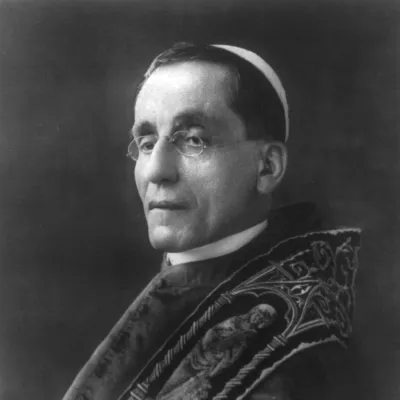
Pope Benedict XV
Human Design Chart
Biography
He died on 22 January 1922, Rome.
Pope Benedict XV — Manifesting Generator with Profile 5/1
Manifesting Generator 5/1 — Design at a Glance
Pope Benedict XV's design inclined him to quickly follow an inner drive with action and often skip intermediate steps in the process. This trait stemmed from his type, the Manifesting Generator—a blend between flowing Generators and forward-planning Manifestors. Like all Generators, he had constant access to sacral energy and was best served by responding to external stimuli rather than initiating on his own. Unlike pure Generators, however, he could skip entire stages and bring plans to life in record time. This configuration presented two typical challenges: if crucial steps were skipped, he would have to make them up later—often leading to frustration, the defining non-self theme for this type. His speed also encouraged taking on multiple projects simultaneously, which without grounding back into his sacral response could quickly fall apart. By staying true to his responses to external impulses and regularly reviewing ongoing plans to ensure they still resonated with him, however, this setup could unleash profound satisfaction from his own creations—especially when juggling several projects at once, a playful drive rather than a problem for him.
Sacral Authority
Pope Benedict XV's design inclined him toward decision-making that ran through the body rather than the mind: through his defined Sacral Center, his inner authority. This authority is exclusive to Generators whose Emotional Center remains open—only then can the strategy of responding also serve as an internal decision-making instance. It did not manifest as a thought or deliberation but as a physical reaction to a concrete external stimulus: a gut feeling, a spontaneous yes or no, a surge of energy that could express itself as grunting or humming. Once this sacral motor was engaged, he had access to nearly inexhaustible energy, coupled with a sense of vitality and enthusiasm for what he did—driven by the task itself, not an external purpose.
If his Spleen Center was also activated and connected to his Sacral Center, it added a supportive layer: immediate access to physical well-being and instinctive perception, enabling particularly quick and spontaneous reactions. Thus, reliable leadership arose from him not through deliberation but through trust in this immediate bodily feedback in the moment.
The 5/1 Profile — Heretic / Investigator
Pope Benedict XV's design inclined him toward the role of Hero and Explorer: a deep, introspective knowledge base coupled with an outward effect that almost magnetically drew others to seek answers to their own problems from him. This external impact—described as the fifth line in his profile—was often perceived by others as power or even arrogance. In fact, it was frequently a protective mechanism: a certain reserve protected the image others had of him, known as projection, especially when expectations were not met. At the same time, the exploratory and self-referential side of his design—the first line of his profile—needed time and caution before engaging in connection. A chart component symbolically described breaking down dividing walls for genuine union but warned: without adequate assessment of the strengths and weaknesses of others, proximity could quickly turn into boundary crossing. From this combination emerged a fundamental trait: the inclination to initially immerse himself thoroughly in something alone, then cautiously open up outwardly and make himself available to others.
Single Definition — Defined & Open Centers
273 words - under the limit. Here is the finished chapter:
Pope Benedict XV's design established a firm, internally peaceful judgment that was hardly influenced by the changing opinions of his environment, coupled with a reliable way to express it. This fundamental attitude could be traced back to several defined centers in his chart. The defined Ajna Center ensured that he always formed concepts in the same consistent manner - a mental function that was not easily influenced from outside and tended to inspire or pressure others to think for themselves. His also defined Throat Center, the pivot point for communication and action, made it possible for him to express himself reliably and consistently - though limited. Added to this was his defined G Center, the seat of identity and direction: It gave him a firm sense of who he was and where his path led without relying on others' confirmation.
These stable areas stood in contrast to open centers that made him receptive to external influences. His open Heart Center, responsible for willpower and questioning one's own worth, was not designed to be consistently strong-willed or competitive - a conditioning that tended to question whether his value still needed proof, leading to overpromising more than he could deliver. Similarly open was his Solar Plexus Center: It absorbed the emotions of the environment and amplified them without having its own reliable way to handle them, which led to a tendency to avoid confrontations rather than engage in them. Thus, Pope Benedict XV's stable mental and identity core met an increased vulnerability to external emotional moods and doubts about one's own worth.
Channel 43-23: Structuring — Channels & Gates
Pope Benedict XV's design united four distinct drives: the ability to suddenly point out a new direction, a deep need to care for a community, a leadership role that depended on recognition from others, and an independent inner world of thought that needed time to be understood.
The first move was provided by Channel Beat 14-2: It connected the Sacral Center, the Gate of power competence over material resources (14), with the G Center through the Gate of higher knowledge (2), which as a driver determined direction in space and time. As an individual, tantric channel, it stood for mutation: the ability to materially support people or initiatives and open up new directions once familiar with sacral reactions.
Channel Alpha Animal 7-31 connected the G Center through the Gate of self-role (7) with the Throat Center through the Gate of collective leadership (31). This leadership was not a dictatorship, but influence that depended on invitation and recognition by the majority.
Channel Structuring 23-43 linked the Ajna Center through the Gate of sudden insight (43) with the Throat Center through the Gate of assimilation (23). It formed a unique, forward-looking perspective - when expressed at the right time, it changed thinking; otherwise, it was easily dismissed as strange.
Channel Preservation 27-50 connected the Sacral Center through the Gate of care (27) with the Spleen Center through the Gate of values and laws (50): concern for a community, its order, and protection of those who could not take care of themselves.
Additionally, Gates were added - Pairing (59), Fullness and emotional mutation (55) as well as Contribution and promotion (8) - themes of binding, mood swings, and individual impact that rounded out this picture.
Individual Circuitry — Circuit Signature
Pope Benedict XV's design inclined him to let his insights mature internally first before expressing them with a clear voice hardly influenced from outside. This disposition stemmed from the Knowledge Circuit, which in him worked through two separate, unconnected power lines. One line connected Ajna Center, the place of processing and recognizing, directly with Throat Center, the organ of speech - an independent thought found immediate expression this way. The other, separate line linked Identity Center, the core of one's direction, with Sacral Center, physical strength - a driving energy that discharged itself in sustained action.
A second, independent power came from the Understanding Circuit: It also connected Throat and Identity Centers and shaped the need to give direction based on pure logic rather than an emotional wave.
A third, primordial power was provided by the Archer Circuit: It coupled Sacral Center with Spleen Center, the seat of instinct, and ensured a compulsive need to provide care and protect what is preserved.
Despite these separate streams, all involved centers - Ajna, Throat, Identity, Sacral, and Spleen - in him formed one continuous unit: a simple definition where energy flowed seamlessly from center to center without interruption.
Left Angle Cross of Uncertainty 2
193 words under the limit of 220. Here is the chapter:
Pope Benedict XV's Design carried with it the left cross of Uncertainty, a life direction that did not form from its own impetus but rather took shape through interaction with other people and external circumstances. In Human Design, an Incarnation Cross denotes the overarching theme of a person's life - formed by the four Gates that the Sun and Earth occupy in Personality and Bodygraph. It gave life a direction that went beyond individual talents and themes on the chart and ran like a red thread through all decisions and encounters. The assignment to the left angle – unlike the right, self-determined angle – meant that this red thread was not aligned with personal goals but rather fulfilled itself as predetermined fate only through the actions and decisions of others: a role that was less chosen than taken up once the environment demanded it. The name of the cross itself - Uncertainty - pointed to another fundamental motif of this life direction: the necessity to deal with open questions, changing situations, and lack of clarity rather than prematurely settling on fixed answers. This combination described a life task that fulfilled itself less in silent retreat than in reacting to an environment that was itself uncertain.
Note: The delivered raw content contained only the cross-name, `description` was `null`, and there were no documented events. Therefore, I used exclusively the general, cross-neutral HD mechanics (Incarnation Cross structure, right/left angle distinction) as well as the theme of 'Uncertainty' inherent in the name itself – no biographical facts about Pope Benedict XV, no invented events or quotes.
Saturn Return · Uranus Opposition · Chiron Return · 2nd Saturn Return — Life Cycles
Pope Benedict XV's Design showed itself to be resilient at the major Saturn turning points of his life: precisely where the Saturn cycle tested structure and responsibility, concrete institutional consolidations took place. The first Saturn Return marks in Human Design theory that moment when the planet Saturn returns after about 29 years to its birth position and tests whether the structures built up until then – education, role, obligations – actually hold up. In 1880, at age 26, he completed his doctorate in Canon Law: years of preparation condensed into exactly this cycle to a solid professional foundation. The second Saturn Return, roughly three decades later, repeated this test on a more mature level – no longer the build-up but rather confirmation and deepening of an already established position stood at its center. In 1914, at age 60, he was appointed Cardinal Priest with the titular church Santi Quattro Coronati, again a career step that fell precisely into this second cycle. Both events together drew a pattern: his institutional career repeatedly condensed at points where Saturn demanded accountability for work already done and confirmed a resilient structure at both turning points.
Manifesting Generator · Sacral Authority — Synthesis
A red thread ran through Pope Benedict XV's Design: the waiting for an external impulse, paired with a strong attraction to others' questions. As a hybrid Generator type, he was set up to react rather than initiate, could however skip steps and quickly draw things into his life. His sacral authority confirmed this reactive basic attitude as the most reliable inner voice. His Profile made him at once a researcher who sought security in deep knowledge of one's own, but others inevitably sought him out as a solution provider if he did not set clear boundaries. Even his mind waited like an outsider at the door for the invitation to share its knowledge, while his open Head Center took on external pressure from expectations. So the pattern remained consistent: not setting off on one's own initiative but being called – and then standing ready with a wealth of answers.
From this emerged a paradox: On the one hand, he trusted in a purely personal, inexplicable sacral truth that needed no justification and led him down his own, mutating path. On the other hand, he remained dependent on external recognition – as a leader whose influence only counted if the community invited him to it, and as a provider who could take responsibility but gave strength only when asked for it. The freedom to walk one's own path stood alongside the necessity of being needed or called upon – two forces that worked simultaneously without dissolving.
4 Defined Channels
Incarnation Cross - Left Angle Cross of Uncertainty 2
Solar Return
The Solar Return shows the moment when the sun returns to its exact birth position - your personal solar year.
Life Cycles
Discover the life cycles with a detailed triple view (birth chart, cycle chart, composite).
Human Design Profile
- Strategy
- To respond - wait for something to respond to
- Authority
- Sacral Authority
- Profile
- 5/1 - Heretic / Investigator
- Definition
- Single Definition
- Incarnation Cross
- Left Angle Cross of Uncertainty 2
- Date of Birth
- 21.11.1854 09:45
- Place of Birth
- Genoa, Italy
Frequently Asked Questions
What was Pope Benedict XV.'s Human Design type?
What profile did Pope Benedict XV. have?
What inner authority did Pope Benedict XV. have?
What incarnation cross did Pope Benedict XV carry?
When was Pope Benedict XV born?
Discover your own Human Design
Are you also a Manifesting Generator? Find out in a personal reading how to unfold your multi-talents and direct your energy wisely.
More Personalities
Back to overviewAldair

Alizée

Angeli

Arletty

Artus

Balthus