
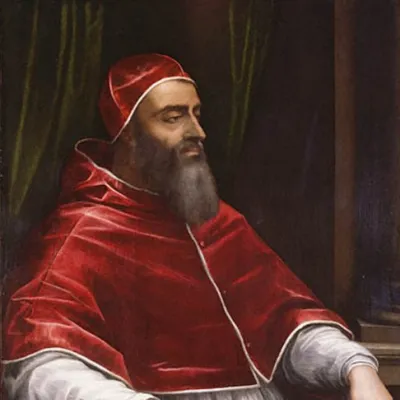
Pope Clement VII
Human Design Chart
Biography
What does Manifesting Generator 5/2 mean for Pope Clement VII?
Manifesting Generator 5/2 — Design at a Glance
Pope Clement VII revealed himself as someone carrying hybrid energy: the constant power of a Generator paired with the lightning-fast expression of a Manifestor. His design allowed him to skip steps and quickly draw things into his life. This speed was, however, a double-edged sword. Often, his initiatives were too quick, causing important intermediate steps to be missed. This forced him later to backtrack and make up for what was missing – a source of deep frustration as he worked against his inner rhythm. Additionally, Pope Clement VII tended to pursue multiple projects simultaneously, driven by many different impulses. Without strict adherence to his strategy, this multitasking ability quickly led to exhaustion rather than satisfaction. His path to contentment lay in not initiating himself but reacting to life. Only when his sacral center gave a clear "yes" did he begin to act. In this "play mode," where he sought variety and consulted his inner authority, Pope Clement VII found deep fulfillment in his work. His strength was not in linearly completing tasks but in the ability to work parallel as long as each action was based on an authentic impulse and he released the pressure of needing everything to be perfect immediately.
Emotional Authority
Pope Clement VII exhibited a decision-making structure characterized by emotional wave movements. His design featured Emotional Authority, meaning that the Emotional Center was defined and thus automatically took on its inner leadership role—regardless of which other Centers were also defined in his graph. This priority rule is a central mechanism: emotional truth always takes precedence over all other internal impulses.
His perception of the world was always colored by the current mood. At one moment, he could be enthusiastic about something, and in the next, view the same matter negatively. These fluctuations were not unreliability but rather the natural ebb and flow of his emotional energy. However, a first impression or sudden outburst of emotion did not yet represent his final truth. Quick, spontaneous decisions based on such a moment could prove misleading.
Instead, Pope Clement VII gained clarity through time. The longer he let a decision mature, the deeper he could understand the situation. This process required patience and consciously sleeping on important questions. Over time, intense emotions subsided, emotional distance grew, and calmness set in. Only then was the inner process complete and a well-founded decision possible. This method primarily served long-term life decisions that significantly shaped his future path.
The 5/2 Profile — Heretic / Hermit
Pope Clement VII appeared as someone who oscillated between the urge for public admiration and a deep need to withdraw. His Human-Design Profile 5/2 conveyed this tension: Line 5 projected the archetype of the hero, while Line 2 preferred hiding in a "cave" to develop undisturbed. As long as he was not discovered, Pope Clement VII worked hard on himself and used his alone time to prepare for a larger role. However, if he passively waited for others to recognize him as a hero, this often led to bitterness and frustration, since being a hero does not thrive in isolation.
The mechanics of his lines further clarified this dynamic. The fifth line from Gate 20 promoted realism and the perception of the full spectrum of beauty and ugliness, without mere observation automatically leading to success. Instead, it was about strengthening survival skills and the ability to help others recognize this duality. Parallel to this, Line 2 projected outward from Gate 37, where Pope Clement VII often underestimated his own abilities himself. This line emphasized individual responsibility within an organic community and a need for undisturbed work in spiritual structures. Since family values were less focused here, he had to earn belonging to find access to resources. Only when Pope Clement VII reviewed his own high expectations and ventured onto the "hero's platform" despite his withdrawal needs, was his presence appreciated by others – provided that he set clear boundaries for his necessary recovery time.
Single Definition — Defined & Open Centers
Pope Clement VII revealed himself through a consistent internal structure: His defined G Center gave him a firm sense of self-identity and clarity about his direction, while the defined Heart Center provided him with the willpower to keep promises and determine resources for himself. This combination marked him as someone who acted from a stable 'I' and communicated his truth easily – a characteristic of his defined Throat Center, which transmitted messages from the Heart and G Centers into the world. His energy source came from the defined Sacral Center, which granted him vital power provided he responded to external requests rather than initiating them; his defined Solar Plexus required emotional clarity before decisions were made.
At the same time, Pope Clement VII was vulnerable to mental confusion through his open Head and Ajna Centers. He tended to be influenced by others' doubts or seek answers that did not align with his nature instead of trusting his inner authority. His open Spleen Center made him sensitive to survival fears; he instinctively sought safety from others, risking unhealthy dependencies or spontaneous decisions that could harm him later on. This openness did not signify weakness but rather a mechanism of adaptation: He learned to observe fears without following them and used his defined centers as anchors in a world full of external mental and emotional stimuli.
Channels for rhythmic flow, powerful connection and community.
Pope Clement VII was characterized by a deep connection to the life flow and the ability to initiate new directions. His design carried the energy of Channel Beat 14-2, which linked the Sacral Center with the G Center. This configuration endowed him with the competence to handle material resources (Gate 14) to drive mutation and innovation, while Gate 2 acted as a driver through space and time. Thus, he could translate innovative impulses into material reality and give others a strengthening new direction through his aura by trusting reactions from his Sacral Center.
Parallelly, the Channel Rhythm 5-15 defined his approach to the world. Through fixed Gate 5 and extreme Gate 15, he was closely connected with the biological flow of life. His timing was guided by inner natural patterns unaffected by intellect or emotional waves. This allowed him to move effortlessly within the stream of existence and draw others into a continuous energy flow through his magnetic rhythm that propelled the community forward.
In interpersonal dynamics, the Channel Pairing 59-6 defined intimacy as a fusion of sexuality (Gate 59) and an emotional wave (Gate 6). Pope Clement VII had a natural sense for the depth of relationships and could dissolve emotional barriers through closeness and touch. However, his intensity required patience since the emotional wave determined the timing for true connection.
Furthermore, Channels Synthesis 19-49 and Charisma 34-20 shaped his actions. The former connected Root with Solar Plexus Centers (Gates 19 and 49) fostering a sensitive awareness of tribal belonging, loyalty, and balance between feasibility and fairness. The Channel of Charisma channeled raw sacral power (Gate 34) through the Throat Center (Gate 20), giving him the ability to act in the moment and sustain activities over longer periods if he listened to his inner guidance.
Individual Gates like Gate 33 Reflection in his personality promoted the process of withdrawal for memory reinforcement before new cycles. In his design, Gates 51 Willpower processed shocks while Gate 42 emphasized experience as a key to completing processes. Finally, Gate 29 represented persistence in saying 'yes' to life force, where false agreement could lead to blockages. Pope Clement VII lived these mechanisms through his trust in the natural flow and his ability to use resources for collective mutation.
Tribal Circuitry — Circuit Signature
Pope Clement VII was a person whose design was marked by a single, cohesive energetic structure. This simple definition united identity, life force, emotions, willpower, and expression into a closed system. Within this flow, several circuits worked parallel alongside each other.
The Knowledge Circuit connected his Identity with the Sacral Center through Channel 'Beat'. This created a pulsating, acoustic quality of individuality based on rhythmic expressions. Parallel to that, the Understanding Circuit also operated between identity and sacrum via Channel 'Rhythm'. Here, sharing logical, rational insights free from emotional influence promoted clear strategic thinking.
Another part was formed by the Ego Circuit connecting Heart, Solar Plexus, and Root Centers through Channels 'Community' (37-40) and 'Synthesis' (49-19). This focused on cooperation, mutual support, and the joint creation of resources. As there was no direct connection to the sacral center, this area required pauses for energy regeneration for the tribe.
The Protector Circuit linked Sacral with Solar Plexus Center through Channel 'Pairing' (59-6), bringing ancient energies of protection, care, and family preservation driven by instinctive reactions and strong emotions into play.
Finally, the Integration between Throat and Sacral Centers via Channel 'Charisma' (20-34) gained power from reacting to life and manifesting it acoustically and individually in the present moment, enabling high self-affirmation through immediate action. All these aspects flowed together in Pope Clement VII's design as a unified whole without separate or isolated energetic islands.
Left Angle Cross of Duality 1
Pope Clement VII was marked by the design of the left cross of duality, establishing a deep connection between his individual self and a larger collective unity. This configuration promoted the ability to understand and live personal experiences as part of a greater whole. His role was to make this synthesis of individuality and collectivity effective in his environment.
The left cross of duality emphasized the importance of relationships and interactions across different levels of existence – from the personal to the universal. It was not just about one's own well-being or the fulfillment of individual goals, but also how these were intertwined with the prosperity of others. For Pope Clement VII, this meant that his actions often went beyond purely personal benefit and instead aimed at harmonizing differing perspectives.
In this context, he showed himself to be someone striving to build bridges between seemingly opposing forces – whether within his own personality or in his relationships with other people. This inclination towards integration and balance helped him approach complex situations with a certain calmness, as he always saw them in the larger context.
Saturn Return · Uranus Opposition · Chiron Return — Life Cycles
Pope Clement VII's design laid a tendency toward internal tensions that intensified when confronted with external forces. His Chiron return, a fulfillment cycle between the ages of 49 and 51, marked a point where his incarnation cross – if he had lived according to his strategy and authority – should increasingly unfold in life. This period offered the possibility of making sense and purpose experiential.
In 1527, at age 49, Rome was conquered and plundered by imperial troops. This crisis revealed itself as a moment when his own design was put to a hard test. The external destruction contrasted with the internal challenge of recognizing and living out one's life mission. For Pope Clement VII, this was not a healing process in the traditional sense but rather a phase of proving oneself, during which his deepest values and goals crystallized. The experience of this crisis shaped his further actions and highlighted the necessity to remain true to himself to find his own path.
Manifesting Generator · Emotional Authority — Synthesis
Pope Clement VII acted influenced by an internal dynamic between initiation and reaction. As a Manifesting Generator, he possessed the ability to quickly set things in motion (Sakral Center defined, connection to Throat Center), yet simultaneously, his emotional authority required a maturing phase to make decisions from the depth of his feelings. This combination led him to potentially act swiftly but also needed time to weigh consequences – an interplay between impulsive energy and emotional deepening that characterized his style of action. The profile as Hero/Natural Talent reinforced this trait: he possessed hidden abilities that he could only fully unfold when he broke out of his inner reserve and put his gifts at the service of others.
A central paradox lay in Pope Clement VII's design being aligned with both individuality and connectedness. The Knowledge Circuit challenged him to walk his own path and advance innovations, while simultaneously the defined throat indicated that his communication and actions were influenced by external factors and interactions. This tension between the desire for autonomy and the necessity of engaging with the world shaped his decisions – especially in times of crisis (documented event 1527), when it was about considering both one's own interests as well as the welfare of others.
6 Defined Channels
Incarnation Cross - Left Angle Cross of Duality 1
Solar Return
The Solar Return shows the moment when the sun returns to its exact birth position - your personal solar year.
Life Cycles
Discover the life cycles with a detailed triple view (birth chart, cycle chart, composite).
Human Design Profile
- Strategy
- To respond - wait for something to respond to
- Authority
- Emotional Authority
- Profile
- 5/2 - Heretic / Hermit
- Definition
- Single Definition
- Incarnation Cross
- Left Angle Cross of Duality 1
- Date of Birth
- 26.05.1478 13:57
- Place of Birth
- Firenze, Italy
Frequently Asked Questions
What was the Human Design type of Pope Clement VII?
Which profile did Pope Clement VII have?
What authority guided Pope Clement VII?
What incarnation cross did Pope Clement VII have?
When was Pope Clement VII born?
Discover your own Human Design
Are you also a Manifesting Generator? Find out in a personal reading how to unfold your multi-talents and direct your energy wisely.
More Personalities
Back to overviewAldair

Alizée

Angeli

Arletty

Artus

Balthus
