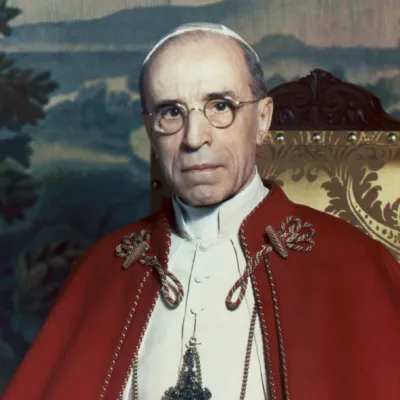
Pope Pius XII
Human Design Chart
Biography
Born into a family devoted to the papal service, Pacelli worked so hard at the Capranica Seminary that his health gave way and he was forced to leave. Pope Leo XIII allowed him to live at home while completing his courses and he was ordained in 1899. He began his career with a combination of parish work and professional study taking a degree in Canon and Civil Law at the Apollinaris. Taken into the department of state by Cardinal Rampolla, Pius X made him a monsignor and set him to work re-codifying canon law.
In 1917 during World War I, involved in humane efforts, he was sent to Munich to the Kaiser. Pacelli was sent to Berlin to be its first nuncio, papal ambassador, 1919. He left Germany in 1929 to be made cardinal and in 1930 he was made secretary of state for the Vatican. His five-point peace program was presented on 24 December 1939.
He was crowned Pope Pius XII on 12 March 1939. At the beginning of World War II he spoke out against the Nazis, helped Jews with false baptismal certificates, allowed thousands to stay in Vatican City, convents and cloisters. Many pled with him not to make public denouncements, as it would hurt them. More a diplomatic peacemaker than a martyr, he was accused of not doing enough to stop the Holocaust in a play, "The Deputy," by Rolf Hochhuth in February 1963. John Cornwell in his scathing biography "Hitler's Pope," 1999, dredges up anecdotal stories purporting the Pontiff's anti-Semitism, not upheld by historian Father Pierre Blet, one of four Jesuits who compiled the official 12-volume record of Pius' was years from Vatican archives. Blet also put out a new book in 1999, "Pius XII and the Second World War," in which he maintains that the 1933 pact was "practically imposed by Hitler.
Pope Pius XII as a Manifesting Generator 2/4 in Human Design
Manifesting Generator 2/4 — Design at a Glance
Pope Pius XII's design showed a fundamental tension between stability and impulsiveness: a constantly available, self-renewing work energy that could also skip steps and bring things to life in an instant. As a Manifesting Generator (MG), he combined two principles usually separate in the Human Design system - Generator and Manifestor. With his active, defined sacral center, he had the same constant driving force at his disposal as a generator, with the same basic rule: not to initiate himself but to react to what was brought to him from outside, and only act when inner consent was palpable. The additional connection to the throat center gave him, however, a property that pure generators lacked: the ability to skip intermediate steps and quickly implement plans as soon as the sacral energy approved.
This configuration also harbored a typical danger: if important steps were skipped, they had to be caught up later, which easily turned into frustration - the non-self theme characteristic of MGs. Similarly, this design tended to trigger several projects simultaneously rather than completing one after another. However, from this speed could emerge a deep, playful creative power that worked on various tasks in parallel without getting distracted.
Emotional Authority
Pope Pius XII's design inclined him not to make decisions based on the first impulse but to let them ripen over time. His inner authority lay in his defined solar plexus center, the emotional center - and this center always carries authority as soon as it is defined, regardless of what else is defined in the chart. Clarity for him thus arose neither from the head nor from a spontaneous gut feeling but exclusively through the emotional wave.
This wave manifested as an ongoing mood swing that colored the world differently each time: The same thing could evoke enthusiasm at one moment and rejection the next. The impression of the moment was only a snapshot, not a reliable truth - quick decisions made out of emotion could accordingly have negative consequences.
For him this meant: Only after a decision had been mulled over several times did he gain emotional distance, intense feelings subsided, and clarity and calmness took their place. Only then was the process complete and a decision viable - especially for those with far-reaching influence on his life course, where patience rather than quick pushiness was necessary.
The 2/4 Profile — Hermit / Opportunist
Pius XII's design carried an inherent tension between two needs from its very foundation: the desire to withdraw and the desire for familiar company. His Profile 2/4 - in Human Design language known as 'Natural Talent/Networker' - describes this pendulum swing precisely: Line 2 stands for the hermit who finds his clarity only in solitude, line 4 for the person who then brings their knowledge into a circle of familiar people. For Pius XII this meant: Phases where he withdrew to organize his own thoughts alternated with phases where he turned again to a closer circle.
The withdrawal side of this pattern was reinforced by Gate 63 on the second line: This position describes someone who makes their own questions and doubts the starting point of their thinking, but retains control over the process in their own hands and prefers to delegate the answering of open questions to others rather than formulating them themselves.
The network side showed itself in Pius XII's insistence on his own rhythm: The fourth line stands in Human Design teaching for persistence and effectiveness through holding onto one's own pace, combined with the readiness to wait for the right moment instead of acting prematurely.
Split Definition — Defined & Open Centers
Pope Pius XII's Human Design shows a tendency towards a firmly established stance with several defined centers. The Head Center and Ajna Center were both defined, indicating an internal pressure to question and understand things deeply, coupled with a strong personal way of thinking that was not easily influenced by others. This drive pushed him to share his insights but the mechanics did not assign immediate implementation power to these two centers - clarity had to wait for the right moment and receptive listeners.
The Solar Plexus Center was also defined, forming an inner authority: emotions and moods served as a measure of what was correct, though only after experiencing a full emotional wave from peak to trough. Clarity never arrived instantly but always with some delay. Additionally, his G Center was defined, the seat of identity and life direction: a strong sense of who he was and where his path led, independent of others' support.
Two centers remained open for him: the Spleen Center, which exposed him to fundamental fears from the environment and made spontaneous decisions out of fear rather than clear personal insight. The Root Center, also open, absorbed adrenalized stress and chaos from the surroundings without providing a reliable source of when urgency was truly necessary.
Channel 25-51: Initiation — Channels & Gates
Pope Pius XII's design shows a personality that values tested evidence over blind faith, driven by strong inner motivation and competitive energy - visible in several firmly connected lines on his chart. The most prominent is Channel 63-4: connecting the Gate of Doubt and the Gate of Formulation, it describes a mind constantly testing patterns for consistency, accepting answers only when proven reliable.
Channel 34-10 connects the Gate of Power with the Gate of Self Behavior: acting from inner conviction, following one's own beliefs regardless of external judgment.
Channel 43-23 links the Gate of Insight and the Gate of Assimilation: sudden breakthroughs in thinking are translated into understandable language - a process requiring time and multiple attempts.
With Channel 51-25, his design includes competitive energy pushing for breakthroughs from the Shock Gate, combined with the Self Mind Gate's ability to appreciate both animate and inanimate things equally.
Channel 36-35 adds an emotional, restless note: connecting Crisis and Change Gates, it creates a pull towards new experiences that resist rigid patterns.
Additionally, individual gates played roles: Gate 64 brings clarity after confusion over past experiences, Gate 5 steady rhythm, Gate 46 dedication to the moment, Gate 16 mastery through practice, Gate 13 memory preservation, Gate 27 caring warmth, Gate 7 leadership claim. Gate 17 connects doubt with order demands, Gate 49 loyalty to principles, Gate 55 fluctuating moods, Gate 3 need for new order.
Individual Circuitry — Circuit Signature
213 words within the limit. Here is the chapter:
Pope Pius XII's design shows a continuous connection from perception through thinking to spoken word while his self-worth and inner beliefs stemmed from an independent field. This split corresponds to the so-called 'Split Definition': two areas firmly connected internally but not linked by a common channel, existing side-by-side.
The first area spans Head, Ajna, Throat, and Solar Plexus Centers, carried by three circuits. The Understanding Circuit connects Head and Ajna for cool logical insights wanting to be shared. The Knowledge Circuit leads from Ajna to Throat Center, driving the urge to express personal insights through words. Finally, the Meaning-Finding Circuit links Throat and Solar Plexus: past experiences and emotions wanted wave-like processing and sharing.
Separately exists the second area: Identity, Heart, and Sacral Centers (seat of physical life force), connected by the Centering Circuit - Channel 'Exploration' and 'Initiation'. This connection represents a strong individual orientation with firm personal beliefs closely tied to self-worth but without Throat Center linkage, preventing external expression through this route.
Right Angle Cross of Consciousness 1
Pope Pius XII's Design indicates a tendency to determine one's own path from within oneself without aligning with others' expectations or life themes. This fundamental orientation stems from belonging to a right cross - in the Human-Design system, one of three major cross categories that describe whose life a person actually lives. While a left cross places a person more into service for their environment or a larger, transpersonal context, a right cross describes a life led from one's own center: one's own drive, pace, and direction are in the foreground, not fulfilling others' expectations. For Pope Pius XII, this right cross also carried the theme of Consciousness in the name - an indication that this life theme was less about external action than perception, understanding, and becoming aware of connections. Where other cross themes tend to be oriented towards visible impact or interpersonal connection, this cross focused more inward: on what a person became aware of before carrying it outward. For Pope Pius XII, this meant a direction in life that was less driven by external roles and more by his own, self-imposed way of perceiving.
Saturn Return · Uranus Opposition · Chiron Return · 2nd Saturn Return — Life Cycles
190 words, within the limit. Here is the chapter:
Pius XII's Design indicated a tendency to take significant career steps precisely during the major development windows of his life - a recurrence that was evident in his career four times. In 1903, at age 27, Pacelli became minutant in the Congregation for Extraordinary Ecclesiastical Affairs - the first Saturn Return, where previous education condensed into a credible institutional position for the first time. In 1917, at age 41, he was appointed Nuncio to Munich and consecrated as Titular Archbishop of Sardes: the Uranus Opposition, a cycle in which people typically break free from previous paths and take a more independent route - for him, the step from curial work into an independently responsible diplomatic position. In 1925, at age 49, he moved his office to the new palace of the Reichnunciature in Berlin-Tiergarten - the Chiron Return, that cycle where life themes increasingly unfold and take visible form if lived according to one's own strategy and authority over previous decades. In 1933, at age 57, he signed the Concordat with Austria and the Reichskoncordat with the Nazi government - the second Saturn Return, where long-term built authority fused into lasting, written results.
Manifesting Generator · Emotional Authority — Synthesis
A recurring pattern ran through Pius XII: first doubt and wait, then respond. As a Manifestor Generator, he should not initiate but react, and although his speed allowed him to skip steps, frustration threatened if he did not check whether his sacral yes truly carried weight. His emotional authority confirmed this: the first impression was never the truth; clarity only set in once the wave of feeling had subsided. In his Profile, the same need showed for withdrawal and posing personal questions before, following his rhythm, moving back into community. Also, the mental pressure from his defined Head and Ajna Centers drove him to constantly question while waiting for the right moment.
At the same time, two forces stood side by side in his Design without being immediately connected. From Head, Ajna, Throat, and Solar Plexus spoke a vigilant, doubting, restless instance seeking experience whose skepticism only transformed into certainty through lived experience. Carried by Sacral, Heart, and Identity Centers rested a firm, fortified conviction of self-worth and direction - bold, independent, fully within oneself. Yet this second force lacked its own access to voice; its silent certainty often remained unspoken while the other instance actually spoke and acted. So in him lived an unwavering inner certainty alongside a persistently doubting, outwardly stepping voice - two forces present simultaneously but not coupled.
5 Defined Channels
Incarnation Cross - Right Angle Cross of Consciousness 1
Solar Return
The Solar Return shows the moment when the sun returns to its exact birth position - your personal solar year.
Life Cycles
Discover the life cycles with a detailed triple view (birth chart, cycle chart, composite).
Human Design Profile
- Strategy
- To respond - wait for something to respond to
- Authority
- Emotional Authority
- Profile
- 2/4 - Hermit / Opportunist
- Definition
- Split Definition
- Incarnation Cross
- Right Angle Cross of Consciousness 1
- Date of Birth
- 02.03.1876 22:30
- Place of Birth
- Rome, Italy
Frequently Asked Questions
What was Pope Pius XII's Human Design type?
What Profile did Pope Pius XII have?
What inner authority did Pope Pius XII have?
What incarnation cross did Pope Pius XII have?
When was Pope Pius XII born?
Discover your own Human Design
Are you also a Manifesting Generator? Find out in a personal reading how to unfold your multi-talents and direct your energy wisely.
More Personalities
Back to overviewAlain-Fournier
Aldair

Alizée

Angeli

Arletty

Artus