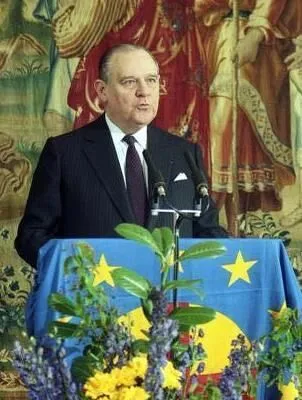
Raymond Barre
Human Design Chart
Biography
Raymond Barre died on 25 August 2007 at age 83 at the Val-de-Grâce military hospital in Paris, where he was taken care for heart problems since his transfer from a hospital in Monaco on 11 April 2007.
What does Generator 2/4 mean for Raymond Barre?
Generator 2/4 — Design at a Glance
Raymond Barres Human Design showed a tendency towards high endurance and a foundation of sacral energy. As a Generator, he had the potential to make things in his life effective, but not through spontaneous initiatives, rather by reacting to inner impulses. His efficiency depended on whether he responded to signals from his environment and his Sacral Center gave a clear “yes” – an instinctive feeling in his gut that urged him into action.
This reactive principle was crucial for his energy balance. If Raymond Barre took on tasks that did not trigger this internal approval signal, he wasted his energy and tended towards exhaustion or burnout. Conversely, his design suffered when external circumstances prevented him from continuing projects for which he still felt full enthusiasm. Both scenarios – forcing himself to do things he disliked or suppressing his heart project – led to frustration and a noticeable lack of energy.
However, if Raymond Barre lived in harmony with this strategy by waiting until an impulse reached him and then acting upon it, deep satisfaction was evident. This inner fulfillment was the direct reward for trusting his own energy source. His success thus rested less on the will to initiate things than on the ability to respond correctly when life called. Through this alignment, he could unfold his full potential without enduring prolonged frustration.
Emotional Authority
Raymond Barre showed a decision-making stance that required time and distance from emotional waves; spontaneous impulses were unreliable in his design, true clarity only emerged after the mood had subsided. This resulted from his emotional authority: Since his Emotional Center was defined, it functioned as an internal guiding force independent of other defined centers in the chart. He was subject to a constant emotional wave with rising and falling phases of feeling. The world appeared colored by the current mood – sometimes enthusiastic, sometimes negative. An immediate judgment was merely a snapshot, not necessarily his truth. Quick decisions from this position could have negative consequences.
The mechanics required patience: The longer Raymond Barre let a decision ripen, the deeper and more comprehensive he could see. This meant consciously “sleeping on” important questions to separate momentary mood coloring from the deeper truth. He should take time and ask multiple times. Over time, intense feelings subsided, emotional distance grew, and calmness set in. Only then had he gone through the process. This cycle was particularly relevant for long-term decisions that significantly influenced his life course. Through waiting, he gained the necessary objectivity to not be misled by temporary emotional coloring.
The 2/4 Profile — Hermit / Opportunist
Raymond Barre lived in a cyclical rhythm between the need for isolated self-reflection and integration into a familiar network. His design as Profile 2/4, the Natural Talent-Networker Profile, shaped this tension: He constantly oscillated between the desire to be alone (Line 2) and the longing to spend time with close confidants (Line 4). For him, it was crucial to create a safe environment where he could clearly communicate when he sought company and when he needed withdrawal. In his “Me-Time,” Raymond Barre immersed himself in internal processes, found peace, and clarified his thoughts. Once this need was satisfied, he emerged from his “cave” to nurture his network. This shift allowed him to reflect on the knowledge of his surroundings in solitude, evaluate it, and develop new ideas from it. Line 2 promoted independence and selectivity but also carried the risk of projecting competence outward without fully possessing it internally. Simultaneously, he sought change and new trends. On the side of Line 4, his focus lay on exploration and integration through collaboration. Here, there was a risk that his own knowledge could be taken in unexpected directions by others, which could feel like losing control. Raymond Barre thus showed himself to be someone who sought balance between ascetic withdrawal for deepening and social exchange for inspiration, connecting his individual insights with the community without losing his own influence.
Split Definition — Defined & Open Centers
Raymond Barres Design established a tendency towards constant internal pressure, resulting from a persistent mental process (defined Head and Ajna Centers) as well as a reliable vital energy source (defined Sacral Center). This configuration generated a permanent drive to question and understand, coupled with the necessity of finding satisfaction through reacting to external impulses rather than initiating actions on his own. His emotional depth (defined Solar Plexus Center) required waiting for waves to gain clarity, while spontaneous intuitions (defined Spleen Center) and a set approach to stress management (defined Root Center) shaped his present moment actions.
The challenge lay in not alleviating this internal pressure through hasty action or mental control. Instead, trust in strategy and inner authority was crucial: Accepting the mental pressure without wanting to implement it immediately, waiting for the sacral response rather than initiating, waiting for emotional clarity, and trusting spontaneous intuition.
At the same time, Raymond Barre showed vulnerability to conditioning in his open centers. His open Throat Center tended to feel pressured to demand attention through speaking or acting instead of waiting for natural invitations. The open G Center led him to adopt identity and direction from the environment, which could cause confusion if he found himself in the wrong place. Additionally, his open Heart Center made him susceptible to trying to prove his worth through promises or competition, despite lacking the consistent energy needed for such efforts. These open areas made him sensitive to external influences and required a conscious distancing from non-self-generated impulses to effectively utilize his defined structure.
Channels for maturation, logic, awareness, transformation and emotion.
Raymond Barre revealed himself through a deep connection with the process of experiencing, concluding, and reflecting. His design suggested that he gained wisdom not through abstract theory but by fully living out life cycles. This attitude was primarily shaped by the Maturity Channel 53-42. This mechanism requires that every experience be lived to its conclusion before one looks back and translates the insights gained into information for others. Without this closure, there was a threat of cycle repetition; with it, collective history emerged.
Alongside this cyclical depth, the Logic Channel 63-4 influenced him. It connected the Head Center with the Ajna Center, fostering an intellect that worked through healthy skepticism. This was not about blind faith but filtering patterns and only accepting answers proven to be consistent and verifiable. This skepticism served to provide reliable predictions for the collective.
Parallel to this, the Channel of Awareness 61-24 activated a capacity for sudden insight. This channel transformed the pressure to know the unknown into rational answers through inspiration. It was an individual thinking process that did not rely on discovery but rather on processing auditory inspiration until a moment of "knowing" occurred.
Furthermore, the Transformation Channel 54-32 propelled him forward with ambition and the desire for social recognition. Driven by the fear of tribal or systemic failure, he sought ways to use his talents and move up to secure continuity and prosperity.
Emotionally, the Channel of Emotional Release 39-55 marked him. It brought a natural moodiness, a wave between joy and melancholy that he had to live authentically rather than rationalize in order to express his spiritual depth.
Additionally, Gates like Gate 62 (Detail Work), Gate 30 (Feeling Recognition), and Gate 14 (Power and Direction Finding) complemented his actions through patience, emotional intuition, and skilled leadership.
Collective Circuitry — Circuit Signature
Raymond Barres Design presented itself through a Split Definition, showing two separate energetic streams: one on the left side for mental impulses and one on the right side for emotional and physical processing. This separation created an internal tension between impulsive insights and wave-like reflection.
The Knowledge Circuit formed here into two isolated segments. The first connected Head and Ajna Centers, generating spontaneous, creative flashes of insight. The second segment included Solar Plexus and Root Centers; this produced emotional waves that were not directly linked to the mind. Simultaneously, the Understanding Circuit also operated only through Head and Ajna Centers, developing logical strategies from these mental impulses without direct emotional influence from the Solar Plexus Center in this specific Channel.
On the right side, the Meaning Circuit processed experiences cyclically. It connected Sacral and Root Centers directly, allowing for a deep, physical reflection of past events. This emotional wave was separated from the mental impulses on the left. Finally, the Ego Circuit through the connection of Spleen and Root Centers provided intuitive resource finding and transformation in the realm of survival instinct.
Raymond Barre thus moved between the pulsating, acoustic format of mental creativity on the left and the cyclical, visual format of emotional meaning-making on the right. The Split Definition meant that these forces did not work as a continuous flow but rather as parallel, sometimes competing energies, each setting its own focus in his life path.
Right Angle Cross of Maya 1
Raymond Barre's Human Design profile featured the archetypal structure of the Right Cross of the Maya. This configuration determined a fundamental stance that was not characterized by external adaptation or mere reaction to circumstances, but rather by an inner, often silent constancy. The Right Cross of the Maya represents a deep connection to a higher truth or spiritual law that exists independently of human opinions or temporal pressures. For Raymond Barre, this meant that his life energy was aligned with embodying and preserving this unshakable reality, even if it wasn't immediately understood by his surroundings.
The mechanics of this cross do not describe an active search for change through external actions but rather a passive yet powerful emanation of stability. It is about the ability to be a fixed point amidst chaos or uncertainty, one that others can orient themselves towards. Raymond Barre thus showed himself as someone whose authority did not stem from loudness or dominance, but from the unshakeable certainty of an inner truth. This structure demanded patience and trust in the transformative power of his mere presence without needing to actively direct it. It was a path of silent dedication to the law that his design followed, making him a symbol of constancy that transcended individual events.
Saturn Return · Uranus Opposition · Chiron Return · 2nd Saturn Return — Life Cycles
Raymond Barre's Human Design profile indicated a tendency towards strategic turning points manifesting through concrete institutional foundations and political representation. His Chiron Return, a cycle of fulfillment and blooming of the incarnation purpose, was evident in 1971 at age 47 when he initiated the World Economic Forum in Davos. This was no mere coincidence but an expression of a life phase where his deeper design intention increasingly unfolded into tangible life experiences.
Later came the second Saturn Return, often associated with consolidation of responsibility and structure. In 1981 at age 57, Raymond Barre entered a new political role: representing the fourth constituency of the Department Rhône in the National Assembly. This event underscores the mechanics of his chart where later life phases were marked by clear representative functions. The sequence of foundation (1971) and representation (1981) illustrates how his inner architecture reflected in external career steps. Without relying on external biographies, it becomes evident that these cycles formed central pillars of his public effectiveness.
Generator · Emotional Authority — Synthesis
Raymond Barre was characterized by a deep, cyclical processing of experiences (Channel 53-42), enabling him to gather knowledge and make it usable for others. This ability to mature, coupled with logical thinking (Channel 63-4) and an acute awareness of details (Gate 9), created a continuous thread of analysis and understanding. He was not primarily an initiator but reacted to impulses (sacral energy) to thoughtfully process them and formulate conclusions – a work style evident in his engagement for international forums. His strength lay in recognizing patterns, filtering information, and deriving grounded insights always in service of a larger community.
The central paradox was the tension between his emotional authority and the need for logical clarity (Channel 63-4). While his emotional wave led him into profound processes, his mind pushed for rational analysis and structuring. This interplay generated a dynamic tension between intuition and intellect that enabled complex decisions but also posed an inner dilemma – the quest for certainty in a world of emotional fluctuation.
5 Defined Channels
Incarnation Cross - Right Angle Cross of Maya 1
Solar Return
The Solar Return shows the moment when the sun returns to its exact birth position - your personal solar year.
Life Cycles
Discover the life cycles with a detailed triple view (birth chart, cycle chart, composite).
Human Design Profile
- Type
- Generator
- Strategy
- To respond - wait for something to respond to
- Authority
- Emotional Authority
- Profile
- 2/4 - Hermit / Opportunist
- Definition
- Split Definition
- Incarnation Cross
- Right Angle Cross of Maya 1
- Date of Birth
- 12.04.1924 06:30
- Place of Birth
- Saint-Denis, Reunion
Frequently Asked Questions
What is Raymond Barre's Human Design type?
What Profile did Raymond Barre have in Human Design?
Which authority guided Raymond Barre?
What incarnation cross did Raymond Barre have?
When was Raymond Barre born?
Discover your own Human Design
Are you also a Generator? Find out in a personal reading how to use your sacral energy correctly and discover deep satisfaction.
More Personalities
Back to overviewAaliyah

Alexia

Angèle

Anne-Marie

Arcángel

Arno