Reinhard von Koenig-Fachsenfeld
Human Design Chart
Biography
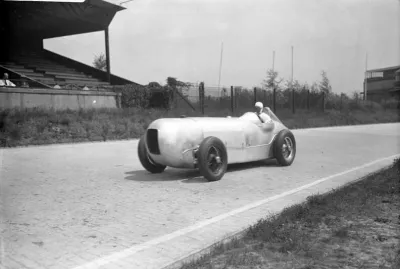
He designed a whole range of racing, record and test vehicles plus streamlined bodies for limousines which were placed on the chassis of renowned manufacturers. His greatest success was the streamlined Mercedes SSKL, which was manufactured by the vehicle bodybuilder Vetter in Cannstatt. With this vehicle Manfred von Brauchitsch won at the AVUS in Berlin in 1932.
In 1982 Freiherr Reinhard von Koenig-Fachsenfeld founded the Schloss Fachsenfeld Foundation. This permanent exhibition at Schloss Fachsenfeld gives an insight into his fundamental work in the field of vehicle aerodynamics.
Reinhard von Koenig-Fachsenfeld died on 9 March 1992 at age 92.
Reinhard von Koenig-Fachsenfeld as a Generator 1/3 in Human Design
Generator 1/3 — Design at a Glance
Reinhard von Koenig-Fachsenfeld's design indicated a tendency towards great endurance and inner strength. As a Generator, he had plenty of sacral energy, which made him extremely strong and resilient—provided this energy was used for tasks that truly mattered to him. His life path was characterized by the principle of reaction rather than initiation. The effective use of his power did not come from independently initiating projects but through reacting to signals from his environment and then acting when his inner self gave a clear "yes."
This mechanism was crucial for his satisfaction: When he acted in harmony with these impulsive responses, he experienced deep fulfillment and could hardly be stopped. However, if he went against this nature—such as by initiating things he had no interest in or being prevented from continuing work on his heart project—it quickly led to frustration or a lack of energy. The risk of burnout lurked where he wasted his resources on foreign interests or blocked himself despite still having power available. His design thus demanded a consistent orientation towards gut feelings: Only by reacting to real impulses could he unleash his full potential and have a lasting impact without falling into exhaustion.
Sacral Authority
Reinhard von Koenig-Fachsenfeld's design inclined towards a direct, physically anchored decision-making process. As a Generator, his strategy was identical to his inner authority: the Sacral Authority. This configuration simplified his process as he did not need to switch between external action and internal feeling. A prerequisite for this was an open Emotional Center, meaning that he relied on his body's immediate reaction rather than waiting for fluctuating moods.
His inner guidance manifested as a "gut feeling" or surge of energy triggered by external stimuli. He learned to pay attention to physical signals like grunting or a confirming "mm-hm." When his Sacral Motor engaged, he felt vital and had inexhaustible energy. This enabled him to dive into activities with great enthusiasm, free from constant purposefulness. His design predisposed him to live joyfully and contentedly by fully immersing himself in his tasks.
Additionally, an activated Spleen Center acted as a supporting authority. This gave him the ability to react particularly quickly and spontaneously. He had direct access to his instinctive well-being and was reliably guided by this physical perception. The combination of Sacral energy and spleen-supported intuition allowed Reinhard von Koenig-Fachsenfeld to make decisions in an instant, based on a deep, bodily resonance with his environment.
The 1/3 Profile — Investigator / Martyr
Reinhard von Koenig-Fachsenfeld revealed himself through his Profile 1/3 as someone whose life path was strongly shaped by the principle of "trial and error." As both a researcher and experimenter, he combined a deep desire for theoretical knowledge with the practical urge to test this knowledge through action. This configuration meant that his judgments and insights were only considered trustworthy if they were both intellectually grounded and tested in reality.
The energy of Line 1 drove him to always want to learn more, which sometimes led him to hesitate because he felt he did not know enough yet. However, Line 3 challenged him to overcome this theoretical preparation through concrete experiments and mistakes. Self-discovered insights were thus his core theme; he had to experience things himself in order to truly understand them.
Additionally, specific energies like Gate 25 influenced him, which stands for spontaneous, selfless action without hidden motives. This connected with the challenge of staying centred despite possible uncertainties or a desire for attention (Line 3 themes). His design suggested that he found his truth through personal experiences and overcoming obstacles, where martyrdom or adapting to external circumstances could be part of this learning process. His authority was not based on mere theory but on proven practical experience.
Single Definition — Defined & Open Centers
Reinhard von Koenig-Fachsenfeld revealed himself through a firm, unshakeable self-identity and a clear sense of direction. His defined G Center gave him the ability to be loved without dependency, as well as the strength to show others new paths. This inner security was connected with his pronounced willpower: The defined Heart Center allowed him to keep promises and control resources autonomously. He enjoyed working independently, followed his internal rhythm of activity and rest, and applied his energy where he deemed it appropriate.
His actions were driven by an enormous vital force. His defined Sacral Center generated daily energy that was only available upon a positive reaction to invitations. Reinhard von Koenig-Fachsenfeld lived this reactive strategy; he did not initiate but waited for life to speak to him before acting with full strength and persistence. This was supported by the constant pressure of his defined Root Center, which helped him master existential challenges and establish himself in the material world.
At the same time, he was vulnerable to mental confusion. His open Head and Ajna Centers meant that he did not have a consistent source for inspiration or logical concepts. He tended to engage with others' questions or seek answers that were not actually his own, which could draw him into a whirlpool of doubts. Emotionally, he was also open: The undefined Solar Plexus Center absorbed and amplified the moods of his environment, putting him at risk of personalizing foreign emotions and feeling overwhelmed by them.
In communication, his open Throat Center showed spontaneity without consistent control; he spoke when invited, not out of a compulsion to demand attention. Finally, his open Spleen Center was vulnerable to survival fears and spontaneous impulses. He had to learn to distance himself from others' false security and avoid impulsive decisions that could distort his own health and intuition through conditioning.
Channels for pioneering spirit, rhythm, focus and self-acceptance.
Reinhard von Koenig-Fachsenfeld revealed himself as someone whose life was characterized by a deep inner pulse and the ability to immerse himself with unwavering dedication in processes. His design tended towards drawing others into his own energy flow through authentic self-confidence and almost magnetic presence, always waiting for the correct reaction from his Sacral energy.
This dynamic connection between biological rhythm and universal attraction was enabled by the Rhythm Channel 5-15. This channel connected his Sacral Center with the G Center, ensuring that he was carried forward by the flow of life. He held onto firm habits (Gate 5) while simultaneously integrating the diversity of society into his personal stream (Gate 15). This gave him an intuitive timing that felt effortless as long as he did not act against his own reactions.
Parallel to this, Reinhard von Koenig-Fachsenfeld possessed a remarkable ability for focused detail work. The Concentration Channel 52-9 connected his Root Center with the Sacral Center and created a steady pressure to remain still and avoid distractions. This format energy allowed him to focus on facts and patterns to perfect them without being distracted by external disturbances.
Additionally, his personality was marked by the Research Channel 10-34 through deep self-love and independence. He followed his own convictions (Gate 34) and initiated behavior from his deepest inner self (Gate 10), helping him accept himself and carry this authenticity outward.
In personal qualities, he also displayed the characteristics of the Initiation Gate 51-25, which combined natural competitiveness with universal love, as well as the Experience Gate 46, demanding full dedication and presence in the here and now. This combination of rhythm, concentration, and self-determined research formed his unique path through life.
Individual Circuitry — Circuit Signature
Reinhard von Koenig-Fachsenfeld revealed himself as a person with a firm inner core and strategic outlook. His simple definition connected Sacral, Identity, and Heart Centers directly to the Root Center, generating coherent, continuous energy. The Focusing Circuit linked the central centers: Identity, Heart, and Sacrum. This gave him an individualistic stance; he was bold in his convictions and encouraged others to live their own individuality. However, these firm values often remained unspoken due to the absence of a Throat Center. Parallel, the Understanding Circuit connected Identity, Sacrum, and Root with logical structure. Here it was about rational insight and strategic planning for the future, free from emotional influence through the Solar Plexus Center. Both circuits colored his entire design: The pulsating creativity of Focusing met the focused, visual logic of Understanding. Thus emerged a person who combined inner values with outer strategy – not through loud proclamation but through structured action and sharing clear, rational insights. His energy was neither outwardly directed nor emotionally charged, but purposefully aimed at improving structures and strengthening individual identities within a logical framework.
Right Angle Cross of the Vessel of Love 1
Reinhard von Koenig-Fachsenfeld's Human Design profile featured a specific configuration known as the 'right cross of the vessel of love.' This structure shaped his inner orientation towards a profound, often painful dedication to life and other people. In Human Design terms, this pattern describes a paradoxical dynamic: it grants an intense sense of beauty and meaning in existence but binds this experience inseparably with the awareness of loss and impermanence. Those who carried this configuration knew love not only as joy but also as a source of great vulnerability.
For Reinhard von Koenig-Fachsenfeld, this meant living a life where experiencing depth and intensity was central. The mechanics of this cross indicate that true fulfillment often came through accepting the path of suffering. It wasn't about passive martyrdom but rather a conscious way to transform one's experiences—both bright and dark sides—into something meaningful. This energy fostered a kind of wisdom that could only arise from directly experiencing and carrying emotional burdens. His design suggested he saw his role in integrating these complex feelings and making them fruitful for himself and his environment, rather than avoiding them.
Saturn Return · Uranus Opposition · Chiron Return · 2nd Saturn Return — Life Cycles
Reinhard von Koenig-Fachsenfeld's Human Design profile indicated a tendency towards structured, goal-oriented action. The first Saturn Return marks the transition from youth to adult responsibility; here, years of groundwork often solidified into tangible results. In 1924, at age 25, Reinhard von Koenig-Fachsenfeld became Germany's first motorbike road champion in the 250-cm³ class. This success manifested as a concrete outcome of this developmental phase: his inner structuring found its external expression in a measurable, public triumph. The design supported the ability to focus discipline and concentration on a clear goal until it was achieved. The Saturn Return didn't function merely as a calendar date but as a catalytic moment where character potential affirmed itself through concrete achievement. Reinhard von Koenig-Fachsenfeld used this energy to prove his abilities in sports competition. The mechanics of this cycle emphasized the necessity of carrying inner values outward and reinforcing them through effort. His victory was thus no accident, but the result of a developmental line that reached maturity under Saturn's influence.
Generator · Sacral Authority — Synthesis
Reinhard von Koenig-Fachsenfeld lived a life deeply marked by an unstoppable drive for experience and verifying personal insights. As a Generator with sacral authority, he responded to external stimuli with an immediate physical reaction—a 'yes' or 'no' from within that ignited or slowed his energy. This principle of responsive activation, combined with the profile of a researcher and experimenter, led him into a continuous process of testing and verifying. The connection between Sacral Center and G Center (Channel of Rhythm) points to a deep rooting in one's life force, expressed through constant searching for the right 'rhythm'—an inner pulse that propelled him forward. His success as a motorbike road champion (Saturn Return) was thus not only an external triumph but also confirmation of his path found through trial and error.
A central paradox in his design lay in the tension between the need for constant activity, fueled by his sacral energy, and the necessity to listen to inner authority and avoid aimless action. The defined identity (G Center) pointed towards a clear sense of direction, yet the experimental profile challenged him simultaneously to explore new paths and learn from mistakes. This dynamic between holding onto inner values and openness to novelty shaped his personality, leading him to act both as an advocate for established principles and a pioneer in his field.
4 Defined Channels
Incarnation Cross - Right Angle Cross of the Vessel of Love 1
Solar Return
The Solar Return shows the moment when the sun returns to its exact birth position - your personal solar year.
Life Cycles
Discover the life cycles with a detailed triple view (birth chart, cycle chart, composite).
Human Design Profile
- Type
- Generator
- Strategy
- To respond - wait for something to respond to
- Authority
- Sacral Authority
- Profile
- 1/3 - Investigator / Martyr
- Definition
- Single Definition
- Incarnation Cross
- Right Angle Cross of the Vessel of Love 1
- Date of Birth
- 19.03.1899 21:45
- Place of Birth
- Stuttgart, Germany
Frequently Asked Questions
What was Reinhard von Koenig-Fachsenfeld's Human Design type?
Which Profile did Reinhard von Koenig-Fachsenfeld have?
What Authority guided Reinhard von Koenig-Fachsenfeld?
When was Reinhard von Koenig-Fachsenfeld born?
Discover your own Human Design
Are you also a Generator? Find out in a personal reading how to use your sacral energy correctly and discover deep satisfaction.
More Personalities
Back to overviewAaliyah

Aldair

Alexia

Angèle

Anne-Marie

Arcángel