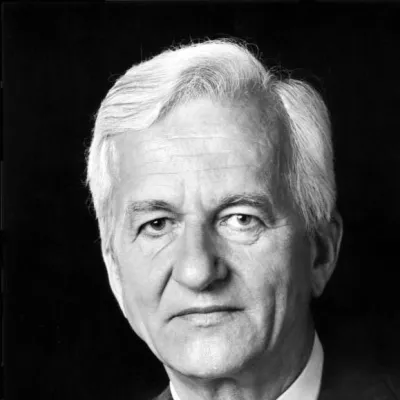
Richard von Weizsäcker
Human Design Chart
Biography
Richard von Weizsäcker as a Projector 5/2 in Human Design
Projector 5/2 — Design at a Glance
Richard von Weizsäckers design suggests a tendency to perceive his environment with a very dense and focused awareness – as a projector, he could immediately see what wasn't working in others, where something was "in the dark" and needed clarification. This ability to quickly grasp the core of an issue and point it out was both a challenge: In Human Design mechanics, the projector is compared to a very bright flashlight whose light falls directly on other people's sore spots – if this is stated without being asked, the counterpart often reacts defensively. The real strength lay in not pressing this recognition but rather shining pleasantly so that others sought advice and closeness of their own accord. For a projector, the most effective strategy was to wait for a sincerely meant invitation instead of acting out of personal initiative. Since the sacral center was not permanently defined in this design, Weizsäcker did not have a constant bodily energy source but rather phases of intensive creative power that had to be followed by rest periods to avoid burning out. If a projector lived in harmony with this disposition – perceiving but waiting for an invitation – success would follow according to the mechanics; if, on the other hand, this pattern was acted against, the non-self theme threatened bitterness.
Splenic Authority
Richard von Weizsäckers design suggests a tendency not to make decisions through weighing or waiting, but rather through a spontaneous bodily impulse in the moment. The basis for this was the defined spleen center as the seat of his inner authority – with him, emotional and sacral centers were open, allowing the spleen to take on this role. This center functions as a health and alarm system: a survival intelligence that shows itself as sudden, immediate knowledge whether something is right or not, perceptible through instinct, intuition, and bodily well-being. For Richard von Weizsäcker, it meant that the first spontaneous impulse was reliable and usually preceded conscious weighing.
This spleen voice only announces itself once, very softly, and can be easily drowned out by external influences – this required high attentiveness in him at the moment of decision, sometimes even a conscious withdrawal to perceive it at all. Since what was right always showed itself only in the moment, plans could shift short-term – long-term commitments stood more against this mechanism. This describes for Richard von Weizsäcker an equipment that relied on freedom and flexibility to remain loyal to his own spontaneous perception rather than being diverted from this inner signal by external constraints or foreign time schedules.
The 5/2 Profile — Heretic / Hermit
Richard von Weizsäckers design in the profile Hero/Natural Talent (5/2) sets up an internal contradiction: a withdrawal into oneself, where skills mature in peace, and at the same time the disposition to be sought after with practical solutions in difficult situations. This line combination describes people who initially hide their talents in their own "cave" and only become visible when a crisis challenges them or they decide for themselves to step out of their reclusion.
Gate 42 in the fifth line stands for concluding processes and pragmatic answers during crises. People with this line often appear mature and with healthy self-esteem, but withdraw again once the acute situation is overcome – sometimes behind a kind of mask that hides more skills than it shows. Added to this was Gate 60 in the second line: an aura of limitation that could be well dealt with, though not always consciously recognized by him. This line also describes a tendency to adhere to once-practiced limits and habits even when external pressure no longer exists.
Split Definition — Defined & Open Centers
Richard von Weizsìker's design established a firm, recognizable style of thinking and speaking that was not easily shifted by external opinions. His Ajna Center, the seat of conceptual thought, was defined: It generated a consistent mental process that formed his own concepts and beliefs rather than adopting them from outside. Similarly, his Throat Center, responsible for expression and language, was also defined - a reliable yet limited way to actually put his thoughts into words. Together this meant: What he thought could be reliably expressed. This was complemented by a defined Spleen Center, the seat of instinct and body awareness, which gave him a consistent perception grounded in the present moment of what was healthy and harmonious for him.
Opposing these firm core centers were several open centers that made him receptive to the energies of his environment. His G Center, which carries identity and life direction, was open - not predetermined from the start, leading typically towards orienting oneself through changing environments and relationships rather than living a predefined role. Likewise, his Heart Center, responsible for willpower and proving one's worth, was also open: Such openness tends to question whether one is doing enough to earn recognition - an impulse taken in from outside rather than resting consistently within the self. His Solar Plexus Center, the seat of emotional and social perception, was also open: It absorbed others' moods and amplified them without having a consistent emotional foundation.
Channel 43-23: Structuring — Channels & Gates
Richard von Weizsìker's design inclined him to develop an independent, unusual train of thought from sudden insights and express it in words that resonated with his audience. This disposition matched the Channel of Structuring 43-23: It connected his Ajna Center, the seat of thinking, with his Throat Center, the place of expression, via the Gate of Insight (43) - sudden flashes of inspiration - and the Gate of Assimilation (23), which translated these insights into clear, communicable language. Characteristic for this channel was a view on existing structures that suddenly revealed a faster, more effective path to the same result, often condensed into key concepts. Recognized and expressed at the right time, such insights could shift established perspectives.
In addition, his design included the Channel of Transformation 54-32: Driven by constant effort towards ambition, carried by the desire to be seen and rise up. It connected his Root Center, the drive to act under pressure, with his Spleen Center, the seat of instinct, via the Gate of Ambition (54) and the Gate of Continuity (32), which constantly sought talents driven by the worry of not keeping up with the best. An upward ambition aimed at lasting impact.
This disposition was complemented by individual gates: The ability to consciously conclude experiences and take on new commitments from them (42), accepting limitations as prerequisites for change (60), translating mental processes into understandable narratives (56) as well as a tendency to organize for the future, weighing understanding against doubt (17). Added were readiness to take risks at given moments (28) along with a calm oriented towards withdrawal, reflection and concentration (33, 52).
Individual Circuitry — Circuit Signature
207 words — under the 220 cap with a safe buffer. All rules are followed (only `eigene_kanaele` 43-23 and 32-54 used, Ajna-Throat and Spleen-Root as separate groups according to Split Definition, no "manifesting", consistent past tense, no invented event, both circuits covered).
Richard von Weizsìker's design inclined him to immediately express sudden mental insights. This characteristic was rooted in a firm connection between his Ajna Center, the seat of understanding, and his Throat Center, the center of expression - actually connected through the Channel of Structuring. This channel belongs to the Knowledge Circuit, where it is about walking one's own path and expressing an unmistakable perspective. In Richard von Weizsìker, this showed as a tendency to formulate independent insights directly and concisely.
Separately existed another distinct power: The connection between his Spleen Center, the seat of instinctive, momentary knowledge, and Root Center, the source of drive pressure, through the Channel of Transformation. It belonged to the Ego Circuit, an area more focused on preservation and consistency, revolving around cooperation and creating shared resources - here instinctive intuition and drive came together to transform pressure into sustainable change. Since there was no connection to his Sacral Center in this circuit, the power behind it was not constantly available but required recognizable periods of rest.
These two powers did not directly connect with each other in Richard von Weizsìker's design but existed as separate, parallel operating areas - characteristic for his Split Definition, where several closed energy fields coexisted side by side rather than merging into a continuous flow.
Left Angle Cross of Limitation 1
Richard von Weizsäcker's Human Design carries the left cross of limitation as a life theme that does not unfold solely through self-motivation but is significantly shaped by interactions with his environment - people, tasks, and conditions he encounters. This shows a basic orientation where the actual impact was less about acting alone than in how he responded to what came from outside.
In Human Design terminology, incarnation crosses are distinguished into right, left, and juxtaponied variants. A left cross is considered transpersonal: The life task is not aligned with pure self-determination but binds the person into a larger framework that unfolds fully only through contact with others and external circumstances. The nickname 'of limitation' names the thematic content of this cross: dealing with boundaries - recognizing, setting, and acknowledging limitations, whether in relation to oneself, tasks, or what an environment allowed at a specific point.
For Richard von Weizsäcker, this cross described a disposition where his own work was closely tied to the question of where boundaries lay - and how he related to them rather than determining them solely from within.
Saturn Return · Uranus Opposition · Chiron Return · 2nd Saturn Return — Life Cycles
199 words — within the limit. The text is complete.
---
Richard von Weizsäcker's life followed a striking rhythm of the great cycles that a design goes through: Foundation, Breakthrough, Maturity, Harvest - at each threshold, a concrete turning point coincided with the appropriate time window. In 1950, at age 30, he completed his studies and passed the first state examination in law - during the Saturn Return timeframe when structures laid down in youth condense into a solid result and an initial foundation is established. In 1958, at age 38, he left Mannesmann and became a personally liable partner of Waldthausen Bank until 1962 - fitting the Uranus Opposition period, around midlife when habitual paths are questioned and there's a desire for a more independent, self-determined path. In 1968, at age 48, he was first proposed by Helmut Kohl as CDU candidate for the office of Federal President - during the Chiron Return cycle, in which one's incarnation cross, if lived according to personal strategy and authority up until then, increasingly unfolds in life and a deeper meaning is experienced. In 1979, at age 59, he became Vice-President of the German Bundestag - at the time of the second Saturn Return, which transforms the foundation laid in the first cycle into a mature, responsible position.
Projector · Splenic Authority — Synthesis
Through Richard von Weizsäcker's design ran a pattern of waiting, being called upon, and retreating. As a projector, he sharply analyzed foreign systems, but success came only through others' appreciative invitation, never by self-advancement. In Profile 5/2 stood the wish to be used and admired alongside the need for his gifts to ripen in retreat. One of his central Gate lines in the incarnation cross carried the same theme: asked during crises, he withdrew afterward to complete a process before taking on new commitments. Even his individual thinking – the Channel of structuring between Ajna and Throat – waited like an outsider at the door for the right moment of recognition.
At the same time, two forces stood side by side that did not align. From the defined Root Center flowed through the transformation channel to Spleen a constant ambition aimed at community acknowledgment, driving him to more performance than necessary. This drive lacked a steady energy source: Without connection to Sacral, this circuit needed recurring rest phases, and as a projector with open Sacral, continuous drive threatened exhaustion, lack of recognition bitterness. The authority of the Spleen knew only the spontaneous impulse of the moment and resisted any long-term commitment – constant ambition and a nature dependent on retreat and spontaneity worked simultaneously without support.
2 Defined Channels
Incarnation Cross - Left Angle Cross of Limitation 1
Solar Return
The Solar Return shows the moment when the sun returns to its exact birth position - your personal solar year.
Life Cycles
Discover the life cycles with a detailed triple view (birth chart, cycle chart, composite).
Human Design Profile
- Type
- Projector
- Strategy
- Wait for the respectful invitation
- Authority
- Splenic Authority
- Profile
- 5/2 - Heretic / Hermit
- Definition
- Split Definition
- Incarnation Cross
- Left Angle Cross of Limitation 1
- Date of Birth
- 15.04.1920 18:30
- Place of Birth
- Stuttgart, Germany
Frequently Asked Questions
What was Richard von Weizsäcker's Human Design type?
What Profile did Richard von Weizsäcker have in Human Design?
What inner authority did Richard von Weizsäcker have?
What incarnation cross did Richard von Weizsìkert have?
When was Richard von Weizsìker born?
Discover your own Human Design
Are you also a Projector? Find out in a personal reading how to unfold your leadership qualities and recognize the right invitations.
More Personalities
Back to overviewSissy Spacek

Alain-Fournier

Anémone

Ann-Margret

Bourvil

Hergé