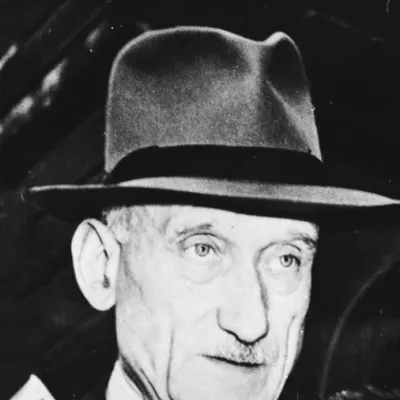
Robert Schuman
Human Design Chart
Biography
Schuman died on 4 September 1963, Scy-Chazelles, Lorraine, France.
The Human Design of Robert Schuman: Projector 4/6
Projector 4/6 — Design at a Glance
Robert Schuman acted as a Projector with a dense aura that immediately recognized systemic flaws. Instead of directly criticizing these shortcomings – which would have triggered resistance from his environment – he attracted through harmonious radiance and waited for sincere invitations to collaborate. This strategy prevented the bitterness associated with the Non-Self theme; living according to this design, he was rewarded with success.
Since his Sacral Center was undefined, Robert Schuman did not possess constant intrinsic life energy. Instead, he experienced cyclical phases of high activity followed by necessary rest periods to avoid burnout. The traditional school system and most jobs of his time did not accommodate this need for rhythmic recovery, which often posed a challenge for Projectors. His ability to bring light into darkness worked best when he acted as an example rather than instructing others. By waiting for appreciative recognition, he could exert leadership without rubbing against the resistance of his environment. This approach allowed him to make his specific contribution by identifying weaknesses in systems and making solutions attractive through his own harmony until others actively sought his advice.
Emotional Authority
Robert Schuman demonstrated decisive inner discipline: he did not base significant decisions on immediate emotional impulses. His inner authority was Emotional Authority, carried by the defined Solar Plexus Center. In Human Design mechanics, this authority is always considered primary for every type except Reflectors, regardless of other defined centers in the chart. This meant that his perception of the world was permanently influenced by waves of emotional ups and downs. At one moment he could be enthusiastic about something, in the next negatively evaluate the same situation. However, his feeling at this moment was only a fleeting first impression, not necessarily the deeper truth. Quick, spontaneous reactions to these transient moods would have easily led him astray. Instead, he used time as a tool for clarification. He let decisions “sleep” multiple times over to break through the deception of current mood swings. Through this patient detachment, intense emotions subsided, allowing him to gain emotional distance. Only when clarity and calmness set in – after the full cycle of emotion had unfolded – did he act. This process was particularly essential for long-term decision-making as it significantly influenced his life path. By consciously delaying and waiting, he protected himself from misjudgments arising from distortions through fleeting moods.
The 4/6 Profile — Opportunist / Role Model
Robert Schuman revealed a clear inner tension between the deep need for social belonging and later the urge towards wise distance. In his first thirty years, he intensely experimented in relationships and friendships, driven by Line 4 of his Profile 4/6. This phase was marked by seeking connection, with his Heart always cautiously acting to avoid injuries from false connections.
The mechanics of this design describe a conflict between the Heart (Line 4) and Head (Line 6). While Line 4 demands self-discipline and social activity, Line 6 in later life calls for a position of wisdom and role modeling. Robert Schuman had to live this contradiction: the desire for community against the impulse to withdraw and reflect on meaning.
In his later years, he was expected to act as a wise example and stand out through cooperation with others. Line 6 represents complete leadership and succession, similar to the stance of a Bodhisattva who only speaks when asked. This development from an experimental networker to a distant mentor shaped his dynamics. Doubts and inner unrest triggered by Jupiter did not serve as obstacles but became useful for the collective if shared. His path was thus a process of externalizing self-discipline within a social framework.
Split Definition — Defined & Open Centers
Robert Schuman was characterized by a constant, trustworthy presence in thought, communication, and willpower. His defined Ajna Center ensured consistent conceptual thinking; he processed data continuously and was mentally hard to influence. This internal structure flowed directly into his also defined Throat Center, allowing him to express his thoughts and concepts clearly and reliably. His voice served as a pivot point for transmitting messages from within himself out into the world.
Parallel to this, his defined Heart Center exhibited strong willpower. He preferred to control his own resources and kept promises strictly, earning him recognition. His self-esteem was strengthened by doing what he said, and he sought leadership roles to follow his inner mechanisms. Emotional depth was added by his defined Solar Plexus Center; here lay his internal authority. He learned to give the emotional wave time before making decisions, as clarity only revealed itself at the end of the cycle. His intuition was protected by his defined Spleen Center, which provided spontaneous and trustworthy judgments in the moment. Stress management worked through his defined Root Center, providing a constant pressure for forward movement and survival.
In contrast, Head, G, and Sacral Centers were open. The open Head Center meant he lacked consistent inspiration but was vulnerable to external mental pressure; he tended to engage with others' questions or become confused if not listening to his inner authority. His open G Center reflected the identities and directions of those around him; he had no fixed direction but found it through the right place and people. The open Sacral Center meant he lacked constant vital energy, instead absorbing and amplifying that of others. This made him prone to overexertion as he did not always know when enough was enough, and he needed to learn setting limits and resting rather than running on borrowed energy.
Channels for logical clarity, emotional depth and community.
Robert Schuman was characterized by a permanent, inner logical organization. His design drove an ongoing process of mentally structuring details and patterns, with understanding arising only through the integration of new information into existing systems. Channel 17-62 connected Ajna Center to Throat Center; Gate 17 visualized patterns while Gate 62 translated them verbally. This created a constant pressure to formulate these logical conclusions effectively, though only upon invitation to speak.
Simultaneously, the Judgment Channel 58-18 acted as a root-driven impulse towards perfectionism. Gate 58 promoted love for life and consistency, while Gate 18 steered correction. This combination fostered an insatiable drive to question and improve patterns to ensure collective quality of life. Criticism arose not from malice but the need for functional optimization.
This logical work always occurred within the context of relationships. The Community Channel 37-40 connected Solar Plexus and Heart Centers, enhancing the ability to create stable agreements and bonds. Simultaneously, the Recognition Channel 41-30 generated an emotional restlessness for new experiences; Gate 41 drove a desire for change while Gate 30 colored this longing emotionally.
Gate 52 as Sun Gate underscored the need for pauses to concentrate on handling high mental loads. Additional Gates like Gate 8 (Contribution), Gate 6 (Friction/Development), and Gate 39 (Mutation) complemented this profile with a focus on collective benefit, necessary friction processes for growth, and selective analysis to preserve the mind. Robert Schuman's mechanics thus synthesized detailed logic, perfectionist correction, and the pursuit of binding community.
Collective Circuitry — Circuit Signature
Robert Schuman did not present as someone with continuous inner logic or emotion. Instead, he reacted to the energy around him; his definition was split, indicating situational activation. The Understanding Circuit offered structured rational strategies for the future. Through the Judgment Channel, he connected Ajna and Throat Centers, enabling the sharing of logical insights without emotional coloring. Simultaneously, there existed a separate connection between Spleen and Root Centers within the same circuit, but this was not integrated with verbal expression.
In contrast, the Meaning Circuit processed emotional waves from the past. Here, the Recognition Channel connected Solar Plexus to Root Center. This energy cycled: feelings rose, peaked, then subsided. It did not directly flow into the rational future-building of the Understanding Circuit but formed a separate wave-like experiential layer.
The Ego Circuit focused on cooperation within the tribe. The Community Channel directly linked Heart and Solar Plexus Centers, promoting mutual support and resource exchange based on the principle of
Right Angle Cross of Service 2
Robert Schuman was characterized by a deeply rooted fundamental orientation towards serving others and supporting community goals. This attitude did not manifest as a temporary phase but rather as a constant imprint on the cross level, permeating his entire being. His design featured the right service cross 2, which describes an inner alignment where serving forms the central life aspect. It was not about conscious choices in everyday life but rather a structural fact of his energy. Robert Schuman lived in a configuration that naturally led him to work for the well-being of the community. The mechanics of this cross imply that his actions were always guided by this service impulse, without deviation from this line; it was the firm foundation upon which his decisions and stances rested. This orientation created a stable basis for his work, independent of external circumstances or specific events not detailed in the raw content. His design determined him to place himself at the service of greater goals, recognizable as a fundamental trait of his character.
Saturn Return · Uranus Opposition · Chiron Return · 2nd Saturn Return — Life Cycles
Robert Schuman's professional development followed a clear rhythm of structuring and authority finding, marked by Saturn return cycles. These phases served as decisive moments where his inner identity solidified and became tangible.
In 1912, at the age of 26, he experienced his first Saturn return. During this period, Schuman passed his second state examination and opened a law office in Metz. This step condensed years of preparation into a viable professional foundation and established his expertise in public space.
His second Saturn return occurred in 1946 when he was 60 years old. Here the mechanics were evident again: inner maturity translated into a significant expansion of responsibility areas. In this year, he was appointed Minister of Finance. This underscores how Saturn cycles for him not only marked personal milestones but structural turning points that redefined his role in societal structures. Through these recurring phases of consolidation, Schuman gradually expanded and stabilized his professional identity, with each cycle bringing a new level of responsibility and recognition.
Projector · Emotional Authority — Synthesis
Robert Schuman was a Projector who, through his ability to recognize patterns and point out imbalances (Channel of Accepting), could bring 'light into the darkness' for others. However, this gift went hand in hand with emotional depth—a permanent up-and-down of feelings (emotional authority)—forcing him to let decisions mature and weigh different perspectives. His profile as a Networker/Role Model suggests that he spent his life oscillating between the desire for community and the necessity of reflection, always striving to stand out through cooperation.
A central paradox in Schuman's design lay in the interplay of mental clarity (defined Ajna Center) and emotional sensitivity. He had the ability to create concepts and make logical connections, yet these processes were always colored by his fluctuating emotions. The recurring turning points in his career (Saturn returns at ages 26 and 60) showed how he continually reoriented himself to meet both his inner needs as well as the expectations of a role model.
4 Defined Channels
Incarnation Cross - Right Angle Cross of Service 2
Solar Return
The Solar Return shows the moment when the sun returns to its exact birth position - your personal solar year.
Life Cycles
Discover the life cycles with a detailed triple view (birth chart, cycle chart, composite).
Human Design Profile
- Type
- Projector
- Strategy
- Wait for the respectful invitation
- Authority
- Emotional Authority
- Profile
- 4/6 - Opportunist / Role Model
- Definition
- Split Definition
- Incarnation Cross
- Right Angle Cross of Service 2
- Date of Birth
- 29.06.1886 02:00
- Place of Birth
- Luxembourg, LUX
Frequently Asked Questions
What was Robert Schuman's Human Design type?
Which Profile did Robert Schuman have?
What Authority did Robert Schuman possess?
What incarnation cross did Robert Schuman have?
When was Robert Schuman born?
Discover your own Human Design
Are you also a Projector? Find out in a personal reading how to unfold your leadership qualities and recognize the right invitations.
More Personalities
Back to overviewSissy Spacek

Alain-Fournier

Anémone

Ann-Margret

Bourvil
Christian-Jaque