
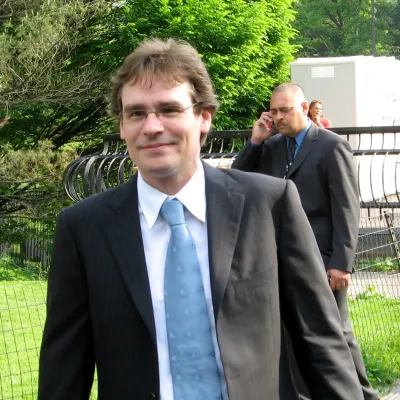
Robert Sean Leonard
Human Design Chart
Biography
He was born Robert Lawrence Leonard in Westwood, New Jersey. Nicknamed "Bobby," he took his brother’s first name as his middle name, becoming Robert Sean Leonard. At Fordham University, he studied history for five years, and as well, he attended Columbia University School of General Studies and Continuing Education.
After working on Broadway in such plays as "Brighton Beach Memoirs" from the age of 12, the talented and creative left-handed actor made his film debut at age 17 when he appeared in "The Manhattan Project," 1986. Although he appeared in various films throughout the late ’80s and early ’90s and narrated classic books for audio release, his first love is the stage. He received a Tony nomination for his work in 1993’s "Candida," and in 1999, he worked with Kevin Spacey in the critically acclaimed revival, "The Iceman Cometh." During 2001, he appeared in the television docudrama, "A Glimpse of Hell." He and several friends have a small theatre company, Malaparte, in New York.
Although romantically linked to various actresses such as Gwyneth Paltrow, he is unmarried.
Robert Sean Leonard as a Manifesting Generator 5/1 in Human Design
Manifesting Generator 5/1 — Design at a Glance
Robert Sean Leonard's design revealed a tendency towards hybrid dynamics: he possessed constant inner energy, yet combined it with the ability to skip steps and quickly draw results into his life. As a Manifestor Generator, he had a defined Sacral Center, giving him a steady energy source. The central advice for this configuration is not to initiate but to react to external impulses. Only when the Sacral Center responds with a clear 'yes' should action be taken.
This mechanism, however, brings specific challenges. Due to the speed, there was a risk of overlooking important steps, leading to frustration as they had to be made up later. Additionally, his design tended to pursue multiple projects simultaneously, driven by various impulses. If strategy and inner authority did not align, the initial creative enthusiasm quickly turned into exhaustion.
When his reaction to life was properly tuned, Robert Sean Leonard could draw deep satisfaction from his work. In this state, parallel working was no obstacle but a source of fun and play. His design allowed him to fall into a creative play mode, where variety enhanced his creative power rather than fragmenting it. The balance lay in using the speed without neglecting the necessary steps of confirmation from the Sacral Center.
Emotional Authority
Robert Sean Leonard's design revealed a tendency towards deep emotional wave movements. His inner authority was Emotional Authority, carried by the defined Emotional Center. In Human Design mechanics, this authority always takes precedence over all other defined centers, regardless of further configurations in the chart. This means that his perception of the world was always colored by his current mood. At one moment, he could be totally enthusiastic about something, in the next, he could negatively evaluate the same situation. His immediate feeling, however, was only a snapshot, not a final claim of truth. Quick, spontaneous decisions from such an emotional state could have negative consequences for him. The mechanics demanded patience: he needed time to let decisions mature. Often, this required going over an issue several times in his mind or letting it rest overnight. Over time, the intense feelings subsided, he gained emotional distance, and clarity and calmness set in. Only then was the decision-making process complete for him. This process was particularly important for long-term decisions that could have a significant impact on his life course. By waiting for this inner peace, he found his true direction, rather than being led by passing moods.
The 5/1 Profile — Heretic / Investigator
Robert Sean Leonard's design revealed a tendency towards a dual role: he showed himself as someone who gathered deep, specialized knowledge to offer others for problem-solving. As a 5/1 (Hero/Researcher), he possessed the magnetic quality that made others seek his expertise. This created a tension field: Line 1 demanded persistence in maintaining personal rhythms and rituals, while Line 5 pushed him into the position of an advisor. Without clear boundaries, he risked being drained by the constant demands of others, similar to an expert who is exhausted after long consultations.
Additionally, Gate 37, Line 5, described the natural surrender to family as a temptation. Here, projections of lasting love could crumble under emotional waves. If measures were taken, dependency and hatred threatened, as the attempt to find security through surrender often led to the opposite. Robert Sean Leonard had to learn to say no to maintain the balance between his research for himself and supporting others. Only in this way could he optimally use his gifts without falling into mutual dependency or frustration. His design challenged him to discover and preserve his own patterns rather than losing himself in the expectations of others.
Split Definition — Defined & Open Centers
Robert Sean Leonard's Human Design profile suggests a clear, self-determined presence, supported by a reliable identity and willpower. His defined G Center provides a stable sense of direction and self-love, while his defined Heart Center gives him the energy to keep promises and control his own resources. This combination marks him as someone who speaks and acts from a place of inner security, without being dependent on external validation.
At the same time, he has a defined Throat Center, which serves as a focal point for his communication. It allows him to translate the energy from his Heart and G Centers into clear messages. His voice is thus a direct expression of his will and identity, enabling him to articulate his truth with ease and honesty, provided he follows his inner guidance.
This stable foundation contrasts with his open centers. His open Head Center makes him vulnerable to mental pressure and the temptation to identify with questions that are not his own. He tends to question whether he has found the right inspiration, rather than trusting his inner authority. Similarly, his open Ajna Center conditions him to adopt the concepts and opinions of others as his own truth to appear intelligent.
His open Spleen Center leads to a fundamental fear of survival and health. He is sensitive to the well-being of his environment and tends to cling to people with defined Spleens to gain a false sense of security, rather than respecting his own intuitive boundaries. Finally, his open Root Center absorbs external stress. He is vulnerable to taking on and amplifying the adrenalized pressure of others, which can lead to cycles of chaos and exhaustion if he does not recognize that this pressure does not belong to him. These open centers challenge him not to be led by mental confusion, false health fears, or external stress, but to trust his stable identity and willpower.
Channels for community, powerful charisma and spiritual initiation.
Robert Sean Leonard's Human Design profile suggests a tendency towards sustained, self-reinforcing activity guided by inner resonance. The Charisma Channel 34-20 connects the Sacral Center with the Throat Center. Here, raw physiological energy is transformed into immediate expressive power. This configuration requires that the urge to act responds to external stimuli rather than being planned from the mind. Without this sacral reaction, the energy tends to break out as obsession or misguided momentum. Correctly applied, this results in a compelling vitality that inspires others while Leonard himself becomes immersed in his satisfying activities.
Parallel to this, a dynamic of individuation and competition is evident. The Initiation Channel 51-25 connects the Heart Center with itself, linking the ego energy of wanting to be first with the universal love of the Higher Self. This creates a natural competitive edge that, however, does not come at any cost, but serves as a mystical process of self-actualization. Through proper engagement in situations, this channel leads to breakthroughs that awaken a new consciousness of one's uniqueness. Initiation here must be experienced as an invitation; forced initiations lead to bitterness.
Socially and emotionally, the Community Channel 37-40, which connects the Solar Plexus Center with the Heart Center, is at work. It emphasizes the need for carefully tuned agreements and emotional clarity for long-term commitments. Leonard sought his place in the whole, with genuine connections forming through personal touch and time, not superficial contact. This energy promotes an equitable collaboration where each person contributes to strengthen a community larger than the individual.
Additionally, Gate 5 sets the basic rhythm and habits, while Gate 9 provides the ability for detailed work and pattern perfection in the Sacral Center. Gate 35 promotes change through interaction, and Gate 56 enables the abstraction of mental processes into vivid narratives. Gate 13 collects experiences for collective memory, and Gate 42 emphasizes the importance of completing processes to take on new commitments. Gate 46 stands for dedication in the present moment, Gate 14 for skillful power handling, and Gate 6 provides the emotional friction necessary for growth.
Individual Circuitry — Circuit Signature
Robert Sean Leonard's Human Design profile suggests a tendency towards fortified, courageous personality structures, strongly based on inner conviction. The Centering Circuit directly connects his Identity and Heart Centers. This connection strengthens self-worth and individual identity, but often leads to difficulties in communicating these firm inner values outward, as the Throat Center is not included. Parallel to this, the Ego Circuit connects the Heart and Solar Plexus Centers, creating a dynamic of giving and taking as well as mutual support in social contexts. Since there is no connection to the Sacral Center here, rest periods are necessary to restore emotional resources for these cooperative exchange processes. A third, energetically separate strand is formed by the Integration Circuit, which connects the Throat with the Sacral Center. This channel allows drawing strength from the reaction to life and expressing it through charisma in the present moment. Due to the shared definition, these three systems – inner centering, emotional cooperation, and expressive integration – exist as adjacent, non-interflowing energy fields. They shape Robert Sean Leonard as someone who, on the one hand, rests strongly within himself, on the other hand, cultivates social bonds, and finally translates his reactions to the world into concrete actions or expressions, with each area maintaining its own logical and energetic autonomy.
Left Angle Cross of Migration 1
Robert Sean Leonard's Human Design suggests a tendency towards persistent perseverance, even when immediate success is not forthcoming. This attitude aligns with the mechanics of the left Moving Forward Cross 1, which is not geared towards quick victories or immediate confirmation but rather the ability to hold steadfast to a goal over long periods. The impulse here is to not give up when obstacles arise but to channel energy into patient endurance. It's less about explosive breakthroughs and more about the quiet, consistent pursuit of a path that often proves itself only in retrospect. This configuration shaped a fundamental attitude of endurance, where failure was not seen as an end but as part of the process. The energy of this cross supports perseverance during phases of uncertainty without the need for external validation. Robert Sean Leonard was defined by this structure as someone who did not define his direction through external approval but through inner constancy. The Moving Forward here is not passive endurance but an active strategy that uses time as an ally to penetrate and master complex situations.
Saturn Return · Uranus Opposition · Chiron Return · 2nd Saturn Return — Life Cycles
Robert Sean Leonard's Human Design indicates a tendency towards sudden, inevitable turning points that profoundly reorder personal life. This dynamic was evident in 2009, at the age of 40, with the birth of his daughter. For his chart, this was not an isolated family event but the concrete expression of the Uranus Opposition. This astronomical cycle marks a phase of radical detachment from old structures and confrontation with one's autonomy. The arrival of a child in this constellation often acts as a catalyst, breaking existing relationship patterns and requiring a new, unconventional form of responsibility. This is not about gentle adaptation but a sharp break with the past, clearing the way for a more authentic, though challenging, way of life. The Uranus energy forces a re-evaluation of bonds: What still serves true freedom, and what is merely habit? In Robert Sean Leonard's case, this cosmic demand manifested in the role of father, presenting him with the task of redefining his identity beyond established roles. The cycle demands flexibility and the ability to deal with the unexpected without falling back into old patterns. It was a moment of clear separation from the known to make way for a new, independent form of existence shaped by the new family constellation.
Manifesting Generator · Emotional Authority — Synthesis
A central red thread in this design is the dynamic between inner perception and outer action. Emotional Authority (Authority) demands a maturing wave of emotions before decisions can be made – a process that requires time and patience. Simultaneously, the Manifesting Generator type (Design View) grants the ability to respond swiftly to sacral impulses and set things in motion (Charisma Channel). The Profile as Hero/Researcher (Profile Role) amplifies this trait by connecting a thirst for knowledge and the ability to provide solutions for others with the need for deep understanding. This combination generates a personality that radiates both inner depth and outer action, drawing energy from the connected centers (Centers).
The central paradox lies in the tension between the need for emotional clarity and the tendency towards quick action. The defined Throat Center (Centers) signals strong communication skills, enhanced by sacral energy (Charisma Channel), yet Emotional Authority (Authority) reins in this impulse to ensure a deeper, authentic expression. This inner conflict between wanting to act and waiting is further emphasized by the Uranus Cycle (Cycles) with the noted event, pointing to a life shaped by changes and the breaking of old patterns.
3 Defined Channels
Incarnation Cross - Left Angle Cross of Migration 1
Solar Return
The Solar Return shows the moment when the sun returns to its exact birth position - your personal solar year.
Life Cycles
Discover the life cycles with a detailed triple view (birth chart, cycle chart, composite).
Human Design Profile
- Strategy
- To respond - wait for something to respond to
- Authority
- Emotional Authority
- Profile
- 5/1 - Heretic / Investigator
- Definition
- Split Definition
- Incarnation Cross
- Left Angle Cross of Migration 1
- Date of Birth
- 28.02.1969 10:00
- Place of Birth
- Westwood, NJ, United States
Frequently Asked Questions
What is the Human Design type of Robert Sean Leonard?
What Profiles does Robert Sean Leonard have?
What Authority does Robert Sean Leonard have?
What is Robert Sean Leonard's incarnation cross?
When was Robert Sean Leonard born?
Discover your own Human Design
Are you also a Manifesting Generator? Find out in a personal reading how to unfold your multi-talents and direct your energy wisely.
More Personalities
Back to overviewSissy Spacek

Aldair

Alizée

Anémone

Angeli

Ann-Margret
