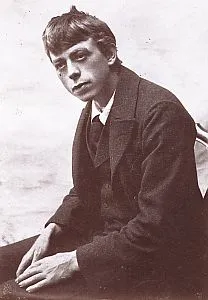
Robert Walser
Human Design Chart
Biography
In the beginning of 1929, Walser, who had suffered from anxieties and hallucinations for quite a time, went to the Bernese mental home Waldau, where he stayed until his death in 1956.
Robert Walser — Manifesting Generator with Profile 6/2
Manifesting Generator 6/2 — Design at a Glance
Robert Walser revealed himself as someone with a hybrid energy structure: He possessed the constant power of a Generator but was also equipped with additional connections that endowed him with the lightning-fast effectiveness of a Manifestor. This configuration suggested he could draw things into his life without going through all intermediate steps.
The challenge of this nature lay in speed. Often, he skipped necessary stages, which led to having to return later and make up for missing steps. This process could cause frustration as the pace did not always align with the depth of implementation. Furthermore, his design tended to pursue multiple impulses simultaneously and tackle various projects parallelly. When internal consent was lacking, initial creative enthusiasm quickly turned into overextension.
Robert Walser's strategy involved not initiating himself but responding to external life impulses. Only when his Sacral Center – his energy source – gave a clear “yes” should he act. Regular checks on whether the projects still brought joy were essential. With correct application of this response to impulses, he could draw deep satisfaction from his work. Parallelism was no barrier for him but rather a means to remain in the “play mode,” keeping his creative power alive through variety.
Emotional Authority
Robert Walser exhibited a fundamental attitude of emotional tolerance: He did not let himself be driven by initial impulses but waited until the internal wave subsided. His inner authority lay in the defined Emotional Center, meaning he was under constant emotional dynamics – an ongoing up and down of feelings that colored his perception of the world through current mood. What appeared inspiring at one moment could turn negative in another. However, his immediate feeling was only a snapshot, not yet necessarily the truth. Quick decisions from this emotional heat often had negative consequences. Therefore, he took time to let decisions mature. This process required patience and multiple nights to think over important questions. Over time, intense feelings subsided, he gained emotional distance, clarity and calmness set in. Only then was he through with the decision-making process. This strategy particularly applied to long-term decisions that could significantly impact his life course. Emotional authority always took precedence over other defined centers in his design; it largely determined how he dealt with internal and external demands and when he was ready for the next step.
The 6/2 Profile — Role Model / Hermit
Robert Walser's 6/2 profile revealed him as a person whose early years were marked by intense experimental enthusiasm. Before turning thirty, the energy of this line acted like a Three: He sought ways to make his own experiences and learn through trial and error. Failed attempts often led to temporary withdrawal, a process of testing and retreating that shaped his youth.
With entry into the sixth life phase, typically after age 30, this dynamic fundamentally changed. The Six line became active, urging him to withdraw physically or mentally – metaphorically into a “cave on the mountain.” In this phase of distance, he intensely reflected upon previously gathered experiences. This withdrawal served not only isolation but was a process of healing and deep self-awareness. He gained an overview of his entire life circuitry, pondered who could complete processes and what could be abstracted from experiences.
The second generation in his profile eventually enabled him to share this acquired wisdom with others. As he emerged from his introspective phase, he radiated a calm and insight that attracted people seeking contact to partake of these life insights and learn the ability for deep self-reflection. His adaptability to limitations and habits played a role; even when external constraints lessened, certain internal structures remained, sometimes appearing as melancholy or rigid routine but part of his specific way of dealing with life.
Quadruple Split Definition — Defined & Open Centers
Robert Walser revealed himself as someone who stood under a constant internal pressure to ask questions and understand things. This tendency arose from his definition between the Head Center and Ajna Center: A permanent mental stimulus that formed inspiration but did not offer direct energy for implementation. Those who did not accept this pressure easily fell into worry or self-doubt. Walser, however, had a reliable voice through his defined Throat Center, which could structure these thoughts, as well as a firm identity in the G Center, giving him a clear sense of direction. His actions drew from the vital energy of the Sacral Center; he reacted to impulses rather than initiating them, providing deep satisfaction so long as he did not act against his inner "no."
At the same time, his system was marked by a complex emotional landscape. The defined Solar Plexus Center demanded patience: Truth revealed itself only at the end of the emotional wave, not in the impulsive moment. This stood in tension to his open Heart Center. Here, there was no constant energy for willpower and competitive thinking. Walser tended to feel the pressure to prove his worth through promises or performance – a classic non-self pattern of this center. Instead of getting caught up in this cycle of proving himself, he relied on using his inner authority and not relying on external validation. His defined Spleen Center supported this by providing spontaneous intuition in the present moment, while the Root Center supplied the necessary drive to move forward without slipping into obsessive stress. The challenge always lay in not interpreting mental restlessness as a lack of willpower but rather accepting it as part of his specific design.
Channels for change, doubt, endurance and ambition.
Robert Walser revealed himself as someone shaped by a mind that used doubt as the necessary motor for logical clarity. The Logic Channel 63-4 connected the Head and Ajna Centers, constantly testing patterns for their consistency. This skepticism served not merely to question but to filter information until an answer was practically verifiable. His mind sought consistent connections, where unfounded belief found little room; only what functioned was considered logically true.
At the same time, a deep need for experience drove him, leaving expectations behind. The Discovery Channel 29-46 connected the Sacral and G Centers, giving him persistent endurance. He had to immerse himself in processes without expecting immediate meaning to gain new perspectives at the end. This energy required clear commitment as it could only be satisfying through correct responses to life impulses.
His ambition was less ego-driven than clan-oriented. The Transformation Channel 54-32 connected the Root and Spleen Centers, enabling him to use talent and competence to secure his position. Driven by the fear of collective failure, he worked hard to gain recognition and support from others. His advancement depended on being valued by the clan.
Emotionally, he constantly sought novelty, aware of impermanence. The Impermanence Channel 36-35 connected the Solar Plexus and Throat Centers, inspiring him to create crises or adventures to experience emotional depth. He learned through living out feelings that were transient but generated wisdom for future generations. Additional Gates like 60 (Acceptance), 56 (Narration), and 2 (Receptivity) rounded out his Profile by accepting genetic limitations, translating mental processes into stories, and reacting to external changes.
Collective Circuitry — Circuit Signature
Robert Walser's Design inclined towards structured logic that operated free from emotional coloring. His Understanding Circuit connected the Head and Ajna Centers through the Logic Channel, promoting the sharing of rational insights with the aim of shaping improvements for the future through focus and strategy.
Parallel to this, two separate streams were active in his Meaning Circuit. A connection between Throat and Solar Plexus Centers generated cyclical emotional waves that allowed for the sharing of experiences from the past. Independently of this, another channel linked Identity and Sacral Centers, leading to an energetic joy of discovery that did not directly flow with the emotional expressions in the throat. This separation meant that rational future visions and emotional past reflections existed as parallel, non-fusing forces.
Additionally, a connection between Spleen and Root Centers was present in his Ego Circuit. This Transformation Channel fostered cooperation and the joint creation of resources within a group. Since there was no direct link to the Sacral Center, pauses were necessary to maintain energy for these supportive community processes. Robert Walser thus emerged as someone who connected logical future structures with emotional past cycles and cooperative tribal energies, each functioning independently and not experienced as a continuous flow.
Left Angle Cross of Limitation 1
Robert Walser was marked by the Left Authority Cross. This configuration established a specific life dynamics characterized by an ongoing struggle between the desire for individual freedom and the necessity of social adaptation. For his design, this meant that he often found himself in situations where he had to test his own limits to understand where they truly lay.
The Left Authority Cross describes a process of learning through experience. It is not about simply accepting rules or blindly breaking them, but rather making the consequences of actions tangible. Robert Walser learned when it was necessary to withdraw and when he needed to integrate himself. This mechanism created an inner tension that drove him to continually renegotiate his position in the world.
He sought a middle path that allowed him to remain authentic without being completely excluded from society. The Authority was not a negative obstacle for him, but rather a structure that helped define his identity. Through constantly exploring these boundaries, he developed a deep understanding of how personal autonomy can be reconciled with societal expectations. This process shaped his entire approach and the way he positioned himself in relationships and communities.
Saturn Return · Uranus Opposition · Chiron Return · 2nd Saturn Return — Life Cycles
Robert Walser revealed himself as someone whose inner structure was marked by cycles of condensation and rupture. His design indicated a tendency towards profound life turning points, often accompanied by external constraints or sudden upheavals. This mechanism became active in 1906: With his first Saturn return, years of preparatory work on his novels "Geschwister Tanner," "Der Gehülfe," and "Jakob von Gunten" condensed into tangible results. It was a phase during which his creative energy coalesced into durable outcomes.
Yet the structure also contained the capacity for abrupt ruptures. In 1919, during the Uranus opposition, a painful break occurred: His brother Hermann took his own life. This cycle often marked moments when old bonds or structures irreparably shattered and new, often more isolated paths became inevitable.
The following phase led to an internal dissolution rather than flourishing. In 1929, at age 51 during the Chiron return cycle, which typically brings about the unfolding of one's life purpose, Walser was involuntarily admitted to Waldau sanatorium against his will. Instead of blossoming, he withdrew; this cycle revealed its shadow side as a retreat from the world. The second Saturn return in 1934 sealed this development: He received a guardian. His design thus revealed a life path that led from creative condensation through sudden ruptures to enforced isolation.
Manifesting Generator · Emotional Authority — Synthesis
Robert Walser lived a life marked by a constant interplay between the urge for rapid implementation and the necessity of deep emotional maturation. As an Manifesting Generator, he possessed the ability to initiate things quickly (through the connection of Sacral Center and Throat Center), yet his Emotional Center required time to thoroughly think through decisions. This internal mechanism led him to initiate ideas – evidenced by creative phases such as the creation of certain works at age 28 – which often needed to be re-examined later on. The defined Head and Ajna Centers (Channel of Logic) intensified this process, creating a constant mental pressure for analysis and questioning.
A central paradox in Robert Walser's design lay in the tension between his need for freedom and his inner compulsion towards self-restriction. The Definition of the Limiting Cross indicates a natural tendency to restrict himself or be restricted by external circumstances. This was particularly evident during crisis periods (such as at age 51), which forced him to withdraw and reflect on his experiences – a pattern reinforced by the Profile Line 6/2. At the same time, the manifesting aspect of his type allowed him to transcend these limits and create something new before retreating into an introspective phase again.
4 Defined Channels
Incarnation Cross - Left Angle Cross of Limitation 1
Solar Return
The Solar Return shows the moment when the sun returns to its exact birth position - your personal solar year.
Life Cycles
Discover the life cycles with a detailed triple view (birth chart, cycle chart, composite).
Human Design Profile
- Strategy
- To respond - wait for something to respond to
- Authority
- Emotional Authority
- Profile
- 6/2 - Role Model / Hermit
- Definition
- Quadruple Split
- Incarnation Cross
- Left Angle Cross of Limitation 1
- Date of Birth
- 15.04.1878 15:00
- Place of Birth
- Biel, SWTZ
Frequently Asked Questions
What was Robert Walser's Human Design type?
What profile did Robert Walser have in Human Design?
What authority did Robert Walser possess?
What incarnation cross did Robert Walser have?
When was Robert Walser born?
Discover your own Human Design
Are you also a Manifesting Generator? Find out in a personal reading how to unfold your multi-talents and direct your energy wisely.
More Personalities
Back to overviewAlain-Fournier

Aldair

Alizée

Angeli

Arletty
Artus