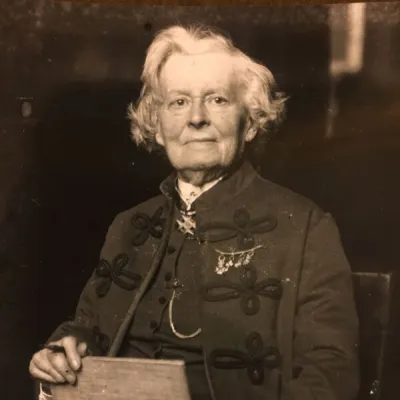
Rosa Bonheur
Human Design Chart
Biography
It has been claimed that Bonheur was openly lesbian, as she lived with her partner Nathalie Micas for over 40 years until Micas's death. After that she lived with American painter Anna Elizabeth Klumpke. However, others assert that nothing supports this claim.
The Human Design of Rosa Bonheur: Projector 4/6
Projector 4/6 — Design at a Glance
Rosa Bonheur's Design created a tendency towards a dense, focused aura that acted like a bright flashlight, immediately recognizing system errors in her environment. She was someone who intuitively saw where others were not functioning or "in the dark." However, this ability to bring light into darkness came with a specific challenge: direct criticism often provoked resistance, similar to shining a harsh light directly into someone's face.
Instead, her presence was most effective when she illuminated through her own harmonious example. Other people were drawn to this attractive quality and sought out her advice independently. The central strategy of her design involved waiting for a respectful and sincerely meant invitation before sharing her insights. This prevented unnecessary conflicts and allowed her to exercise her leadership role without friction.
Since Projectors do not have a defined Sacral Center, Rosa Bonheur did not possess a constant intrinsic energy source. Her rhythm consisted of phases of high activity that had to be balanced by periods of rest to prevent burnout. Living according to this pattern of invitation and rhythmic pausing rewarded her design with success. Deviations from this strategy led to the experience of non-self energy: bitterness. Therefore, her path was not defined by constant action but by targeted illumination upon request and respectful handling of her energy boundaries.
Emotional Authority
Rosa Bonheurs Design established an emotional authority, meaning her defined Emotional Center carried her internal decision-making process. This configuration followed a cyclical wave pattern of mood swings, upswings and downswings. The world appeared to her always colored by the current state of mind; in one moment there was great enthusiasm for something, but in the next, the same option was already viewed negatively.
However, this emotional impulse represented only a snapshot, not a final claim on truth. Quick, spontaneous decisions based directly on this fleeting emotional color risked negative consequences as they did not align with her deeper inner truth. Therefore, Rosa Bonheur's correct strategy required patience and consciously delaying judgments. She had to let options mature by taking time and sleeping over decisions multiple times.
Only through this process of waiting did the intense feelings gradually subside. With an increasing emotional distance, clarity and calmness set in. This mechanism was particularly crucial for long-term, life-shaping decisions. By enduring until the wave movement subsided, Rosa Bonheur reached that stable inner truth which went beyond the fleeting first impression and provided a solid foundation for her actions.
The 4/6 Profile — Opportunist / Role Model
Rosa Bonheur's Design set a tendency towards a two-phase life development. In her first three decades, she experimented vividly, driven by the energy of Line 3, which behaved like a precursor to Line 4 in this stage. She actively sought relationships and gathered experiences through an extensive networking behavior. Line 4 promoted a tendency toward "espionage" in a positive sense: collecting confidential information and cautiously checking whom she opened up to, to avoid getting hurt. Her heart was big, yet always wary of false contacts.
Starting from the age of 30, with the activation of Line 6, her inner dynamics fundamentally changed. A tension arose between the deep desire for emotional belonging (Line 4) and the need for intellectual distance and far-sighted meaning-making (Line 6). This conflict of heart versus head shaped her further development. Line 6 mediated the ability to accept transitions as part of a natural cycle and adapt accordingly. She developed a speculative perspective that allowed her to understand the collective flow. In her later years, she was expected to function as a wise role model that stood out through cooperation with others while simultaneously preserving her gained wisdom.
Split Definition — Defined & Open Centers
Rosa Bonheur showed herself through a stable foundation of self-love, ego strength, and emotional authority. Her defined G Center gave her a reliable identity and direction, while the Heart Center shaped her willpower and desire for control over her own resources. This inner security contrasted with her open Throat: She tended to wonder if she was noticed rather than waiting for natural invitations to speak.
Her design generated a constant mental pressure through the defined Head-Ajna Channel. This channel pushed forward questions and concepts continuously, without providing the energy for direct implementation. Rosa Bonheur faced the challenge of accepting inspirations as pure questions instead of hastily converting them into actions, which would otherwise have led to frustration. At the same time, she experienced a deep emotional wave due to her defined Solar Plexus Center. Her decisions required patience; she had to wait for the emotional clarity at the end of the wave cycle rather than reacting impulsively to highs or lows.
The open centers marked areas of conditioning. Her open Sacral Center made her vital energy unstable; she was prone to driving herself to exhaustion through "borrowed" energy from others, instead of respecting her natural resting phases. The open Spleen Center led to absorbing foreign fears or health conditions rather than trusting her own instincts. Additionally, her open Root Center absorbed external stress pressure, which encouraged fighting against this non-native pressure through hyperactivity. The challenge lay in not seeing these open areas as personal deficits but using her defined strengths – identity, willpower, and emotional depth – as guiding stars to live in resonance with the environment rather than in conflict.
Channels for logical doubt, pioneering spirit and community.
Rosa Bonheur's Design established a foundational stance of active skepticism. Her mind constantly filtered patterns to check if they were consistent or not. This process was essential for her logical formulation; unfounded belief was rejected, as logic is only sound when it stands up to verifiable evidence.
The Logic Channel 63-4 connected the Head Center with the Ajna Center through the Gate of Doubt (63) and the Gate of Formulation (4). This configuration created a doubting mind that built pressure whenever a pattern was recognized as inconsistent. This pressure resulted in questions demanding answers. The release did not occur through personal life decisions but by sharing these questions and answers with the collective. When her busy mind could not find a solution and released mental pressure without encountering resistance, it could trigger anxiety. The channel served to be of use to others by providing well-considered predictions based on current data and recognizable patterns.
Additionally, Channel of Initiation 51-25 connected the Heart Center through the Gate of Shock (51) and the Gate of Self Spirit (25). This promoted natural competitiveness and the ability to recognize potential for individuation in others. When correctly invited, it could deliver the "shock" that initiated and reinforced others. This channel linked ego with universal love and allowed her to see the beauty of both animate and inanimate objects equally.
Channel of Community 37-40 connected the Solar Plexus Center with the Heart Center through the Gate of Friendship (37) and the Gate of Solitude (40). Here she sought recognition and her place within the whole, while simultaneously needing reward and breaks. She built bridges for individuals to live in a community where everyone had an honorable place. A good business was carefully considered and formulated over time so that it would be beneficial for both sides.
Individual Gates like Gate 6 (Friction), Gate 11 (Visual Memory), and Gate 30 (Recognition of Feelings) complemented this picture with emotional waves, memory functions, and the confrontation with illusions and fate.
Collective Circuitry — Circuit Signature
Rosa Bonheur's Design established a tendency towards inner strength and individual self-worth. Her Centering Circuit directly connected Identity and Heart Centers, which shaped a bold personality with strong, inward-directed convictions. This energy strengthened her own individuality as well as that of others but often lacked the verbal expression due to the absence of connection to the Throat Center. The pulsating, acoustic Format Energy of this circuit colored her entire chart and emphasized a creative, melancholic note of her uniqueness in the here and now.
Parallel to this, there was a separate segment of the Understanding Circuit between Head and Ajna Centers. This promoted the sharing of logical, rational insights free from conditioning, focused on visual future perspectives. Another independent element was the Ego Circuit connecting Heart and Solar Plexus Centers. This area emphasized cooperation and the joint creation of resources through a balanced relationship of giving and taking. Since there was no connection to the Sacral Center, periods of rest for energy regeneration were necessary for these social interactions. The timeless Format Energy of this circuit acted conservatively and traditionally, with emotional waves appearing in wave-like patterns.
Due to the shared definition, these energetic streams existed as parallel, not directly connected forces within her system.
Right Angle Cross of Eden 1
Rosa Bonheur's Human Design profile included the right cross of Eden 1, a configuration that pointed to a profound connection between spiritual truth and material expression. This archetypal mechanism acted as a fundamental energetic pattern in her life. It was not just a psychological profile but a specific structure within Human Design that shaped certain life rhythms and challenges.
The right cross of Eden 1 describes a path of transformation through experience. The energy of this cross often demands a process of learning through direct encounters with reality, coupled with a search for deeper meaning behind external events. For Rosa Bonheur, this meant her life was strongly marked by the dynamic tension between the visible and the hidden. She faced the task of bringing her inner truth into the world, often through confrontation with resistance or complex situations that served as catalysts for personal growth.
This mechanism suggested that her path did not follow a linear course but was determined by cycles of understanding and reordering. The energy of the cross supported drawing wisdom from difficult experiences and shaping it into forms accessible to others. It was about integrating opposites – between light and shadow, between individual experience and collective consciousness. Rosa Bonheur's chart thus depicted someone whose development was closely tied to her ability to undergo profound changes and develop an authentic life stance.
Saturn Return · Uranus Opposition · Chiron Return · 2nd Saturn Return — Life Cycles
Rosa Bonheur's design showed a tendency to oscillate between institutional responsibility and radical creative focus. This dynamic manifested concretely in two prominent cycles of her career. In 1849, at the age of 27, she experienced her first Saturn return. This cycle often condensed years of groundwork into solid results and promoted the establishment of authority. Rosa Bonheur was appointed director of the Ecole Impériale Gratuite de Dessin pour les Demoiselles in Paris – a moment that underscored her ability to take on structural responsibility and anchor herself within social structures.
Yet, her design also contained an opposing pole: the need to break free from external expectations to follow the inner impulse. In 1860, at age 38, she experienced the Uranus opposition. This cycle typically marks a rupture with established structures and forces a return to authentic self. Rosa Bonheur stepped down from her leadership role to fully dedicate herself to painting. She relinquished institutional roles not out of failure but because her design required a phase of radical focus on creative essence. The shift from director to artist illustrates the mechanism of her design: first, create and stabilize structures, then consciously leave these structures to remain true to the deepest expression.
Projector · Emotional Authority — Synthesis
Rosa Bonheur lived a life marked by deep inner clarity and an unwavering sense of direction (G Center). This internal compass allowed her to be authentic and inspire others through her work. Her ability to recognize patterns and expose errors (Head and Ajna Centers), combined with the emotional depth of her Solar Plexus Center, led her to intensely perceive the world around her and capture it in her works. The connection between logic and intuition enabled her to formulate visions and make them accessible to others (Channel 6/4). By waiting out the emotional wave, she could gain clarity and make decisions aligned with her innermost self.
A central tension field in Rosa Bonheur's design lay between the desire for community and the need for individuality (Profile 4/6). On one hand, she sought recognition and valued collaboration with others (Gate 37), while on the other, she needed space for reflection and pursuit of her own unique visions (Gate 25). This dynamic led to a constant interplay between the desire for belonging and affirmation of self. The ability to accept this inner conflict and transform it into creative energy was a defining characteristic of her life path.
3 Defined Channels
Incarnation Cross - Right Angle Cross of Eden 1
Solar Return
The Solar Return shows the moment when the sun returns to its exact birth position - your personal solar year.
Life Cycles
Discover the life cycles with a detailed triple view (birth chart, cycle chart, composite).
Human Design Profile
- Type
- Projector
- Strategy
- Wait for the respectful invitation
- Authority
- Emotional Authority
- Profile
- 4/6 - Opportunist / Role Model
- Definition
- Split Definition
- Incarnation Cross
- Right Angle Cross of Eden 1
- Date of Birth
- 16.03.1822 20:00
- Place of Birth
- Bordeaux, France
Frequently Asked Questions
What was Rosa Bonheur's Human Design type?
What Profile did Rosa Bonheur have in Human Design?
What authority did Rosa Bonheur possess?
What incarnation cross did Rosa Bonheur have?
When was Rosa Bonheur born?
Discover your own Human Design
Are you also a Projector? Find out in a personal reading how to unfold your leadership qualities and recognize the right invitations.
More Personalities
Back to overviewSissy Spacek

Alain-Fournier

Anémone

Ann-Margret

Baekhyun

Balthus