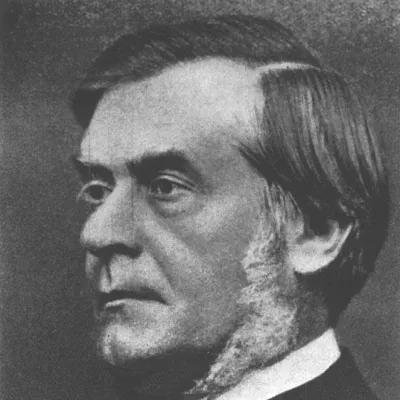
Rudolf von Roth
Human Design Chart
Biography
Roth was educated at the universities of Tübingen and Berlin. He continued his studies in Paris and London, and in 1848 was appointed as extraordinary professor of Oriental languages in Tübingen University, becoming a full professor and principal librarian in 1856. He died on 23 June 1895 at age 74 in Tübingen.
What does Projector 5/1 mean for Rudolf von Roth?
Projector 5/1 — Design at a Glance
Rudolf von Roths design points to a tendency towards precise system analysis. As a projector, he did not have an intrinsic energy source like other types but rather had a dense, focused aura that worked similarly to a bright flashlight: it shone light directly on areas in his surroundings that were still dark or functioning suboptimally. Rudolf von Roth thus showed himself as someone who could immediately recognize errors in systems. This ability, however, carried a specific risk: when he pointed out these flaws abruptly, it often felt like glaring light into the face of others and provoked defense or anger rather than awareness.
His effective strategy was not to push actively but to wait for a respectful invitation from his environment. By harmonizing his own path, he became attractive; others came to him naturally seeking advice. Since his sacral center was undefined, he lacked the consistent life energy of a generator. Instead, he experienced phases of high work intensity followed by necessary rest periods for regeneration. Ignoring this need for pauses led to burnout. Living according to this rhythm and waiting for invitations rewarded him with success; deviating from it sooner or later led to his non-self theme: bitterness.
Ego Authority
Rudolf von Roths design features a rare inner authority: the authority of the ego. This configuration appears only in projectors or manifestors whose emotional, sacral, and spleen centers are open while the egocenter is defined. This great openness in the graphic combined with strong suggestibility facilitated distractions. His truth lay in his will, which was evident in his words. Rudolf von Roth had to learn to listen to himself when speaking to distinguish between when reason spoke and when the egocenter did. Spontaneous, uncensored statements aligned with his truth; reason served the open centers, often pursuing foreign interests. When he acted on something truly important to him, he possessed the willpower to achieve goals and keep promises. Consistently following his will could appear selfish to others; it was crucial that he stood by himself. For him, his activities had to be rewarding in some way, encompassing a desire for material success and possession. Alternatively, this meant the will to be first, surpass limits, and leave conventional paths, enabling him to guide others into new directions. After achieving goals, a pause was necessary; continuous work did not yield desired results but led to unhealthy exhaustion and illness.
The 5/1 Profile — Heretic / Investigator
Rudolf von Roth showed himself as someone with deep, specialized knowledge that he offered to others for problem-solving. His design as a 5/1 profile – Hero/Researcher – shaped this dynamic: Line 1 fostered intensive research and a solid knowledge base, while Line 5 gave him almost magnetic appeal. Others sought him out specifically to find solutions, which could quickly lead to exhaustion if clear boundaries were not set.
This tension between the need for withdrawal to learn and external expectations was central to his experience. Line 5 demanded objectivity and impartiality, especially in crisis situations, to secure material success. Simultaneously, Line 1 emphasized secret alliances and hidden relationships. Rudolf von Roth gained influence not through open confrontation but by mastering these subtle, often unspoken alliances. Revealing such structures would have weakened his power; instead, he used this discreet level for transformation and advancement within his community.
The challenge lay in maintaining the beneficial balance: taking time for personal research (Line 1) without being overwhelmed by constant requests from the environment (Line 5). Only through learning to say no could he optimally use his gifts and avoid ending up as an exhausted expert whose inbox was overflowing with further demands. His path was marked by striving for this equilibrium between private depth and public effectiveness.
Single Definition — Defined & Open Centers
Rudolf von Roths design points towards a tendency for a stable, self-determined identity paired with the ability to consistently utilize his own resources. His defined G Center gives him a clear sense of direction in life and a deep feeling of belonging; he intuitively knows where he belongs without having to rely on others. Combined with the defined Heart Center, he has consistent willpower. He can give promises and keep them, which strengthens his self-esteem. He prefers following his own rhythm and applying his energy precisely where he sees success rather than being driven by external expectations.
This inner strength contrasts with the sensitivity of his open centers. His open Head Center makes him vulnerable to mental pressure; he tends to get entangled in other people's issues or seek inspiration to resolve uncertainties instead of insisting on clear answers. Similarly, his open Ajna Center: He absorbs ideas and concepts from the environment but cannot identify them as his own, consistent truth. This often led him to pretend certainty about things to find acceptance, even though his mind was actually open for new perspectives.
Also, the open centers Throat, Sacral, Solar Plexus, Spleen, and Root influence his dynamics. Without a defined Throat Center, he does not attract attention through constant talking but waits to be invited to speak. His open Sacral Center means no constant energy flow; he absorbs others' vitality, which can lead to exhaustion if boundaries are neglected. Emotional waves from the environment are absorbed and amplified by his open Solar Plexus Center, making him often experience foreign moods as personal crises. The open Spleen Center generates latent survival anxiety; he tends to cling to situations or people that provide a false sense of security rather than following impulsive decisions. Finally, his open Root Center absorbs external stress, making him vulnerable to chaos and burnout if he tries to escape this pressure through hyperactivity.
Channels for pioneering spirit and universal love.
Rudolf von Roth showed himself as someone who not only lived competitive energy but also awakened and strengthened it in others. His design includes the Initiation Channel 51-25, connecting the Heart Center with the Shock Gate (51) and Holy Spirit Gate (25). This configuration combines the driving force to be first with a universal love for the beauty of all things. For Rudolf von Roth, initiation is an art: He recognizes the potential for individualization in others and can provide the necessary 'shock' when invited, catapulting people out of their comfort zones towards deeper self-awareness. This process transforms collective 'we are' into a strong 'I am'.
Additional energies also influence him. Gate 21 brings the necessity of control over material circumstances as well as the need for respect in service to the community. Gate 48 gives him the ability to recognize deep patterns and logically correct them, though this sometimes leads to frustration because knowledge is not always directly applicable. Gate 54 links worldly success with mystical insight; for him, material achievements often precede spiritual development, supported by close partnerships. Finally, Gate 53 enables him to pioneer new paths and leave old cycles behind, but the lack of a clear conclusion occasionally triggers depressive phases when new experiences do not bear fruit. Gate 10 in his G Center guides his behavior through genetically fixed rules that help secure survival through appropriate action in complex situations. Rudolf von Roth uses this combination to advance both himself and his environment by living authentically and allowing initiation rather than forcing it.
Individual Circuitry — Circuit Signature
Rudolf von Roth's design shows him as someone whose inner structure is strongly oriented towards self-determination and personal conviction. His Human Design has a Simple Definition, meaning that his energetic centers are clearly separated from each other and he does not need external energies to form a complete picture. This promotes an independent way of being.
Central to this orientation is the active Centering Circuit in him. In Rudolf von Roth, this circuit specifically connects the Identity Center with the Heart Center. This connection creates a closed loop between his divine identity and self-worth. The energy pulses internally, leading to a fortified, courageous personality. He lives by the attitude: 'I am as I am.' This strengthens not only him in his individuality but also encourages others to accept their own uniqueness.
However, since this circuit does not connect with the Throat Center, his firm convictions are often hard to articulate verbally. The power lies in inner knowledge and authenticity rather than external rhetoric. Through the simple definition, this energy remains isolated without being diverted or diluted through other channels. Rudolf von Roth thus lives in a clear, if introverted certainty of himself, which protects him from internal fragmentation and provides a stable basis for his actions.
Left Angle Cross of Endeavour 1
Rudolf von Roths design encouraged a tendency to channel one's own strength through consistent and often laborious efforts. He was someone whose path was not determined by spontaneous inspiration or external coincidences, but rather by conscious and disciplined work on tasks. This attitude stemmed from the mechanics of his left cross effort: a configuration aimed at systematically organizing inner resources and transforming them into concrete results. It wasn't an impulsive drive, but a structured endurance that could only fully unfold through overcoming obstacles. Rudolf von Roth lived this dynamic as a continuous task where the value of action lay in the quality of the effort itself. His design challenged him to not seek quick solutions, but rather prioritize the depth and sustainability of his efforts. This shaped his approach to challenges: he did not avoid or superficially adapt, but met them with thoughtful yet strenuous consequences. The energy of this cross acted as an inner compass guiding him where patience and persistence were required. Thus, a pattern emerged in which personal development was inseparably linked to the ability to focus on long-term goals while maintaining necessary inner stability.
Saturn Return · Uranus Opposition · Chiron Return · 2nd Saturn Return — Life Cycles
Rudolf von Roths design inclined towards structural anchoring, manifesting clearly in professional and social stations. In 1848, at age 27, he was appointed Extraordinary Professor for the Indian branch of Oriental languages. This coincided with his first Saturn Return, a cycle often condensing years of groundwork into sustainable results and laying professional foundations.
Later, in 1872 at age 51, he received the personal noble title 'von Roth'. This marked his Chiron Return, a fulfillment cycle of blooming. Here, one's incarnation cross increasingly unfolds in life; meaning and purpose become experiential if lived according to strategy and authority. It was not about healing old wounds but visible confirmation of the life path through external recognition. Both events illustrate how Rudolf's design translated inner developmental steps into concrete societal positions: first professional establishment in young adulthood, later social integration and appreciation midlife.
Projector · Ego Authority — Synthesis
Rudolf von Roth lived deeply rooted in observation and analysis. His Projector design paired with defined G Center (Love, Identity, Direction) points to a natural ability to recognize the potential of others and guide them – always from clear inner orientation. The connection through Initiation Channel (51/25) amplified this tendency by encouraging others to tap into their own potential while simultaneously perceiving beauty in all living things. His Profile as Hero/Researcher (5/1) underscores this process: he actively sought solutions for complex problems and shared his knowledge willingly, always focusing on deeper understanding.
A central paradox shaped his path. The openness of his centers, especially linked with authority in the ego, created a tension field between the need for recognition and the risk of being influenced. While inspiring others through insights (Channel 51/25), he had to ensure that spontaneous expressions from the ego did not lead to distractions or prioritize other people's interests over his own. Evidence of professional advancement and societal recognition (Saturn Return, Chiron Return) showed how this tension field manifested repeatedly throughout his life.
1 Defined Channel
Incarnation Cross - Left Angle Cross of Endeavour 1
Solar Return
The Solar Return shows the moment when the sun returns to its exact birth position - your personal solar year.
Life Cycles
Discover the life cycles with a detailed triple view (birth chart, cycle chart, composite).
Human Design Profile
- Type
- Projector
- Strategy
- Wait for the respectful invitation
- Authority
- Ego Authority
- Profile
- 5/1 - Heretic / Investigator
- Definition
- Single Definition
- Incarnation Cross
- Left Angle Cross of Endeavour 1
- Date of Birth
- 03.04.1821 16:00
- Place of Birth
- Stuttgart, GER
Frequently Asked Questions
What was Rudolf von Roth's Human Design type?
Which Profile did Rudolf von Roth have?
What was Rudolf von Roth's Authority?
What incarnation cross was assigned to Rudolf von Roth?
When was Rudolf von Roth born?
Discover your own Human Design
Are you also a Projector? Find out in a personal reading how to unfold your leadership qualities and recognize the right invitations.
More Personalities
Back to overviewSissy Spacek

Alain-Fournier

Anémone

Ann-Margret

Bourvil
Hergé