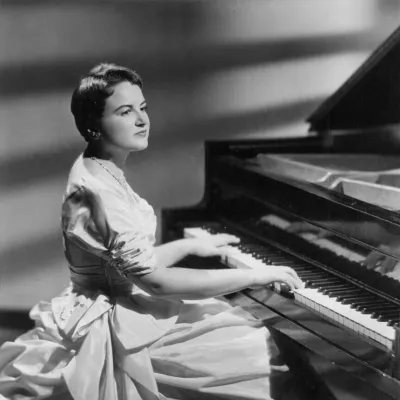
Photo: Wikimedia Commons
Ruth Slenczynska
Human Design Chart
Biography
Her first marriage turned out a continuance of her domination, her husband pushing her career until she divorced him. She made a second marriage in August 1967. Slenczynska continues her concert career at a schedule of her own choosing.
Ruth Slenczynska as a Projector 5/1 in Human Design
Projector 5/1 — Design at a Glance
Ruth Slenczynska's design inclined towards a focused and penetrating perception. As a projector, she did not have an intrinsic constant energy source but acted like a bright flashlight that was directed specifically to places in her environment that were still dark or not functioning optimally. This configuration gave her the ability to recognize errors in other people's systems immediately.
The challenge of this type lay in not addressing these insights directly and confrontationally, which often triggered resistance. Instead, her impact was strongest when she herself embodied harmony and guided others without lecturing them. Her strategy involved waiting for an honest invitation from her surroundings. People were drawn to her clear aura and actively sought her advice.
This mechanism protected her from energy depletion. Since projectors must alternate phases of high activity with necessary rest periods to avoid burning out, waiting for the invitation was crucial for their maintenance. If Ruth Slenczynska lived according to this pattern, she was rewarded with success. Ignoring this rhythm and acting without an invitation or taking on too much work against her natural energy flow led sooner or later to a feeling of bitterness as an expression of her non-self. Her design thus demanded restraint in action but presence in perception.
Emotional Authority
Ruth Slenczynska's design inclined towards emotional depth and fluctuation. She was someone whose inner truth did not lie in the first reaction, but only emerged after emotions had subsided. Her inner authority was Emotional Authority carried by the defined Solar Plexus Center. In Human Design mechanics, this center always carries authority regardless of which other centers are also defined; this priority is a central mechanism.
This design meant that Ruth Slenczynska was under permanent emotional waves. Her perception of the world was always colored by her current mood: at one moment she could be enthusiastic about something, in the next view it negatively. However, these immediate feelings were only snapshots and not yet her deeper truth. Therefore, quick decisions based on such emotions risked negative consequences.
Her path to clarity required patience and time. By letting decisions ripen and sleeping multiple times, she gained emotional distance. The intense feelings subsided over time, allowing for calmness and true insight. This process was particularly crucial for long-term life decisions. Only through this waiting and hesitation could she distinguish the temporary emotional coloring from her actual inner direction and act accordingly.
The 5/1 Profile — Heretic / Investigator
Ruth Slenczynska's design was characterized by a specific dynamic: She appeared to others as a source of deep knowledge that she willingly used for problem-solving. As a person with Profile 5/1 – the
Split Definition — Defined & Open Centers
Ruth Slenczynskas Design reveals a tendency towards self-determined willpower and a deep emotional process. She had a defined Heart Center, which gave her permanent access to her own energy source for decisions and commitments; she preferred to control her resources herself and required recognition for her contribution. Parallel to this, her Solar Plexus Center was also defined, making emotions the foundation of her inner authority. She demonstrated patience by waiting out the emotional wave before acting, as clarity only emerged at the end of this cycle. Her defined Spleen Center provided a reliable instinct for health and well-being in the present moment, while her defined Root Center supplied constant pressure to move forward and survive.
In contrast, her mental and communicative areas were receptive to external influences. Her open Head and Ajna Centers meant that she did not have a consistent mental truth but tended to absorb doubts or confusion from others when she did not trust her inner authority. She was designed to use ideas as classrooms rather than holding them as personal convictions. Her open Throat Center showed an attraction that drew attention to herself; attempting to actively seek approval often led to stress and unwanted resistance. The open G Center implied that her identity and direction crystallized only in correct relationships and contexts; she relied on being initiated rather than setting a fixed life plan. Finally, her open Sacral Center acted as a mirror for the energy of the environment. She tended to become overwhelmed by "borrowed" energy if she did not consciously take breaks and set boundaries, since her own energy flow was inconsistent. This configuration required a constant balance between her strong inner willpower and sensitive reception of external impulses.
Channels for instinctive devotion and emotional waves.
Ruth Slenczynska's design was characterized by instinctive alertness paired with the ability to consciously use her own emotional wave motion. She had a deep sense of what was needed in her environment or "tribe" and could convincingly convey this.
The Channel of Devotion 44-26 connected her Spleen Center with the Heart Center. This gave her entrepreneurial intelligence: she used historical memories and instinctive warning signals (Gate 44) to sell solutions or products through willpower (Gate 26), which were felt as improvements. This mechanism served as a primary health network in the body, instinctively recognizing threats and manipulating the tribe for survival—not out of malice but from the necessity to use resources efficiently. Ruth Slenczynska could intuitively assess which message or offer would fall on fertile ground at any given moment and spontaneously adapt her communication to the market.
At the same time, the Channel Release Emotions 39-55 shaped her inner experience. This channel connected the Root Center with the Solar Plexus Center, generating a pulsating wave between joy and melancholy. Ruth Slenczynska was compelled not to rationalize this moodiness but to live it as authentic emotional alchemy. Through provocation (Gate 39), she could engage and provoke others' minds while being grounded in the depth of her emotional truth (Gate 55). Her impact depended heavily on her current mood; when she lived authentically, she radiated a seductive warmth or passionate intensity that often found artistic expression.
Additionally, Gates like Gate 61 (inner truth and silence) as well as Gate 50 (protective reflex and tradition) gave her a strong internal value system and defensive alertness. Gate 3 in the Sacral Center drove her towards mutation and adaptation, while Gate 62 brought logical structure and attention to detail into her work. This combination allowed her to navigate between instinctive intuition and emotional depth, always mindful of finding the right balance between rest and productive use of her gifts.
Individual Circuitry — Circuit Signature
Ruth Slenczynska's Design indicated a tendency towards emotional intensity and strategic resource utilization, which did not appear as a unified flow. Her Shared Definition separated these forces into two parallel areas: the emotional drive and the strategic action.
Her Knowledge Circuit connected Solar Plexus Center and Root Center through Channel "Emotionen freisetzen". This created a pulsating, acoustically effective energy that responded to emotional waves. She sought her unique path to transform new knowledge and initiate change. This process followed the rhythm of her feelings – sometimes melancholic, sometimes creative – thereby manifesting her unique individuality through expression in Throat Center.
Completely separate from this was the Ego Circuit, which connected Heart Center and Spleen Center through Channel "Hingebung". Here it was not about individual identity but cooperation and the joint creation of resources in the trunk. This connection promoted the gift of mediation and communication as well as a good balance between giving and taking. Since this area did not have a direct connection to Sacral Center, there was no constant life force; instead, pauses were necessary to build energy for material wellbeing and mutual support. Ruth Slenczynska thus lived with two distinct energetic systems: an emotionally-driven impulse towards transformation and a strategically-cooperative approach to resource management that never directly merged into one another.
Left Angle Cross of Obscuration 2
Ruth Slenczynska's Human Design carried the imprint of the left cross of Veiling. This configuration was characterized by a deep, often unconscious search for the essential, combined with a natural inclination to hide or veil things—not out of malice but as a protective mechanism for her innermost self. She lived in a tension field between the urge to uncover the truth and the necessity to protect certain aspects of herself from the outside world.
This cross acted like an internal compass driving her to seek hidden patterns behind the facades of everyday life. Simultaneously, veiling served as a filter: she intuitively decided which parts of her experiential world could be shared and which had to remain secret. This dynamic created a complex inner world where clarity and confusion coexisted side by side. Ruth Slenczynska navigated through her life with this dual energy—open to deep insights on one hand, yet reserved about revealing her true motives or feelings. It was a path of constant weighing between transparency and protection that significantly influenced her actions and decisions.
Saturn Return · Uranus Opposition · Chiron Return · 2nd Saturn Return — Life Cycles
Ruth Slenczynska's Human Design showed a tendency towards profound structural changes in her relationships, often as a response to internal processes of maturation and freedom. This dynamic became visible through specific astrological-human-design cycles that shaped her interpersonal bonds.
In 1953, at the age of 28, Ruth Slenczynska divorced from her husband. This coincided with her first Saturn Return, a time when years of internal work and maturation often culminate in necessary structural clarification. For her design, this moment marked not only an end but also a consolidating phase where she redefined personal boundaries and commitments to lay the groundwork for the future.
The quest for autonomy and new orientation continued. In 1967, at the age of 42, Ruth Slenczynska married political scientist James Kerr. This occurred during the Uranus Opposition, a cycle typically associated with a need for personal freedom and questioning existing structures. For Ruth Slenczynska, this period signaled a conscious decision towards partnership that respected her growing independence and desire for an equal relationship. The mechanics of her design thus promoted not static binding but a dynamic process of adaptation where she continually renegotiated her identity in relationships and approached her inner authority.
Projector · Emotional Authority — Synthesis
Ruth Slenczynska lived a life marked by a deep drive for understanding and the ability to recognize hidden patterns (Channel 44-26). Her Profile as Hero/Researcher (5/1) indicates that she gathered knowledge and wanted to make it available to others—a tendency reinforced by her defined Heart Center, which emphasizes self-determination and keeping promises. This combination led to an inner motivation to solve problems and offer solutions, with a focus always on deeper understanding (Knowledge Circuit). Emotional authority required time for decisions, yet the ability to perceive moods contributed to fine-tuned awareness of what was happening in others.
A central paradox of her nature lay in the tension between the Projector design—designed to identify system errors and shed light into darkness—and emotional authority that needed maturing time for decisions. She quickly saw what wasn't working (Projector), yet the emotional wave demanded patience before she could communicate her insights. This might have led to internal conflict, as the need for immediate clarity clashed with the necessity of considering decisions over a longer period. A documented event during her Saturn Return (1953) points to an encounter with relationship patterns, while the Uranus Opposition (1967) signaled change and new connections.
2 Defined Channels
Incarnation Cross - Left Angle Cross of Obscuration 2
Solar Return
The Solar Return shows the moment when the sun returns to its exact birth position - your personal solar year.
Life Cycles
Discover the life cycles with a detailed triple view (birth chart, cycle chart, composite).
Human Design Profile
- Type
- Projector
- Strategy
- Wait for the respectful invitation
- Authority
- Emotional Authority
- Profile
- 5/1 - Heretic / Investigator
- Definition
- Split Definition
- Incarnation Cross
- Left Angle Cross of Obscuration 2
- Date of Birth
- 15.01.1925 07:45
- Place of Birth
- Sacramento, CA, United States
Frequently Asked Questions
What is Ruth Slenczynska's Human Design type?
What Profile did Ruth Slenczynska have?
What authority did Ruth Slenczynska possess?
What incarnation cross was determined for Ruth Slenczynska?
When was Ruth Slenczynska born?
Discover your own Human Design
Are you also a Projector? Find out in a personal reading how to unfold your leadership qualities and recognize the right invitations.
More Personalities
Back to overviewSissy Spacek
Aaliyah

Alain-Fournier
Alexia

Alizée

Anémone