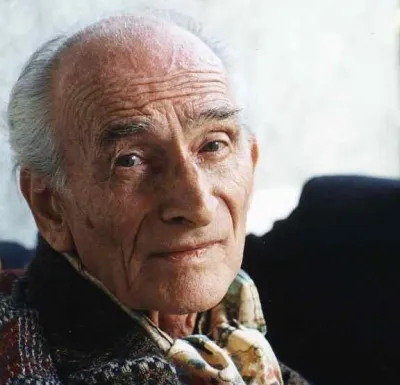
Sam Peckinpah
Human Design Chart
Biography
Raised on a ranch on Peckinpah Mountain in the Sierras east of Fresno, Sam's dad was a judge and his mom a Christian Scientist from a family with money. He had one brother, Denver. Growing up under the strict discipline of military school, after graduation he joined the Marines during World War II with a tour of duty in China.
When he returned he enrolled in the University of Southern California, graduating with a master's degree in drama. He got a job sweeping floors in a Los Angeles TV station in 1953 and was fired because he wouldn't wear a suit. Hired as fourth assistant casting director by Allied Artists, he moved up to dialogue director then played a bit role in the original "Invasion of the Body Snatchers." After being asked to write episodes for TV's "Gunsmoke," "Tales of Wells Fargo" and other Westerns, he began writing and directing his own TV series, "The Rifleman," in 1959.
Peckinpah's first film, "The Deadly Companions," was in 1961. A creative man, his films were known not only for their technique of showing gritty, realistic violence in slow motion but also for the psychological motivations behind the actions. His "Ride the High Country" won awards from Brussels, Paris and Mexico. "The Wild Bunch" was released in 1969 and although he was called brilliant, the film earned him the title of Picasso of Violence. In December 1971 "Straw Dogs" was released.
A genius and a perfectionist, Sam would spend 24 hours a day in the cutting room getting editing just right if the union would allow it. He hated stupidity and wanted to control everything from direction to cutting of his films. In later years he was blacklisted as a difficult man, a drinker and a fighter, but was nonetheless given the chance to direct "Noon Wine" for TV, airing on 23 November 1966. His reputation as a genius was reinforced.
What does Manifesting Generator 3/5 mean for Sam Peckinpah?
Manifesting Generator 3/5 — Design at a Glance
Sam Peckinpah's design inclined him towards hybrid working: He had the constant, sacral energy of a Generator but also possessed Manifestor qualities through active connections between his Motor Centers and Throat Center. This created a hybrid character trait that allowed for quick action. Sam Peckinpah could skip steps and rapidly draw things into his life. However, this speed was a double-edged sword. Often he acted too quickly and skipped necessary intermediate steps, leading him to have to backtrack later and make up missed sections. Such feedback loops caused frustration as they worked against his internal rhythm.
Furthermore, Sam Peckinpah tended to pursue multiple projects simultaneously, driven by various impulses. Without clear inner consent, this multi-layered approach threatened to turn into exhaustion. His strategy was not to initiate himself but to react to life's impulses and only act when his Sacral Center responded with a clear "yes." When correctly applying this reactive tactic, he drew deep satisfaction from his work. Variety was essential for him; the compulsion to complete one thing before starting another would have blocked his energy. Instead, he fell into a play mode where parallel working and spontaneous reorientation fueled his creative power and allowed him to function satisfyingly despite the complexity of his hybrid nature.
Emotional Authority
Sam Peckinpah's design inclined towards intense emotional waves that significantly shaped his perception of the world. With his Emotional Center defined, it served as an inner authority – a mechanism that always took precedence in decisions regardless of other defined centers. This did not mean he acted arbitrarily but rather that his feelings had to be filtered before any choice was made.
His emotional state fluctuated constantly; at one moment he could be enthusiastic about an idea, and the next moment view the same situation negatively. His immediate feeling was only a fleeting coloration, not an ultimate truth. Quick, spontaneous decisions from this emotional heat often proved problematic as they were based on unresolved moods.
The strategy of his design required patience: He needed time to let a decision mature. By sleeping on important questions multiple times, the intense feelings gradually subsided. Only when he had gained emotional distance and clarity along with calmness did he complete the inner process. This cycle of initial emotion followed by later detachment was essential for long-term life decisions that profoundly influenced his path. Without this waiting period, he risked sinking into the flood of the moment rather than recognizing the deeper, more comprehensive truth of his emotional authority.
The 3/5 Profile — Martyr / Heretic
Sam Peckinpah's design inclined him towards a heroic adventurous spirit, paired with the role of the cool storyteller. As a person of Profile 3/5 – Experimenter and Hero – he initially believed nothing was predetermined and had to try everything himself. This Line 3 drove him to accumulate practical knowledge through his own experiential values, including failures. This authentic understanding derived from life experience shaped his presence: others felt drawn to his rich treasure trove of experiences and sought advice from him. Here, the Hero Line (Line 5) came into play, aiming to solve other people's problems with this self-learned knowledge. This role of the rescuer appealed to his nature but could be painful when experiments failed in public. His presence was also marked by a certain power presence as described by Gate 34 on Line 5, which often became effective only during crisis times. At the same time, there was an adaptability (Gate 55) that oscillated between innocence and authenticity. His path involved overcoming resistance through his own experiments to find a truth he then passed on as an authority – not out of dogma but from lived practice.
Triple Split Definition — Defined & Open Centers
Sam Peckinpah's Design was characterized by an immense and always available energy source in his defined Sacral Center. This vital force generated a constant inner hum and the urge to be active. His willpower was also established: The defined Heart Center gave him the ability to keep promises and determine his own worth. He preferred to be the boss so he could work and take breaks according to his internal rhythm.
This structural stability, however, operated within a complex emotional field. His defined Solar Plexus served as an inner authority; he had to wait out the emotional wave before clarity emerged. Impulsive decisions made at the peaks or troughs of this wave often led to chaos and later regret. Only through patience could he utilize his emotional depth without putting pressure on others.
At the same time, his Throat Center was defined, giving him a consistent way of communicating. Since it was connected to motor centers, there was a risk of talking too much or acting impulsively if he did not listen to his strategy. His truth came out best when he responded trustingly rather than initiated actions.
The open centers shaped his vulnerabilities. The open G Center meant that he did not carry a fixed identity but instead absorbed it from the environment around him. He tended to question who he really was and what the right direction might be, often depending on where he was and whom he was with. The open Head and Ajna Centers made him susceptible to mental confusion. He could get caught up in endless questions posed by others or try to find answers that were not his own, rather than trusting his intuitive Spleen Center, which gave clear warning signals at the moment of truth. His defined Root Pressure drove him forward, yet without inner alignment, he risked projecting unhealthy stress onto others or becoming obsessive.
Channels for charisma, devotion and emotional release.
Sam Peckinpah exhibited a fundamental disposition marked by an urgent physical energy. His design featured the Channel of Charisma 34-20, which channeled raw physiological power from the Sacral Center directly into immediate expression in the Throat Center. This connection created a constant internal pressure to move “now”; stillness was nearly impossible for him as generative power and manifesting impulse seamlessly merged. His vitality arose through self-absorption in activities that resonated with his inner rhythm – not due to external expectations.
At the same time, he had an instinctive sense of what the "tribe" or his environment needed. The Channel of Devotion 44-26 linked his intuitive awareness (Spleen) with arbitrary strength (Heart). This gave him the ability to present products or ideas persuasively and accurately gauge what would attract others – often before they knew it themselves. He acted like an entrepreneur who mobilized resources to realize a vision.
Emotionally, Sam Peckinpah was governed by a pulsating wave. The Channel of Emotional Release 39-55 connected the provocative energy of the Root Center with the emotional Solar Plexus. This produced mood swings that oscillated between ecstatic joy and melancholic uncertainty. His authenticity lay in not rationalizing these fluctuations but using them as driving forces for his creative depth. Only when he was in the right "mood" could he unleash his full passion; forced actions without inner resonance led to internal conflict.
Additionally, Gates like Rhythm (5) and Openness (22) influenced him to follow his own life rhythms and patiently await mutations in his environment without imposing himself. His design required that he invest energy only where there was genuine inner confirmation, ensuring his charismatic presence remained healthy and inspiring.
Individual Circuitry — Circuit Signature
Sam Peckinpah's Design established a tendency towards separate, parallel energy flows. As a Triple-Defined individual, he had three independent power centers that were not connected to each other but rather functioned as autonomous modules. This shaped his experiential world through clearly delineated functional areas instead of a single continuous stream.
The Mental Circuit linked his Solar Plexus Center with the Root Center. Through Channel "Release Emotions" (Gates 55–39), there was a pulsating, acoustic energy at work. This promoted the ability to transform inner emotional waves into immediate, transformative impulses and thus find new expression.
Parallel to this, the Ego Circuit formed a connection between Heart and Spleen Centers. Here, Channel "Devotion" (Gates 26–44) stood for cooperation and the joint creation of resources. Since this flow did not draw direct life force from the Sacral Center, this kind of giving and taking required conscious rest periods for regeneration.
A third, isolated stream was created through the Integration Circuit, which connected Throat and Sacral Centers. Channel "Charisma" (Gates 20–34) allowed drawing power from reactions to life and channeling it in the present moment through intuitive knowledge. This configuration supported a highly individual expression that drew directly from vital life energy but operated independently of the other two systems.
Right Angle Cross of the Sleeping Phoenix 1
Sam Peckinpah's design carried the signature of the right cross of the sleeping Phoenix. This configuration set a specific inner tension arising from the combination of Gate 40 in the emotional center and Gate 17 in the logical center. In the emotional center, there was a need for deep trust and the feeling of being loved, often accompanied by some uncertainty or despair when this emotional security was not present. Simultaneously, the logical center brought the power of creation and manifestation of new ideas.
The mechanics of this cross described a process where inner emotional turbulence or the feeling of "sleeping"—that is, temporary disorientation—was not seen as an end but rather as a necessary prerequisite for a powerful rebirth. The energy of the Phoenix often required a descent into darkness or a phase of isolation to emerge with renewed clarity and creative power. Sam Peckinpah was marked by this structure with an intense inner dynamic where emotional fluctuations were not perceived as weakness, but rather as the motor for transformative acts of creation. The connection between emotional flow and logical implementation created a unique quality that allowed him to develop new, often radical perspectives from personal crises or feelings of loss.
Saturn Return · Uranus Opposition · Chiron Return · 2nd Saturn Return — Life Cycles
Sam Peckinpah's Design indicated a tendency towards intense, condensing life phases where inner maturity and external recognition converged. This was evident in 1974, at the age of 49, when "Bring Me the Head of Alfredo Garcia" was released. For his Human-Design chart, this marked the Chiron Return – a fulfillment cycle between the ages of 49 and 51. During this phase, one's personal Cross unfolds increasingly in life if they follow their Strategy and Authority; meaning and purpose become experiential without focusing on healing old wounds. The release of his film was an expression of this blooming period when his creative essence fully came into its own.
Later, in 1983 at the age of 58, Peckinpah directed "The Osterman Weekend," his last film assignment. This coincided with his second Saturn Return. The second Saturn cycle often brings a final structuring and consolidation of one's life work up to that point. Here, years of experience condensed into a solid conclusion to his cinematic career. His Design showed how these astrologically specific Human-Design cycles shaped his career: first the bloom of self-realization through the Chiron Return, followed by structural reinforcement and the end of a major chapter due to the second Saturn influence. Both events illustrate how deeply rooted mechanical patterns accompanied and formed his work throughout.
Manifesting Generator · Emotional Authority — Synthesis
Sam Peckinpah lived a life marked by a strong urge to act and a deep reaction to the environment. The combination of manifesting and generative qualities (Design View) led him to quickly recognize and seize opportunities – an energy reinforced by his defined sacral area. However, this quick action often came at the cost of skipping necessary steps, forcing him to return to his decisions (Design View). Emotional authority demanded a maturation of choices, yet the sacral energy and the charisma channel (Channels/Gates) pushed him to act immediately.
A central paradox in his design lay in the interplay between the need for expression and the necessity to wait on external impulses. The defined Throat Channel (Centers) points to a strong communicator whose voice should be channeled through sacral reactions. This created tension between the desire to implement visions directly and the wisdom of responding to the right moment – a dynamic that played out in career turning points (Cycles), where creative energy was linked with strategic patience (Circuit).
3 Defined Channels
Incarnation Cross - Right Angle Cross of the Sleeping Phoenix 1
Solar Return
The Solar Return shows the moment when the sun returns to its exact birth position - your personal solar year.
Life Cycles
Discover the life cycles with a detailed triple view (birth chart, cycle chart, composite).
Human Design Profile
- Strategy
- To respond - wait for something to respond to
- Authority
- Emotional Authority
- Profile
- 3/5 - Martyr / Heretic
- Definition
- Triple Split
- Incarnation Cross
- Right Angle Cross of the Sleeping Phoenix 1
- Date of Birth
- 21.02.1925 14:15
- Place of Birth
- Fresno, CA, United States
Frequently Asked Questions
What was Sam Peckinpah's Human Design type?
What Profile did Sam Peckinpah have in Human Design?
What Authority did Sam Peckinpah have?
What incarnation cross was Sam Peckinpah assigned to?
When was Sam Peckinpah born?
Discover your own Human Design
Are you also a Manifesting Generator? Find out in a personal reading how to unfold your multi-talents and direct your energy wisely.
More Personalities
Back to overviewAldair
Alizée

Angeli
Arletty
Artus

Balthus