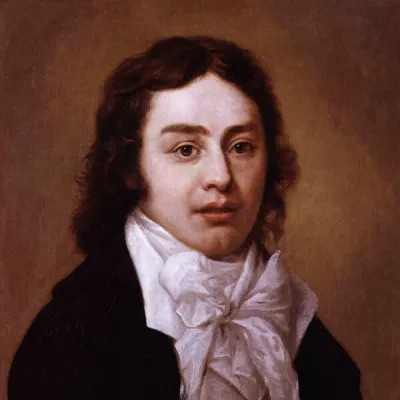
Samuel Taylor Coleridge
Human Design Chart
Biography
Coleridge wrote the poems The Rime of the Ancient Mariner and "Kubla Khan", as well as the major prose work Biographia Literaria. His critical works were highly influential, especially in relation to William Shakespeare, and he helped introduce German idealist philosophy to English-speaking cultures. Coleridge coined many familiar words and phrases, including "suspension of disbelief". He had a major influence on Ralph Waldo Emerson and American transcendentalism.
Throughout his adult life, Coleridge had crippling bouts of anxiety and depression; it has been speculated that he had bipolar disorder, which had not been defined during his lifetime. He was physically unhealthy, which may have stemmed from a bout of rheumatic fever and other childhood illnesses. He was treated for these conditions with laudanum, which fostered a lifelong opium addiction.
Coleridge had a turbulent career and personal life with a variety of highs and lows, but his public esteem grew after his death, and he became considered one of the most influential figures in English literature.
Samuel Taylor Coleridge — Manifesting Generator with Profile 3/5
Manifesting Generator 3/5 — Design at a Glance
Samuel Taylor Coleridge showed himself to be someone who could quickly draw things into his life. His design as a Manifesting Generator combined the constant sacral energy of a Generator with the accelerating qualities of a Manifestor. This hybrid nature allowed him to skip steps and push projects forward rapidly. However, this speed carries two specific risks: First, he tended to overlook important stages, leading to the necessity of going back and filling in missing parts – a potential source of frustration. Second, he reacted to many impulses simultaneously and began several undertakings at once. Without consistent application of his strategy, namely waiting for inner signals before acting, this creative enthusiasm could quickly turn negative. Crucial for him was confirmation from his sacral center; only when it gave a clear "yes" should he act or continue existing projects. When this condition was met, Samuel Taylor Coleridge drew deep satisfaction from his work. For him, working on several tasks simultaneously was no problem. On the contrary: The compulsion to finish one thing before starting another went against his nature. His creative power was strongest in a playful mode characterized by variety and fun, provided he responded to life rather than initiating it himself.
Sacral Authority
Samuel Taylor Coleridge was a Generator whose decision-making was shaped by sacral authority. This internal voice did not manifest as mental deliberation but rather as an immediate physical reaction to external stimuli. His design required waiting for an impulse – often felt as gut instinct, a quiet rumble or sudden surge of energy – before taking action. Once his sacral motor kicked in, Samuel Taylor Coleridge had vital energy and inexhaustible enthusiasm. He lived with the ability to immerse himself fully in activities without them being bound by strict purposefulness. Joy and satisfaction arose from the act itself, not through an external goal.
The prerequisite for this clear sacral guidance was his open Emotional Center. This meant that he did not make impulsive decisions based on fleeting moods but waited for consistent, physical confirmation from his Sacral Center. Additionally, his activated Spleen acted as a supportive authority. This connection gave him quick and spontaneous reaction capability and direct access to his instinctive perception of well-being. Samuel Taylor Coleridge could thus reliably orient himself by these bodily signals that showed when he had energy and when he needed to step back. His strategy was to respond to these inner signals, which structured his daily life and protected him from exhaustion through false initiatives.
The 3/5 Profile — Martyr / Heretic
Samuel Taylor Coleridge's Human Design profile suggests a tendency towards a heroic yet experimental way of living. As a Profile 3/5 individual – the experimenter and hero – he initially believed little in predetermined truths. Instead, he learned through personal experimentation and accumulated a wealth of practical experience. This Line 3 drove him to test things himself, even if it meant encountering failures. The knowledge gained later served him well in solving others' problems, which aligned with the heroic role of Line 5. His appeal to others stemmed from their desire to learn from his experiences. Yet this role could be painful when experiments failed in public.
Specifically, Gate 50 influenced him on Line 3, affecting adaptability and dependence on support from others to maintain personal values. Mental constraints also played a part here. Simultaneously, Gate 56 shaped how he drew attention on Line 5 through storytelling and unusual behaviour, stirring projections from his surroundings. The world expected inspiration from his stories. This pressure could lead him into situations where lying or inappropriate storytelling seemed necessary to meet high expectations. Thus, his design depicted a person who learned from personal mistakes and then shared these insights as captivating narratives, often blurring the line between genuine experience and projected expectation.
Split Definition — Defined & Open Centers
Samuel Taylor Coleridge's Human Design profile indicated a tendency towards constant mental pressure. The definition between the Head Center and Ajna Center created a permanent state of inspiration, asking questions, and wanting to understand. However, this process was disconnected from direct energy for implementation; the Throat Center served as the pivot point for communicating these concepts without having the power to immediately put them into practice in the world. Instead, the Sacral Center provided a reliable source of vital energy that was activated through reaction, enabling persistence in mastering skills. The Spleen center offered spontaneous intuition and well-being in the present moment while the Root Center supplied the necessary pressure to maintain the life impulse.
At the same time, Samuel Taylor Coleridge revealed himself as vulnerable to conditioning through undefined centers. His open G Center meant no fixed self-image; he tended to take on or seek identity and direction from his environment rather than owning them himself. The Heart Center was also undefined, which left him without constant willpower. He showed a tendency to try proving his worth through promises or competition, often leading to frustration as the energy for this was lacking. Additionally, his open Solar Plexus center absorbed emotions of others; Samuel Taylor Coleridge amplified these feelings and could personalize them as his own, making him emotionally vulnerable and prone to avoiding confrontation or losing himself in foreign moods. This openness required careful selection of environment to maintain emotional health and clear identity.
Channels for change, intuition, care, ambition and abstraction.
Samuel Taylor Coleridge's Human Design profile indicated a tendency towards sudden, deep transformation processes paired with the ability to express intuitive truths in the moment. This configuration created an inner rhythm of chaos and order that shaped his way of creating.
The Mutation Channel 60-3 connected the Root Center with the Sacral Center through Gate of Limitation (60) and Gate of Order (3). This channel brought potential for evolutionary change, dependent on accepting limitation and moving beyond the confusion of a new beginning. The energy was pulsing and often came with melancholy as it built internal tension in phases of stillness before releasing itself as a new mutation. Samuel Taylor Coleridge had to learn not to fight this moodiness but rather patiently wait for the change to flow through him.
Parallel to that, the Flash of Insight Channel 57-20 between Spleen and Throat Center worked through Gate of Intuitive Understanding (57) and Gate of Now (20), giving his intuition a clear voice. This allowed him to communicate existential knowledge and self-awareness directly in the moment. His spontaneous verbal outbursts often hit the core of an issue faster than considered answers from others, as they were based on ancient primal instincts.
The Preservation Channel 27-50 connected Sacral with Spleen Center via Gate of Caring (27) and Gate of Values (50). This gave him the ability to take responsibility for others and preserve traditional values. His aura attracted trust, yet he had to ensure that he only cared when a clear request was present to avoid overloading himself.
Additionally, the Transformation Channel 54-32 between Root and Spleen Center drove his ambition. Driven by Gate of Ambition (54) and Gate of Continuity (32), he sought ways to improve his position through talent and persistent effort. This drive was marked by fear of failure but also a desire to be seen and recognized by the tribe.
The Abstraction Channel 64-47 connected Head with Ajna Center through Gate of Confusion (64) and Gate of Understanding (47). His mind filtered every experience through mental images to recognize patterns and stories. Although this often led to mental unrest, it resulted in the ability to translate complex connections into inspiring narratives.
Individual Gates complemented this picture: Gate 56 promoted abstracting processes into illustrative tales; Gate 4 sought logical formulas for future security; Gate 42 emphasized closing experiences for new commitments; Gate 33 required calmness for reflection; Gate 29 stood for persistent saying yes to challenges; and Gate 23 supported explaining his uniqueness as part of the mutational process.
Individual Circuitry — Circuit Signature
Samuel Taylor Coleridge's Human Design profile indicated a tendency towards pulsating creativity and deep reflective capacity. His split definition created two parallel, not directly connected energy blocks: a large stem complex (Sacral, Root, Spleen, and Throat centers) as well as a separate thinking center (Ajna and Head centers).
In the Knowledge Circuit, he linked the Throat Center with the Spleen for flashes of insight as well as Sacral with Root for mutative changes. This created pulsing energy that blazed new trails. The Meaning Circuit isolated his thinking center (Head and Ajna) through the Abstraction Channel. Here, he visually reflected cyclically on past experiences, separate from his physical action power.
The Ego Circuit linked Spleen with Root Center through Transformation. Without direct Sacral connection in this circuit, Samuel Taylor Coleridge needed pauses for resource generation in cooperative contexts. Finally, the Archer Circuit connected his Sacral Center to the Spleen via the Preservation Channel. This gave him instinctive, primal energies for protection and preservation of his family, rooted in the life force of the Sacral.
This configuration marked him as someone who spoke innovative impulses from the gut while his mind simultaneously abstractly analyzed the past. The separation between thinking and acting required a balance between impulsive creation and reflective meaning-making, always underpinned by deep need for familial security and resource-preserving cooperation.
Right Angle Cross of Laws 3
Samuel Taylor Coleridge's Human Design profile suggests a tendency towards deep and often painful confrontations with the law and morality. He was someone who not only intellectually understood but also emotionally and existentially felt the burden of correctness. This stance arose from the configuration of the right cross of Laws 3. In Human Design, this structure marks a specific focus on the Root Center and its connection to the Solar Plexus through the Judgment and Intuition Channels. It's about more than superficial rules; it involves an inner, often conflict-ridden examination of what is felt as true or false. Samuel Taylor Coleridge carried this energy as a constant challenge: His perception of justice was closely tied to his emotional response, leading to intense, sometimes painful reflections on guilt and responsibility. This mechanism shaped the way he experienced the world—not as a neutral observer but as someone who directly felt the weight of moral decisions in their nervous system. It was a path of learning through conflict between what he believed to be right and what he felt. This inner tension formed the core of his experiential world, driven by a deep need to understand and live through the laws of life in all their complexity and harshness.
Saturn Return · Uranus Opposition · Chiron Return · 2nd Saturn Return — Life Cycles
In 1798, at age 26, Samuel Taylor Coleridge published *Lyrical Ballads* with William Wordsworth. For his Human Design profile, this success marked a typical moment: the first Saturn Return. In Human Design mechanics, this phase occurs approximately every 29 years and signals that long-term internal preparation and structural maturation have condensed into a tangible external result. Samuel Taylor Coleridge did not show himself as an impulsive actor during this time but rather as someone whose inner architecture was now stable enough to bundle complex creative impulses in a form that could be sustainably received by the outside world. The first Saturn Return functions here less as a sudden stroke of luck and more as confirmation that the previously lived strategy and authority had borne fruit. His collaboration with Wordsworth underscored the necessity of anchoring personal visions within a context offering stability. Samuel Taylor Coleridge used this cycle to pour his intellectual and poetic resources into a work that would have lasting impact beyond the moment. It was a phase of crystallization, in which latent potentials of his design were established concretely in social and artistic spaces without sacrificing his own integrity.
Manifesting Generator · Sacral Authority — Synthesis
Samuel Taylor Coleridge lived a life marked by a constant flow between inner drive and external reaction. As an Manifesting Generator, he possessed the ability to quickly draw things into his life (Sacral Center), yet at the same time, his sacral authority demanded that he respond to impulses rather than initiate them himself. This dynamic was reflected in his profile as an Explorer/Hero: He tried many things out (Line 3) to generate knowledge which he then made available to others (Line 5). The defined mental pressure (Head and Ajna Centers) further strengthened this process by constantly urging him to ask questions and understand things.
A central paradox in Coleridge's design lay in the interplay between Mutation and a desire for order. The Channel of Mutation (3-60) endowed him with the ability to create new things and deviate from conventions, while simultaneously there was a need for structure and limitation. This tension manifested in his creative process, often accompanied by melancholy—a sign of the pulsating energy of this circuit. A notable event at age 26, the publication of a poetry collection, indicates that he could use this internal conflict to bring something new into the world.
5 Defined Channels
Incarnation Cross - Right Angle Cross of Laws 3
Solar Return
The Solar Return shows the moment when the sun returns to its exact birth position - your personal solar year.
Life Cycles
Discover the life cycles with a detailed triple view (birth chart, cycle chart, composite).
Human Design Profile
- Strategy
- To respond - wait for something to respond to
- Authority
- Sacral Authority
- Profile
- 3/5 - Martyr / Heretic
- Definition
- Split Definition
- Incarnation Cross
- Right Angle Cross of Laws 3
- Date of Birth
- 21.10.1772 10:45
- Place of Birth
- Ottery St Mary, England, United Kingdom
Frequently Asked Questions
What was Samuel Taylor Coleridge's Human Design type?
What Profile did Samuel Taylor Coleridge have in Human Design?
What Authority did Samuel Taylor Coleridge have?
What incarnation cross did Samuel Taylor Coleridge have?
When was Samuel Taylor Coleridge born?
Discover your own Human Design
Are you also a Manifesting Generator? Find out in a personal reading how to unfold your multi-talents and direct your energy wisely.
More Personalities
Back to overviewAldair

Alizée

Angeli

Arletty

Artus

Balthus