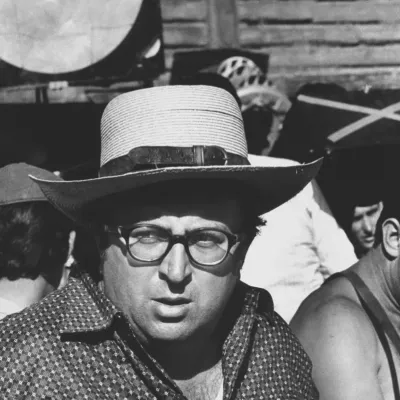
Sergio Leone
Human Design Chart
Biography
Born the son of film director Vincenzo Leone, he began his career in 1948 as an assistant director, working up to director of "The Colussus of Rhodes."
Leone died of a heart attack at his home in Rome on 30 April 1989, c.2:00 AM. He was 60.
What does Manifesting Generator 3/5 mean for Sergio Leone?
Manifesting Generator 3/5 — Design at a Glance
Sergio Leone revealed himself as someone who quickly drew things into his life and often skipped steps in the process. As an Manifesting Generator, he possessed constant sacral energy that gave him hybrid power from both Generators' and Manifestors' traits. This configuration allowed him to act with great speed but also brought specific challenges.
His tendency to tackle multiple tasks simultaneously resulted from reacting to many different impulses. Without strict adherence to his strategy – not initiating himself but responding to life – this creative drive could quickly turn into frustration. His inner authority and sacral center had to always agree; only when they gave a clear 'yes' was his action sustainably satisfying.
Despite the risk of overlooking important steps and having to catch up later, Leone found deep satisfaction in his work once he acted at the right rhythm. It wasn't a problem for him to work on various projects simultaneously. On the contrary: The compulsion to complete one thing before starting another would have slowed down his energy. His true power unfolded when he fell into a playful mode and sought variety, with regular checks ensuring that his authority continued to support the paths he had started.
Sacral Authority
Sergio Leone was a Generator whose decision-making was shaped by sacral authority. As the only type, he could directly connect his strategy – reacting to external stimuli – with his inner authority, simplifying his process. A prerequisite for this was his open emotional center, ensuring that decisions did not stem from fleeting mood swings. His inner voice manifested physically: as gut feeling, surge of energy or sounds like grunts and hums. When his sacral motor responded to a stimulus, he felt vital and energized. This reaction gave him seemingly inexhaustible energy and great enthusiasm for his tasks. He lived to go through life with joy and satisfaction, fully immersed in his work without rigid purposefulness. If his spleen center was activated and possibly directly connected to the sacral center, it acted as supporting authority. This allowed Sergio Leone particularly quick and spontaneous reactions and decisions. He had immediate access to his physical well-being and instinctive perception, guiding him reliably. This configuration described a lifestyle based on trust in these bodily signals to use energy efficiently and stay in the flow of life.
The 3/5 Profile — Martyr / Heretic
Sergio Leone revealed himself as someone who learned through personal experimentation and then presented these practical experiences to others. His design showed a tendency towards heroic adventure spirit paired with the role of a cool storyteller. As a person of Profile 3/5, he initially believed nothing given; instead, everything had to be tested by him personally. This process of trial and error formed the basis of his knowledge. From his own experiments – and also failures – he drew conclusions to solve other people's problems later on. Line 3 emphasized learning from mistakes as a core mechanism.
The second half of his profile, Hero Line 5, used this self-acquired knowledge to offer solutions. His attractiveness to others resulted from their desire to partake in his rich practical experiences. This role flattered him but became painful if he failed before an audience. Additionally, he possessed a charm that enabled him to mobilize resources to implement collective solutions during crises. However, uncertainty about his own depth could hinder action and limit experiments. Alliances for supporting conflicts often did not last long with him; they were dissolved after the end of the fight. The Sun increased his ability to maintain vitality through cooperation while egoistic alliances weakened the partners' energy. Thus, he acted as someone who activated deep processes with energy and brought them outward.
Split Definition — Defined & Open Centers
Sergio Leones Human Design shows a tendency towards relentless mental activity and consequent self-actualization. His defined Head and Ajna centers created an ongoing internal pressure to question and develop concepts. This mental energy, however, was not directly actionable; it primarily served for inspiration and conceptual thinking. To avoid turning this pressure into frustration or self-doubt, it was essential for him to patiently wait for the right moment rather than acting hastily.
At the same time, he had a defined G Center, which gave him a firm, reliable identity and a clear sense of direction. He intuitively knew where he belonged and could convey this inner security to others without being dependent on their expectations. His power source lay in his defined Sacral Center: As a Generator, he possessed enormous vital energy that was released through reaction. His mantra was “Do not initiate.” Only when he responded to questions or circumstances and received an affirmative sacral answer (“Mmmh”), full energy for lasting satisfaction became available. Initiatives from the mind led instead to resistance and exhaustion.
This stable foundation contrasted with his open centers, which made him vulnerable to external conditioning. His open Heart Center tended to constantly prove itself and make promises to demonstrate value – a game he could not win due to lacking consistent willpower. He often questioned whether he was doing enough or keeping up, leading into spirals of self-deprecation.
Similarly, his open Solar Plexus absorbed and amplified foreign emotions. He was no barometer for his own feelings but reflected the emotional climate of his environment. This often led to fear of confrontation; he avoided conflict to avoid negative reactions, suffering under the illusion that he was emotionally unstable when personalizing others' moods.
Furthermore, his open Spleen Center was marked by a fundamental survival anxiety. It desperately sought security through others, leading him to cling to unhealthy situations or people just to not lose the feeling of well-being. Spontaneous decisions were risky for him as they often stemmed from conditioned fear and could be harmful in the long run.
Finally, his open Root Center absorbed external stress. He felt the pressure of the environment as a personal urge to hurry or constantly stay active to escape this unpleasant feeling. This could lead to hyperactivity and burnout if he did not recognize that this adrenaline surge was not his own. The wisdom of his design lay in observing these external influences without accepting them as his truth or necessity, instead trusting his inner authority and sacral reaction.
Channels for rhythm, powerful impact and clear insight.
Sergio Leone appeared as someone whose internal compass was steered by a deeply rooted biological pulse. This fundamental disposition resulted from the Rhythm Channel 5-15, connecting his Sacral Center with his G Center. Gate 5 held onto fixed habits and rituals while Gate 15 integrated the diversity of society into the flow of life. This mechanism generated a magnetic pull that propelled him impersonally but powerfully forward; he followed a natural timing that felt effortless as long as it was not disturbed by external pressure.
Parallel to this, he possessed direct, manifesting power. The Charisma Channel 34-20 connected his sacral energy with his Throat Center. Gate 34 delivered raw physiological power which had to be expressed in the here and now through Gate 20. This created a drive for immediate action that often made him restless but allowed impressive achievements when properly aligned. His energy was, however, self-referential: It served his own reinforcement rather than being tapped by others.
Mentally, his system worked differently from pure logical thinking. The Awareness Channel 61-24 connected the Head Center with the Ajna Center. Here it was not about long analysis but sudden insights (Satori). Gate 61 brought inspiration from the unconscious which was rationalized through Gate 24. Knowledge came to him spontaneously; he did not have to force it but could surrender to the inner truth when it arose.
Additionally, further gates shaped his profile: Gate 38 set boundaries for individual integrity under pressure while Gate 39 generated adrenaline through provocation and analysis for mutations. Gate 21 directed material things with control in service of the community. In personality aspects, Gates 8 (Contribution), 14 (shrewd power preservation) and 12 (creative restraint) contributed to his external perception as well as visual memories from Gate 11 and mystical innocence from Gate 25.
Individual Circuitry — Circuit Signature
Sergio Leones design points towards pulsating, acoustic creativity. His split definition clearly separated the energetic fields: One stream connected the Sacral-, Identity- and Throat Centers; another the Ajna- with the Head Center. These groups worked parallel, not as a continuous flow.
In the Knowledge Circuit he activated the Awareness Channel (24-61). This channel exclusively linked his Ajna- to his Head Center in him. It was about innovative flashes of insight and deviation from the known – an energy that made new knowledge arise through intuitive inspiration, separate from his emotional or identity-forming side.
The Understanding Circuit showed itself through the Rhythm Channel (15-5). This channel connected the Identity- with the Sacral Center. Here a focused visual energy for the future worked. Sergio Leone used logic and structure to improve things and share rational insights free of conditioning. This “emotionless ratio” served to guide society in a better direction, driven by the inner rhythm of his identity.
In the Integration Circuit, the Charisma Channel (20-34) was active. It linked the Throat- with the Sacral Center. This allowed drawing strength from reacting to life and expressing it acoustically in the now. Through proper behavior and intuitive knowledge, he secured his survival and strengthened his highest individuality. The energy flowed directly from life force to voice, without detouring through mind or Solar Plexus emotions.
Sergio Leone lived these separate but potent streams: Intuition in the head, rational structure in identity, and direct, charismatic expressive strength from the life center.
Right Angle Cross of Tension 4
Sergio Leone's Design included the structure of the Right Cross of Tension Four. This configuration shaped a fundamental stance where internal tensions were not perceived as disturbing but served as driving forces. The Right Cross of Tension Four describes a mechanism in which pressure and friction within the system are utilized to focus and propel energy forward. Instead of seeking external validation or harmonious integration, this structure operated through the ability to transform conflicts and challenges into dynamic impulses.
The mechanics of this cross show a tendency to unfold in environments where differences and contrasts exist. Sergio Leone lived with an internal architecture that allowed him to endure tensions and use them productively. This did not mean a constant search for peace or balance in the classical sense, but rather an active engagement with reality, where friction functioned as a motor. The energy of this configuration was designed to grow through resistance and express itself most clearly during moments of high intensity. It was a design feature that found stability not by avoiding conflicts but through their conscious integration. This structure suggested that Sergio Leone drew his strength from mastering and utilizing internal pressure, enabling him to remain capable in turbulent situations and forge his own paths based on this specific energetic dynamic.
Saturn Return · Uranus Opposition · Chiron Return · 2nd Saturn Return — Life Cycles
Sergio Leone revealed himself as someone whose creative expression was marked by a tension between explosive breakthroughs and later internal blockages. His design featured the structure of an Uranus Reversal: a configuration that often leads to sudden, revolutionary impulses when old structures break apart. This characterized his mid-forties period. In 1971, at age 42, this energy culminated in his greatest successes with "Once Upon a Time in the West" and "The Good, the Bad and the Ugly." Here, the uranian force condensed into a groundbreaking cultural moment marked by innovation and disruption.
In contrast, later came his second Saturn return. This cycle typically marks a phase of testing where ambitions meet hard reality and often compel one to abandon plans that no longer seem viable. For Sergio Leone, this occurred in 1987 when he was 58 years old and planned the TV miniseries "Colt," but ultimately abandoned the project. This crisis was not accidental but an expression of Saturn's necessity to break through illusions and focus on what is essential. While the Uranus aspect stood for a sudden triumph, the Saturn return revealed the limits of what could be sustainably built. Both cycles together describe a life path marked by an intense, disruptive peak followed by a necessary yet challenging phase of reduction and letting go.
Manifesting Generator · Sacral Authority — Synthesis
Sergio Leone lived a life marked by a strong urge to experience and subsequently share that knowledge. His design as an Manifesting Generator (with sacral authority) indicates he was not destined for initiating but rather responded to external stimuli with constant energy – a process amplified by Line 3 in the Profile of the Experimenter. He tried things out, learned from them, and then shared his insights as something of a hero or savior (Line 5). The defined mental pressure (Head Center) points to an unceasing need to understand and ask inspiring questions, which he conveyed through his creative expression.
A central paradox in his design lay in the interplay between quick reaction and the potential for skipping important steps – a trait of the Manifesting Generator. This corresponded with cycles marked by both great success (1971) and abandoning a project (1987). Leone seemed to oscillate between the ability to swiftly push things forward and the need to go back and reassess processes, showing a dynamic tension between quick action and careful consideration.
3 Defined Channels
Incarnation Cross - Right Angle Cross of Tension 4
Solar Return
The Solar Return shows the moment when the sun returns to its exact birth position - your personal solar year.
Life Cycles
Discover the life cycles with a detailed triple view (birth chart, cycle chart, composite).
Human Design Profile
- Strategy
- To respond - wait for something to respond to
- Authority
- Sacral Authority
- Profile
- 3/5 - Martyr / Heretic
- Definition
- Split Definition
- Incarnation Cross
- Right Angle Cross of Tension 4
- Date of Birth
- 03.01.1929 00:30
- Place of Birth
- Rome, Italy
Frequently Asked Questions
What was Sergio Leone's Human Design type?
What Profile did Sergio Leone have in Human Design?
What Authority did Sergio Leone have?
What incarnation cross did Sergio Leone have?
When was Sergio Leone born?
Discover your own Human Design
Are you also a Manifesting Generator? Find out in a personal reading how to unfold your multi-talents and direct your energy wisely.
More Personalities
Back to overviewAldair

Alizée

Angeli

Arletty
Artus

Balthus