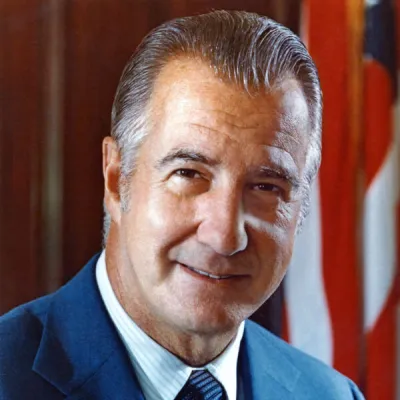
Spiro Agnew
Human Design Chart
Biography
The son of a Greek immigrant peddler, Agnew grew up during the Depression days when his dad was forced to shut down his restaurant and sell fruits and vegetables in the streets. After serving as a combat infantry officer during WW II, he earned a law degree from the University of Baltimore in 1947. He found it difficult to establish a practice and took a job as an insurance adjuster and as personnel manager for a small market chain. In the '50s, he returned to law and into politics. Tall, well built and silver haired, Agnew first came to public attention in 1966 when he won office as Governor of Maryland. His income was still comparatively modest with a salary of $25,000 a year and a limited expense account.
He was a little-known politician when Nixon picked him as a running mate in 1968; he made a name for himself with die-hard conservatism and rhetoric, colorful phrases and changes in mid-stream. He held office during one of the most turbulent periods in American history and was embroiled in racial conflicts and the role of the press, Vietnam and Watergate. A novice in national politics, he suffered from his own inexperience and clumsiness. He made such faux pas as calling a reporter "a fat Jap," using the word "Pollack," and remarking casually, "When you've seen one slum, you've seen them all." Nonetheless, he accompanied Nixon in winning the presidential office in November 1968.
In early 1973, the bludgeoning of the Watergate scandal did not seem any threat to Agnew's position. There was no evidence that linked him or his staff to the growing outcry.
Spiro Agnew as a Manifesting Generator 4/6 in Human Design
Manifesting Generator 4/6 — Design at a Glance
Spiro Agnew revealed himself as someone with constant life energy but could only effectively channel this power when responding to external impulses rather than initiating on his own. His design as an Manifesting Generator combined the endurance of a Generator with the speed of a Manifestor. This configuration allowed him to skip steps and achieve results quickly, enabling him to handle multiple projects simultaneously.
However, the central challenge lay in balancing this natural quickness with the necessity of going through all necessary processes. If he acted too hastily or pursued several things without internal consent, it led to frustration quickly. His design required him to start only when his sacral core gave a clear “yes”.
With proper application – reacting to impulses while maintaining a playful and varied mode – he experienced deep satisfaction. For him, handling different tasks simultaneously was no problem; in fact, the compulsion to complete one thing before starting another would have stifled his creative power. His effectiveness depended on falling into a “play-mode” and regularly checking if his projects still aligned with his inner authority. This way, he could leverage his ability for quick implementation without overburdening himself or skipping crucial steps that had to be addressed later.
Sacral Authority
Spiro Agnew was a Generator whose decision-making relied on sacral authority. His design inclined him not to cognitively plan but to wait for internal physical signals in response to external stimuli. This mechanism manifested as a specific “gut feeling”: physical sounds like grunts, hums or an affirming “mm-hm”, signaling resonance. When his sacral motor was engaged, Spiro Agnew felt a clear surge of power and vitality, giving him seemingly inexhaustible energy with which he accomplished tasks with great enthusiasm.
For this type, the strategy – to wait and react – is identical to inner authority, simplifying the process. The goal was enthusiastic, joyful action without aimlessness; living fully immersed in activities that brought satisfaction. A prerequisite for this was an open emotional center ensuring these physical impulses weren’t distorted by emotional waves. Through this configuration, Spiro Agnew had direct access to his well-being and reliably followed this instinctive perception rather than searching for the right solution in his head.
The 4/6 Profile — Opportunist / Role Model
Spiro Agnew’s life dynamics evolved from experimental exploration in youth to an expectation of wise role modeling later on. His design set a fundamental tension between the heart’s desire for community belonging and the head’s wish for distant meaning-making. This required selective opening of the heart to avoid injury through false connections.
The mechanics describe this developmental line from creative isolation in youth to the ability to distribute power justly and delegate. Line 4 emphasized solitude as necessary space for creativity and mutation, unaffected by external pressure. Creativity had to arise alone to enable successful changes. Later, the activating Line 6 focused on mystical recognition of individual roles. The learning theme was not classical leadership but practical implementation through delegation and fair distribution of power. Agnew lived the conflict between the need for belonging and the drive towards higher distance. In his later years, he was expected to meet high standards of a wise role model while his large heart remained cautious about opening up to the wrong people.
Split Definition — Defined & Open Centers
Spiro Agnew revealed himself as someone who acted from a deeply rooted internal authority. His design featured a massive, defined energy infrastructure: The Sun in the Throat Center (Gate 1) worked together with the defined G-, Heart-, and Sacral centers. This constellation created a closed system of willpower, identity, and vital endurance. He did not speak impulsively; his words were actions; communication served creation. The G-Center determined direction, the heart fulfilled promises, the sacral center provided persistent energy, and the throat articulated this as clear messages. This generated unwavering self-confidence.
At the same time, his vulnerability was revealed through four open centers: Head, Ajna, Solar Plexus, and Root. These were not designed for consistent mental or emotional processing. Instead, they absorbed external stimuli. The open Head Center tended to personalize mental pressure from the environment as personal doubt rather than observing it as temporary inspiration. Similarly, the open Ajna Center took on concepts without fixing them as personal truth, leading to confusion upon identification.
The open Solar Plexus Center amplified emotions of others. Spiro Agnew was confronted with sensing foreign moods and temperaments. The danger lay in interpreting these emotional waves as his own instability or avoiding confrontation out of fear of rejection. Finally, the open Root Center absorbed adrenalized stress from the environment. This could lead to a feeling of constantly being under pressure or developing hyperactivity to escape this foreign stress. The challenge was not to personalize these external influences as personal reality but to observe them as information to protect his defined inner strength from burnout and emotional overload.
Channels for self-acceptance, leadership, reflection and devotion.
Spiro Agnew revealed himself as a leadership figure who used logical patterns to gain collective trust. His design featured the Alpha Animal Channel 7-31, connecting G-Center and Throat Center. Gate 7 provided the role of manager or general, while Gate 31 embodied the voice of the collective leader. This configuration predisposed him to be effective only when invited by the majority to lead established structures. He acted less as a sole ruler but more as a 'power behind the throne', guiding without taking away others' paths.
Interestingly, this worked together with Channel of Exploration 34-10 in his personality. This channel connected Sacral Center and G-Center through Gate 34 (inner strength for convictions) and Gate 10 (self-acceptance). It demanded a deep, individual self-love that only became effective through reactions to the environment, not by imposing it. This created an internal tension between the need for collective leadership and the desire for authentic individuality.
Additionally, juxtaposed channels added a dynamic layer. Channel of Lost Son 13-33 connected Gate 13 (listener, storing information) with Gate 33 (withdrawal for reflection). Agnew gathered experiences and secrets, withdrew to process them before passing them on. Parallel to this, Channel of Devotion 26-44 linked Spleen Center (Gate 44: instinctive alertness) with Heart Center (Gate 26: ego strength), giving him the ability to act as a promoter or seller by instinctively recognizing what the tribe needed and selling it with willpower. This combination allowed him to steer political narratives through reflective experience and instinctual insight.
Collective Circuitry — Circuit Signature
Spiro Agnew was marked by strong self-esteem and pronounced individuality. The Centering Circuit connected his Sacral with Identity Center in a way that promoted solid personalities with clear convictions, allowing them to be their own kind and reinforcing others in doing so. Since there was no connection to the Throat Center, these firm stances often remained unspoken or hard to verbalize.
Parallel to this, the Understanding Circuit connected his Identity with the Throat Center. This circuit focused on logical, rational insights and strategic thinking free from emotional influence. The energy aimed at the future and sharing structured knowledge for improvement.
Another aspect was the Meaning-Making Circuit also between Identity and Throat Centers. In contrast to the cool logic of the Understanding Circuit, this area dealt with emotions and experiences from the past. The cyclical nature of this energy served to reflect on past events and make their meaning accessible to the collective.
Finally, his social interactions were shaped by the Ego Circuit through the connection between Heart and Spleen Centers. This circuit focused on cooperation and building shared resources. Mediation and mutual support stood in the foreground, with a lack of Sacral connection necessitating regular breaks for regenerating strength. As a person with split definition, these energies existed as two separate, not directly connected systems: an inner core of identity, action impulse, and expression alongside a social system of will and resource management.
Right Angle Cross of the Sphinx 4
Spiro Agnew's Human Design profile featured the right cross of the Sphinx 4. This configuration stood alone without additional specific Gate, Channel or Center activations to provide a more detailed characterization. As there was no mechanical description in the raw content, it was not possible to derive any concrete behavioral patterns or psychological tendencies from this information. The focus was solely on naming this cross without further elaboration available. There was no basis for translating this into human behaviors or life tasks. Spiro Agnew was thus marked by this specific designation while other aspects of his design were not covered in the provided material. The analysis therefore limited itself to identifying the presence of this element without linking it to additional mechanical details or embedding it within a larger context. No assumptions about personality traits or life events were made as they did not emerge from the given facts. The presentation remained strictly on naming the right cross of the Sphinx 4 as the sole identifiable feature in this chapter.
Saturn Return · Uranus Opposition · Chiron Return · 2nd Saturn Return — Life Cycles
Spiro Agnew's Human Design profile indicated a tendency towards strategic turning points marked by planetary cycles. His Chiron Return, a fulfillment cycle of blooming and finding purpose, occurred around his 49th year. During this phase, his life mission increasingly crystallized into everyday actions. In 1967 at the age of 49, Agnew was elected Governor of Maryland and took office in January of that year. This was not a coincidence but rather an expression of how the Inkarnation Cross often fully unfolds at this age if inner authority is respected.
In contrast, his second Saturn Return showed a harsh confrontation with structure and consequences. This cycle tests whether established foundations are sustainable or must collapse. In 1973, at the age of 55, Agnew was forced to resign due to bribery charges and tax evasion allegations. This event illustrated the mechanics of the second Saturn Return: the final encounter with the consequences of earlier actions and possible loss of established structures. While the Chiron Return accompanied his assumption of authority, the Saturn cycle marked a phase of dissolution and accountability. Both phases decisively shaped his life path by carrying inner dynamics outward – once as an ascent to power, later as its collapse.
Manifesting Generator · Sacral Authority — Synthesis
Spiro Agnew's life was characterized by a constant interplay between the drive to set direction and the ability to respond to present momentum. As a Manifestor Generator with defined sacral authority, he had a constant energy source driving him to initiate things – yet his connection to the Throat Center also challenged him to pay attention to external stimuli rather than blindly proceeding. This duality was evident in a personality capable of swift action as well as the necessity to be present and adapt to circumstances in the moment. The connection between G-Center and Throat Center (Channel of Alpha) points towards a natural influencer who, however, always needed to gain others' trust to realize his visions.
A central paradox in his design lay in the tension between the need for self-confirmation and the ability to let oneself be carried by the energy of the moment. The defined Heart Center signaled a strong will and desire for control, while the open Solar Plexus Center made him vulnerable to others' emotions. This led to an inner conflict between the wish to be authentic and the tendency to conform to environmental expectations – a tension field that manifested in a life marked by public perception and political calculation.
4 Defined Channels
Incarnation Cross - Right Angle Cross of the Sphinx 4
Solar Return
The Solar Return shows the moment when the sun returns to its exact birth position - your personal solar year.
Life Cycles
Discover the life cycles with a detailed triple view (birth chart, cycle chart, composite).
Human Design Profile
- Strategy
- To respond - wait for something to respond to
- Authority
- Sacral Authority
- Profile
- 4/6 - Opportunist / Role Model
- Definition
- Split Definition
- Incarnation Cross
- Right Angle Cross of the Sphinx 4
- Date of Birth
- 09.11.1918 09:00
- Place of Birth
- Forest Hill, MD, United States
Frequently Asked Questions
What was Spiro Agnew's Human Design type?
What profile did Spiro Agnew have?
Which authority guided Spiro Agnew?
What incarnation cross did Spiro Agnew have?
When was Spiro Agnew born?
Discover your own Human Design
Are you also a Manifesting Generator? Find out in a personal reading how to unfold your multi-talents and direct your energy wisely.
More Personalities
Back to overviewAldair

Alizée

Angeli

Arletty

Artus
Balthus