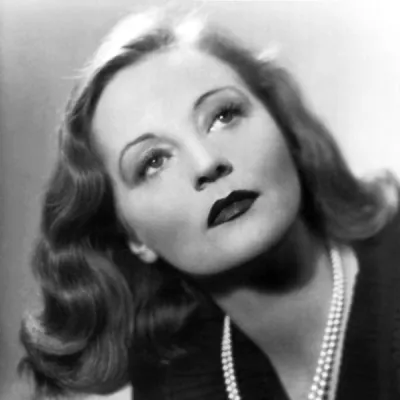
Tallulah Bankhead
Human Design Chart
Biography
Upon returning to the USA in 1931, she resumed her stage career and signed a film contract with Paramount. Her film and TV work were less memorable than her stage performances. However, Bankhead achieved an award-winning performance in at least one film—Alfred Hitchcock's Lifeboat (1944) —and made a brief but successful career on radio. She later made appearances on television as well. During her career, Bankhead amassed nearly 300 film, stage, television and radio roles.
Her 1932 movie Devil and the Deep is notable for the presence of three major co-stars, with Bankhead's receiving top billing over Gary Cooper, Charles Laughton, and Cary Grant; it is the only film with Cooper and Grant as the film's leading men. She later said "Dahling, the main reason I accepted [the part] was to fuck that divine Gary Cooper!"
In 1933, while performing on Broadway in Jezebel, Bankhead nearly died following a five-hour emergency hysterectomy due to gonorrhea, which she claimed she had contracted from George Raft. Weighing only 70 lb (32 kg) when she left the hospital, she vowed to continue her promiscuous and party lifestyle, stoically saying to her doctor "Don't think this has taught me a lesson!"
Her brilliant portrayal of the cold and ruthless, yet fiery Regina Giddens in Lillian Hellman's play The Little Foxes (1939) won her Variety magazine's award for Best Actress of the Year.
Bankhead's autobiography, Tallulah, was published in 1952. Though her career slowed in the mid-1950s, she never faded from the public eye.
What does Generator 4/1 mean for Tallulah Bankhead?
Generator 4/1 — Design at a Glance
Tallulah Bankhead's Design indicated a tendency towards high endurance, which however strictly depended on the quality of her inner resonance. She was someone whose energy capacity was enormous as long as she responded to impulses rather than taking initiative independently. Her system worked like that of a workhorse: strong and durable, but only efficient when the task was confirmed from within.
This mechanism of a Generator means that energy is not initiated by willpower but through reacting to signals from life. Tallulah Bankhead had much sacral energy that would be released as soon as her inner self gave a clear "yes". If she acted against this signal or suppressed her heart's projects, she fell into a state of frustration and burnout. Restraining her natural responsiveness led to a lack of energy, while waiting for the right impulse generated deep satisfaction and fulfillment. Her success was based on not anticipating but waiting until life presented an occasion that she could respond to with full force. This dynamic created a clear contrast between powerful effectiveness in resonance and exhaustion from forced action.
Emotional Authority
Tallulah Bankhead's Human Design profile indicated a tendency towards conscious timing delays in critical decision-making moments. She was someone who did not immediately act on spontaneous impulses but rather allowed them to settle first. This stemmed from her emotional authority: With her Emotional Center defined, she was subject to constant waves of emotional highs and lows. The world appeared colored by her current mood; something that excited her completely one moment could be seen negatively the next.
However, this emotional state was only a snapshot, not a final judgment. A quick decision made from this temporary wave risked proving false later on. Therefore, it was mechanically necessary for Tallulah Bankhead to avoid making immediate decisions and instead "sleep on" them. This process of patience allowed intense emotions to subside. Only with the gained emotional distance did true clarity and calmness set in.
This strategy applied regardless of other defined Centers in her chart; the Emotional Center had priority here as an inner authority. She used this time to recognize deeper connections, especially for long-term steps with significant influence on her life course. Through this conscious waiting and allowing others to question her multiple times, she protected herself from impulsive misjudgments and acted only when the emotional wave movement had subsided and a stable insight was present.
The 4/1 Profile — Opportunist / Investigator
Tallulah Bankhead's Human Design profile established a deep unchangeability of her essence. As a 4/1 Networker/Researcher, her character was so rooted that she rarely deviated from her individual path. This Profile marks the transition from "I" to "You", where traits are firmly anchored; she could and would not change her nature.
Line 4 brought mutual dependence and cooperation, coupled with a large but cautious heart. Tallulah Bankhead expected others to keep up quickly in order to create this bond. At the same time, Line 1 added creation that worked independently of will or ego. Mutation followed its own laws here and required patience. Creativity had to develop on its own, without being influenced by force of will.
This configuration often led to well-intentioned impulses for change from others being rejected. Since she neither could nor wanted to alter her essence, she quickly excluded people who questioned her acceptance from her heart. Externally, this often appeared as stubbornness or a lack of critical thinking, which could endanger self-confidence. With self-acceptance, however, Tallulah Bankhead was stable like a rock in the surf and teachable, since she rested securely in her own character.
Quadruple Split Definition — Defined & Open Centers
Tallulah Bankhead's Human Design profile revealed a massive, continuous internal architecture: inspiration, willpower, and vitality were constantly present. She had defined Head and Ajna centers, which generated a persistent mental pressure towards questioning and conceptual thinking. This internal engine was supported by a defined G Center (fixed identity) and Heart Center (willpower), fueled by Sacral energy (vitality), Solar Plexus (emotional wave), Spleen (intuition), and Root (stress/format). She was a 'motor' with a firm instinctual and identity foundation.
However, her Throat Center remained open. This meant no constant manifestation power but situational communication. While her inner fields from inspiration to emotional depth were consistently active, she could not carry this richness outward at will or constantly. The mechanics of an open throat tend towards feeling pressured to demand attention or worry about visibility – a pattern Tallulah Bankhead experienced when acting against her nature. Her expression thus depended on the right invitation and timing, not from a constant desire for expression. The discrepancy between her enormous inner density (eight defined centers) and the open door to expression created dynamics where the internal richness only became effective when it did not fight against the resistance of undefined expression but waited for appropriate moments.
Channels for synthesis, clarity, rhythm and dedication.
Tallulah Bankhead's personality was marked by a deep emotional anchoring in the collective, yet driven by sudden, mystical insights. This tension between the need for belonging and individual inspiration defined her essence.
The Synthesis Channel 19-49 acted as an emotional 'glue' for her relationships. It connected the Root Center with the Solar Plexus through Gate 19, the pressure to form a tribe, and Gate 49, the principles of loyalty. This generated a strong need for validation from the tribe and a balance between feasibility and fairness in their bonds. She sought the emotional security of 'we', where loyalty became the central survival factor.
Simultaneously, the Awareness Channel 61-24 shaped her mental world. This channel connected the Head Center with the Ajna Center through Gate 61, inspiration from secrets, and Gate 24, rationalizing inner truth. This led to mutative knowledge that could not be controlled but entered as Satori insight in its own time. Her mind sought true inspiration independently of emotional tribal pressure, often an isolated experience.
The Rhythm Channel 5-15 supported this dynamic through Gate 5, fixed habits, and Gate 15, love for extremes. It connected the Sacral Center with the G Center and created a magnetic flow that synchronized her with the universal life rhythm. This channel allowed her to draw others into her energy field and intuitively sense timing, enhancing her presence in social fields.
Additionally, the Devotion Channel 44-26 linked the Spleen Center with the Heart Center. Through Gate 44, awareness, and Gate 26, ego, she had an instinctive feel for the market and tribal needs. This gave her entrepreneurial qualities and the ability to effectively sell or promote her gifts when the tribe sought her support.
The prioritization of gates like Gate 33 (Reflection) and Gate 2 (Receptivity to Mutation) underscored the need for calm to process her intense internal processes and openness to evolutionary direction changes.
Tribal Circuitry — Circuit Signature
Tallulah Bankhead's design inclined towards pulsating, acoustic creativity. Her Knowledge Circuit connected Head and Ajna centers through the Awareness Channel (61-24). This generated innovative flashes of insight – spontaneous, mutative ideas that diverged from the existing. This energy followed an emotional wave, a pulse connecting melancholy with creative power and seeking her unique path.
Parallel to this, a separate focused ratio flowed through her Mind Circuit. Here, the Rhythm Channel (5-15) connected Identity with Sacral Center. This connection stood for logical structure and strategic sharing of insights, free from emotional coloring. It served to improve things and lead society towards a better future – a visual, forward-looking focus independent of the impulsive creativity of her head.
Another separate power field formed her Ego Circuit, which had two unconnected segments. The Heart and Spleen Centers were connected through the Devotion Channel (26-44), promoting cooperation and joint creation of resources. Simultaneously, the Synthesis Channel (19-49) linked Solar Plexus and Root Center, making emotional support and mutual aid in crises possible. As there was no connection to the Sacral Center, this tribal energy required rest periods for regeneration. Tallulah Bankhead thus lived with four parallel, non-interconnected energetic systems: impulsive inspiration, strategic logic, cooperative resource building, and emotional support.
Juxtaposition Cross of Need
Tallulah Bankhead's Human Design profile revealed a tendency towards simultaneous presence of contradictory elements. She was someone who did not resolve polarities but rather allowed them to coexist in a fruitful tension side by side. This trait stemmed from the archetypal structure of the 'Cross of Needs,' which defined her life purpose through the principle of juxtaposition.
This means that her existence and contribution were based on bringing together seemingly incompatible perspectives or energies to create new truths. It was not a linear process of unification but rather the parallel arrangement of opposites. This configuration shaped how she saw and moved in the world: by combining differences. The ability to hold these tensions, instead of eliminating them, was central to her inner functioning. Her design thus did not demand harmony through elimination of conflicts but creation of synergies through their conscious maintenance and juxtaposition.
Saturn Return · Uranus Opposition · Chiron Return · 2nd Saturn Return — Life Cycles
Tallulah Bankhead's Human Design profile established a developmental line that showed three clear phases of identity consolidation. Her first Saturn Return marked the transition from searching to established professionalism. In this cycle, years of groundwork condensed into a solid structure: in 1931, she signed a film contract with Paramount Pictures, which concretized her professional responsibility and positioning within her field.
The subsequent Uranus Opposition brought a phase of sudden opening and breakthrough. This cycle promoted innovations or unexpected recognitions that broke the existing framework. In 1944, she experienced great success in Alfred Hitchcock's war drama “Lifeboat,” a moment that underscored her ability to attract attention through new, surprising forms of expression and differentiate herself from earlier patterns.
The Chiron Return was not a process of healing old wounds but rather a time of blooming and self-affirmation of her life purpose. Here it was about the final consolidation of her identity as an act of sovereignty. In 1950, she legally protected her first name “Tallulah.” This step symbolized the completion of her incarnation task: a clear and unassailable definition of self after living out strategy and authority earlier on. The three cycles thus shaped the path from professional anchoring through innovative breakthrough to final identity strengthening.
Generator · Emotional Authority — Synthesis
Tallulah Bankhead lived a life marked by a deep inner drive to be authentic and manifest in the world. Her design as a Generator with emotional authority points to someone who drew from an inexhaustible source of energy, but could only fully unfold it when responding to the right signal – an internal yes filtered through the necessity of waiting for emotional waves. The combination of a defined G Center and Channel of Rhythm (5/15) amplifies this tendency: a deep, instinctive connection to her direction and a natural sense for life's flow that led her through challenges and helped maintain herself in a constantly changing environment.
A central paradox in Tallulah Bankhead's chart lies in the interplay between her emotional depth and defined Head Center. While the emotional center offered clarity only after a process of confrontation, the Head Center provided constant inspiration and questioning. This led to an internal tension: the need for deep understanding and emotional maturity versus the ability to quickly develop ideas and express them. This dualism created a complex yet fascinating personality – someone capable of deeply understanding herself and others but always seeking new ways to express her creativity.
4 Defined Channels
Incarnation Cross - Juxtaposition Cross of Need
Solar Return
The Solar Return shows the moment when the sun returns to its exact birth position - your personal solar year.
Life Cycles
Discover the life cycles with a detailed triple view (birth chart, cycle chart, composite).
Human Design Profile
- Type
- Generator
- Strategy
- To respond - wait for something to respond to
- Authority
- Emotional Authority
- Profile
- 4/1 - Opportunist / Investigator
- Definition
- Quadruple Split
- Incarnation Cross
- Juxtaposition Cross of Need
- Date of Birth
- 31.01.1902 21:00
- Place of Birth
- Huntsville, AL, United States
Frequently Asked Questions
What was Tallulah Bankhead's Human Design type?
Which Profile did Tallulah Bankhead have?
What Authority guided Tallulah Bankhead?
What incarnation cross did Tallulah Bankhead have?
When was Tallulah Bankhead born?
Discover your own Human Design
Are you also a Generator? Find out in a personal reading how to use your sacral energy correctly and discover deep satisfaction.
More Personalities
Back to overviewSissy Spacek
Aaliyah

Alexia

Anémone

Angèle

Ann-Margret