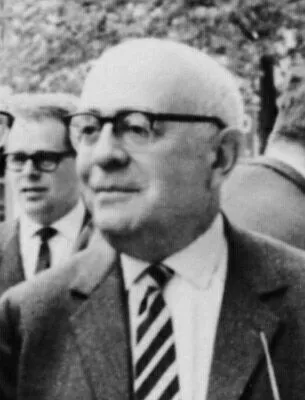
Theodor Adorno
Human Design Chart
Biography
In an intellectual climate shaped by existentialism and logical positivism, Adorno developed a dialectical conception of history and philosophy that challenged the foundations of both, anticipating the divide that would later emerge between the analytic and continental traditions. As a classically trained musician, Adorno studied composition with Alban Berg of the Second Viennese School, influenced by his early admiration for the music of Arnold Schoenberg. Adorno's commitment to avant-garde music formed the backdrop of his subsequent writings and led to his collaboration with Thomas Mann on the latter's novel Doctor Faustus (1947), while the two men lived in California as exiles during the Second World War.
Theodor Adorno — Manifestor with Profile 1/3
Manifestor 1/3 — Design at a Glance
Theodor Adorno proved to be a pioneer and visionary whose design predisposed him to steer the world in new directions. His Human Design type was that of a Manifestor, often compared to an emperor in ancient Rome: He carried the vision of a great whole but did not wage the necessary wars himself; instead, he initiated changes through others, his 'soldiers'. This role came with a specific burden. Since his thinking often surpassed that of his surroundings, he was frequently misunderstood and polarized strongly. Some people loved his big dreams and followed him, while others rejected or even hated him because of these visionary ideas. This paradox of following was central to his experience. To minimize resistance and find the right supporters, his design required a clear strategy: timely and precise informing about his intentions and visions. If Theodor Adorno adhered to this informing strategy, he was rewarded with an inner sense of peace. However, if he lived against this design, instead, a persistent deep anger arose within him. His path was thus marked by the necessity to flank his initiative through communication to overcome polarization and find his peace.
Splenic Authority
Theodor Adorno showed a basic attitude of high vigilance not to miss fine internal signals. His design dictated that decisions had to be made in the immediate moment, as only the first spontaneous impulse was considered correct. This mechanism originated from his authority in the Spleen, a defined center for survival intelligence and an inner alarm system. Since his Emotional and Sacral centers were open – a prerequisite for this specific form of authority – his body feeling served as a reliable indicator whether a situation or environment was healthy. This allowed him to rigorously distance himself from harmful influences.
However, the impulse of the Spleen was only once-off and very subtle. It could easily be drowned out by other thoughts, which is why Theodor Adorno needed withdrawal to perceive this fine sound. Long-term commitments stood in the way of this flexibility; his design preferred spontaneous adaptation over rigid plans as what was right would only show itself at each moment. This need for freedom and the ability to immediately intuitively distance himself shaped how he dealt with his environment. He lived in constant readiness to listen to these once-off signals instead of distorting them through reflection or external expectations.
The 1/3 Profile — Investigator / Martyr
Theodor Adorno's design tended never to view knowledge as purely abstract but rather to validate it through direct experience. His Profile 1/3, the Researcher and Experimenter, marked him as someone who combined theoretical study with practical trial and error. Line 1 drove him towards meaning and foundation but brought the risk of paralysis due to fear of inadequate preparation. Simultaneously, Line 3 demanded experimentation and learning from mistakes, where topics such as attachment, humiliation, and the struggle for inclusion in social contexts were relevant.
The authenticity of his judgment emerged only through this synthesis: Only when something was both intellectually understood and practically tested on heart and gut was it trustworthy. The inner conflict lay between the urge to know everything and the imperative to simply start. In hard times, he sought out culprits to find meaning in their mistakes, while Neptune's Fall warned of seeing distress as an exclusively negative phenomenon. Despite the humiliation that came with trying to be useful for the tribe, he took measures towards inclusion. His judgment only applied when theory and practice aligned; self-earned insights were the topic par excellence. Thus, his life task was shown as a cyclical process where negative factors were eradicated to develop seemingly meaningful ideas which, however, always had to stand up to practical testing.
Single Definition — Defined & Open Centers
Theodor Adorno's design was characterized by a constant triad of willpower, intuition, and expressiveness. His defined throat, connected to heart and spleen, created a reliable voice that spoke with a clear 'I want' as well as spontaneous, intuitive knowledge in the present moment. This configuration allowed him to articulate his truth with honesty and clarity without relying on mental concepts.
At the same time, an acute sensitivity to environmental impulses was revealed through six open centers: Head, Ajna, G, Sacral, Solar Plexus, and Root. Theodor Adorno was situationally vulnerable to foreign mental pressure, emotional waves, and stress that he did not understand as his own experiences but absorbed. His open head tended to get entangled in questions that were not his own, while the open Ajna Center took on concepts from the environment without constantly possessing them.
The open G Center meant a lack of stable identity; he reflected the direction and love of his environment rather than generating it himself. This required distance from identity-forming pressure. His open sacral center made him sensitive to foreign energy levels, leading to the risk of overextending himself through 'borrowed' vitality and experiencing exhaustion due to the absence of constant generative power.
Furthermore, his open solar plexus absorbed the emotions of others and amplified them, causing him to be subject to emotional fluctuations that were not his own. The open root center absorbed external stress and adrenaline surges, making him vulnerable to cycles of avoiding action or overreacting. Thus, Theodor Adorno's mechanism showed a tension between a strong, intuitive expressiveness and the need to protect himself from the conditioning power of foreign mentality, emotions, and stress.
Channels for intuitive mastery and courageous realization.
Theodor Adorno's design tended towards synthesis through intuitive depth and technical mastery. This was evident in Channel 48-16, which connected Gate of Depth (48) with Gate of Skillfulness (16). This mechanism required the combination of inner intelligence with repeated practice to perfect skills and transform them into talent. Recognition as well as material reward was crucial for continuing the process of refinement and expressing his unique wavelength.
Parallel to this, Channel 21-45 shaped his approach to material responsibility. This channel connected Gate of Hunter (21) in the heart center with Gate of Gatherer (45) in the throat center. There arose a need for control over one's own rhythms and tasks, flanked by the authoritative voice of the tribe regarding resource distribution. Theodor Adorno sought independence to follow his natural rhythm while simultaneously taking responsibility for the well-being of his environment.
This structure was contextually supplemented by additional gates: Gate 47 promoted collective sense-making from confusion; Gate 22 enabled social ease and mutation through listening; Gate 26 allowed innovation despite a weak ego. Additionally, Gate 18 supported the ability to discriminate necessary corrections in the collective process.
Collective Circuitry — Circuit Signature
Theodor Adorno's design presented two clearly separated energetic poles that did not communicate directly with each other. On one side, rational, future-oriented analytical capability dominated; on the other, a conservative instinct for resources and cooperation prevailed. This separation created an internal tension between individual intelligence and collective responsibility.
The Understanding Circuit connected his throat center to the spleen via Channel 'The Wavelength'. This enabled him to visually formulate and convey logical structures and strategic insights clearly. Since this circuit did not connect to the solar plexus, it was a dispassionate ratio seeking objective truth free from subjective conditioning. The focus was always on improving society through shared knowledge and clear visions for the future.
Parallel to this, the Ego Circuit operated, which connected his throat center with the heart via 'The Money Line'. This circuit belonged to the tribe group and emphasized cooperation as well as management of material resources. It was about traditional values and mutual support within a group. However, the lack of connection to the sacral center was crucial: without this constant life force, Theodor Adorno could not act continuously. Strategic pauses for regeneration were necessary to maintain energy for creating collective prosperity. Both systems existed side by side – one analyzed coolly and future-oriented, the other conserved and resource-oriented – without forming a common energetic flow.
Right Angle Cross of Rulership 3
Theodor Adorno's design included the structure of the right cross of Governing 3. This configuration represented a specific but not further elaborated mechanical alignment in the given data. Since no content details or behavioral descriptions were provided for this cross, no concrete characterization could be derived from it. The structure was merely named without explaining its functional significance or influence on Adorno's personality. There was no documented event that could serve as evidence of the effectiveness of this mechanism. Therefore, the description of life tasks or typical challenges associated with this cross remained incomplete. The analysis focused solely on naming the structure in Adorno's chart without making assumptions about his reaction to authority, leadership style, or internal dynamics, which were not evident from the provided facts. The focus was exclusively on noting that this element was part of his Human Design without speculating how it manifested in everyday life or its role in his life. Thus, the mechanism remained as an uninterpreted structure.
Saturn Return · Uranus Opposition · Chiron Return · 2nd Saturn Return — Life Cycles
Theodor Adorno's design structured his intellectual development through clear phases of establishment and confrontation. In 1931, at age 28, he was habilitated at Frankfurt University, marking his first Saturn return, a cycle in which years of groundwork condenses into a solid professional foundation and strengthens one's positioning.
In 1943, at the age of 40, Thomas Mann invited him to read from *Doctor Faustus*. This fell on the Uranus opposition, a phase of deep inner upheaval often requiring external impulses to open new perspectives or question existing structures.
In 1952, at 49 years old, Thomas Mann criticized Adorno's social critique. This corresponded to his Chiron return, a fulfillment cycle of bloom. Here, not healing but confrontation with one's incarnation purpose was evident: The meaningfulness of one's path was put on trial through external criticism and thus became experiential.
Finally, in 1960 at the age of 57, Adorno gave lectures on culture and administration. This marked his second Saturn return, a phase of mastery and integration. The previously gathered experiences and conflicts culminated in a mature, authoritative teaching that confirmed and stabilized his intellectual authority.
Manifestor · Splenic Authority — Synthesis
Theodor Adorno moved through life with an inner logic fueled by the connection between intuition (Spleen Center), willpower (Heart Center), and the need to communicate (defined Throat Center). This combination led to a profound drive to recognize patterns – both in the world around him and within himself (Gate 47) – and express these insights precisely (Channel 16/48). However, his ability to gain deep insights was inseparable from the need to secure resources and exert influence (Channel 21/45), suggesting an internal dynamic between gaining knowledge and manifesting it in the material realm. He navigated the world by constantly gathering, analyzing information, and articulating judgment and criticism – a process that both propelled him forward and shaped him.
Adorno lived in a central paradox: On one hand, he was geared towards recognizing patterns and changing the world (Manifestor type), on the other, he possessed open centers making him vulnerable to external influences (especially Solar Plexus and Root). This led to a tension between his inner drive for autonomy and constant absorption of information and emotions from his environment. He was a thinker who lost himself in the vortex of thought, an observer who was simultaneously part of what he observed – a dynamic that shaped his work and forced him into critical engagement with the world.
2 Defined Channels
Incarnation Cross - Right Angle Cross of Rulership 3
Solar Return
The Solar Return shows the moment when the sun returns to its exact birth position - your personal solar year.
Life Cycles
Discover the life cycles with a detailed triple view (birth chart, cycle chart, composite).
Human Design Profile
- Type
- Manifestor
- Strategy
- To inform others before acting
- Authority
- Splenic Authority
- Profile
- 1/3 - Investigator / Martyr
- Definition
- Single Definition
- Incarnation Cross
- Right Angle Cross of Rulership 3
- Date of Birth
- 11.09.1903 05:30
- Place of Birth
- Frankfurt, Germany
Frequently Asked Questions
What is Theodor Adorno's Human Design type?
What Profile did Theodor Adorno have in Human Design?
Which Authority guided Theodor Adorno?
What incarnation cross did Theodor Adorno have?
When was Theodor Adorno born?
Discover your own Human Design
Are you also a Manifestor? Find out in a personal reading how to use your initiation power peacefully and dissolve resistance.
More Personalities
Back to overviewChristian-Jaque
Kesha

Lucebert
Masaccio
Papus
Petrarch