
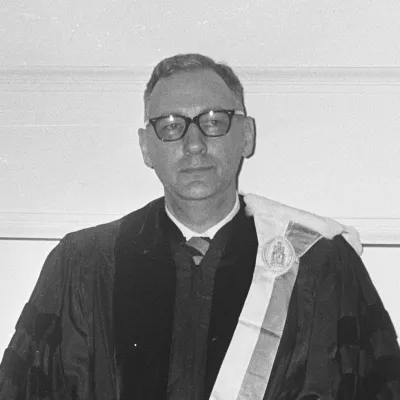
Tjalling Charles Koopmans
Human Design Chart
Biography
He was as the youngest son of Sjoerd Koopmans (22 June 1877, Oppenhuizen, Wymbritseradeel – 19 Oct 1959 8 PM, Hilversum), a Christian head schoolmaster and Wijtske van der Zee (12 February 1878 11h30 AM, Sneek, - 22 May 1952, 12h30 PM Hilversum). His elder brothers were Jan Koopmans (Sliedrecht, 26 May 1905 - Amsterdam, 24 March 1945, Amsterdam), who became a PhD theologian and Hendrik Koopmans (13 August 1907, Sliedrecht - 12 July 1992, Zeist), who became a chemical engineer.
His brother Jan Koopmans had connections with the "Bekennende Kirche" (Confessing Church) in Germany and became a political activist during WW2. Since 1941 he worked in Amsterdam and tried to help Jewish people. At the end of the war he had to hide. On 12 March 1945, Jan was hit in his head by a lost bullet, during the execution of 24 innocent civilians, as a reprisal for the killing by resistance fighters of an SD agent in his street. Twelve days later, he died of his injuries. At that time his brother Tjalling was in the USA.
It is of interest that the Frisian name Tjalling derives from the German name Detlef, meaning "Son of the people". The name is associated with the Nordic mortal helper of Thor Thialfi. The surname "Koopmans" means (son of a) merchant. Because the English American speaking people could not pronounce the name "Tjalling" and called him "Charles", he added the name Charles when he was naturalised as an American citizen in 1946. Charles or Karl means "free man" or "to rub; to be old; grain.".
Tjalling Koopmans was a bright and musical student (composed music and played the violin), that could study Mathematics and Physics in Utrecht from age 17 until age 26 with a stipend by a private foundation — the St. Geertruidsleen stipend. He had many interests, even considered to study psychiatry, but switched in 1930 from pure mathematics to theoretical physics.
What does Generator 4/1 mean for Tjalling Charles Koopmans?
Generator 4/1 — Design at a Glance
Tjalling Charles Koopmans revealed himself as someone who possessed enormous inner endurance, comparable to a workhorse that is ready to provide its strength once it receives the right stimulus. His design as a Generator determined that this energy was not released through self-initiated action but rather in response to signals from the environment. The strategy involved waiting for impulses and then responding with a clear, gut-driven 'yes' answer.
This mechanism protected him from two specific dangers: Firstly, it prevented him from investing energy into tasks that felt alien internally – a path that would have quickly led to exhaustion for him. Secondly, it kept him from being held back from his true work when he was still full of power. If Tjalling Charles Koopmans lived in harmony with this reactive strategy, his system rewarded him with deep feelings of fulfillment and satisfaction. However, if he constantly initiated himself or ignored his internal signals, the result would be persistent frustration and a noticeable lack of energy over time. His effectiveness thus did not lie in actively shaping the world but rather in responding to life when his sacral center confirmed that the path was right.
Sacral Authority
Tjalling Charles Koopmans revealed himself as someone whose decision-making process was based on direct physical resonance. As a Generator, he possessed sacral authority, meaning that his strategy and inner guidance were identical: waiting for an internal impulse and then responding to it. This configuration greatly simplified his process since no conflicting internal signals arose between the will to act and the decision-making instance.
His reactions did not appear as mental analysis but rather as immediate physical signals – a gut feeling or a surge of energy expressed through sounds like grunts or affirming 'mm-hm'. When his sacral motor responded to an external stimulus, he felt vital and energized; these states were indicators that something was in alignment with him. In such moments, he had inexhaustible energy and could immerse himself in tasks driven by intrinsic joy rather than external purpose.
Additionally, his activated Spleen Center served as a supportive instance to the sacral authority. This gave him the ability for particularly quick and spontaneous reactions. He possessed an immediate access to his instinctive perception and physical well-being, enabling him to make decisions that were not only energetically appropriate but also intuitively accurate. This combination of sacral confirmation and spleen-supported speed shaped his way of moving through the world: reactive, alive, and focused on the present moment.
The 4/1 Profile — Opportunist / Investigator
Tjalling Charles Koopmans revealed himself as someone with a deeply rooted, hardly changeable essence structure. As a 4/1 Networker/Researcher, he had a big heart that was protected by strict filtering. Well-meaning advice for change was often rejected; those who did not fully accept him quickly fell out of his inner circle. This attitude sometimes appeared stubborn or incapable of criticism from the outside but served as a protective mechanism for his unchangeable nature.
The 4/1 configuration marks the transition from 'I' to 'You'. The fourth line emphasized brotherhood and friendship over sexual intimacy as a path to union. Non-sexual closeness served as a foundation for deeper bonds, where intellectual understanding without implementation was a recurring theme.
Simultaneously, the first line of Gate 16 marked a lifelong process of experimentation and skill development. Daydreams allowed him to play out skills in his mind and recognize patterns. However, this creative process also contributed to self-deception since it remained unclear when plans would materialize. Only once he stabilized within his character did he become the rock in the storm, capable of magnificently teaching others. His path was challenging, yet his inner stability provided a reliable foundation for deep friendships and sharing insights.
Split Definition — Defined & Open Centers
Tjalling Charles Koopmans revealed himself as someone whose thinking had a constant, trustworthy structure. His defined Ajna Center ensured that he created concepts and theories in the same way consistently; his mind was a steady active process that processed data and acted as an external authority without being easily influenced by others. This mental stability flowed directly into his communication: The defined Throat Center allowed him to express what he thought clearly and reliably. His voice was the pivot point where inner concepts were translated into outer manifestation.
The driving force behind this expressive ability came from his defined Sacral Center. As a guardian of an enormous vitality source, he had constant energy that was only correctly available through reaction – not initiation. His truth lay in the "yes" or "no" of the gut, a mechanical process that bypassed every rational consideration. This endurance was supported by the defined Spleen Center, which gave him spontaneous intuitive intelligence. He acted from the present moment, trusted his instincts for health and well-being, and did not let himself be distracted by reason, which was existentially correct. The defined Root Pressure also provided the necessary push to move forward in the material world and transform stress into productive motion.
At the same time, he was vulnerable to conditioning through open centers. His open Head Center meant that he lacked his own mental pressure for inspiration; he tended to engage with other people's questions or seek answers that were not his, which could lead to confusion. His open G Center lacked a firm identity; he adapted to his environment and often sought "borrowed" direction or love rather than defining it himself. The open Heart Center made him sensitive to questions of value and willpower; he risked making promises to prove his worth, even though he did not consistently possess the energy for it. Finally, his open Solar Plexus absorbed foreign emotions and amplified them, which could lead him to feel emotionally unstable or avoid confrontation out of fear of rejection rather than standing up for his own truth.
Channels for insight, experimental depth and mature development.
Tjalling Charles Koopmans revealed himself as someone who combined intuitive depth with methodical precision. His design indicated a tendency towards long-term perfectionism, where he gradually elevated his skills to mastery through repeated experimentation and practice. This approach stemmed from Channel 48-16, which connects the Spleen Center with the Throat Center. Gate 48 constantly sought out vital information, while Gate 16 considered new experimental possibilities and refined dexterity. Koopmans used this combination to develop a unique wavelength based on lifelong engagement.
Parallel to this, he structured his thinking through Channel 43-23, which links the Ajna Center with the Throat Center. This channel allowed him to process spontaneous insights (Gate 43) and clearly express them (Gate 23). His innovative thinking often led to quantum leaps in efficiency by developing techniques that promoted collective progress. However, his insights required the right timing to be accepted by the environment; without support, he risked being perceived as an outsider.
Furthermore, Koopmans went through a process of maturation via Channel 53-42, which connects the Root Center with the Sacral Center. This drove him to fully experience and reflect on each experience (Gate 33) in order to gain wisdom from it. Each new experience built upon the previous one, as he learned to enter cycles without rigid expectations to avoid frustration.
His design included further nuances: Gate 59 pursued a genetic strategy of attachment, Gate 55 brought emotional mood swings, and Gate 9 focused on detailed work in the Sacral Center. Gate 27 promoted care for the clan, while Gate 8 emphasized contribution to the group. Gate 14 handled power with grace, Gate 54 connected worldly success with spirituality, and Gate 20 enabled authentic action in the present moment. Gate 18 discriminated between necessary corrections, Gate 3 initiated mutations towards order, and Gate 12 expressed individual creativity, often influenced by emotional mood.
Collective Circuitry — Circuit Signature
Tjalling Charles Koopmans revealed a design showing two separate energetic poles. The Split Definition meant that his strengths did not work as one continuous flow but operated in two parallel systems: a cognitive-communicative domain and a vital impulse domain.
In the first system, the Knowledge Circuit connected the Ajna Center with the Throat Center through Channel 43–23. This created an ability to clearly articulate internal thought structures. Parallel to this, the Understanding Circuit also involved the Throat Center but this time linked it with the Spleen (Channel "The Wavelength," Gates 16–48). Here, it was about precise selection and transmission of logical insights, free from emotional coloring. Both circuits used the Throat Center as a common point for expression yet remained energetically separate.
The second system consisted of the Meaning Circuit, which connected the Sacral and Root Centers (Channel "Maturation," Gates 42–53). This connection provided a cyclical energy processing based on experience, differing from the cool rationality of the first system. Thus, Tjalling Charles Koopmans lived with a tension-filled duality: between structured, future-oriented logic and rhythmic, past-focused emotional depth, without these areas directly overlapping each other.
Juxtaposition Cross of Strategy
Tjalling Charles Koopmans carried the design of the Juxtaposition Incarnation Cross. This configuration marked a deep, often unconscious tension between his natural urge for independent action and a strong inner compulsion to conform to external expectations or authorities. For him, the question 'What do I really want to do?' was not just a philosophical reflection but a central life dilemma. The Strategy Cross described the path from blind obedience – the attempt to gain security through submission to others – to conscious, sovereign decision-making for his own direction. In his biography, this was seen as an ongoing struggle with the pressure to fit into systems while his inner compass called for autonomy. The challenge lay in not simply rebelling or conforming but developing a personal strategy that integrated both poles. This required immense internal clarity and the courage to walk his own path, even if it was misunderstood by his environment. His design suggested that true freedom for him could only be achieved through this conscious boundary-setting from mere rule-following. It was a process of maturation in which he had to learn to place his own values above others' approval without falling into isolation. This dynamic shaped his entire work and personal decisions significantly.
Saturn Return · Uranus Opposition · Chiron Return · 2nd Saturn Return — Life Cycles
Tjalling Charles Koopmans’ life followed the rhythmic phases dictated by his planetary cycles. His first Saturn Return marked an initial consolidation; here, early experiences coalesced into a sturdy structure that gave him stability. Shortly after, the Uranus Opposition entered, a phase of detachment and realignment, in which old bonds were dissolved to make room for new perspectives.
The Chiron Return followed as a central bloom period. During this time, his incarnation purpose unfolded increasingly; if he had followed his strategy, meaning became tangible and his life mission concrete. This was not healing in the medical sense but the fulfillment of his personal plan.
His second Saturn Return rounded off this process. It brought further deepening of already established structures, confirmation of long-term work, and a final stabilization of his path. This sequence shows how Tjalling Charles Koopmans’ design led him through phases of building up, transformation, fulfillment, and solidification, with each cycle fulfilling its specific function in the overall development.
Generator · Sacral Authority — Synthesis
Tjalling Charles Koopmans lived deeply within his sacral authority and found his energy in action, especially when it truly resonated (Design). This Generator was not a person easily swayed from his path – the fixed Profile as a 4/1 indicated a deep rooting of his essence (Profile Role). He sought connections and inspiration externally to perfect his skills (Channel of Frequency), yet the decision whether something was right always fell on gut feeling. The defined Ajna Center showed a consistent way of thinking that developed concepts and inspired others (Centers).
A central tension field marked his life: the deep necessity to follow his inner compass stood in contrast to the desire to refine his abilities and make an impact in the world (Circuit). He was a Generator whose energy came from action itself, yet the defined Ajna Center pointed to a strong drive to generate and disseminate knowledge. This combination created a dynamic between the present moment of sacral drive and the long-term vision of consistent thinking and creation.
3 Defined Channels
Incarnation Cross - Juxtaposition Cross of Strategy
Solar Return
The Solar Return shows the moment when the sun returns to its exact birth position - your personal solar year.
Life Cycles
Discover the life cycles with a detailed triple view (birth chart, cycle chart, composite).
Human Design Profile
- Type
- Generator
- Strategy
- To respond - wait for something to respond to
- Authority
- Sacral Authority
- Profile
- 4/1 - Opportunist / Investigator
- Definition
- Split Definition
- Incarnation Cross
- Juxtaposition Cross of Strategy
- Date of Birth
- 28.08.1910 00:15
- Place of Birth
- 's-Graveland, Netherlands
Frequently Asked Questions
What was Tjalling Charles Koopmans' Human Design type?
Which Profile did Tjalling Charles Koopmans have?
What Authority guided Tjalling Charles Koopmans?
What incarnation cross did Tjalling Charles Koopmans carry?
When was Tjalling Charles Koopmans born?
Discover your own Human Design
Are you also a Generator? Find out in a personal reading how to use your sacral energy correctly and discover deep satisfaction.
More Personalities
Back to overviewAaliyah

Alexia

Angèle

Anne-Marie

Arcángel

Arno
