
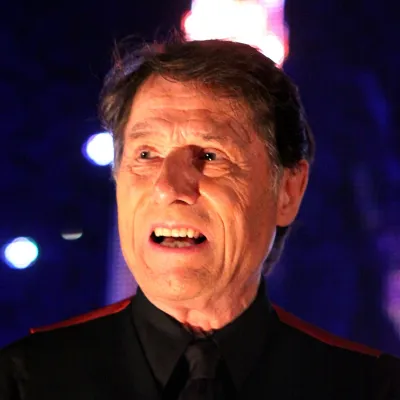
Udo Jürgens
Human Design Chart
Biography
Jürgens was married to the model Erika Meier from 1964 to 1989, with two kids John (20 February 1964) and Jenny (22 January 1967). He has two more daughters from other relationships.
In June 1977 he moved to Switzerland, where he lived in Zürich, the suburb Zumikon and recently, since 2013, in Meilen. He was married to Corinna Reinhold from 1999 to 2006. Jürgens died on 21 December 2014 at 16.25 in Münsterlingen, from a heart attack, at age 80. He had been on tour recently, with the tour title In the mid of life, his last concert was on 7 December 2014 in Zürich.
Udo Jürgens — Projector with Profile 4/6
Projector 4/6 — Design at a Glance
Udo Jürge ns revealed himself as someone with a dense, focused aura that directed his environment like a bright light beam directly onto problematic areas. His design inclined him to immediately recognize errors in the system – intuitively seeing where others were not functioning or 'in the dark'. This ability to literally bring 'light into darkness' for other people and illuminate their path was central to his impact.
As a projector, however, he did not have a constant, intrinsic source of life energy through his undefined Sacral Center. Instead, he worked in phases of high intensity followed by necessary rest periods to avoid burnout – a rhythm that the conventional school system and many career profiles often ignored. The most effective strategy for him was to wait for appreciative and sincerely meant invitations from others rather than addressing observations directly. A direct confrontation with another's mistakes could have been perceived as unpleasant, similar to a light beam in someone's face. Instead, he worked best through his own harmonious glow; others would then come to him of their own accord seeking advice. If Udo Jürge ns lived according to this design, he was rewarded with success. Deviating from it led sooner or later to the non-self theme of bitterness appearing.
Emotional Authority
Udo Jürge ns showed himself as someone who never made decisions immediately but consciously let them rest. His design inclined him to be guided by momentary moods without accepting these as final truth. This arose from his emotional authority: Since his Emotional Center was defined, he was subject to an inner wave of emotional ups and downs. The world appeared to him always colored by his current mood – sometimes enthusiastic, sometimes negative. A first impression was merely a snapshot, not yet clarity. Quick, spontaneous actions based on this emotion often had negative consequences.
The mechanics of his internal authority required patience and time. Udo Jürge ns needed to 'sleep over' decisions to gain emotional distance. Only when the intense feelings subsided did calmness set in and true clarity became effective. This process was essential for long-term realignments that shaped his life path. Crucial here is the central mechanism: Whenever the Emotional Center is activated, it takes on the role of internal authority – regardless of which other centers were also defined. This priority was absolute; only reflectors do not have such a fixed inner authority. Udo Jürge ns thus lived in a rhythm of emotional activation and necessary waiting time until the depth of his perception fully came into play.
The 4/6 Profile — Opportunist / Role Model
Udo Jürge ns revealed himself in his youth as someone who intensively experimented with relationships and friendships. This corresponded to the first part of his 4/6 profile: Before the first Saturn return, line 6 initially appeared like a line 3, leading to much experimentation. Later, however, an inner conflict came to light. His design brought the contradiction between the desire for community (line 4) and the need to withdraw to think about the meaning of life (line 6). It was a struggle between heart and head.
Line 4 in his profile conveyed great emotional openness that always had to be careful not to get hurt by false people. At the same time, line 6, represented through Gate 52, brought a striving for inner peace and spirituality with it. This level often required much time to fully unfold as it went beyond earthly logic. Neptune's influence could lead to self-deception that was mistakenly taken for true tranquility.
In his later years, Udo Jürge ns was expected to take on the role of a wise mentor. His task was to excel through cooperation with others while also meeting the high standards set by his position. The difficulties of line 4, especially Gate 18, pointed to fears of failure if things could not be corrected. Nevertheless, his great heart remained his trademark as long as he learned to open it selectively.
Split Definition — Defined & Open Centers
Udo Jürgens revealed himself as someone whose inner compass was a precise blend of logical thinking and deep emotional sensitivity. His defined Ajna Center ensured a constant, trustworthy mental function; he processed data and creativity consistently in his own way, unaffected by external opinions. This mental structure flowed directly into his defined Throat Center, allowing him to articulate clearly and reliably what he thought. His communication was not an impulse but the articulation of his conceptual truth.
At the same time, his defined Heart Center exhibited a strong willpower. He determined his life himself, kept promises, and sought recognition for his contribution. This ego strength worked hand in hand with his defined Solar Plexus Center, which served as his inner authority. Udo Jürgens was designed to wait for the emotional wave before making decisions. His feelings were indicators of correctness; he needed time to achieve emotional clarity and used this depth to understand situations from various perspectives. His defined Spleen Center also gave him spontaneous intuition in the present moment, while his defined Root Center provided the necessary pressure to rise materially and nourish existential awareness.
On the other hand, his open Head Center revealed a vulnerability to mental stress and confusion if he did not follow his authority. He tended to engage with others' questions or fall into an internal monologue about meaning rather than letting things happen simply. His open G Center meant that he had no fixed identity; he adapted to his environment and sought the right place to find love and direction. Additionally, his open Sacral Center made him vulnerable to exhaustion if he took on the energy of others and did not stop until truly tired. These opennesses required him to set boundaries and not get entangled in foreign energies.
Channels for logic, principles, emotional clarity and community.
Udo Jürgens revealed himself through a design that combined logical precision with a deep need for tribal belonging. His mind was constantly integrating details into his mental system; anything he could not organize so neatly did not make sense to him. This process was marked by the Accepting Channel 17-62, which translated visual patterns and created language to give meaning. He found satisfaction in detailing his opinions if the timing was right and listeners were receptive.
At the same time, an insatiable drive pushed him to correct and perfect patterns. The Judgment Channel 58-18 ensured that logic had to prove it had the best answers. He assessed whether what he perceived made life cheerful for the collective or needed correction. However, this ability was effective when requested; otherwise, it could be seen as a constant search for flaws.
Emotionally, Udo Jürgens was strongly oriented towards loyalty and protecting his tribe. The Synthesis Channel 19-49 connected root energy with emotional wave frequency to manifest belonging or reject deviations from ideals. He sought balance between feasibility and fairness within his community. This complemented the Community Channel 37-40, which relied on carefully considered contracts and mutual support. Here, it was not about spontaneous deals but long-term commitments where everyone found their honorable place.
In the background, other energies were at work: Gate 52 demanded concentrated pattern correction in silence, while Gate 39 selected through provocation and analysis. Gate 50 protected traditional values as a conservative reflex, and Gate 6 regulated emotional boundaries for growth. Gate 4 formulated logical formulas for future security, Gate 20 promoted authentic selfhood here and now, Gate 45 expressed royal willpower, Gate 48 recognized deep patterns without implementation, Gate 30 steered the longing for positive feelings, and Gate 33 enabled necessary withdrawal for reflection.
Collective Circuitry — Circuit Signature
Udo Jürgens revealed himself as a person whose thinking and actions took place in two separate, not directly connected energetic blocks. This resulted from his Split Definition: One group linked Ajna with Throat Center, the other Spleen, Root, Heart, and Solar Plexus Centers. Between these two groups there was no direct flow; they worked as parallel forces side by side.
In the Understanding Circuit, he connected through the Accepting Channel (17-62) his visual perception in Ajna Center with articulation in Throat Center. This allowed him to clearly formulate logical strategies and future-oriented concepts. Simultaneously, he used the Judgment Channel (18-58), which linked Spleen Center (intuitive knowledge) with Root Center (immediate energy). Here, a quick, instinctive reaction to situations arose free from emotional coloring of Solar Plexus in this specific path.
The Ego Circuit formed the second block. Through the Community Channel (40-37), he connected Heart Center (will/contractual loyalty) with Root Center, promoting balance between giving and taking. Additionally, the Synthesis Channel (49-19) integrated Solar Plexus Center (emotional wave) into this structure. Since this circuit did not connect to Sacral Center, resource generation here required necessary rest periods. The emotional wave of Solar Plexus had to subside before effective decisions could be made in Heart. This separation of systems shaped his actions: clear communication on one side, instinctive and emotional resource work on the other - always as two independent areas.
Right Angle Cross of Service 3
Udo Jürgens showed a basic attitude based on the right cross of service. This configuration in Human Design suggests a tendency towards a specific kind of support and dedication to others. It was not passive martyrdom but rather an active, often silent willingness to take responsibility for the well-being of his environment.
The right cross of service describes an energy characterized by selflessness and loyalty. People with this design feature tend to put their own needs aside to help others or hold a community together. This attitude acted like an invisible foundation providing stability without seeking the spotlight. Udo Jürgens lived this dynamic, often seeing himself as a pillar in relationships and projects that radiated security and reliability.
The mechanics of this cross emphasized giving without expecting immediate return. It was about a deep connection to the whole, where the individual saw themselves as part of a larger structure. This orientation shaped his interactions and led others to perceive him as always being there for them. The energy of service manifested not through loud announcements but through consistent action in the background that fostered cohesion and enabled others to flourish.
Saturn Return · Uranus Opposition · Chiron Return · 2nd Saturn Return — Life Cycles
Udo Jürgens was someone whose creative expression was marked by a clear rhythm of building up and renewal. His design indicated a tendency towards structured milestones alternating with sudden impulses for change. In 1964, at the age of 30, he started in Copenhagen for Austria's Grand Prix Eurovision and placed sixth. This marked his first Saturn return, a cycle where long-term groundwork often condenses into a solid result that strengthens one’s identity. Later, in 1972 at the age of 38, he wrote the musical “Heroes, Heroes.” Here he encountered the Uranus opposition, a phase where established structures are questioned and new, often unexpected paths sought. This configuration described a life path that did not rely solely on stability but also required courage for radical restructuring. The interplay between Saturn’s condensing power and Uranus’ disruptive energy shaped his career: he built stable foundations to boldly expand or rethink them in the next step. This was no arbitrary instability, but a mechanical pattern that combined stability with innovation.
Projector · Emotional Authority — Synthesis
He was a projector whose life was marked by the ability to recognize patterns and respond to others' needs (Gate 17/62). This talent manifested as an acute observational skill and a need to understand and articulate structures. Through his defined Mental Center, he always created concepts that were often adopted by others – an internal process of organizing and understanding that allowed him to filter information and transform it into new forms. The Line 6 in Profile strengthened this tendency towards reflection and seeking deeper meaning, leading him to look beyond the surface and find innovative paths.
A central paradox lay in the tension between the desire for recognition through cooperation (Line 4) and the need for independent thinking and reflection (Line 6). He lived this conflict by trying on one hand to meet others' expectations and position himself as a role model, while simultaneously harboring a desire to develop his own concepts and view the world from his unique perspective. Emotional authority also required time for decision maturation, which contrasted with quick pattern recognition and created an inner dynamic.
4 Defined Channels
Incarnation Cross - Right Angle Cross of Service 3
Solar Return
The Solar Return shows the moment when the sun returns to its exact birth position - your personal solar year.
Life Cycles
Discover the life cycles with a detailed triple view (birth chart, cycle chart, composite).
Human Design Profile
- Type
- Projector
- Strategy
- Wait for the respectful invitation
- Authority
- Emotional Authority
- Profile
- 4/6 - Opportunist / Role Model
- Definition
- Split Definition
- Incarnation Cross
- Right Angle Cross of Service 3
- Date of Birth
- 30.09.1934 19:30
- Place of Birth
- Klagenfurt, Australia
Frequently Asked Questions
What was Udo Jürgens' Human Design type?
What Profile did Udo Jürgens have?
What Authority did Udo Jürgens have?
What incarnation cross did Udo Jürgens have?
When was Udo Jürgens born?
Discover your own Human Design
Are you also a Projector? Find out in a personal reading how to unfold your leadership qualities and recognize the right invitations.
More Personalities
Back to overviewSissy Spacek

Aaliyah

Alain-Fournier

Alexia

Alizée

Anémone
