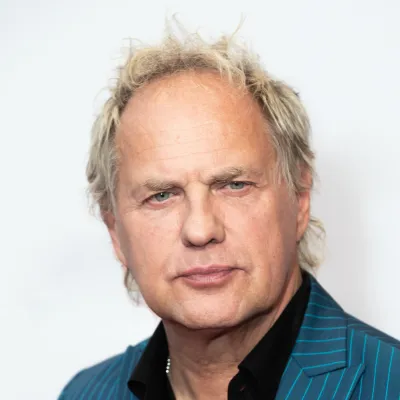
Uwe Ochsenknecht
Human Design Chart
Biography
In the early 1990s, he gained a second foothold in music. He has since released several albums; he is a singer in the band The Screen, while Mick Rogers (Manfred Mann's Earth Band) and Thomas Blug are guitar players. The two ex-musicians of Gary Moore's band Pete Rees (bass) and Graham Walker (drums) are also represented.
Ochsenknecht was married to model Natascha Ochsenknecht until 2012 and has three children with her, sons Wilson Gonzalez Ochsenknecht (b. 1990) and Jimi Blue Ochsenknecht (b. 1991), who are both actors, and daughter Cheyenne Savannah Ochsenknecht (b. 2000). His oldest son, Rocco Stark, is from a relationship with an earlier girlfriend. Wilson and Jimi Ochsenknecht acted together with him in the films Enlightenment Guaranteed and The Wild Soccer Bunch and its four sequels.
In July 2017, Ochsenknecht married Kiki Viebrock.
What does Generator 1/3 mean for Uwe Ochsenknecht?
Generator 1/3 — Design at a Glance
Uwe Ochsenknecht's design points to a tendency towards great endurance and inner strength, comparable to a workhorse that efficiently uses its energy when it is driven by a task. As a Generator, he had a lot of sacral energy, which was released not through self-initiated action but by reacting to impulses from the environment. The motto was clear: initiate nothing, but react.
His path to deep satisfaction and a sense of fulfillment led through a specific strategy: waiting for signals from life and then, when the sacral center gave a clear 'yes', responding with active action. This reaction 'from the gut' was the key to activating his immense creative power and making things in life effective.
If he did not live according to this design and instead tried to force things or react to impulses that did not resonate with him internally, he would encounter two typical stumbling blocks. Either he wasted energy on tasks without inner resonance, leading to burnout, or he was held back from his heart project, even though he was still full of power. In such cases of non-alignment with his design, a feeling of persistent frustration and a lack of energy would eventually set in. Only in alignment with his sacral response was he unstoppable.
Sacral Authority
Uwe Ochsenknecht's design points to a tendency towards intuitive, body-based decision-making. As a Generator, he had sacral authority, which also served as his strategy. This simplified his process: he did not need to think, but listen to his body. A prerequisite was an open emotional center, meaning he did not react to fleeting moods but to a stable inner voice.
This authority showed as gut feeling or surge of energy in response to external stimuli. Uwe Ochsenknecht learned to pay attention to bodily signals such as grunting, humming, or a simple 'mmh'. When his sacral motor kicked in, he felt vital and alive. He had access to inexhaustible energy and tackled tasks with great enthusiasm. His design promoted joy and satisfaction through immersion in work without the need for purposefulness.
Additionally, an activated spleen acted as a supportive authority. It gave him the ability to react particularly quickly and spontaneously. Through the direct connection with the sacral center, he had immediate access to instinctive perception and physical well-being. This combination allowed him to reliably follow his instincts, making his decision-making even more precise and agile.
The 1/3 Profile — Investigator / Martyr
Uwe Ochsenknecht's design points to a dual approach: intensive theoretical preparation paired with the urgent need to test these insights in practice. As a 1/3, the Researcher and Experimenter, a fundamental attitude is required that learning through direct contact with reality is necessary. The first line of the profile brings the desire to deepen knowledge, which sometimes leads to implementation being delayed out of fear of ignorance. However, the third line, the line of trial and error, demands the opposite: it requires testing to learn from mistakes and adapt.
This dynamic is supported by specific energies. The line 1 of Gate 54 points to the influence through hidden alliances; here, it's about transformation and understanding power structures that are not obvious. At the same time, the line 3 of Gate 57 brings the ability to adapt through intuitive clarity. This line is self-referential in the sense of survival and personal development, not in the sense of egoism. It allows refining intuition through clear experiences.
For Uwe Ochsenknecht, this means that his judgment about a matter or activity is only trustworthy if he has both theoretically analyzed it and practically tested it on his heart and gut. His path is characterized by uncovering hidden connections and subsequently testing these insights in real life, where mistakes serve as necessary steps towards adaptation and refinement of his intuition.
Split Definition — Defined & Open Centers
Uwe Ochsenknecht's design showed a tendency towards a fixed self-identity and inner drive. With the defined G Center, he had a clear sense of his own direction and the ability to comfort others with his reliability. This worked together with the defined Heart Center, which gave him the strength of will and the desire to control his life and resources, as well as to consistently fulfill promises. His energy source came from the defined Sacral Center, which generated a constant vital force, but was only correctly available in response to invitations. This was supported by the defined Spleen Center, which allowed him to make intuitive, momentary judgments about health and well-being, as well as the defined Root Center, which provided a steady pressure to move forward in the world and to survive.
At the same time, Uwe Ochsenknecht was someone who was vulnerable to external mental and emotional influences. His open Head Center allowed him to function without constant mental inspiration, but he tended to be overwhelmed by doubts and questions from others when trying to solve them. The open Ajna Center meant that he could not hold concepts and opinions as his own truth, but rather responded flexibly to intellectual stimulation without identifying with it. The open Throat Center attracted attention naturally, but suffered under the pressure of actively seeking or controlling attention. Particularly defining was the open Solar Plexus Center, which absorbed and amplified the emotions of the environment. Uwe Ochsenknecht tended to personalize these foreign feelings or avoid confrontation to prevent emotional waves, rather than recognizing them as not belonging to him and letting them go.
Channels for devotion, discovery and transformation.
Uwe Ochsenknecht showed an instinctive understanding of how to translate talents and ideas into concrete, recognized structures. His design leaned towards entrepreneurial creativity and persistent self-assertion.
The Channel of Devotion 44-26 connected his Spleen Center with the Heart Center. This gave him a fine sense of what the 'tribe' – his environment or market – actually needed before it was verbalized. He could transform these needs into convincing offers with willpower, acting less as an isolated creator and more as a promoter who generated and distributed resources. His success depended on the environment recognizing his gifts and providing him with a platform.
Parallel to this, the Channel of Transformation 54-32 between Root and Spleen Centers was at work. This channel drove him through ambition and the desire for social recognition. He was willing to work harder than others to prove his worth and move up. The fear of failure or loss of existence security functioned as a motor for continuous development and the building of continuity.
A third aspect was the Channel of Discovery 29-46, which connected the Sacral and G Centers. This was about the ability to completely immerse oneself in experiences without wanting to exercise control. Through pure yes-saying to impulsive reactions and persistent perseverance – even if the purpose was not immediately apparent – he could land at the right place at the right time and embark on new paths.
Additionally, Gates like 53 (Freedom, Pioneer Spirit) and 57 (intuitive clarity) shaped his attitude: He sought new cycles and relied on a clear, present intuition. Gates like 51 (Willpower, Adaptation) and 41 (evolutionary development through crises) underscored his ability to process shocks and further develop through change.
Tribal Circuitry — Circuit Signature
Uwe Ochsenknecht's design showed a tendency towards cyclical emotional waves that drew from the past. The Meaning-Finding Circuit connected his Identity and Sacral Centers. This generated rhythmic energy: feelings and insights from the past were not only processed individually but were used to share with the collective. The experience was wave-like – with a beginning, peak, and end – and promoted learning from history together.
Parallel to this, a separate but equally powerful structure was evident. The Ego Circuit connected Heart, Spleen, and Root Centers. This concerned cooperation and the joint creation of resources. Through the connection of Heart and Spleen, as well as the Root, an instinctive, probing intelligence was at work that aimed at mutual support. Since this circuit did not include a Sacral Center, there was no constant life force; instead, rest periods were necessary to maintain energy for the tribe.
The shared definition meant that these two systems – the emotional past division and the resource-oriented cooperation – did not flow directly into each other. They existed as two parallel, independent forces. Uwe Ochsenknecht thus moved between the reflective process of the past and the practical, instinctive cooperation in the here and now, without these areas automatically forming a single, continuous experience.
Right Angle Cross of Penetration 4
Uwe Ochsenknecht's design points towards a tendency for profound, often spiritual penetration, coupled with the need to translate these insights into the material world. This configuration, known as the right cross of penetration 4, describes a life task that moves between two poles: the search for the invisible and the necessity to make it visible.
In Human Design, this cross represents a specific energy that compels one to uncover hidden truths and not only keep them to oneself but actively share them. It is about the ability to penetrate complex connections and articulate them in a way that others can understand and apply. Uwe Ochsenknecht showed himself through this mechanism as someone who does not just think theoretically but seeks practical solutions based on a deep inner conviction.
The challenge lies in finding the right moment to express these insights without being distracted by external expectations. The design supports a stance that is both introspective and communicative, with a focus on the authenticity of the message. Uwe Ochsenknecht used this energy to build bridges between the spiritual and the everyday, which significantly shaped his interactions and decisions.
Saturn Return · Uranus Opposition · Chiron Return · 2nd Saturn Return — Life Cycles
Uwe Ochsenknechts design showed a tendency to shape life phases through clear structuring and long-term commitment. This attitude crystallized in 1985, at the age of 29, with the success of the comedy "Männer". This point marked his first Saturn return, a cycle in which years of groundwork often culminate in a solid, visible result. It was a moment of confirmation, where inner discipline became outwardly effective.
Later, in 1994 at the age of 38, a new dynamic emerged: Uwe Ochsenknecht became the voice actor for Archie in "Felidae". This coincided with the phase of the Uranus opposition, an astrological aspect that often triggers unexpected turns or innovative role changes. Here, the ability to break established patterns and open up to new, often surprising challenges expanded his career.
The second Saturn return in 2013, at the age of 57, culminated in the publication of his autobiography "Was bisher geschah". This cycle represents maturity and the integration of life experiences. The publication was not just a retrospective, but a structured summary of a life phase, where inner clarity was poured into an orderly form. These three points illustrate how Uwe Ochsenknecht's design navigated between the necessity of stable foundations and openness to transformative impulses.
Generator · Sacral Authority — Synthesis
A central red thread in Uwe Ochsenknecht's chart is the dynamic connection between energy and insight. As a Generator with sacral authority (Sacral Center), he relies on continuous activity and reacting to life circumstances to reach a state of deep engagement and energy flow. This potential is amplified by the Profile of the Researcher/Experimentor (Line 1/3), which possesses an insatiable urge to learn and try things out – a process that is linked to instinctive intelligence and the ability to learn from experiences through the Spleen Center and the Channel of Devotion (Gate 44/26). The recurring events in the cycles (Saturn Return, Uranus Opposition) seem to always coincide with creative work and sharing insights.
The central paradox lies in the tension between the need for constant activity and the necessity to direct one's energy purposefully. While the Generator can generate immense power, there is a risk of getting lost in aimless activities (stumbling blocks). At the same time, the Profile of the Researcher/Experimentor demands trying new paths, which can be associated with uncertainty and the feeling of not knowing enough yet. This dynamic between the sacral impulse to act and the researching need for preparation shapes a character that is both powerful and reflective.
3 Defined Channels
Incarnation Cross - Right Angle Cross of Penetration 4
Solar Return
The Solar Return shows the moment when the sun returns to its exact birth position - your personal solar year.
Life Cycles
Discover the life cycles with a detailed triple view (birth chart, cycle chart, composite).
Human Design Profile
- Type
- Generator
- Strategy
- To respond - wait for something to respond to
- Authority
- Sacral Authority
- Profile
- 1/3 - Investigator / Martyr
- Definition
- Split Definition
- Incarnation Cross
- Right Angle Cross of Penetration 4
- Date of Birth
- 07.01.1956 04:15
- Place of Birth
- Biblis, GER
Frequently Asked Questions
What is Uwe Ochsenknecht's Human Design type?
What profile does Uwe Ochsenknecht have?
What authority does Uwe Ochsenknecht have?
Which incarnation cross is Uwe Ochsenknecht assigned to?
When was Uwe Ochsenknecht born?
Discover your own Human Design
Are you also a Generator? Find out in a personal reading how to use your sacral energy correctly and discover deep satisfaction.
More Personalities
Back to overviewSissy Spacek
Aaliyah

Alexia

Anémone
Angèle

Ann-Margret