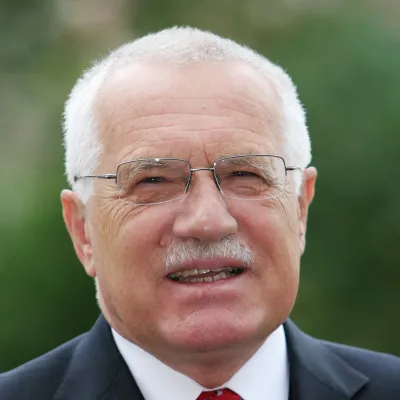
Vaclav Klaus
Human Design Chart
Biography
Klaus graduated from the University of Economics in Prague in 1963. He was a research worker at the Institute of Economics of the Czech Academy of Sciences in 1968 when he completed his Ph.D. in economics. After working for several years at the Czechoslovak State Bank, he joined the Forecasting Institute of the Czech Academy in 1987. At the beginning of the 1989 Velvet Revolution, which brought about the peaceful demise of communism in Czechoslovakia, Klaus entered politics. During this time he continued to lecture and publish in the field of economics.
Klaus served as minister of finance (1989–92) and became involved in the Civil Forum Movement—an organization he ultimately chaired in 1990.
Klaus was elected President of the Czech Republic by secret ballot of the parliament on 28 February 2003. He was re-elected on 9 February 2008 and took oath for the second term on 7 March.
Klaus published more than 20 books.
Vaclav Klaus — Manifesting Generator with Profile 6/2
Manifesting Generator 6/2 — Design at a Glance
Vaclav Klaus showed himself to be someone who possessed lightning-fast initiative and often bypassed conventional processes. His design as a Manifesting Generator combined the constant energy source of a Generator with the direct assertiveness of a Manifestor, allowing him to skip steps and quickly pull things into his life rather than building them up slowly.
This hybrid nature brought specific challenges along with it. The tendency towards speed occasionally led to important intermediate steps being overlooked, which required corrections later on and could cause frustration – a classic sign of the non-self theme for this type. Additionally, Vaclav Klaus tended to pursue multiple projects simultaneously instead of focusing on one task at a time.
The key to his deep satisfaction lay in not taking initiative himself but rather responding to inner impulses. Only when his Sacral Center said a clear "yes" should he act. Regularly checking his own motivation was essential to ensure that the parallel activities continued to bring joy. In this state of playful engagement, his creative power could work without friction, while clinging to linear completion processes would be more detrimental to him.
Emotional Authority
Vaclav Klaus exhibited a basic attitude characterized by emotional wave movements: His perception of the world was always coloured by his current mood. At one moment he could be totally enthusiastic about something, and in the next view the same matter negatively. These fluctuations were not instability but an expression of his inner authority – the defined Emotional Center.
Here applies a central rule: Whenever the Emotional Center is activated, it functions as the inner authority regardless of which other centers are also defined in the design. This means that his feeling at any given moment was just a snapshot, a first impression, and not necessarily his truth yet. Quick, spontaneous decisions based on such emotions could therefore have negative consequences.
Instead, his design required patience and multiple nights to sleep on decisions. The more time Vaclav Klaus took to let a choice mature, the deeper and more comprehensively he could perceive the situation. Through this process, intense feelings subsided, emotional distance was gained, and eventually clarity and calmness set in. Only then was the decision-making process complete – a mechanism particularly important for long-term, life-defining choices.
The 6/2 Profile — Role Model / Hermit
Vaclav Klaus revealed himself as someone who initially gathered life experience through intensive experimentation. In his younger years, before the return of Saturn, his design appeared as a 3/2 line: trial and error characterized this phase, with withdrawal after failures becoming the driving principle. It was about making many personal experiences without immediate confirmation.
After around thirty years, the sixth line of his Profile "Role Model / Natural Talent" activated. Then he metaphorically retreated into a cave high up on a mountain. From there, he looked back at all his earlier experiments with great distance. This period of intense reflection was also a time of healing and deep self-discovery.
When the right time came, Vaclav Klaus emerged from this isolation as a very wise person. Others recognized this wisdom and came to him to partake in his life lessons. They learned from him the ability for deep introspection. His Line 6 described a development in three phases towards authentic role models. It required trust in change and waiting for major societal changes, while he himself remained grounded as a natural talent in the here and now.
Split Definition — Defined & Open Centers
Vaclav Klaus appeared as someone who was constantly under mental pressure to ask questions and understand connections. This trait stems from his defined connection between the Head Center and Ajna Center. He possessed a firm way of conceptual thinking that allowed him to inspire or put others under pressure through his ideas. However, since these centers do not have their own energy for implementation, patience was crucial: hasty actions would have led to frustration, while waiting for the right moment brought clarity.
His design also featured a reliable sense of self-identity and direction through a defined G Center as well as an enormous source of vitality in his defined Sacral Center. This gave him the strength to engage with tasks that received an affirmative inner response from him. This was complemented by defined centers in the Solar Plexus (emotional depth), Throat (expression), and Root (stress management).
At the same time, Vaclav Klaus was vulnerable to conditioning in his open areas. His open Heart Center tended to want to prove its worth through promises or competition – a pattern that often led to exhaustion without inner authority due to lacking necessary willpower. Additionally, his open Spleen Center carried fears about health and survival. It was important for him not to act spontaneously or cling to uncertain situations just to gain a false sense of security. Instead, he needed to acknowledge these fears and make decisions based on his defined authorities rather than reacting impulsively to external stimuli.
Channels for maturation, presence, openness, clarity and emotion.
Vaclav Klaus appeared as someone who influenced others through mere presence and authenticity. His design tended towards quiet self-confirmation: the Awakening Channel 10-20 connected the G Center with the Throat Center. It expressed the wisdom that survival and success depend on accepting oneself in every moment. This configuration spoke for him; through his behavior as a living expression of self-love, he indirectly inspired others to be themselves without actively persuading them.
At the same time, he possessed deep emotional intensity. The Openness Channel 22-12 connected the Solar Plexus Center with the Throat Center. Here social interaction strictly depended on current mood. Gate 22 brought passion and melancholy while Gate 12 acted as a filter limiting communication to people with high mutational potential. When in the right emotional wave, his voice could deeply touch others; forcing himself into interaction made him abrupt and withdrawn.
Mentally, his mind worked not linearly but through sudden insights. The Awareness Channel 24-61 connected the Head Center with the Ajna Center. Inspiration from Gate 61 met rational processing at Gate 24. This did not produce predictable logic but spontaneous 'Satori' moments where knowledge simply arrived. He had to trust this process and wait until inner truth ripened rather than actively seeking solutions.
This mental clarity rested on a pulsating emotional foundation. The Freedom of Feeling Channel 39-55 connected the Root Center with the Solar Plexus Center. Through provocation (Gate 39) and mind (Gate 55), a wave of joy and melancholy was set in motion. This allowed him to 'tickle out' the nature of others, discovering who truly fit for him.
Ultimately, he sought meaning through complete cycles. The Maturation Channel 42-53 connected the Root Center with the Sacral Center. He needed time to go through experiences from start to finish and only then share resulting wisdom in retrospect. Individual gates like Gate 11 (visual memory) or Gate 25 (mystical innocence) underscored this stance of observing distance and spiritual centering, while gates such as Gate 46 (devotion) and Gate 36 (crisis as development) showed that he could only gain depth through full engagement in the process.
Individual Circuitry — Circuit Signature
Vaclav Klaus appeared through his design as someone who wanted to walk new paths and initiate change. This tendency came from the Knowledge Circuit. In him, two separate streams ran here: one connected Head with Ajna Center (intuitive flashes), the other linked Throat, Solar Plexus, and Root Centers. The latter allowed translating emotional waves directly into expression – without logical filtering by mind since these centers were not connected to Ajna or Head.
Parallel to this, the Meaning Circuit worked. It connected Vaclav Klaus' Sacral with his Root Center through maturation (Channel 42-53). This created a cyclical energy reflecting past experiences and anchoring them sustainably in the body. Since this connection lay separate from the Knowledge Circuit, two independent power sources existed: on one hand, impulsive-creative expression; on the other, deep experience-based learning.
Additionally, integration shaped his actions. The Awakening Channel connected Throat with Identity Center. This gave him a clear individual voice in the here and now. Together these separate groups formed a profile that possessed both innovative impulses as well as emotional depth, yet not as one continuous flow but as parallel acting specific forces experienced.
Left Angle Cross of Education 1
Vaclav Klaus’ Design established a fundamental approach of systematic transmission. His chart technical background, the left cross of education 1, describes an impulse to not only possess knowledge and structures but actively transmit them to the next generation or learners. This is not a passive stance as a repository of knowledge but rather a dynamic task: learned knowledge must be taught so that it remains alive and effective.
The mechanics of this cross combine a drive for order with responsibility towards others. It’s about preparing complex relationships in such a way that they can be understood and taken over by others. Vaclav Klaus showed himself through this configuration as someone who did not keep his experiences and insights to himself but placed them into an educational or structuring context. The energy of this design calls for creating security through clear guidance and recurring patterns.
It is a process of giving through teaching. Those who carry this expression often find their confirmation in the fact that others can become independent due to their insights. The quality of transmission stands out: it must be precise, understandable, and tailored to the recipient. Vaclav Klaus’ design thus underscores the role of mediator, bridging established knowledge with new learners to ensure continuity and development.
Saturn Return · Uranus Opposition · Chiron Return · 2nd Saturn Return — Life Cycles
Vaclav Klaus appeared as a personality whose life path was characterized by clear structuring and institutional anchoring. His design tended towards seeking authority and responsibility in established systems, where the integration of knowledge and economic logic took precedence. This orientation became visible during his first Saturn return: in 1971 at age 30, he worked at various positions with the Czechoslovak Academy of Sciences, the Central Bank, and the Prognostic Institute. This cycle condensed years of groundwork into a solid professional foundation based on analytical precision.
Further development led to his Chiron return, an achievement cycle in which one’s incarnation cross unfolds and meaning becomes tangible. In 1992 at age 51, Vaclav Klaus became Prime Minister of the Czech Republic. This position marked not a healing of old wounds but the bloom of his life mission: taking up a central leadership role that made his strategic competence effective on a national level. His second Saturn return confirmed this anchoring. In 1999 at age 58, he received the Bernhard-Harms-Medal from the Kiel Institute for World Economics. This recognition underscored international acknowledgment of his economic policy work and completed the arc from analytical research to political implementation, where structure and expertise remained the determining factors.
Manifesting Generator · Emotional Authority — Synthesis
A central red thread runs through the design: the dynamic connection between initiation and reaction. As a Manifesting Generator (MG), he possesses both the ability to quickly initiate things – an impulse from the defined sacral center paired with process shortening – as well as the necessity to wait for internal impulses. This combination is reinforced by the defined head center (inspiration, questions), which creates a constant drive towards understanding and engaging with new ideas but simultaneously requires an emotional wave to mature decisions. The repeated references to experimenting in his early life phase (6/2 Profile) and the later wisdom that arises from it underscore this process of acting, reflecting, and ultimately sharing insights.
The design reveals a central paradox between the desire for autonomy and the necessity of emotional clarity. The knowledge circuit drives him to independently generate knowledge and initiate changes while emotional authority requires thorough engagement with feelings and sleeping on decisions. This leads to tension between the quick action that the MG type allows and the internal need to navigate through emotional waves to achieve authentic and sustainable results. The documented events – career shifts and success – seem to emerge from this interplay of swift action and reflective decision-making.
5 Defined Channels
Incarnation Cross - Left Angle Cross of Education 1
Solar Return
The Solar Return shows the moment when the sun returns to its exact birth position - your personal solar year.
Life Cycles
Discover the life cycles with a detailed triple view (birth chart, cycle chart, composite).
Human Design Profile
- Strategy
- To respond - wait for something to respond to
- Authority
- Emotional Authority
- Profile
- 6/2 - Role Model / Hermit
- Definition
- Split Definition
- Incarnation Cross
- Left Angle Cross of Education 1
- Date of Birth
- 19.06.1941 02:58
- Place of Birth
- Prague, Czech Republic
Frequently Asked Questions
What is Vaclav Klaus' Human Design type?
What Profile does Vaclav Klaus have in Human Design?
What authority does Vaclav Klaus possess?
Which incarnation cross is active for Vaclav Klaus?
When was Vaclav Klaus born?
Discover your own Human Design
Are you also a Manifesting Generator? Find out in a personal reading how to unfold your multi-talents and direct your energy wisely.
More Personalities
Back to overviewAldair

Alizée

Angeli

Arletty

Artus
Balthus