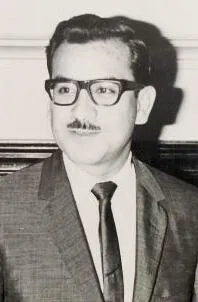
Valentín Paniagua
Human Design Chart
Biography
Five years after he left the presidency of the republic, after being hospitalized due to poor health since 21 August, he died on 16 October 2006 at 5:00 AM.
Human Design Analysis: Valentín Paniagua as Generator 3/5
Generator 3/5 — Design at a Glance
Valentin Paniagua revealed himself as someone who did not ignite his strength through spontaneous initiatives but rather through consistent responses to external impulses. As a Generator, he possessed considerable sacral energy that enabled him great endurance and high workloads – comparable to a robust working horse that only brings its full performance when it feels inner consent for the task.
His life force was primarily released when he responded to signals from his environment. The strategy consisted of not taking the first step himself but waiting until a clear impulse came, which his inner self reacted with a “Yes”. When Valentin Paniagua acted in harmony by setting actions as responses to life events, his design rewarded him with deep satisfaction and a sense of fulfillment.
Conversely, ignoring this inner resonance led to two specific risks: Either he wasted his energy on tasks without inner enthusiasm, which tended towards exhaustion, or he was prevented from his heart project despite the energy still being present. If he did not live by the principle of reacting from the gut, he instead encountered persistent frustration and a noticeable lack of energy. His effectiveness therefore depended on him only deploying his enormous endurance when inner confirmation pointed the way.
Sacral Authority
Valentin Paniagua showed a direct, physically anchored approach to decision-making. As a Generator, he possessed sacral authority, meaning that his strategy and his inner guidance were identical: He reacted to external stimuli. This configuration simplified his process as no abstract analysis was needed, but an immediate physical response sufficed.
His reactions appeared as “gut feeling” or surge of power – often audible through grunting, humming, or a confirming “Mhm”. Such signals marked the moment when his sacral motor kicked in. Feeling then vital and alive, he had access to inexhaustible energy. He tackled his tasks with great enthusiasm and immersed himself fully without questioning an external purpose. The joy of the activity itself was his motivation.
Additionally, his activated spleen center acted as a supportive instance. It gave him the ability to act especially quickly and spontaneously. Through this connection, he had immediate access to his instinctive perception and physical well-being. These instincts could be reliably used to make decisions in an instant without hesitation or deliberation. His system was designed to respond directly and energetically to life, guided by the inner confirmation of the body.
The 3/5 Profile — Martyr / Heretic
Valentin Paniagua revealed himself as someone who derived knowledge not from books but from direct action and failure. His design as a 3/5 Profile, that of an experimenter and hero, suggested he first had to try everything himself before believing it. This “trial-and-error” approach shaped his way of learning: Mistakes were not defeats but necessary steps for adaptation.
Especially relevant was the dynamics of Gate 46 on the third line. It brought a force that threw him out of balance and required constant adjustment. Valentin Paniagua had to learn not to prematurely project the future as present – which otherwise led to egoism and loss of support – but patiently draw conclusions from his own mistakes. Only when this practical experience was gathered could he use it.
Then Gate 15, representing the fifth line, came into play. It described his role as a rescuer or hero in crisis times. This was about extreme stances and growth through challenging circumstances. Valentin Paniagua’s ability to adapt to shifting demands made him attractive to others; they sought his solutions because they arose from real necessity. His value therefore lay not in theoretical perfection but in the authentic overcoming of obstacles, which he then offered as guidance to others.
Split Definition — Defined & Open Centers
Valentín Paniagua was someone who constantly felt an internal pressure to ask questions and understand connections. His defined Head Center and Ajna Center created a reliable but unbroken mental activity; he thought continuously, without being able to willfully stop or control this function. This configuration did not mean that he knew the answers immediately – inspiration initially only forms questions – but rather that he served as an inspirational source for others, particularly those with undefined Head Centers.
His design connected this mental process with a clear identity and direction through his defined G Center. He had a fixed self-esteem and intuitively knew where he belonged without having to prove himself. At the same time, his defined Sacral Center possessed a vast vital energy source that should not be used for initiative. His strength only unfolded in reaction to external impulses; only when he waited and responded to life's questions could his sacral energy fully and satisfyingly manifest. A mental decision alone would have blocked this energy and led to frustration.
As an open Heart Center, Valentín Paniagua was not designed to exercise willpower in the sense of competition or promises. He tended to internally question whether he was doing enough or if he was worthy when absorbing environmental pressure – a typical pattern for those with an open Heart Center. This center did not need to prove anything; it merely reflected other egos' vibrations to recognize who was trustworthy.
Similarly, his open Solar Plexus Center absorbed the emotions of his environment like a barometer. It was essential for him not to identify these feelings as his own but to let them go once he was alone. Only in this way could he remain emotionally clear and avoid falling into conditioned reactive patterns out of fear of confrontation. His open Root Center further amplified external stress from others; he had to learn not to misinterpret this pressure as a personal drive towards hyperactivity, but rather to consciously reduce it or selectively use it for productive phases.
Channels for curiosity, discovery, intuition and abstraction.
Valentín Paniagua was someone whose life was marked by a deep curiosity about human nature. The Channel of Curiosity 11-56 connected his Thinking Center with the Projector Center and drove him to constantly seek new perspectives. He functioned as a storyteller, conveying information not just as dry data but as living parables to inspire others and stimulate their imagination. This ability to weave narrative truth from ideas served to offer new belief systems for collective scrutiny.
Parallel to this, he possessed an intuitive depth that through repeated practice was transformed into concrete talent. The Channel of Wavelength 48-16 connected his inner intelligence with the capacity for perfectionism. Here it was not about mere theory but about gradually refining a skill until mastery was achieved. His design required recognition and resources to maintain this process of excellence; his talent only bloomed when energized by engagement and external affirmation.
His life energy followed the Channel of Discovery 29-46, linking his Action Center with his Self-center. This gave him an unshakable persistence. Once he encountered a positive experience, he fully immersed himself in it without having expectations about the outcome. This dedication allowed him to endure until the end of a process and ultimately make discoveries that could change collective understanding. Control did not play a role; important was trust in his direction.
Mentally, he worked with the Channel of Abstraction 47-64, connecting his Head Center with his Thinking Center. His mind searched every experience for hidden patterns and possibilities. Although this often led to temporary confusion, it was a necessary process to eventually reveal a clear, inspiring story or new perspective that he could then communicate. Individual Gates like Gate 25 (Innocence) and Gate 10 (Integration) underscored his ability to focus on the essential and transform complex connections into life-saving actions.
Collective Circuitry — Circuit Signature
Valentín Paniagua's design inclined towards analytical clarity and emotional reflection. As a person with split definition, he had two energetically independent blocks that worked parallel without directly flowing into each other.
The Understanding Circuit connected his Throat Center to the Spleen Center via the Channel 'Wavelength'. This allowed for precise, emotionless logic to visually and focusedly articulate logical insights – aimed at future improvements.
The Meaning-Finding Circuit consisted of two separate parts. The first linked Head-, Ajna- and Throat Centers through Channels Abstraction, Curiosity, and Discovery. Here a cyclical flow emerged: Intuition from the Head was processed in Ajna and expressed in the throat as an expression – serving to reflect past experiences and share them collectively. The second part connected Identity with Sacral Center, providing a stable, powerful base for these processes.
The Awareness Stream of Meaning-Finding in the Ajna Center underscored the collective dimension of this perception. Thus, Valentín Paniagua was someone who combined rational future visions with a deep, wave-like processing of past emotions – two separate but equally potent forces of his character.
Right Angle Cross of the Vessel of Love 3
Valentín Paniaguas design pointed to a profound, often unspoken dedication that was less about loud gestures and more about silent, steady presence. This attitude stemmed from the configuration of the "right cross of the Love Vessel 3". In Human Design mechanics, this specific pattern marks a particular quality of emotional and spiritual connection. It wasn’t about superficial interest in relationships but rather a structural anchoring that made Valentín Paniagua tend to see himself as a carrier or “Vessel” for deep human resonance.
The term “Cross of Love” here does not point towards romantic drama but rather to a fundamental ability to receive and hold emotional currents. Valentín Paniagua lived with an inner architecture that allowed him to act as a stabilizing force in moments of uncertainty or transition. His way of relating to others was marked by this silent readiness to accept. He did not necessarily seek the appearance of connection but rather its substance. This mechanism shaped his essence such that he saw relationships and communities not as means to an end, but as spaces where deep, often wordless understanding processes could unfold. His presence thus mirrored the emotional depth of his surroundings without dissolving his own identity.
Saturn Return · Uranus Opposition · Chiron Return · 2nd Saturn Return — Life Cycles
In his middle life phase, Valentín Paniagua showed himself ready to question established structures and take new political paths. This attitude reflected the dynamics of a Uranus Opposition: an astrological aspect often associated with a drive for change, independence, and questioning existing authorities. Uranus stands for innovation and breaking conventions; in opposition, it calls for adaptation to unexpected circumstances or conscious realignment.
In 1974, at age 38, Valentín Paniagua made a significant move: He switched to the Acción Popular party. This career change was not an arbitrary act but aligned with the typical energy of this cycle. The Uranus Opposition often marks a time when old bonds must be released to make space for a more authentic alignment. Valentín Paniaguas decision to join a new political force can be understood as an expression of his inner need for renewal and breaking free from earlier constraints. It was a moment of clear separation from the known towards a path that better aligned with his personal convictions and desire for change.
Generator · Sacral Authority — Synthesis
Valentín Paniagua lived a life path marked by a deep drive to experience practicality and share these experiences. As a Generator with sacral authority, he reacted immediately to the world around him, activating a powerful energy source within when interested (Sacral Center). His profile as an Explorer/Hero and Rescuer indicates that he learned through personal experimentation and shared this knowledge with others – a pattern that strengthened over time. The definition in Head Center created a constant urge to understand and inspired the development of new ideas (Gate 11), communicated through the Channel of Curiosity (56).
A central tension field in his design lay between the need to fully commit to tasks – to optimally use his sacral energy – and the inner pressure to constantly explore and question new things (Understanding Circuit). This dynamic led him to work persistently on matters while remaining open to new impulses. The transition into a different political direction in 1974 underscores his readiness for experimentation and adaptation, even after years of experience.
4 Defined Channels
Incarnation Cross - Right Angle Cross of the Vessel of Love 3
Solar Return
The Solar Return shows the moment when the sun returns to its exact birth position - your personal solar year.
Life Cycles
Discover the life cycles with a detailed triple view (birth chart, cycle chart, composite).
Human Design Profile
- Type
- Generator
- Strategy
- To respond - wait for something to respond to
- Authority
- Sacral Authority
- Profile
- 3/5 - Martyr / Heretic
- Definition
- Split Definition
- Incarnation Cross
- Right Angle Cross of the Vessel of Love 3
- Date of Birth
- 23.09.1936 10:30
- Place of Birth
- Cuzco, Peru
Frequently Asked Questions
What was Valentín Paniagua's Human Design type?
What profile did Valentín Paniagua have?
What authority did Valentín Paniagua have?
What incarnation cross did Valentin Paniagua have?
When was Valentin Paniagua born?
Discover your own Human Design
Are you also a Generator? Find out in a personal reading how to use your sacral energy correctly and discover deep satisfaction.
More Personalities
Back to overviewAaliyah

Alexia

Angèle

Anne-Marie

Arcángel

Arno