
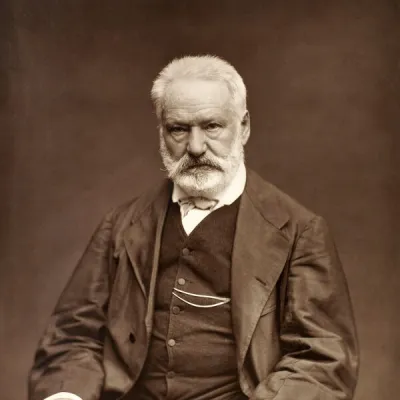
Victor Hugo
Human Design Chart
Biography
His most famous works are the novels The Hunchback of Notre-Dame (1831) and Les Misérables (1862). In France, Hugo is renowned for his poetry collections, such as Les Contemplations and La Légende des siècles (The Legend of the Ages). Hugo was at the forefront of the Romantic literary movement with his play Cromwell and drama Hernani. His works have inspired music, both during his lifetime and after his death, including the opera Rigoletto and the musicals Les Misérables and Notre-Dame de Paris. He produced more than 4,000 drawings in his lifetime, and campaigned for social causes such as the abolition of capital punishment and slavery.
Although he was a committed royalist when young, Hugo's views changed as the decades passed, and he became a passionate supporter of republicanism, serving in politics as both deputy and senator. His work touched upon most of the political and social issues and the artistic trends of his time. His opposition to absolutism, and his literary stature, established him as a national hero. Hugo died on 22 May 1885, aged 83. He was given a state funeral in the Panthéon of Paris, which was attended by over two million people, the largest in French history.
Human Design Analysis: Victor Hugo as Generator 3/5
Generator 3/5 — Design at a Glance
Victor Hugo possessed immense and enduring strength that allowed him to push forward projects with great consistency. His design characterized him as someone who appeared like a workhorse: extremely strong and resilient, provided his energy was available for the task at hand. This quality stemmed from his Generator type, which provides a lot of sacral energy.
The crucial mechanism, however, did not lie in mere endurance but rather in the way he accessed this strength. Victor Hugo’s design called on him to respond to signals from life rather than initiate actions himself. Only when an external impulse came and his sacral center responded with an inner “yes” could he unleash his full power. Acting from this gut feeling led to deep satisfaction and fulfillment; no one could then stop him.
Dangers lurked at two points. Either he wasted energy on things that did not resonate internally – a path that quickly led to burnout given his potential. Or he was held back from his heart project even though he still had plenty of drive left. If he lived by the principle of initiating rather than responding, it resulted in ongoing frustration and a noticeable lack of energy. His success thus depended on whether he waited for life to speak to him before answering with full force.
Emotional Authority
Victor Hugo's decision-making process was marked by a necessary delay: spontaneous reactions carried the risk of incorrect assessments. His inner authority lay in his defined Solar Plexus Center, meaning he was constantly under the influence of an emotional wave. This wave movement generated a perpetual up and down of his feelings; the world appeared to him always colored by his current mood. In one moment, he could be totally enthusiastic about something, only to see it completely negatively in the next.
This immediate impression was merely a snapshot, not necessarily his deeper truth. Quick decisions made from his current emotion could therefore have negative consequences. The mechanism of his authority required patience and the avoidance of instant reactions. The more time he took to let a decision mature, the deeper and more comprehensive he could understand the situation. This process demanded repeatedly "sleeping on things"; he should hesitate and ask himself multiple times.
Over time, the intense feelings subsided, allowing him to gain emotional distance. Only then did clarity and calm set in, signaling that he had gone through the process. This need for distancing was especially important for long-term decisions that could have a significant impact on his life course. By working through these emotional cycles, he arrived at a stable understanding independent of passing moods.
The 3/5 Profile — Martyr / Heretic
Victor Hugo revealed himself as someone who gained knowledge exclusively through personal experimentation. His design indicated a tendency to initially believe nothing and instead test everything practically. This attitude stemmed from his Line 3, the Experimenter, which defined the trial-and-error process as the central path to developing practical wisdom. Through this constant adaptability and learning from mistakes, he accumulated a rich trove of life experience.
He then used this self-acquired knowledge to solve other people's problems – the task of his Line 5, the Hero. For his design, it was crucial that he gained credibility for this role through personal experience. The tension in his character lay between the attractiveness of this hero image and the painful public visibility of failures during his experimenting. Failing in front of others could be very hurtful but was necessary to gain the required wisdom.
His Line 5 also connected with a specific approach to details and loyalty. He focused on what was essential, convinced that certain patterns would recur. This belief in the recurrence of patterns drove him forward even when doubts about the correctness of a process arose. Victor Hugo ultimately presented his experiences to others who wanted to learn from his practical knowledge, thus being perceived as a heroic storyteller.
Single Definition — Defined & Open Centers
Victor Hugo's Human Design profile points towards a tendency for self-determined resource control and emotionally filtered decision-making. His defined Heart Center endowed him with the ability to actively shape his life and independently deploy his energy. He had a clear sense of his own worth, only making promises he could keep, which strengthened his self-esteem. This willpower formed the basis for his actions, combined with the constant vitality of his defined Sacral Center. This center generated a steady stream of energy that became available only in response to external requests; initiating actions without prior invitation often led to exhaustion or resistance.
His decision-making process was significantly influenced by his defined Solar Plexus Center. Here lay his inner authority: He had to wait for the emotional wave to clear before taking action. Impulsive decisions made during emotional highs or lows proved counterproductive; patience was key to correct judgment.
At the same time, he showed a receptivity to external influences through several open centers. His open Head Center made him susceptible to mental pressure and the adoption of others' questions, leading to confusion if he did not trust his inner authority. His open Ajna Center allowed for a flexible mind but risked interpreting other people's concepts as his own truth or feigning uncertainty. The open Throat Center led him to seek attention or speak under pressure rather than waiting for natural invitations to communicate. Additionally, his open G Center was open to identity questions; he gathered directions through relationships and environments instead of having a fixed inner direction. His open Spleen Center made him sensitive to the health and safety needs of his environment, leading to impulsive decisions out of fear of survival risks if not reflected upon. Finally, his open Root Center absorbed stress from the environment, which could lead to a sense of urgency or burnout when he confused external pressure with his own.
Channel 59-6: Mating — Channels & Gates
Victor Hugo sought deep intimacy and had a desire to build bridges between people. His design inclined him towards shaping relationships through an intense aura that promoted merging as well as the need for fair exchanges in groups.
The Pairing Channel 59-6 connected his sacral energy with the emotional center, creating an electromagnetic tension that defined intimacy as a core need. The mechanics required patience: Victor Hugo had to wait until the emotional wave of pleasure and pain clarified before acting on relationships. This prevented confusion and allowed him to nurture friendships before they deepened. His intensity could quickly build trust but required time to clear misunderstandings about his intentions.
Parallel to this, the Community Channel 37-40 linked his heart with the Solar Plexus center, driving a desire to be part of a larger unit and to conclude fair agreements. Victor Hugo sought his place in the whole and built bridges between individuals. The mechanics of this channel required a personal invitation and careful consideration; business or commitments could not be made spontaneously but needed emotional maturity to be sustainable for all parties involved. He understood the importance of honor and mutual support within a community where everyone had a respected place.
Both channels shared a common strategy: waiting for the emotional wave. Whether in intimacy or social exchange, Victor Hugo's design showed that clarity only emerged over time. Through this patience, he could enter stable, fruitful connections and make fair agreements based on real understanding rather than impulsive reactions.
Tribal Circuitry — Circuit Signature
Victor Hugo exhibited a tendency towards mutual support within the Ego Circuit. His design connected his Heart Center with the Solar Plexus center through Channel 37-40, establishing a clear pattern of 'Give and Take': Today I give you, tomorrow you give me back. This promoted cooperation and shared resource management within his tribal group. However, since this circuit did not connect to his Sacral Center, it lacked a constant life force as an infinite energy source. Instead, his structure required mandatory rest periods for regeneration to provide sustainable support; without these breaks, the resource production would have been exhausted.
Parallel to this, Victor Hugo's Archer Circuit worked through Channel 6-59 between the Sacral and Solar Plexus centers, emphasizing the theme of pairing by connecting instinctive energies with emotional waves to protect the survival and continuation of his genetic line. Although both circuits shared the Solar Plexus center, they formed separate energetic sub-parts: The Ego Circuit focused on social exchange without a sacral connection, while the Archer Circuit directly linked the sacral life force with emotional intensity. Victor Hugo's design thus combined cooperative resource sharing under strict observance of recovery phases with deep, instinctive devotion to protect and preserve the family unit through the connection of life force and emotion. This configuration shaped his actions as someone who acted both in exchange and care, always limited by the necessity to regenerate energy.
Right Angle Cross of Planning 1
Victor Hugo's design established a tendency towards strategic alignment and long-term vision. He was someone who could penetrate complex situations and develop a clear plan for the future. This ability stemmed from his specific configuration: the right cross of planning 1.
This structure linked various energetic centers into a coherent system of foresight. It enabled him not only to grasp current events but also to derive their implications for upcoming phases. It was a mechanical ability to synthesize information into action-guiding strategies. Victor Hugo used this capacity to look beyond the immediate moment and set long-term goals. The energy did not flow impulsively, but followed a logical sequence of planning steps. This shaped his approach to challenges: he sought out the underlying pattern before acting. The configuration provided him with an internal framework to transform uncertainties into structured perspectives. Thus, his strength was not merely reacting to what was given, but actively shaping the future through well-founded foresight. This mechanical foundation significantly determined how he approached future tasks: always with a view towards the big picture and the intention of finding sustainable solutions.
Saturn Return · Uranus Opposition · Chiron Return · 2nd Saturn Return — Life Cycles
Victor Hugo's life followed a clear rhythmic structure that was marked by three distinct astrological cycles. These phases served as decisive structuring moments for his creative work and public recognition.
At the age of 28, he experienced his first Saturn return. This cycle condensed years of groundwork into a solid result. Victor Hugo marked this transition with the premiere of "Hernani" in 1830, which entered literary history as the "bataille d’Hernani". It was a moment of consolidation for his artistic position.
Ten years later, in 1841, at age 39, he experienced the Uranus opposition. This cycle often demands breaking free from old structures to embrace new freedoms or higher-level recognition. Victor Hugo responded by being elected to the Académie française. It was a clear success that confirmed his established role within the literary establishment and freed him from earlier struggles.
At age 60, in 1862, he went through his second Saturn return. This cycle often brings maturity and the full weight of a life's work into focus. Victor Hugo published "Les Misérables". This event marked the culmination of a long creative phase and firmly anchored his work in cultural history. The three cycles show how his energy developed from initial assertiveness to institutional recognition, culminating in mature mastery.
Generator · Emotional Authority — Synthesis
A central red thread runs through the design: the deep connection to sacral energy (Generator Type, Pairing Channel) and the resulting need to work on something that truly fulfills. This energy is present but requires emotional maturity (emotional authority) to be directed into productive channels – otherwise there is a risk of wasting energy or even burnout. The profile as an experimenter/hero and savior underscores this process: gaining knowledge through personal experimentation, then making it accessible to others, which is a natural consequence of the defined heart that emphasizes the need for self-actualization and sharing resources.
A central paradox lies in the combination of emotional authority and the experimenter profile. On one hand, the emotional wave requires time for decision-making and clarity (Heart Center), while on the other hand, the 3/5 profile urges direct experience and experimentation to gather experiences at all. This tension between inner maturity and the urge to act creates a dynamic process that is reflected in the documented career cycles: the publication of significant works (1831, 1862) apparently followed phases of experimenting and emotional processing.
2 Defined Channels
Incarnation Cross - Right Angle Cross of Planning 1
Solar Return
The Solar Return shows the moment when the sun returns to its exact birth position - your personal solar year.
Life Cycles
Discover the life cycles with a detailed triple view (birth chart, cycle chart, composite).
Human Design Profile
- Type
- Generator
- Strategy
- To respond - wait for something to respond to
- Authority
- Emotional Authority
- Profile
- 3/5 - Martyr / Heretic
- Definition
- Single Definition
- Incarnation Cross
- Right Angle Cross of Planning 1
- Date of Birth
- 26.02.1802 22:30
- Place of Birth
- Besançon, France
Frequently Asked Questions
What was Victor Hugo's Human Design type?
What Profile did Victor Hugo have in Human Design?
Which Authority guided Victor Hugo's decisions?
What incarnation cross did Victor Hugo have?
When was Victor Hugo born?
Discover your own Human Design
Are you also a Generator? Find out in a personal reading how to use your sacral energy correctly and discover deep satisfaction.
More Personalities
Back to overviewAaliyah

Alain-Fournier

Alexia

Angèle

Angeli

Anne-Marie
