
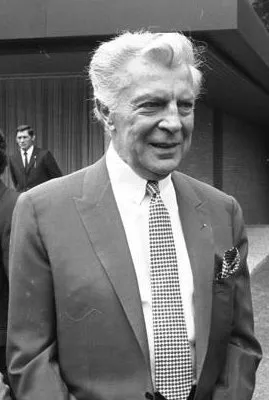
Viktor de Kowa
Human Design Chart
Biography
Having attended drama classes with Erich Ponto, he gave his acting debut at the Staatstheater Dresden in 1922. After appearances in Lübeck, Frankfurt and Hamburg, de Kowa entered the stages of the Volksbühne and the Deutsches Theater in Berlin, as well as of the Prussian State Theatre under Gustaf Gründgens.
He had a first small film appearance in Nils Olaf Chrisander's The Heart Thief in 1927 and subsequently became one of the leading comic actors of the UFA film industry. During the Third Reich he joined the Nazi Party, directing the propaganda movie Kopf hoch, Johannes! in 1941. The film idealized the education of the German youth in National Political Institutes of Education, which earned de Kowa an entry on the Gottbegnadeten list to evade his Wehrmacht conscription, though Minister Goebbels was disillusioned with his directing.
Despite his involvement in Nazi cinema, de Kowa's film and theatre career quickly proceeded after the war. In 1945 he became director of the Berlin Tribüne theatre and an ensemble member of the Vienna Burgtheater from 1956 to 1962. As chairman of the trade unions for art, culture and media, he was also a board director of the Confederation of German Trade Unions (DGB).
First married with actress Ursula Grabley (1908–1977) in 1926, de Kowa in 1941 secondly married the Japanese singer and actress Michiko Tanaka (1909–1988).
He died on 8 April 1973, aged 69, in West Berlin.
Human Design Analysis: Viktor de Kowa as Generator 1/3
Generator 1/3 — Design at a Glance
Viktor de Kowa revealed himself as someone with immense inner endurance and strength, comparable to that of a workhorse. His Generator design endowed him with abundant sacral energy, which he could use to achieve things in his life. However, this energy was not released through initiative but became active only when he responded to signals from his environment. Therefore, his motto was: do not initiate, but react.
When an impulse came from life and his sacral center answered with a deep inner 'yes', he could engage fully with action. In this state, he was impetuous and effective; living in harmony with this strategy rewarded him with a profound sense of fulfillment and satisfaction.
Two situations were dangerous for his energy: first, when he continuously did things that brought him no joy or that he actually had no desire to do. Then, he squandered his strength and tended towards exhaustion. Second, he suffered frustration when prevented from working on heart projects, even though his inner self was still full of power wanting to continue. If he constantly initiated independently without waiting for an external signal, he encountered a lack of energy and persistent frustration. His path to effectiveness lay in responding intuitively to life.
Sacral Authority
Viktor de Kowa's design inclined towards intuitive-physical decision-making. As a Generator, he possessed sacral authority that also served as his life strategy, simplifying the process of choice. This inner guidance did not manifest in the head but rather as a direct physical reaction to external stimuli: an intuition or a noticeable surge of energy. His system signaled interest through sounds like grunts or hums and noises such as 'Mhm'. When this resonance occurred, he felt vital and alive; energy seemed inexhaustible. Work was then accomplished with great enthusiasm driven by joy and satisfaction rather than duty. He was born to dissolve himself into tasks.
Additionally, a supportive authority through an activated Spleen Center, possibly directly connected to the Sacral Center, facilitated quick, spontaneous reactions and decisions. Viktor de Kowa had immediate access to his physical well-being and instinctive perception. He relied on this instinctual level for reliable guidance, shaping his ability to quickly orient himself in the here and now. The open Emotional Center was a necessary prerequisite for this clear sacral leadership.
The 1/3 Profile — Investigator / Martyr
Viktor de Kowa appeared as someone whose life was marked by deep curiosity and a drive to understand knowledge not just theoretically but practically through testing. His design as an Investigator and Experimenter (Profile 1/3) suggested that he gained insights through direct contact with reality – a process of trial and error. While Line 1 of the profile promoted thorough preparation and information gathering, Line 3 urged him to test these theories in practice.
This dynamic meant that Viktor de Kowa might have experienced phases of uncertainty when the desire for more information (Line 1) delayed action. Yet ultimately, his path led to forming judgments based on personal experience. What he deemed valuable or correct had been previously examined both intellectually and through practical application.
Additionally, energies of Self-Discovery and Attention (Gate 22) together with the theme of Influence Through Experience (Gate 26) were at play. This indicates that he learned to move in various roles and accepted rejection or setbacks as necessary parts of the learning process. His wisdom did not arise from abstract speculation but from the ability to integrate mistakes and derive practical support for his environment from them. His judgment was thus the result of a rigorous yet effective training through life's practice.
Single Definition — Defined & Open Centers
Viktor de Kowa's design tends to stand out through a constant, vital energy source. His defined Sacral Center generated a daily supply of consistent power that pushed him into action and gave him the ability to master tasks with persistence – provided he responded to external impulses rather than initiating them himself. This sacral energy was available for deep satisfaction through proper use. Complementing this structure was his defined Root Center, which delivered a steady, adrenalized pressure to maintain life's impulse and move forward in the material world. This inner drive ensured a constant basis of survival awareness and existential stability.
At the same time, his chart revealed several sensitive areas without their own definition. His open Head Center made him vulnerable to mental confusion and the pressure to find answers for others' questions that were not his own. Similarly, his open Ajna Center allowed him to be flexible in taking on various concepts but often left him feeling unsure when he had to assert a firm intellectual position or opinion. His open Throat Center meant that he lacked a fixed identity or direction; instead, he tended to reflect himself within relationships and environments and often sought confirmation of who he was. Likewise, his open Heart Center showed an inclination towards needing to prove his worth through promises or competition, despite lacking the consistent willpower for it. Finally, his open Solar Plexus absorbed emotions from his surroundings, making him emotionally vulnerable and causing him to experience others' moods as his own. His undefined Spleen Center was prone to fundamental survival fears and clinging to unhealthy situations out of false security.
Channels for focused energy and detailed endurance.
Viktor de Kowa directed his attention with almost physical intensity towards details. This attitude stemmed from the Channel of Concentration 52-9, a format energy between Root and Sacral Centers. It connected the passive urge of Gate 52 not to act with the focused logic of Gate 9. Viktor de Kowa remained still to avoid distractions and used this inner tension like a yoga pose to apply his energy precisely. He hated it when this powerful focus was diluted by multitasking. Instead, he waited for his Sacral Center to react before acting; only then did his true life focus reveal itself, which he aimed to perfect.
Alongside this central structure, other energies were at work. Gate 22 promoted a calm openness and listening until the end, enabling individual processes without intrusion. Gate 47 helped him recognize collective meaning from past experiences by organizing random image sequences. In his Heart Center, Gates 26 and 45 shaped his way of engagement: Gate 26 linked a weak ego with the ability to accept innovations through continuity, while Gate 45 expressed pure energy of possession and royal hierarchy. On the Family level, Gates 60 and 41 contributed to development: Gate 60 accepted limitations as prerequisites for transcendence and overcame melancholy through creativity, whereas Gate 41 propelled evolutionary sense development and focused feeling in crisis times. Together, these gates formed a design oriented towards logical precision, patient observation, and profound meaning-making.
Collective Circuitry — Circuit Signature
Viktor de Kowa's design leans toward structured, emotionless rationality. His energetic architecture was characterized by a simple definition where the connection exclusively existed between the Sacral and Root Centers. These two centers formed a single, connected group; other defined areas were absent or not directly linked to this core flow.
This structure manifested in the Understanding Circuit. For Viktor de Kowa, specifically the Channel of Concentration (Gates 9 and 52) was active here. This channel connected his Sacral Center, the source of his life energy, directly with his Root Center, the center for urgency and impulsive action. The general mechanics of this circuit aim to apply logical strategies and focus to improve structures or guide societal developments towards a better future. A central feature is sharing rational insights ideally free from conditioned emotional distortions – since the Solar Plexus Center is not part of this circuit, it involves pure logic.
For Viktor de Kowa, this configuration meant that his strategic thinking and focus were directly fueled by his fundamental life energy. The connection between Sacral and Root Centers created a direct flow between endurance and immediate readiness for action. This shaped a way of working where concentrated attention was not just intellectual but physically and energetically immediate. His energy served to focus visual or strategic formats and share these insights with others, ensuring that the urgency of his Root Center translated logical impulses into concrete actions swiftly.
Right Angle Cross of Rulership 1
Viktor de Kowas design points towards a tendency for strategic action based on the principle of proper alignment. This configuration, known as the Right Authority Cross 1, does not describe the ability to seize power arbitrarily or enforce one's plans against resistance. Instead, Viktor de Kowa showed himself to be someone who became effective by positioning himself where his natural radiance and inner compass harmonized with external demands. The Right Authority Cross implied a life task of practicing leadership not through coercion but through authentic presence. Viktor de Kowa lived this mechanism by seeking out or accepting situations in which his presence created order and clarity naturally. This was a passive form of influence: when circumstances were right, others followed his example without explicit instruction. This structure emphasized that true authority for Viktor de Kowa did not lie in the struggle for control but in the ability to find the right moment and place where his energy could flow naturally. His design challenged him to swim with the current rather than fight against it, thereby growing his influence organically and sustainably without having to actively "rule" in the traditional sense.
Saturn Return · Uranus Opposition · Chiron Return · 2nd Saturn Return — Life Cycles
Viktor de Kowa revealed himself as someone whose professional positioning was strongly influenced by external power structures and collective currents. His design showed a tendency to act during phases of societal upheaval or under the pressure of authoritarian systems, where his role was often determined by the larger political landscape. This aligned with the dynamics of an Uranus opposition: a cycle that challenges traditional boundaries and forces the individual to either adapt to the collective change or fight against it. In this context, in 1944 at the age of 40, a decisive event occurred: Viktor de Kowa was included on Goebbels' list of "geniuses by divine providence." This inclusion marked the peak of this planetary configuration. It illustrated how the pressure of the Uranus cycle – often accompanied by sudden changes, liberation, or submission to new orders – manifested in a concrete career-defining decision. The mention on this list was not an isolated success but rather the result of a long-term adaptation process to the prevailing ideology, which took its definitive form through the influence of Uranus. Here, the mechanics of his design were evident: the individual stands in a tension field between personal integrity and the compulsion to conform with a revolutionary or authoritarian movement. Viktor de Kowa's design suggested that he chose the path of adapting to the prevailing system during this life phase, securing his professional existence but also irrevocably linking him to the NS ideology. This constellation described a time when personal autonomy gave way to collective belonging.
Generator · Sacral Authority — Synthesis
Viktor de Kowa lived deeply rooted in his Sacral Center and his ability to generate energy – an unrelenting drive that led him to engage intensively with topics and gain insights through experimentation. As a Generator with sacral authority, he reacted immediately to stimuli, made decisions from the gut, and found confirmation for his path in the activity itself. This energy was channeled through the Channel of Concentration (Gate 9/52), leading to a focus on details and an ability to delve deeply into issues and structure them. The Profile as a Researcher and Experimenter underscored this process of learning through experience, where self-discovered insights were particularly valuable.
At the same time, a tension emerged between the need for activity and the necessity to listen to his inner sacral voice. The energy was present, but it needed to be used meaningfully and not wasted on aimless activities. This led to a search for authentic inspirations that his Sacral Center approved of – an ongoing balance between the urge to implement (Line 3) and the inner wisdom signaled by sacral authority. The right Authority cross points toward a direction in which he could use his energy purposefully, yet also take responsibility for the outcomes.
1 Defined Channel
Incarnation Cross - Right Angle Cross of Rulership 1
Solar Return
The Solar Return shows the moment when the sun returns to its exact birth position - your personal solar year.
Life Cycles
Discover the life cycles with a detailed triple view (birth chart, cycle chart, composite).
Human Design Profile
- Type
- Generator
- Strategy
- To respond - wait for something to respond to
- Authority
- Sacral Authority
- Profile
- 1/3 - Investigator / Martyr
- Definition
- Single Definition
- Incarnation Cross
- Right Angle Cross of Rulership 1
- Date of Birth
- 08.03.1904 05:00
- Place of Birth
- Przesieczany, Poland
Frequently Asked Questions
What was Viktor de Kowa's Human Design type?
Which Profile did Viktor de Kowa have?
What Authority did Viktor de Kowa possess?
What incarnation cross did Viktor de Kowa have?
When was Viktor de Kowa born?
Discover your own Human Design
Are you also a Generator? Find out in a personal reading how to use your sacral energy correctly and discover deep satisfaction.
More Personalities
Back to overviewSissy Spacek

Aaliyah

Alexia

Anémone

Angèle

Ann-Margret
