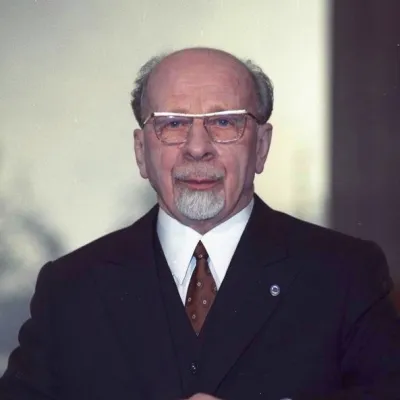
Walter Ulbricht
Human Design Chart
Biography
Ulbricht's difficult relationship with Leonid Brezhnev, combined with his unwillingness to seek a rapprochement with West Germany, proved to be his eventual undoing. On 3 May 1971 Ulbricht was forced to resign from virtually all of his public functions 'due to reasons of poor health' and was replaced – with the consent of the Soviets – by Erich Honecker. He was allowed to remain head of state as Chairman of the Council of State.
Ulbricht was probably the most hated figure of the East German communist goverment and responsible for the building of the Berlin Wall after 13 August 1961.
What does Manifestor 6/2 mean for Walter Ulbricht?
Manifestor 6/2 — Design at a Glance
Walter Ulbricht revealed himself as a pioneer and visionary whose nature was geared towards steering the world into a new future. His design corresponds to that of a Manifestor type, often compared to the role of an emperor in ancient Rome: he possessed the vision of a great empire but did not wage the necessary wars and battles himself; instead, he sent others to achieve his goals for him. This distance from direct implementation characterized his style of leadership.
His greatest pain body was constantly polarized by these grand dreams. Because he often thought ahead of his environment, he was misunderstood. Some people loved him because of his visions and a following developed around him; others hated or rejected him precisely because of these enormous goals. This dilemma between love and hate was a central aspect of his design.
To gain the right support, it was crucial for Walter Ulbricht to inform others about his plans in good time and accurately. This strategy of informing served to reduce misunderstandings and attract suitable allies. If he followed this strategy, he was rewarded with an inner sense of peace. However, if he lived against his design, he instead felt a persistent, deep anger within him. His path was therefore marked by the necessity of clear communication to minimize resistance and maintain his state of inner peace.
Splenic Authority
Walter Ulbricht's design showed a tendency towards spontaneous, instinctive decision-making. He trusted in a fine internal impulse to determine what was right at any given moment. This attitude stemmed from his authority in the Spleen Center, which was based on a defined Spleen Center. Since his Emotional and Sacral Centers were open – a prerequisite for this specific form of authority in Projectors or Manifestors – the Spleen Center functioned as his health and alarm system. It provided spontaneous survival intelligence that manifested as immediate physical well-being or discomfort. Walter Ulbricht therefore had to make decisions on the spot; the first impulse was the reliable indicator of his health and well-being. This allowed him to rigorously protect himself from harmful influences and take good care of himself. However, it was a very subtle signal tone that only occurred once. High vigilance was required so that this fine impulse would not be drowned out by external influences. Since knowledge of what is right was always only available in the present moment, plans often changed at short notice. This made long-term commitments significantly more difficult. Walter Ulbricht therefore needed a lot of freedom and flexibility rather than binding himself early on. A temporary withdrawal could be helpful to hear the Spleen voice clearly before an action took place.
The 6/2 Profile — Role Model / Hermit
Walter Ulbricht showed a clear development arc: In his youth, impulsive experimentation dominated, often ending in retreat. This behavior corresponded to the 6/2 Profile Dynamics, where Line 6 acts like a 3-line until age 30 – driven by trial and error. He actively sought ways but stumbled frequently, leading to phases of isolation.
After about thirty years, his attitude changed fundamentally. Line 6 became effective, allowing Walter Ulbricht to develop a deep distance from his earlier experiences. He metaphorically retreated into a 'cave' to look introspectively at his life. This phase served healing and self-awareness before he later appeared as a wise advisor that others sought.
At the same time, the design carried tension: Line 6 strove for inner peace and spirituality, often accompanied by self-deception or Neptunian veiling. True tranquility only set in when the entire circuit was fulfilled. When Walter Ulbricht felt pressure or interference with his autonomy, Line 2 reacted extremely. Here 'might made right'; his defensive measures were decisive and intimidating. After such outbursts, there often followed a Neptunian regret over the harshness of the reaction, even if it seemed justified to him. This combination shaped his essence: from youthful trial-and-error to mature, detached wisdom, paired with protective, sometimes hard boundaries.
Single Definition — Defined & Open Centers
Walter Ulbricht was characterized by a consistent, reliable voice and a set approach to dealing with pressure. His defined Throat Center ensured clear communication, while the also defined Spleen Center allowed for spontaneous intuition in the present moment. The Root Center provided the necessary stress to secure material safety. In contrast, Head, Ajna, G-, Heart, Sacral, and Solar Plexus Centers were open. This meant no inherent source of mental inspiration, identity or willpower; instead, he tended to be guided by external influences without claiming them as his own truth. His design shaped a presence based on existential security and clear expressiveness, while emotional and identity-forming areas remained situational.
Channels & Gates
Walter Ulbricht was characterized by a deep drive to perfect structures and systematically correct errors. His design combined intuitive depth with the need for practical repetition to achieve mastery. This dynamic was marked by Channel 48-16: Gate 48 sought out life-critical information, while Gate 16 refined skills through experimentation and precision. This created an energy that translated intuitive insights into technical proficiency.
Simultaneously, the Channel of Judgment 58-18 acted as a driving force for criticism and optimization. Gate 58 fueled the insatiable drive for "better and more", while Gate 18 brought in correction by questioning patterns and naming the unhealthy. This combination allowed Walter Ulbricht to not only identify problems but develop logically founded solutions that challenged the status quo. The energy required, however, recognition and resources to be sustainably effective; without this support, the development of talent was difficult.
Additionally, other Gates shaped his approach: Gate 52 promoted focused pauses for pattern correction, while Gate 62 called for patience and logical detail work for framework building. Gate 31 stood for the transmission of power in a collective context, and Gate 44 ensured through awareness transformational interactions without preconditions. Walter Ulbricht used these mechanisms to influence societal as well as individual patterns through continuous review and refinement, always driven by the desire for functional excellence and correct alignment.
Circuit Signature
Walter Ulbricht was shown as someone who utilized logic and structure to pursue social improvements. His design tended towards an emotionless ratio since the Solar Plexus Center was not involved. This happened through the Understanding Circuit, whose core is sharing rational insights without conditioning. In Ulbricht's case, this circuit directly connected Throat, Spleen, and Root Centers. The energy thus flowed from intuition and knowledge (Spleen) over communication (Throat) to endurance (Root). This allowed him to clearly articulate strategic concepts and consistently implement them. The focus was on visual aspects and the future, supported by the Channels "The Wave" and "Judgment". This connection ensured that his rational insights were not only kept private but actively shared. As it was a Simple Definition, these centers formed a continuous flow within a single group. Ulbricht lived in the belief that logical strategies could lead society to a better future. His approach was characterized by the need to make complex connections understandable and to refrain from emotional influence. The structure of his design thus promoted clear, forward-looking communication based on rational analysis.
Left Angle Cross of Demands 1
Walter Ulbricht's design indicated a tendency towards strategic orientation, particularly in dealing with demands and requirements. His character was defined by a structural pattern that determined how he handled pressure or the necessity of expectations. This was not an arbitrary reaction but a firmly anchored principle in his Human Design.
This attitude resulted from the configuration 'The left cross of demands 1'. This specific structure describes a life task where the 'how' of action in the context of demands is central. Walter Ulbricht did not react impulsively to external pressure, but followed an inner compass that helped him navigate strategically. The mechanics of this cross emphasized how he dealt with the claims of his environment. It was less about simply fulfilling tasks and more about the quality and strategy of fulfillment under the weight of demands.
For Walter Ulbricht, this meant that in situations where demands were placed on him, he sought a certain inner order. He did not merely accept these tensions but channeled them through his specific strategic orientation. The left cross of demands 1 thus significantly shaped his actions: it was the filter through which he took in external expectations and translated them into actionable tasks for himself. This structure helped him maintain clarity under pressure, focusing his energy rather than being overwhelmed by others' demands.
Saturn Return · Uranus Opposition · Chiron Return · 2nd Saturn Return — Life Cycles
Walter Ulbricht's career development followed a pattern of recurring astrological cycles marking critical turning points. These phases structured his rise through specific life stages where external events aligned with internal developmental milestones.
In 1933, at the age of 40, Ulbricht led the secret functionary meeting of the KPD. This occurred during an Uranus opposition cycle, which often initiates unexpected breaks or new responsibilities in professional structures. The situation required quick adaptation to changed political realities.
In 1941, at 48 years old, Ulbricht was deployed on the German-language program of Radio Moscow. This timing coincided with his Chiron return. In Human Design mechanics, this cycle does not signify healing of past wounds but a phase of fulfillment and bloom where one's incarnation cross unfolds. Ulbricht found a position that made his purpose tangible and oriented him internationally.
In 1950, at the age of 57, Ulbricht became the leader of the GDR and SED regime. This marked his second Saturn return. While the first return often signifies the establishment of a stable base, the second return condenses years of groundwork into a firmly established authority and structure. Ulbricht's design showed itself in this phase through the consolidation of his power position, where the cycle favored the final anchoring of his influence in the political system. Each step was no coincidence but an expression of the underlying temporal mechanics.
Manifestor · Splenic Authority — Synthesis
Walter Ulbricht was a Generator whose life was marked by a deep-rooted drive towards creation. The defined connection between Throat and Spleen centers (Channel of Wavelength) points to a voice arising from profound inner perception that manifested in purposeful communication. This combined with natural authority, lying in spontaneous recognition of opportunities and dangers – an instinctive knowledge of what was beneficial or harmful. The profile as role model and natural talent suggests he developed unique wisdom through experimentation in his youth, which he later imparted. Repeated events marked by Uranus opposition, Chiron return, and Saturn return at ages 40, 48, and 57 respectively, underscore a life characterized by deep transformations and the building of new structures.
Ulbricht's design contained a central paradox: the combination of manifesting energy as a Pioneer with the necessity of inner boundaries and withdrawal (Profile 6/2). He acted as an initiator but also required phases of intense reflection and distancing to preserve his inner wisdom. This tendency towards withdrawal stood in tension with his role as a public figure and visionary, possibly leading to misunderstandings and polarization – a pattern inherent to the Manifestor type.
2 Defined Channels
Incarnation Cross - Left Angle Cross of Demands 1
Solar Return
The Solar Return shows the moment when the sun returns to its exact birth position - your personal solar year.
Life Cycles
Discover the life cycles with a detailed triple view (birth chart, cycle chart, composite).
Human Design Profile
- Type
- Manifestor
- Strategy
- To inform others before acting
- Authority
- Splenic Authority
- Profile
- 6/2 - Role Model / Hermit
- Definition
- Single Definition
- Incarnation Cross
- Left Angle Cross of Demands 1
- Date of Birth
- 30.06.1893 13:20
- Place of Birth
- Leipzig, GER
Frequently Asked Questions
What is Walter Ulbricht's Human Design type?
What Profile did Walter Ulbricht have in Human Design?
What Authority did Walter Ulbricht have in Human Design?
What incarnation cross did Walter Ulbricht have in Human Design?
When was Walter Ulbricht born?
Discover your own Human Design
Are you also a Manifestor? Find out in a personal reading how to use your initiation power peacefully and dissolve resistance.
More Personalities
Back to overviewChristian-Jaque

Kesha

Laurent-Eynac
Lucebert

Masaccio

Papus