Photo: Wikimedia Commons
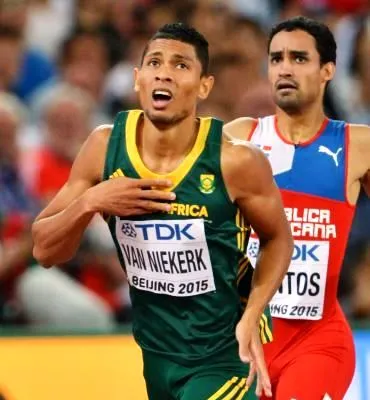
Wayde Van Niekerk
Human Design Chart
Biography
Van Niekerk was the silver medallist in the 400m at the 2014 Commonwealth Games and took bronze in the 4×400 metres relay at the 2013 Summer Universiade. He also represented South Africa at the 2013 and the 2015 Athletics World Championships. At the 2015 World Championships, he won the gold medal in the 400 metres.
In the 2016 Olympic Games Men's 400m, he won the gold medal with a World Record time of 43.03 seconds (reaction time 0.181 s), beating the time of 43.18 seconds set by Michael Johnson during the 1999 World Championships in Athletics in Seville, Spain.
He is a Christian, tweeting "Jesus Did It" and "GOD IS POWER" after setting the world record for the 400m. Wayde's recent Olympics win set off a racial debate after a tweet storm when Coloured South Africans celebrated his win by creating a hashtag #ColouredExcellence.
Human Design Analysis: Wayde Van Niekerk as Projector 3/5
Projector 3/5 — Design at a Glance
Wayde Van Niekerks Human Design points towards a tendency for focused perception. As a Projector, his aura appeared like a precise beam of light that directly targeted weaknesses in other people's systems. This configuration allowed him to immediately recognize what was not functioning or 'in the dark' within others. However, this direct approach carried the risk of being perceived as unpleasant when he pointed out these flaws right away – similar to shining a bright light directly into someone’s face.
The mechanics of his design showed that an elegant approach involved not actively correcting but attracting through his own harmony. When Wayde Van Niekerk simply 'shone' in a balanced manner, others would naturally come to him seeking advice. His strategy was therefore to wait for an honest and respectful invitation from the environment rather than forcing himself upon them.
Since Projectors do not have a defined Sacral Center, Wayde Van Niekerk lacked a constant internal energy source. Instead, he experienced phases of high productivity followed by necessary rest periods for regeneration. Ignoring this need for pause could lead to burnout. However, if he lived according to this rhythm and waited for the invitation, his path was typically rewarded with success; deviating from it could result in feelings of bitterness.
Splenic Authority
Wayde Van Niekerks Human Design points towards spontaneous, instinctive decision-making. His inner authority lies in the Spleen Center, a defined center that functions as a health and alarm system. Given this configuration only occurs for Projectors or Manifestors – assuming Emotional and Sacral Centers are open – his intelligence primarily manifested as a survival instinct. This instinct provided immediate internal knowledge about whether a situation, environment, or society was right for him. His physical well-being served as a reliable indicator.
Decisions had to be made in the moment; the first impulse was always correct and directly served his health. This allowed him to rigorously shield against harmful influences and take good care of himself. However, since the Spleen voice is a very fine, unique impulse, its use required high vigilance to avoid being drowned out by external influences. A brief retreat could be helpful in decision-making.
Since what was right only became apparent in the moment, plans could change at short notice. Long-term commitments were therefore difficult; instead, he needed much freedom and flexibility to act spontaneously without unnecessarily limiting himself. This mechanism shaped his lifestyle through constant adaptation to current impulses.
The 3/5 Profile — Martyr / Heretic
Wayde Van Niekerks Human Design is characterized by a clear tension between an unbridled urge to experiment and the role of a rescuing expert. As a 3/5 Profile, he had a tendency to reject anything predefined and test everything himself – often with mistakes that were understood as necessary learning steps. This line of the experimenter drove him to make unusual discoveries through pure 'button pressing' and recognize valuable details in practical work.
At the same time, he attracted others because he could use this knowledge gained from personal experience to solve their problems. The Hero Line (5) gave him the ability to offer practical solutions during crises and successfully conclude processes, creating a strong sense of self-worth and an impression of maturity. However, this configuration also harbored specific vulnerability: public failure in testing new paths was particularly painful given his heroic role. After such phases or after overcoming a crisis, Wayde Van Niekerk typically withdrew to gather new strength before stepping back into the role of advisor.
Split Definition — Defined & Open Centers
Wayde Van Niekerk was characterized by a constant inner pressure to question and understand connections. His defined Head Center and Ajna Center generated permanent mental activity; he did not just think when necessary, but was constantly in the process of concept formation. This energy flowed into his defined Throat Center, making his thoughts and theories reliably manifest as communication or action externally. Additionally, a defined Spleen Center endowed him with spontaneous intuitive perception of 'now' – an instinctive sense of health and safety that worked independently of reason. Furthermore, he had a defined Root Center, which provided constant adrenaline-driven pressure to move forward and manage stress.
At the same time, Wayde Van Niekerk was open in several areas to external influences. His open G Center meant that he did not have a fixed identity or direction; instead, he reflected his environment and often unconsciously sought confirmation from others about who he was or where love could be found. The open Heart Center made him vulnerable to the pressure of having to prove his worth, which could lead to cycles of promises and disappointment when trying to simulate willpower that wasn't structurally present. His open Sacral Center meant he did not have constant generative energy; instead, he absorbed the vitality of his environment, leading easily to overexertion and exhaustion as he struggled to set boundaries or recognize when enough was enough. Finally, his open Solar Plexus absorbed the emotions of others, causing him to fluctuate between joy and sorrow without identifying these waves as his own, making him particularly vulnerable to emotional conditioning.
Channels for clear structure, ambition and mental abstraction.
Wayde Van Niekerk showed a mind intent on translating complex patterns into understandable structures. His design inclined towards not just absorbing information but logically organizing it and expressing it in words others could follow. This happened less through spontaneous inspiration than through an ongoing internal process of analysis and integration.
The Accepting Channel 17-62 connected his thinking ability with his capacity for expression. Through the Gate of Opinions (17), he visualized patterns, while the Gate of Details (62) translated these into precise language. For Wayde Van Niekerk, understanding meant that new data could logically integrate into his existing worldview. Anything not organically fitting remained foreign to him. This channel endowed him with the ability to communicate detailed visual impressions as theories or formulas, provided he waited for the right timing and invitation to speak to avoid resistance.
Parallel to this, the Structuring Channel 23-43 was at work. Here he received insights through the Gate of Insight (43), which he then processed and expressed via the Gate of Assimilation (23). This configuration promoted innovative thinking that often felt like a quantum leap, pointing out more efficient paths. His challenge lay in letting go of control and allowing his mind to assimilate knowledge at its own pace. When shared at the right time, his unique perspectives could change collective thought patterns; otherwise, misunderstanding or rejection loomed.
Additionally, the Transformation Channel 32-54 shaped his actions. Driven by the Gate of Ambition (54) and the Gate of Continuity (32), he sought recognition through consistent effort. His instinct helped him recognize when support was available to solidify his well-being or status. This ambition was closely tied to concern for the survival of his 'tribe', motivating him to work up through competence to secure the stability of his environment.
The Abstraction Channel 47-64 completed this picture. Through the Gate of Understanding (47) and the Gate of Confusion (64), he filtered every experience through a kaleidoscope of mental images. He sought a story that made sense, often accompanied by temporary confusion. Patience was key: only over time did individual points coalesce into a clear image, which he could then share as an inspiring narrative.
Individual Gates like 61 (inner truth), 42 (conclusion through experience), and 56 (mental stimulation) underscored this process: knowledge was gained through inner resonance and reflection on experiences, while doubt (Gate 63) propelled the mental process to gain security.
Collective Circuitry — Circuit Signature
Wayde Van Niekerk's design inclined towards structured communication that combined logical clarity with emotional resonance. This dynamic arose from two separate energetic systems within his Split Definition.
The first system encompassed the Ajna and Throat Centers. Here, the Knowledge Circuit worked through the Structuring Channel (Gates 43-23), fostering the ability to organize thoughts into clear expression forms. Parallel to this, the Understanding Circuit connected the same centers via the Accepting Channel (17-62). This supported sharing rational, forward-looking insights free from conditioning. Both channels operated in the same center pair, enabling Wayde Van Niekerk to convey complex ideas both structurally and acceptingly.
The second system comprised Head and Ajna Centers. The Meaning Circuit worked here through the Abstraction Channel (64-47). This directed attention towards reflecting on past experiences to grasp their deeper meaning. This visual, cyclical energy contrasted with the rational future perspective of the first system and complemented it with emotional depth.
A third independent stream connected Spleen and Root Centers via the Ego Circuit (Transformation Channel, 32-54). As no connection existed to the Sacral Center, this configuration required conscious rest periods for resource regeneration. The separated groups – on one hand, communicative-intellectual centers; on the other, the instinct-driven Spleen-Root pair – existed as parallel forces without direct energetic flow between them.
Right Angle Cross of Maya 2
Wayde Van Niekerk's Human Design shows a tendency towards a specific inner dynamics that is marked by the presence of the right Maya 2 cross in his chart. This configuration is not a general mechanism but an individual expression of his energetic structure. It points to a way he processes information or impulses and translates them into action.
The right Maya 2 cross does not describe an external directive for actions, but rather an inner orientation. It's about the ability to recognize certain patterns and integrate these into one's life context. For Wayde Van Niekerk, this means that his design provides a foundation to absorb complex connections and make them useful for himself.
Since no specific event is given in the raw content, the description remains at this characteristic orientation. No assumptions are made about concrete life events but only what emerges from the mentioned configuration is described. The mechanics show here a structure designed to organize inner processes and direct them personally. This shapes his way of dealing with his environment and accessible information without slipping into general cliches.
Saturn Return — Life Cycles
Wayde Van Niekerk's Human Design points towards explosive, focused energy application characterized by clear goals and physical presence. This configuration describes a system that can unleash its full power in moments of high alignment and discipline, often coupled with a strong will to overcome limits and achieve visible results.
In 2017 at the age of 25, he won the gold medal over 400 meters at the World Athletics Championships in London. For his design, this was a typical moment: The first Saturn Return marked a point where years of groundwork and structural development condensed into a tangible, visible success. This cycle often brings the first major proofs for one's life direction and the potential of the design when following inner authority. The gold medal was not only a sporting triumph but an expression of mature, structural alignment where internal discipline and external performance were in harmony. It showed how the design under pressure and with clear goal setting could achieve maximum efficiency by concentrating resources and overcoming obstacles. This success confirmed the effectiveness of his specific energetic patterns in the realm of physical performance capability and competitive spirit.
Projector · Splenic Authority — Synthesis
A central red thread runs through the design: the ability to recognize patterns and make them understandable for others (Channel 17/62). This manifests as a natural gift to uncover weaknesses – shining light into darkness – coupled with the drive to learn through experience (Profile 3/5) and share this knowledge. The defined connection between Head Center and Ajna Center amplifies this mental pressure, constantly questioning and understanding connections before communicating the gained insights. This process is guided by the Spleen Center as an inner authority that spontaneously signals which information is relevant and can be shared – an intuitive sense for what works in the context of others.
The design reveals a central paradox: projecting knowledge and insight (Projector Type) meets the necessity of personal experience (Line 3). While there's an impulse to illuminate paths for others and identify errors, the profile requires a personal 'test run' before this knowledge is considered valid. This creates tension between immediate recognition of solutions and the need to try them out oneself, potentially leading to internal pressure (defined Head Center), but ultimately underlining the authenticity of shared knowledge – knowledge that's not only theoretical but also practically tested. A documented event shows how this process can succeed.
4 Defined Channels
Incarnation Cross - Right Angle Cross of Maya 2
Solar Return
The Solar Return shows the moment when the sun returns to its exact birth position - your personal solar year.
Life Cycles
Discover the life cycles with a detailed triple view (birth chart, cycle chart, composite).
Human Design Profile
- Type
- Projector
- Strategy
- Wait for the respectful invitation
- Authority
- Splenic Authority
- Profile
- 3/5 - Martyr / Heretic
- Definition
- Split Definition
- Incarnation Cross
- Right Angle Cross of Maya 2
- Date of Birth
- 15.07.1992 00:55
- Place of Birth
- Cape Town, SAFR
Frequently Asked Questions
What is Wayde Van Niekerk's Human Design type?
What profile does Wayde Van Niekerk have?
What authority does Wayde Van Niekerk possess?
What incarnation cross does Wayde Van Niekerk have?
When was Wayde Van Niekerk born?
Discover your own Human Design
Are you also a Projector? Find out in a personal reading how to unfold your leadership qualities and recognize the right invitations.
More Personalities
Back to overviewSissy Spacek
Alain-Fournier
Anémone
Ann-Margret

Bourvil
Hergé