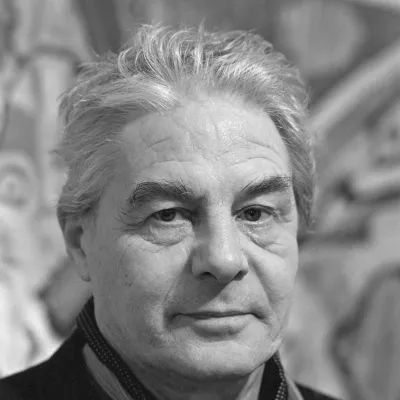
Photo: Wikimedia Commons
Whitley Strieber
Human Design Chart
Biography
He is married with one son and has lived at his home in New York for the past 20 years.
Human Design Analysis: Whitley Strieber as Manifestor 6/2
Manifestor 6/2 — Design at a Glance
Whitley Strieber revealed himself as someone who acted with a clear, often forward-thinking vision, which polarized people. His design as a Manifestor describes an energy that is not designed to wait on others or adapt, but to actively push the world into a new direction. Like an emperor who expands his empire without fighting himself, Strieber initiated processes that set others in motion. However, this pioneering role came with a specific pain point: the feeling of being misunderstood. Because his perspective often reached further than that of his surroundings, it inspired enthusiasm in some and rejection in others.
The mechanics of his design therefore require a precise strategy: informing. Before he acted or implemented his visions, it was crucial for him to clearly inform his surroundings about his intentions. This was not to gain approval, but to reduce friction. Only through this transparency could he find the right resonance and minimize resistance. Living this strategy led to a deep sense of inner peace. Ignoring it and acting without prior communication resulted in persistent, deep anger. His path thus consisted of channeling his initiatory power through clear communication to generate peace instead of frustration.
Emotional Authority
Whitley Strieber showed himself as someone who did not make decisions based on a first, often intense emotional impulse, but consciously postponed them until a deeper clarity set in. His design carried Emotional Authority, meaning his defined Solar Plexus Center had the inner leadership – regardless of which other centers were also defined. This authority was subject to a constant emotional wave, an up and down, filtering the perception of the world through the current mood. What seemed absolutely right in one moment could be felt as negative in the next. Since this immediate reaction was only a snapshot and not necessarily the truth, his system required patience. Quick, spontaneous judgments could have negative consequences. Instead, it was necessary to take time for decisions to mature and to rethink them multiple times. Only when the intense feelings subsided and emotional distance was gained, did calmness set in. This process was particularly crucial for long-term, life-defining steps. Whitley Strieber had to allow himself to be delayed and respect the natural rhythm of his emotions to arrive at an authentic, clear insight that transcended the transient mood fluctuations.
The 6/2 Profile — Role Model / Hermit
Whitley Strieber revealed himself through his design as someone who intensely experimented in the first decades of his life. His 6/2 line initially worked as a 3-line, which made trial and error and a retreat after failures a driving principle in his youth. This phase served the collection of personal life experiences.
After the age of 30, with the activation of the 6-line, this dynamic fundamentally changed. Whitley Strieber metaphorically retreated into a cave to look back at his earlier experiments with distance. This period of intense reflection was also a phase of healing and deep self-awareness. From this isolation, he developed into a wiser figure.
His Gate 45 emphasized the necessity of individual mutation and the integration of others to bring in innovations. This happened not as a collective compulsion, but as personal development. Parallel to this, his Gate 36, Line 2, gave him the ability to help emotional energies in crisis times. This support was selective: Whitley Strieber helped others through crises, often without knowing it himself, and used imagination for useful projects. Only when he emerged from his reflective phase could others recognize his life wisdom and learn from his ability for deep introspection.
Split Definition — Defined & Open Centers
Whitley Strieber's Human Design shows a tendency towards deep emotional processing and intuitive body intelligence, coupled with vulnerability to mental overload and identity search. His defined Solar Plexus Center acted as an inner authority, requiring emotional waves to be waited out before decisions were made. This energy colored the environment, while his defined Throat Center reliably articulated messages from this emotional depth as well as the intuitive Spleen Center's definition. The defined Spleen Center provided spontaneous, existential perceptions in the present, connected with the defined Root Center, which offered a firm pressure to maintain the life impulse.
Simultaneously, several undefined centers revealed a susceptibility. The open Head Center tended to identify with others' doubts and questions rather than following clear inspiration. The open Ajna Center made him susceptible to foreign concepts, which he could misinterpret as his own truth. Particularly defining was the open G Center, which did not offer a fixed identity but led to reflecting in relationships and environments to find direction. The open Heart Center lacked consistent willpower, which could lead to a compensatory need to prove himself through promises. Finally, the open Sacral Center reflected the energy of others, leading to exhaustion if he did not listen to his intuitive authority to set boundaries. This configuration described a path that required patience with his own emotions and intuition to separate from the conditioning external world.
Channels for logical clarity and emotional expression.
Whitley Strieber displayed a fundamental disposition marked by an insatiable drive to question and perfect patterns. This inclination towards correction and analysis formed the foundation of his perception, coupled with a restless search for new, emotionally profound experiences.
This dynamic resulted from the Judgment Channel 58-18, connecting the Root Center with the Spleen Center. Gate 58, the Gate of Vitality, drove a logical impulse constantly striving for 'better and more,' while Gate 18, the Gate of Correction, assessed what was healthy or in balance. This channel functioned like a sentry, evaluating whether what was perceived served the well-being of the collective. Whitley Strieber found his validation when asked to identify errors and develop solutions applicable to others.
Simultaneously, the Ephemeral Channel 36-35, connecting the Solar Plexus Center with the Throat Center, was at work. Gate 36, the Gate of Crisis, perceived inexperience as inadequacy and often generated crises to set things in motion. Gate 35, the Gate of Change, manifested the desire for newness, driven by the question: 'What is new?' This emotional channel sought adventures to gain wisdom through experience, even if this led to instability when expectations were not met.
Additionally, further gates shaped his design: Gate 45 represented the tribal level and the will to attract similar forces, while Gate 26 promoted innovations in a conservative tribe. Gate 6 steered emotional waves in the context of fertility and growth. On the personality level, Gate 31 with its transmission of leadership and Gate 39, which through provocation and analysis prepared adrenaline for mutations, were influential. In his design, Gate 53 promoted freedom for new cycles, Gate 54 connected worldly success with spirituality, Gate 49 required obedience to principles, Gate 16 enabled mastery through experimentation, Gate 52 created pauses for concentration, and Gate 33 ensured reflection and withdrawal.
Collective Circuitry — Circuit Signature
Whitley Striebers Human Design shows a tendency towards precise, emotionless analysis, existing alongside deep, wave-like emotional cycles. These two forces were not directly connected but formed separate, parallel systems.
The Understanding Circuit connected Whitley Striebers Spleen and Root Centers. This generated the ability to develop logical strategies and structural improvements for the future. The energy was focused and rational, free from emotional coloring, as the Solar Plexus Center was not involved here. It was about sharing clear, unconditioned insights.
Simultaneously, the Meaning Circuit, connecting Throat and Solar Plexus Centers, was at work. Here, the processing of past and emotions was in the foreground. This energy ran cyclically and wave-like: feelings and experiences from the past were reflected to grasp their meaning and share these insights with the collective.
As Whitley Strieber had a Split Definition, these two circuits existed as independent blocks. The rational, future-oriented logic of the first system did not directly exchange with the emotional, past-oriented reflection of the second. Instead, they shaped his experience as two distinct, parallel processes: on the one hand, clear, strategic reason, on the other hand, deep, emotional meaning-making.
Left Angle Cross of Confrontation 1
Whitley Strieber was revealed through a design that brought him into situations of direct confrontation to unveil deeper truths. This fundamental stance stems from the influence of the left Cross of Confrontation 1. This is an archetypal structure that does not confront for the sake of conflict but because only by breaking illusions and challenging established norms can new insights be made possible.
For Whitley Strieber, this meant that his path was often marked by uncovering inconsistencies or questioning what was taken for granted. The mechanics of this Cross describe a life task where the person acts as a catalyst: they ask uncomfortable but necessary questions to overcome stagnation. It is not about aggression but the necessity to break through the surface to reach the true substance of a matter.
This configuration set a tendency to not settle for superficial answers but to penetrate to a more authentic reality through confrontational processes – whether with oneself, others, or societal structures. The energy of this design urges to bring the hidden into the light, even if this process can provoke resistance. Whitley Strieber carried a specific responsibility by contributing through his presence and actions to making visible what had previously remained hidden or ignored.
Saturn Return · Uranus Opposition · Chiron Return · 2nd Saturn Return — Life Cycles
Whitley Striebers design revealed a deep inclination to engage with the unknown and the unexpected, often within a private, familial context. This configuration points to a life task of expanding the boundaries of the known, not through abstract theory but through immediate, personal encounters with the extraordinary.
This tendency became manifest in 1985, at the age of 40, when he and his family experienced aliens in a cabin in New York. This event marks the beginning of the Uranus Opposition, a cycle often associated with sudden, disruptive insights that challenge the existing worldview. In Striebers case, this challenge did not present itself as an intellectual concept but as a direct, shared reality within the relational sphere. The Uranus Opposition demands to question old structures and integrate new, often shocking truths. For Strieber, this meant that the encounter with the strange did not occur in isolation but involved the family unit, fundamentally changing personal authority and interpersonal dynamics. It was a moment when the unimaginable became tangible experience and laid the groundwork for a lifelong engagement with these phenomena.
Manifestor · Emotional Authority — Synthesis
A central red thread in this design is the dynamic interaction between inner perception and the urge to carry this outward. Emotional authority requires a maturing wave of feeling, while the defined Throat Center channel enables the expression of messages from the deepest centers. The profile as role model/natural talent points to a development where personal experiences are initially lived intensely and later passed on as wisdom. This process is reinforced by the Judgment Channel, which continuously questions and corrects patterns – a continuous cycle of experience, reflection, and communication.
The central paradox lies in the tension between the Manifestor type and emotional authority. The Manifestor is destined to act and initiate, while the emotional wave requires time and maturation. This creates an internal dynamic where the impulse for immediate action is tempered by the necessity to experience and integrate feelings. The left Cross of Confrontation underscores this tension by pointing to a confrontation with the outer world that is strengthened by the inner necessity to communicate authentically. A documented event shows how an intense experience can influence perception and expression.
2 Defined Channels
Incarnation Cross - Left Angle Cross of Confrontation 1
Solar Return
The Solar Return shows the moment when the sun returns to its exact birth position - your personal solar year.
Life Cycles
Discover the life cycles with a detailed triple view (birth chart, cycle chart, composite).
Human Design Profile
- Type
- Manifestor
- Strategy
- To inform others before acting
- Authority
- Emotional Authority
- Profile
- 6/2 - Role Model / Hermit
- Definition
- Split Definition
- Incarnation Cross
- Left Angle Cross of Confrontation 1
- Date of Birth
- 13.06.1945 04:45
- Place of Birth
- San Antonio, TX, United States
Frequently Asked Questions
What is Whitley Strieber's Human Design type?
What Profile does Whitley Strieber have in Human Design?
Which Authority guides Whitley Strieber?
What incarnation cross defines Whitley Strieber?
When was Whitley Strieber born?
Discover your own Human Design
Are you also a Manifestor? Find out in a personal reading how to use your initiation power peacefully and dissolve resistance.
More Personalities
Back to overviewAlain-Fournier
Angeli
Christian-Jaque

Juninho

Kesha

Lucebert