
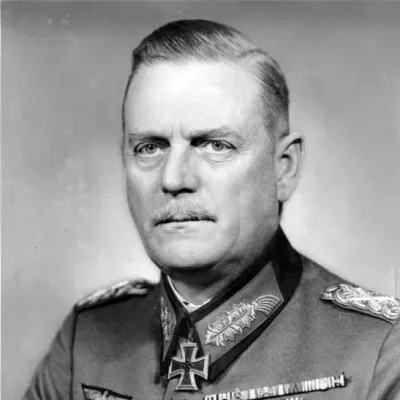
Wilhelm Keitel
Human Design Chart
Biography
Keitel was 1.85 m (6 ft 1 in) tall, later described as a solidly built and square-jawed Prussian. He married Lisa Fontaine on 18 April 1909 and had three sons and two daughters.
In October 1940, he took over the Axis African Command. He condoned measures leading to mass murder in Poland and Russia. Described as hard, unsmiling and mysterious, he was tried by the International Military Tribunal, found guilty of war crimes and crimes against humanity, and hanged on 16 October 1946 in Nuremberg Prison.
Before his execution, Keitel published his memoirs which were titled in English as In the Service of the Reich. It was later re-edited as The Memoirs of Field-Marshal Keitel by Walter Görlitz. Another work by Keitel later published in English was named Questionnaire on the Ardennes offensive.
He was played by Scottish actor Kenneth Cranham in Valkyrie, a 2008 historical political war thriller film.
Human Design Analysis: Wilhelm Keitel as Manifesting Generator 1/3
Manifesting Generator 1/3 — Design at a Glance
Wilhelm Keitel revealed himself as a Hybrid being with a constant inner energy source, yet possessing the ability to push processes forward at an unusual speed. His design combined the endurance of a Generator with the direct action power of a Manifestor. This allowed him to skip steps and draw things into his life quickly.
However, this speed was a double-edged sword. Often he acted too hastily and skipped necessary intermediate steps, leading to the need to return later to fill gaps. Such setbacks caused frustration as they went against his natural pace. Additionally, he tended to tackle multiple tasks simultaneously, driven by various impulses. If this multitasking tendency was not guided by clear inner consent, his enthusiasm for creation quickly turned into dissatisfaction.
His strategy involved initially reacting to external life impulses before acting. Only when his sacral center signaled a clear "yes" should he begin. Under these conditions, he could derive deep satisfaction from his actions. Parallelism then became an asset rather than a hindrance. He found his greatest contentment in a playful mode that sought variety and was not dependent on rigid sequentiality. His success depended on whether he adhered to this reactive strategy or succumbed to the temptation of initiating too early.
Sacral Authority
Wilhelm Keitel had as a Generator a simplified decision-making structure: His strategy was identical to his inner authority. This meant that his actions sprang directly from his physical sensations without the detour through intellectual deliberations. His design required an open emotional area, meaning he did not react based on mood-based judgments but rather on the immediate feedback of his Sacral Center.
This sacral authority manifested as a kind of gut feeling or a physical surge of energy that arose in response to external stimuli. Wilhelm Keitel learned to interpret these bodily signals – whether it was a soft grunt, an affirming "Mhm," or a dismissive sound. When his sacral motor was engaged, he felt vital and energized. He then had an inexhaustible source of power and devoted himself to his tasks with great enthusiasm. His design suggested that he was born to perform activities with joy, driven by an inner motivation without compulsive purpose.
Moreover, his activated Spleen Center acted as a supportive instance. In conjunction with the Sacral Center, this allowed for quick, spontaneous reactions. Wilhelm Keitel had direct access to his instinctual perception and physical well-being. This combination enabled him to make decisions rapidly and reliably follow these deep, bodily impulses, which shaped his ability to act in dynamic situations.
The 1/3 Profile — Investigator / Martyr
Wilhelm Keitel revealed himself as a person whose life path was marked by Profile 1/3 – the Researcher and Experimenter. This design established a foundational approach based on learning through direct experience and trial and error. Line 1 drove him to accumulate theoretical knowledge and practice devotion in secrecy, often feeling that he did not know enough yet to proceed with implementation. At the same time, however, Line 3 demanded experimentation. This internal tension between fear of inadequate preparation and the urge to act defined his development.
He learned primarily through his own mistakes. The mechanics of this profile state that self-earned insights form the foundation. When Wilhelm Keitel made a decision or deemed a strategy effective, it had previously withstood both theoretical scrutiny (Line 1) and practical testing (Line 3). Line 3 brings the dynamics of "I-Inflation" and extreme strategies; it learns through recognition or its absence. Through this process of experimentation, he developed an opinion that could be trusted as it was based on tested reality. His path was not a linear plan but a continuous adaptation to circumstances, where every experience – whether successful or not – served as a necessary step towards understanding.
Split Definition — Defined & Open Centers
Wilhelm Keitel was marked by a design characterized by constant mental pressure and clear inner direction. The definition between Head Center and Ajna Center created a permanent state of contemplation, questioning, and searching for conceptual clarity. This was not a choice but a mechanical given: His mind constantly worked on concepts and theories. This mental activity flowed directly into his defined Throat Center, through which he consistently articulated what he thought. His communication served to carry these mental structures outward and put pressure on others or inspire them with his ideas.
At the same time, Wilhelm Keitel had a firm identity (defined G Center) and possessed immense vital energy (defined Sacral and Spleen Centers). He knew who he was and where he was going, reacting to life with a powerful, instinctive presence. His defined Root Center provided the necessary stress to advance in the material world and master existential challenges.
This strong foundation stood in contrast to his open centers. The open Heart Center meant that he was not designed to generate willpower from within himself in an ego-driven sense or competitive spirit. He tended to put himself into situations to prove value, although the energy to keep promises long-term was lacking – often leading to frustration when he failed. Additionally, his open Solar Plexus absorbed the emotions of his surroundings like a sponge. He was vulnerable to experiencing foreign moods and conflicts as his own, making him emotionally more fragile than his outer strength suggested. This combination of clear mind, strong reaction, and emotional openness shaped his work significantly.
Channels for ambition, expression, rhythm, presence, insight, endurance and abstraction.
Wilhelm Keitel showed himself not only living his unique individuality but also using it as a means to inspire and move others. This attitude was deeply rooted in his energetic structure: The Inspiration Channel 1-8 connected his G Center with the Throat Center. Through Gate 1 of Self-expression and Gate 8 of Contribution, he acted as a public role model. His impact did not primarily arise from words but by boldly displaying his identity and thereby drawing public attention to himself. He was designed to awaken new perspectives in others through his example.
This inspiring presence was driven by the Beat Channel 14-2, which linked his Sacral Center with his G Center. Here Gate 14 of skillful handling of power and resources combined with Gate 2 of higher knowledge gave him the ability to set innovative directions and drive mutations. He could lead others into a new direction through actions that trusted reactions from his Sacral, thereby setting material changes in motion.
At the same time, he was shaped by channels aimed at inner clarity and structuring. The Awakening Channel 10-20 connected his G Center again with his Throat Center, this time via Gate 10 of Presence and Gate 20 of Now. This fostered an attitude of constant awakening in the moment, where self-love and acceptance formed the basis for his survival and strengthening. Parallel to this, the Structuring Channel 43-23 helped him assimilate complex mental insights (Gate 43) and clearly express them (Gate 23), promoting efficiency and evolutionary change.
His drive towards discovery and transformation was evident in the Discovery Channel 29-46, which linked his Sacral Center with his G Center. Through Gate 29 of Saying Yes and Gate 46 of Determination, he was geared to lose himself in experiences to ultimately gain valuable insights for the collective. Finally, the Transformation Channel 54-32 propelled him by linking his Root Center with his Spleen Center. Gate 54 of Ambition and Gate 32 of Continuity motivated him to rise through constant effort and improve his position, always driven by a desire to be seen and support the tribe.
Individual Circuitry — Circuit Signature
Wilhelm Keitel's design laid a tendency towards structured, inspired communication deeply rooted in his individual identity. The Knowledge Circuit connected his Ajna, Throat, Identity, and Sacral Centers into one pulsating stream. This allowed him to absorb new insights through the Inspiration Channel (1-8), shape them in the mind (Ajna) and express them outwardly with the constant energy of the Sacral Center via the Throat Center. His creativity (Channel 20-57) and ability for structuring (43-23) supported this form of expression, enabling him to initiate changes through his unique voice.
Parallel to this, in the Meaning Circuit existed a separate dynamic: Head and Ajna Centers formed one group while Identity and Sacral Centers were another. Here it was about reflecting on the past (Channel 46-29) and abstracting experiences (64-47), learning collectively from them. These two segments worked side by side, not as a continuous flow.
In the Ego Circuit, he connected Spleen and Root Centers through the Transformation Channel (32-54). This fostered intuitive cooperation and joint creation of resources but required pauses due to no direct connection to life force. Finally, the Integration Channel 'Awakening' (10-20) between Throat and Identity Centers strengthened his self-affirmation in the Now Moment by channeling power from reactions to life directly into his expression. Overall, a person emerged who acted through inspired structuring, reflected on past experiences while intuitively remaining cooperative.
Right Angle Cross of the Vessel of Love 3
Wilhelm Keitel showed a deep, often unspoken devotion to those people or structures he saw as his "vessel". His design carries the right cross of Love Vessel 3, a configuration that does not seek public affirmation but works in secrecy. This energy marked him as someone who knew strength through silent loyalty and unconditional support. He did not act for the applause of the crowd but from an inner imperative to serve those he had chosen or felt obligated to.
In Human-Design, this cross describes a specific dynamic: Love here is not understood as romantic feeling but as a fundamental, almost ritualistic dedication to a goal or person. Wilhelm Keitel lived this energy in a way that led him to fully dedicate himself to the service of others – often without seeking personal recognition. His motivation lay in stabilizing and nourishing the "vessel", regardless of any personal costs it incurred. It was an attitude of silent self-sacrifice, where his own ego stepped back to preserve the integrity of another. This structure created in him an unshakable loyalty that could also lead him to neglect his own boundaries as long as they served the well-being of the other person. His strength did not lie in self-expression but in the ability to support and carry others through his enduring, silent presence.
Saturn Return · Uranus Opposition · Chiron Return · 2nd Saturn Return — Life Cycles
Wilhelm Keitels design shows a tendency to anchor in stable structures and take responsibility through clear hierarchies. This attitude crystallized in 1909, at the age of 27, when he married Lisa Fontaine – a typical moment of his first Saturn return, during which years of groundwork often forms into a solid personal foundation.
Later, in 1934, he experienced the death of his father. At 52 years old, he was going through his Chiron return, a fulfillment cycle where one's incarnation cross unfolds and meaning becomes experiential. This period marked not a healing of past wounds but a phase of bloom, during which his life task increasingly took shape.
The structuring of his role reached another peak in 1940: His appointment as Field Marshal. At 58 years old, he was experiencing his second Saturn return, a phase often characterized by consolidation and the establishment of long-term authority. Thus, his design promoted a life regularly stabilized structurally by Saturn returns – initially privately, later professionally – while the Chiron return deepened the underlying meaning context of his existence.
Manifesting Generator · Sacral Authority — Synthesis
Wilhelm Keitel lived a life characterized by a constant drive for understanding and practical application. As an Manifesting Generator with sacral authority (and the Profile of the Researcher/Experimentor), he primarily responded to external stimuli but also had the ability to quickly initiate and experiment with things. This combination of reactive energy and initiating power led to a cycle of action, observation, and refinement – a continuous testing of theories through experience (Profile 1/3), fueled by a persistent inner drive (Sacral Center). The defined mental pressure (Head/Ajna Centers) further intensified this process, driving him towards constant inspiration and the need for knowledge.
A central paradox in his design lay in the interplay between quick implementation and the necessity to return to fundamental steps. His ability to quickly initiate things (MG Hybrid) clashed with the need to thoroughly examine and learn from mistakes (Profile 1/3). This led to an internal tension between the desire for progress and the realization that haste was not always the best strategy. The Knowledge Circuit, particularly Channel of Inspiration (Channel 1-8), indicates a talent for expressing new perspectives – yet the associated melancholy might suggest that this expression often came with a certain inner conflict.
7 Defined Channels
Incarnation Cross - Right Angle Cross of the Vessel of Love 3
Solar Return
The Solar Return shows the moment when the sun returns to its exact birth position - your personal solar year.
Life Cycles
Discover the life cycles with a detailed triple view (birth chart, cycle chart, composite).
Human Design Profile
- Strategy
- To respond - wait for something to respond to
- Authority
- Sacral Authority
- Profile
- 1/3 - Investigator / Martyr
- Definition
- Split Definition
- Incarnation Cross
- Right Angle Cross of the Vessel of Love 3
- Date of Birth
- 22.09.1882 02:00
- Place of Birth
- Bad Gandersheim, Germany
Frequently Asked Questions
What was Wilhelm Keitel's Human Design type?
Which Profile did Wilhelm Keitel have in Human Design?
What Authority did Wilhelm Keitel have?
What incarnation cross did Wilhelm Keitel have?
When was Wilhelm Keitel born?
Discover your own Human Design
Are you also a Manifesting Generator? Find out in a personal reading how to unfold your multi-talents and direct your energy wisely.
More Personalities
Back to overviewAldair

Alizée

Angeli

Arletty

Artus

Balthus
