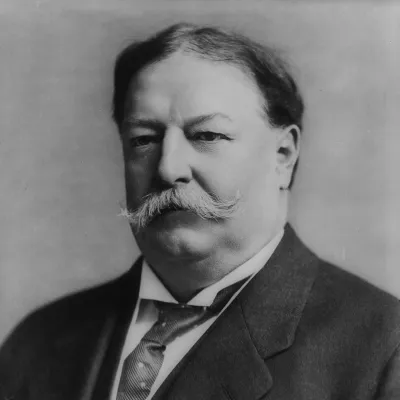
William Howard Taft
Human Design Chart
Biography
Taft graduated Yale with second honors in 1878 and two years later, passed the Ohio bar. He worked as assistant prosecuting attorney for two years and as an assistant county solicitor. He was Judge of the Superior Court in 1887 to 1890, Solicitor-general for the U.S. 1890-1892 and U.S. Circuit Judge 1892-1900.
On 16 June 1886, he married Helen Herron; they had three children; his wife had a breakdown in 1909. Defeated in re-election in 1912, he became a Law Professor at Yale in 1913. Taft was appointed Chief Justice of the U.S. Supreme Court on 11 July 1921.
Suffering with ill health, he resigned in February 1930 and died in his Washington home on 8 March 1930 at the age of 72.
The Human Design of William Howard Taft: Manifesting Generator 1/3
Manifesting Generator 1/3 — Design at a Glance
William Howard Taft revealed himself through his design as a hybrid of Manifestor Speed and Generator Energy. This configuration gave him the ability to skip steps in implementing projects and achieve results quickly. As a Manifesting Generator, he had a defined Sacral Center, providing constant energy. However, the crucial mechanism was not initiating on his own but responding to external impulses.
This responsiveness was essential to avoid frustration, which is the non-self theme of this type. Taft tended, due to his inner speed, to overlook important processes or take on multiple projects simultaneously. When he acted without internal approval from his Sacral Center—that is, without a clear "yes" from his inner authority—his joy in creating quickly turned into overwhelm. It was necessary for him to regularly check whether his current activities still aligned with his inner resonance.
Happiness did not come for him through linear task completion but rather in the "play mode". Variety and fun were not distractions, but driving forces of his effectiveness. As long as he responded to impulses and included his authority, he could leverage the benefits of his speed without falling into the trap of rushed multitasking. His design demanded a balance between dynamic progress and disciplined internal confirmation.
Emotional Authority
William Howard Taft demonstrated a decision-making approach that required time and emotional distance. Impulsive reactions were considered unreliable in his design; instead, it was necessary to postpone judgments to gain clarity rather than succumbing to impulsive misjudgments. This structure stemmed from his emotional authority: His defined emotional center carried this inner leadership responsibility. In Human Design mechanics, this rule is absolute – regardless of other defined centers, the emotional center determines the decision-making strategy if it is active. Taft was subject to a constant wave of emotional ups and downs. The world appeared colored by his current mood: A topic could seem exciting at one moment and negative in the next. However, this immediate feeling was only an initial reaction, not yet the deeper truth. Making quick decisions from within this emotional flood risked negative consequences. The mechanics required patience and consciously “sleeping on” choices. By repeatedly delaying and questioning, intense feelings could subside. Only with increasing distance did Taft gain the necessary calm to fully understand the situation. This process of emotional maturation was particularly crucial for long-term life decisions, ensuring that actions were based on clarity rather than temporary mood swings.
The 1/3 Profile — Investigator / Martyr
William Howard Taft's Human Design profile established a cyclical life path: deep, isolated study followed by practical application through trial and error. As a 1/3 (Researcher/Experimentor), he needed phases of withdrawal to gain inner clarity and regenerate before taking action; the conflict often lay in his own decision about commitments or steps.
Simultaneously, Line 3 (Experimentor) drove him into social interactions where learning occurred through mistakes. Here, there was a risk of self-hatred from false connections or failures since he frequently had to explain and justify himself. His authenticity emerged only when theoretical knowledge (Line 1) merged with practical experience (Line 3). When William Howard Taft believed something was good, it had been both intellectually vetted and personally tested through his own mistakes.
The challenge lay in the tension between a desire for more knowledge and the urge to act. If he felt inadequately informed, fear of implementation would block the necessary step into practice. However, his judgment was trustworthy because it rested on self-earned insights – a synthesis of isolated reflection and social proof through error.
Split Definition — Defined & Open Centers
William Howard Taft's Human Design profile indicated a tendency towards consistent mental conception and reliable self-identity. His defined Ajna Center provided a trustworthy, specific way of thinking; he was always engaged in a mental process that processed data and acted as an external authority. This mental stability flowed directly into his defined Throat Center, which consistently and clearly manifested his communication. He spoke from the mind without being easily distracted by external influences.
His defined G Center gave him a firm inner direction and a sense of lovability. Intuitively, he knew where his mission lay and could show others new perspectives without needing to control their path. However, the vital energy source of his defined Sacral Center required the strategy of waiting for answers. His energy was only available for things that he responded to; initiations without prior questions led to frustration and exhaustion as the sacral power would be lacking.
Emotionally, William Howard Taft was marked by his defined Solar Plexus Center. His inner authority lay in waiting out the emotional wave. He made clear decisions only after experiencing highs and lows, not impulsively. This emotional depth created a captivating aura that attracted others but required patience to avoid manipulation.
In contrast, his vulnerability showed through his open centers. His open Head Center made him susceptible to external mental pressure and confusion; he tended to internalize other people's questions as his own problems. The open Heart Center freed him from the compulsion to keep promises or prove worth, yet conditioning often pushed in the opposite direction. His open Spleen Center absorbed health and well-being frequencies from the environment, which could lead to unhealthy attachments to false safety sources. Finally, his open Root Center took on external stress, making him vulnerable to burnout through absorbing others' adrenaline.
Channels for emotional openness, logical acceptance and persistent discovery.
William Howard Taft exhibited a social dynamic strongly influenced by emotional waves. The Openness Channel 22-12 connected his Solar Plexus Center with the Throat Center, making his vocal articulation directly dependent on his mood. Gate 22 brought passion and drama, while Gate 12 added cautious restraint, limiting this openness to people with high mutational potential. His impact was strongest when he was in the right mood; forced interactions led to harshness and misunderstandings.
Parallel to this, his mind organized visual patterns logically through the Acceptance Channel 17-62. This connection between Ajna and Throat Centers used Gate 17 for pattern visualization and Gate 62, responsible for language creation, to translate these into details. This ongoing internal process required that new information be logically integrated into his worldview to be understood. He found satisfaction in detailing his opinions and understanding of connections when invited to speak, which reduced resistance and created clarity.
Fundamental to his actions was the Discovery Channel 29-46, linking Sacral and G Centers. Gate 29, the Yes-Saying Gate, provided access to the endurance of the Sacral through positive reaction, while Gate 46 established a connection with Higher Self and correct direction. This channel drove him towards persistent, experience-based processes where commitment and patience were crucial. He had to let go of expectations and immerse himself in the depth of experience to make discoveries that could change collective understanding. Control was irrelevant; instead, it was about finding new perceptions through unwavering perseverance until the end of a cycle without being distracted by external influences. This combination of vocal resonance in emotional moments, intellectual structuring, and experience-based persistence defined his unique way of interaction and gaining insights.
Collective Circuitry — Circuit Signature
William Howard Taft's Human Design profile indicated an energy structure divided into non-connected fields. His experience consisted of two parallel, independent power fields. The first field connected the Throat and Solar Plexus Centers through the Openness Channel (12-22). This generated a pulsating acoustic energy that directly translated emotional waves into current expression – creativity in the moment. The second field linked Ajna and Throat Centers via the Acceptance Channel (17-62). Here, focused visual logic structured rational insights. As both circuits utilized the Throat Center, spontaneous emotion met cool reason in expression. A third circuit connected Identity and Sacral Centers (Channel 46-29), separate from the other two groups. This represented cyclical meaning-making from the past. William Howard Taft lived with these three isolated energies: impulsive emotional outburst, logical future thinking, and reflective past resolution. They did not flow into each other but existed as separate, parallel forces in his system.
Right Angle Cross of Eden 3
William Howard Tafts Human-Design profile carries the imprint of the right cross of Eden 3. This configuration combines a profound, often unconscious search for life's meaning with a marked tendency towards introspection and withdrawal. It creates an inner pressure to find answers to existential questions not primarily for public consumption but as a personal necessity.
The right cross of Eden 3 describes an energetic structure that strongly focuses inward. It involves grappling with death, impermanence, and one's own destiny. People with this configuration tend to engage intensively with these themes during moments of silence or isolation. This is not a superficial philosophical inclination but a deeply rooted impulse to question and understand their existence.
This inner orientation shaped William Howard Taft as someone who often gathered his strength in the stillness. The energy of this cross promotes a serious, contemplative attitude towards life. It conveys the feeling that true insight can only be achieved through deep self-reflection and confrontation with the great questions of existence. This is a path of inner depth that aims less at external validation than at an authentic connection to one's truth. This structure suggests that his actions and decisions were guided by this strong internal compass, seeking meaning and coherence in a life often marked by chaos.
Saturn Return · Uranus Opposition · Chiron Return · 2nd Saturn Return — Life Cycles
William Howard Tafts Human-Design profile indicates a tendency towards cyclical maturation where existential turning points act as tests of structure and authority. His Chiron Return around 1904 marked a fulfillment cycle where his incarnation purpose deepened. At this age, he was appointed Secretary of War – a moment of integration where professional responsibility merged with inner development. This cycle promoted the unfolding of life's meaning rather than therapeutic healing.
The second Saturn Return around 1912 presented another structural test. Here, established patterns were seen reacting under pressure. Taft ran for re-election but placed third behind Woodrow Wilson. This crisis revealed the tension between his inner authority and external expectations. The Saturn Return acted as a catalyst for necessary adjustments in life's path by reviewing existing structures for their viability. For his design, this meant a phase of realignment where old strategies were questioned. Confronting this defeat served to align future actions more closely with his true nature rather than adapting to external validations. Both cycles together shaped his development towards greater self-determination despite challenging circumstances.
Manifesting Generator · Emotional Authority — Synthesis
William Howard Taft lived a life marked by a deep drive for understanding and the desire to articulate that knowledge. The defined mental center (Ajna) in conjunction with Profile Line 1 indicated a persistent tendency to develop and refine concepts, while Profile Line 3 added an insatiable urge to experiment and practically test these ideas. This process of learning through trial and error, combined with the ability to filter information and form one's own opinion, created a character that was both intellectually grounded and pragmatic – always seeking new insights and their application.
Tafts essence, however, was marked by an inner paradox: the combination of sacral energy (Manifesting Generator) and emotional authority. The ability to initiate things quickly stood in tension with the necessity to let decisions mature and fully exhaust emotional waves. This likely led to an internal conflict between the desire for rapid progress and the realization that thorough consideration is essential; a dance of initiation and reaction evident in documented events where swift steps repeatedly needed correction.
3 Defined Channels
Incarnation Cross - Right Angle Cross of Eden 3
Solar Return
The Solar Return shows the moment when the sun returns to its exact birth position - your personal solar year.
Life Cycles
Discover the life cycles with a detailed triple view (birth chart, cycle chart, composite).
Human Design Profile
- Strategy
- To respond - wait for something to respond to
- Authority
- Emotional Authority
- Profile
- 1/3 - Investigator / Martyr
- Definition
- Split Definition
- Incarnation Cross
- Right Angle Cross of Eden 3
- Date of Birth
- 15.09.1857 20:00
- Place of Birth
- Cincinnati, OH, United States
Frequently Asked Questions
What was William Howard Taft's Human Design type?
What profile did William Howard Taft have?
What authority did William Howard Taft have?
What incarnation cross did William Howard Taft have?
When was William Howard Taft born?
Discover your own Human Design
Are you also a Manifesting Generator? Find out in a personal reading how to unfold your multi-talents and direct your energy wisely.
More Personalities
Back to overviewAldair

Alizée

Angeli

Arletty

Artus

Balthus