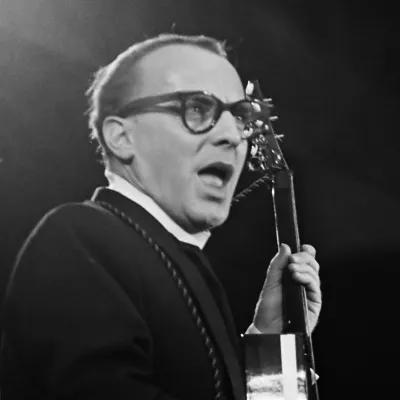
Wim Sonneveld
Human Design Chart
Biography
He was the youngest of six children. His father Gerrit Sonneveld (14 November 1882, Vrijenban - 29 December 1957, Utrecht) was a grocer; his mother Geertruida van den Berg (1 January 1883, Bergschenhoek - 26 September 1922, Utrecht) died when he was four. After his time at school, where he was the class clown, he had a few unsuccessful jobs.
In 1936 he worked for Louis Davids, becoming his secretary. Later he became a singer in Das Kurhaus Cabaret, where he learned a lot from Jewish actors from Berlin and Vienna who had fled to the Netherlands for the Nazi's. He debuted with "only for ladies" December 1943. The text was written by Hella Haase.
The name Zonneveld means Sun's field. Together with Win Kan and Toon Hermans, he was one of the three greatest cabaret entertainers of his generation. Because of the advent of television, his satirical opinions given in stage performances became part of Dutch culture. Creations like Willem Parel (1952) and Frater Venantius, (1963) became well-known.
He died 8 March 1974 in Amsterdam of heart disease after a visit to his house in France.
Personal
Sonneveld was raised Catholic. He held his private life secret. Few knew that he was gay. He had important friend relation with Huub Janssen (7 March 1910 - 26 December 1984, Paris) and Friso Wiegersma (14 October 1925, Deurne - 5 June 2006, Amsterdam))
Wim Sonneveld — Projector with Profile 2/5
Projector 2/5 — Design at a Glance
Wim Sonneveld's design inclined towards sharp, focused perception. As a projector, he had an aura that acted like a bright flashlight: it illuminated precisely those areas in his surroundings that were still in the dark or not functioning properly. This configuration gave him the ability to immediately recognize systemic errors and weaknesses in others.
However, this direct view carried a risk. If Wim Sonneveld addressed these deficiencies abruptly, it could provoke resistance or anger in others, similar to shining a light directly into someone's face. The mechanics of his design showed that elegant leadership was not achieved through confrontation, but through leading by example. By radiating harmony and clarity himself, he became attractive. Others then sought his advice on their own, drawn to his luminous presence.
His central strategy was to wait for an honest and appreciative invitation before bringing his leadership skills into play. Without this invitation, he risked his intense presence being perceived as unpleasant. Additionally, his undefined Sacral Center lacked a constant, intrinsic energy source. Instead, he experienced phases of high activity followed by necessary rest periods to prevent burnout. Living by these principles rewarded him with success; ignoring them led to bitterness as an expression of his non-self.
Splenic Authority
Wim Sonneveld's design inclined towards spontaneous, intuitive decision-making. He trusted his inner impulse in the immediate moment to protect his health and well-being. This stance originated from his authority in the Spleen.
The Spleen Center functions as a health and alarm system. It provides a fine-tuned survival intelligence that manifests as spontaneous inner knowledge. This impulse signaled Wim Sonneveld whether a situation or environment was right for him. Since this impulse only appeared once in the moment, it required high vigilance to not miss it. A brief retreat could help hear this subtle voice.
As the knowledge was only available in the moment, plans often changed at short notice. Long-term commitments were therefore difficult. His design demanded a lot of free space and flexibility to rigorously avoid harmful influences. The authority in the Spleen only appears when the Emotional and Sacral Centers are open. This restricts this configuration to projectors or manifestors. For Wim Sonneveld, this meant he could not adhere to rigid guidelines but had to listen to his first, healthy instinct to best serve himself.
The 2/5 Profile — Hermit / Heretic
Wim Sonneveld's design created a tension between a deep need for withdrawal and the external expectation of him as a problem solver. As a person with the Profile 2/5, the 'Natural Talent', a fundamental dynamic emerged: Line 2, the Hermit Line, demanded intense phases of isolation. During this time of seclusion, it was necessary to look inward to gain clarity about where he truly wanted to invest his energy. This phase of concentration and pausing was essential to avoid falling into egoistic withdrawal and instead position himself strategically.
Simultaneously, Line 5, the Hero or Illusion Line, acted outwardly. Others instinctively sought solutions from him and expected him to act as a rescuer. This dynamic created an internal conflict: the urge for self-discovery in silence stood in opposition to the social pressure to be immediately available. The mechanics of this profile emphasized the need to use his 'alone time' to set boundaries. Only through this inner work could he decide when and for whom he offered his help without forgetting himself. It was about accepting his position in the hierarchy and establishing order, rather than bowing to the dependence of others or selfishly retreating. His strength lay in synthesizing these two poles: consciously steering his withdrawal for strength and his appearance for assistance.
Split Definition — Defined & Open Centers
Wim Sonneveld's Human Design profile indicates a tendency towards constant, structured thinking that translates directly into clear communication. His defined Ajna Center generates consistent mental concepts that are always articulated through his defined Throat Center. This enables him to reliably convey his internal processes and theories outward, without these thoughts remaining trapped inside. Additionally, his defined Spleen Center acts as an intuitive authority for the immediate 'now'. It provides spontaneous, existential judgments about health and well-being that he must trust without rationalizing. His defined Root Center, finally, prepares the necessary physical pressure to advance and survive in the material world.
At the same time, Wim Sonneveld is strongly influenced by his environment due to several open centers. His open Head Center makes him susceptible to mental confusion and the pressure to find answers to questions that are not his own. He tends to get caught in intellectual whirlpools if he does not listen to his inner authority. The open G Center means that he does not have a fixed, unchanging identity but reflects himself in relationships and places; he relies on others to initiate him in the right direction. His open Heart Center leads him to often feel the need to prove his worth through promises or competition, although he does not have the constant energy for it. Furthermore, his open Solar Plexus absorbs the emotions of others, making him emotionally vulnerable and leading him to avoid conflicts. His open Sacral Center, finally, means that he does not have a constant life force but takes it from others and amplifies it, which can lead to exhaustion if he does not pay attention to his limits.
Channels for logical order and discerning judgment.
Wim Sonneveld's Human Design profile indicates a tendency towards precise, logical structuring paired with a deep drive to question and correct patterns. This configuration creates an internal dynamic between the need to mentally organize information and the impulse to continuously question the validity of these orderings.
The Acceptance Channel 17-62 connects his Ajna Center with his Throat Center. Through the Gate of Opinions (17), he visualizes patterns, while the Gate of Details (62) translates these into language. This generates a constant pressure to verbally communicate his ordered perceptions and evaluations. He finds satisfaction in explaining complex connections in detail, provided he waits for the invitation to speak to generate clarity rather than resistance.
At the same time, the Judgment Channel 58-18, connecting his Root Center with his Spleen Center, is driven by the Gate of Vitality (58) and the Gate of Correcting (18). This creates an insatiable urge to check any patterns for their functionality and health. This channel nourishes the art of mastery through logical perfection. Sonneveld is someone who questions patterns to improve them, while he must ensure that his critical assessments are only offered when asked, to conserve energy and promote solutions rather than friction.
Additionally, individual gates shape his profile: Gate 52 demands strong concentration on pattern correction in silence, while Gate 38 sets boundaries to defend individual integrity. Gate 39 provides the fuel for mutations through provocation and analysis, and Gate 16 enables mastery through experimentation. Gate 8 promotes individual contribution, Gate 56 abstracts mental processes into stories, and Gate 54 links worldly success with spiritual insight. Gate 53 allows him to pioneer new paths, while Gate 24 steers individual renewal in the rhythm of the pulse. Gate 45 consolidates energy at the tribal level, and Gate 31 transfers leadership to others.
Collective Circuitry — Circuit Signature
Wim Sonneveld's Human Design profile indicates a tendency towards clear, structured analysis, separate from emotional coloring. His energy works in two parallel, not directly connected strands, as he has a Split Definition.
One strand connects the Ajna Center with the Throat Center. This corresponds to the Acceptance Channel. Here lies the ability to articulate and share internal images and strategies in words. It is about conveying logical insights, free from conditioning, to guide society towards a better future.
The second, independent strand connects the Spleen Center with the Root Center. This is the Judgment Channel. It ensures focused attention on what is truly important and provides the necessary energy to maintain these priorities.
Both areas belong to the Understanding Circuit. This circuit emphasizes 'emotionless ratio'. Since the Solar Plexus Center is not involved, it is pure logic and strategy. Wim Sonneveld is someone who combines visual and strategic concepts (Ajna-Throat) with a deep, instinctive focus on the essential (Spleen-Root). These two forces exist side by side, without directly merging. They shape his way of processing and conveying information: on the one hand, through clear communication of strategic ideas, on the other hand, through precise, energy-efficient selection of what deserves attention. The separation of the groups means that these processes do not automatically interweave, but work as separate yet complementary abilities.
Right Angle Cross of Service 2
Wim Sonneveld's design placed a deep, often unspoken commitment to a higher order that was expressed not through individual fame but through quiet service. This configuration, known as the right cross of service, described a life energy oriented towards working behind the scenes to support structures without seeking the spotlight. It was a force that brought stability and continuity to systems, often at the cost of its own visibility.
Wim Sonneveld lived with the inner instruction to offer his gifts to others, not as a sacrifice but as a natural expression of his essence. The mechanics of this design promoted a stance of humility and reliability. He acted as a silent pillar, recognizing that true significance lay in supporting the whole, not in individual dominance. This energy did not require external validation but found its confirmation in the smooth functioning of what he carried or promoted.
It was a dynamic of the unseen: His strength was evident in the consistency with which he fulfilled his role, regardless of whether he was recognized for it. The design indicated that his contribution often only became fully visible when he was no longer there, as he had shaped the infrastructure of the lives of others or his community. Wim Sonneveld embodied the essence of the serving spirit, finding his identity in the connection to the greater whole and through his quiet work creating a lasting, though invisible, foundation.
Saturn Return · Uranus Opposition · Chiron Return — Life Cycles
Wim Sonneveld's design set a tendency towards structural renewal that crystallized into clear life phases. In 1943, at the age of 26, he founded his group Cabaret Wim Sonneveld. This marked his first Saturn return, a cycle where inner discipline and outer form meet. For his chart, this was the moment when years of groundwork turned into a viable, institutional result. The energy of this transit promoted the ability to pour personal visions into stable structures that grew beyond the momentary.
Later, in 1960 at the age of 43, Sonneveld played Professor Higgins in My Fair Lady. This fell during the Uranus opposition, a phase of deep restructuring and breaking free from old patterns. Here, his capacity to reinterpret established roles and renew through radical authenticity was evident. This configuration drove him to break free from conventional expectations to find a more personal, often provocative expression form. Both events illustrate how his design responded to cyclical pressures: initially by building foundations, later by transformative renewal of his artistic identity.
Projector · Splenic Authority — Synthesis
Wim Sonneveld lived a large part of his life in recognizing patterns and articulating them through precise language (Channel Accepting, Gate 62). This was evident in his ability to grasp the essence and convey it in the form of concepts and opinions (defined Ajna Center). His thinking was steady and little influenced, making him a kind of guide for others seeking solutions – a role that was further strengthened by the Profile Natural Talent/Hero and Rescuer. He was oriented towards understanding the world around him and sharing this understanding, always in search of details and logical connections (Understanding Circuit).
Central for Wim Sonneveld, however, was a tension field between the need for inner withdrawal (Line 2) and the expectation to be available as a problem solver for others (Line 5). The Spleen Authority challenged him to listen to his intuition and set boundaries, while the defined Ajna Center and the ability to recognize patterns simultaneously pulled him out into the world to share his knowledge. This interplay between the desire for isolation and the role of the servant shaped his way of life.
2 Defined Channels
Incarnation Cross - Right Angle Cross of Service 2
Solar Return
The Solar Return shows the moment when the sun returns to its exact birth position - your personal solar year.
Life Cycles
Discover the life cycles with a detailed triple view (birth chart, cycle chart, composite).
Human Design Profile
- Type
- Projector
- Strategy
- Wait for the respectful invitation
- Authority
- Splenic Authority
- Profile
- 2/5 - Hermit / Heretic
- Definition
- Split Definition
- Incarnation Cross
- Right Angle Cross of Service 2
- Date of Birth
- 28.06.1917 01:00
- Place of Birth
- Utrecht, NETH
Frequently Asked Questions
What was Wim Sonneveld's Human Design type?
What was Wim Sonneveld's Profile?
What was Wim Sonneveld's Authority?
What incarnation cross did Wim Sonneveld have?
When was Wim Sonneveld born?
Discover your own Human Design
Are you also a Projector? Find out in a personal reading how to unfold your leadership qualities and recognize the right invitations.
More Personalities
Back to overviewSissy Spacek
Alain-Fournier
Anémone
Ann-Margret

Arletty
Arno