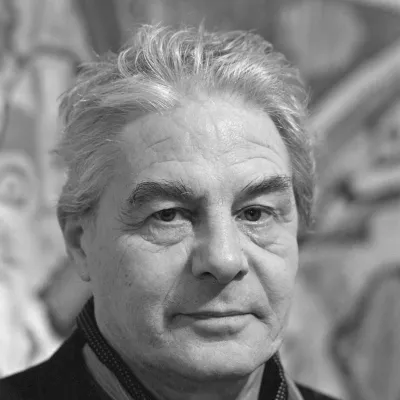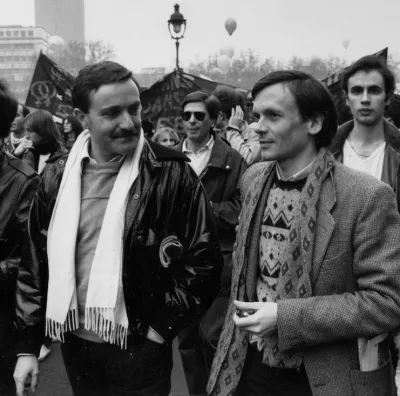
Yves Navarre
Human Design Chart
Biography
A gay man, most of his work concerned homosexuality and associated issues, such as AIDS.
Suffering from AIDS, he committed suicide on 24 January 1994.
What does Manifestor 3/5 mean for Yves Navarre?
Manifestor 3/5 — Design at a Glance
Yves Navarre revealed himself as a pioneer and visionary whose design aimed to lead the world into a new future. His Human Design chart identified him as a Manifestor, a type often compared to an emperor in ancient Rome. This emperor had the vision of a great empire but did not lead the necessary wars himself; instead, he sent his soldiers out to conquer foreign lands for him.
This structure shaped Yves Navarre's essence: He often thought further ahead than others, which led to polarization. Some people loved and followed him because of his great dreams, while others misunderstood or even hated him because of these visions. This pain point of not being understood was a central aspect of his experience.
To find the right followers, it was crucial for Yves Navarre to inform others about his visions in a timely and precise manner. This was his ideal strategy. When he followed this strategy and his inner authority, he was rewarded with a feeling of inner peace. If he lived against his design, he likely felt a persistent, deep anger within. His design thus established a clear dynamic: Through information and leadership, he could find peace, while ignoring this mechanism led to inner unrest.
Splenic Authority
Yves Navarre showed himself as someone who made decisions not through long deliberation but through an immediate, physical impulse. His design was characterized by authority in the Spleen, a mechanism that only appears in Projectors or Manifestors with open Emotional and Sacral centers. The defined Spleen center functioned as his inner alarm system and health monitor. It provided a spontaneous survival intelligence: Yves Navarre instantly felt whether a situation, environment, or person was beneficial or harmful to his well-being. This first impulse was the most reliable indicator of what was right. It helped him set strict boundaries and protect himself from negative influences.
Since this Spleen impulse was very subtle and only effective in the present moment, it required high vigilance not to overlook it or override it with external advice. A brief retreat could sharpen the perception of this signal. Because Yves Navarre only knew what was right for him in the moment, long-term plans were often difficult to maintain and changed at short notice. This made rigid commitments difficult. His design therefore required a lot of flexibility and space to react spontaneously to new, healthy impulses rather than being bound to commitments. The ability to protect himself in the here and now always stood in the foreground.
The 3/5 Profile — Martyr / Heretic
Yves Navarre revealed himself as an experimenter and hero, whose design pushed him into the role of a heroic adventurer and humorous rebel. His Profile 3/5 shaped him as someone who initially accepted nothing but tested everything himself. This attitude came from Line 3 of the Experimenter, which forced him to learn through trial and error. He accumulated a rich treasure of practical experiences that he was happy to present to others, which earned him the role of the Rescuer (Line 5).
Gate 46 in Line 3 brought a force that threw him off balance and required constant testing for adaptation. This presented a challenge, as the determination to maintain success often clashed with the chaotic learning process. The danger was to project a possible future as the present, leading to unwarranted egoism and the loss of support. His process involved learning from mistakes and recognizing when to act and when to wait.
At the same time, Gate 15 in Line 5 showed how extreme stances were effective in crisis times. It was about the ability to adapt to the demands of a changing environment and be extreme when necessary. Jupiter pointed to growth through these intense experiences, while Pluto revealed a tendency towards overcompensation that could disrupt the natural flow. Yves Navarre used his self-acquired knowledge to solve others' problems, which made him attractive to his environment, but also painful if he failed in public.
Single Definition — Defined & Open Centers
Yves Navarre revealed himself as someone with a clear, steady voice and a deep inner direction. His defined Throat Center gave him the ability to translate messages from various areas of his design—from the mind to intuition—into the world. This defined throat ensured that his communication was not arbitrary but came from a reliable source. Parallel to this, he had a defined G Center, which gave him a firm sense of self-identity and a sense of his own life mission. He knew who he was and where he was going without being dependent on others. His defined Heart Center supported this through available willpower; he could make and keep promises, which strengthened his self-esteem. Additionally, his Spleen Center was defined, giving him a spontaneous, intuitive body intelligence. He reacted in the here and now to what was relevant for his well-being and survival, and trusted this momentary perception.
In contrast, Yves Navarre was receptive to external influences through several open centers. His open Head Center meant that he did not have a constant mental pressure but was open to inspiration, though he could easily get entangled in the questions of others. His open Ajna Center also made him flexible, allowing him to take in concepts and ideas from the environment without identifying them as his own truth. This allowed him to process a variety of intellectual stimuli. His open Sacral Center made him vulnerable to the energy of the environment; he could become exhausted if he did not listen to his own authority to set boundaries. Similarly, his Solar Plexus was open, causing him to absorb and amplify emotions from the environment rather than generating them himself. Finally, his open Root Center took on external stress, which made him tend to be driven by this pressure rather than using it as his own drive. This configuration showed a person who had to use their inner clarity and intuition to avoid being overwhelmed by the mental, emotional, and energetic waves of the world.
Channels for logical leadership, intuitive integration and universal love.
Yves Navarre was marked by a double leadership dimension: on the one hand, through logical, collective leadership, and on the other hand, through a deep, intuitive self-determination. The Alpha Animal Channel 7-31 connected his G Center with the Throat Center. This gave him the ability to recognize tested patterns and articulate them through his voice as a collective leader. His authority was not based on coercion but on the trust he gained through an understanding of societal trends. He sought his own sphere of influence, his "pack," and led from there by showing the way without taking it away from others. He achieved success when invited by the majority to take on his logical role.
At the same time, the Channel of the Perfected Form 57-10 connected the Spleen Center with the G Center. Here, the intuitive insight of Gate 57 combined with the behavior of the self in Gate 10. This allowed Yves Navarre to spontaneously and appropriately adapt to his immediate environment, guided by a sharp sensitivity to the quality of the surroundings. He acted from a deep, intuitive consciousness, which helped him release unfounded future fears and perfect his survival in the here and now. His way of loving himself and living authentically created a unique aesthetic that inspired others, even though he did not intend to do so.
The Initiation Channel 51-25 connected the Heart Center with the Shock Gate and the Self Spirit Gate. This gave him a natural competitive edge, which he used to awaken the potential for individuation in others. He could provide the necessary "shock" to initiate people to new levels of consciousness, provided he was invited to do so. His goal was to feel the wonder of his own mind and thereby strengthen the collective.
Additionally, priority gates shaped his work: Gate 46 promoted devotion and body love as the temple of the mind, while Gate 15 supported collective behavior and adaptation to natural rhythms. Gate 48 enabled pattern recognition and perfection, even though this sometimes led to frustration. Gate 21 ensured control over material things and required respect. Gate 12 brought restraint and poetic expression, Gate 2 receptivity to evolutionary directions, and Gate 8 promoted the individual contribution to the group. In his design, Gate 56 with its narrative stimulation, Gate 62 with its patient attention to detail, and Gate 23 with its amoral negotiation brought multifaceted mutations into the world.
Individual Circuitry — Circuit Signature
Yves Navarre revealed himself as a person with a deep, inner strength and a strong self-esteem that was often not put into words. His design connected the Identity Center directly to the Heart Center through the Projector Circuit. This connection created a pulsating, individualistic energy that drove him to strengthen his own identity and encourage others in their uniqueness. Since the Throat Center was missing here, these firm convictions often remained silent.
Parallel to this, there was a separate connection between the Throat Center and the Identity Center through the Reflecting Circuit. This was about logical, rational insights and the vision of a better future. This energy was focused and visual, driven by the desire to share strategic insights, free from emotional coloring.
A third, also separate aspect connected the Identity Center to the Spleen Center through the Manifestor Circuit. This gave him the ability to draw strength from reacting to life and to act through intuitive knowledge in the present moment. It was a highly individual strategy for ensuring his own survival, seeking perfection and form.
As a simple definition, these three energetic strands – inner confirmation, rational vision, and intuitive survival – existed side by side. They did not form a continuous chain but rather parallel forces that shaped Yves Navarre's essence: a man of strong inner substance, clear future vision, and instinctive art of living, whose expression fluctuated between silence and rational communication.
Right Angle Cross of the Vessel of Love 3
Yves Navarre had the Human Design configuration of the right cross of the Vessel of Love 3. This specific pattern established a deeply rooted tendency towards emotional devotion and the need for intimate connection. It was not superficial affection but a structural orientation where the ability to give and receive love stood at the center of his existential experience.
This configuration describes a life dynamics in which emotional resonance and the sharing of feelings acted as central driving forces. The 'Vessel of Love' symbolizes the space where Yves Navarre held his own emotional substance and shared it with others. The number 3 points to a specific expression of this energy, often characterized by direct, sometimes passionate forms of expression. It was about bridging to others through his own emotional presence and creating a deep, transformative impact in interpersonal relationships.
Yves Navarre lived this dynamic as someone who understood the power of love not just as a feeling but as an active, shaping force. The configuration promoted an approach where closeness and trust were prioritized to establish an authentic connection. This shaped his way of showing himself in relationships: engaged, emotionally attuned, and striving to touch a deeper level of humanity through emotional openness. The energy of this cross worked as a constant impulse to live out his own emotional truth and thereby inspire others to acknowledge and share their feelings.
Saturn Return · Uranus Opposition · Chiron Return — Life Cycles
Yves Navarre lived with a profound inner discipline, manifesting in his willingness to endure years of groundwork until the results were ripe. In 1971, at the age of 31, a manuscript was accepted for publication. This marked his first Saturn Return, a cycle in which structural maturity and long-term responsibility often crystallize as a solid foundation for further development.
Later, in 1980, he received the Prix Goncourt. At 40 years old, he was in the Uranus Opposition, a phase in Human Design that is considered a moment of sudden, often unexpected opening. Here, what had been building up broke through to reach a new, expansive level. This configuration described a dynamic where inner work and outer recognition stood in a tension field that was only resolved through this sudden affirmation. Yves Navarre thus showed himself to be someone whose path was marked by the connection of patient structuring and the potential for abrupt, transformative successes. His lifespan illustrated how inner authority can condense over decades into a public voice that stands on solid ground and possesses the potential to transcend established boundaries.
Manifestor · Splenic Authority — Synthesis
Yves Navarre was a Manifestor who, through his design, possessed a deep inner certainty and an unshakable will to shape the world. His Spleen Center as authority, coupled with the Profile of the Experimenter/Hero, points to a person who oriented himself through spontaneous intuition and gained knowledge through personal experiences to pass it on. The connection of G Center and Throat Center (Channel of the Alpha Animal) strengthened his natural ability to lead, not through coercion, but by pointing out logical, forward-looking paths. This constellation shaped a character who did not shy away from new paths and inspired others to follow him.
At the same time, his chart revealed a central paradox: the tension between the drive to initiate as a Manifestor and change the world, and the inner necessity to listen to the fine impulses of the Spleen. While the design signaled a clear direction and a desire for influence, his authority required a moment of inner stillness and waiting to ensure his own health and well-being. This duality showed in phases of action followed by times of reflection and shaped a life path marked by creative energy and the need for authentic self-care.
3 Defined Channels
Incarnation Cross - Right Angle Cross of the Vessel of Love 3
Solar Return
The Solar Return shows the moment when the sun returns to its exact birth position - your personal solar year.
Life Cycles
Discover the life cycles with a detailed triple view (birth chart, cycle chart, composite).
Human Design Profile
- Type
- Manifestor
- Strategy
- To inform others before acting
- Authority
- Splenic Authority
- Profile
- 3/5 - Martyr / Heretic
- Definition
- Single Definition
- Incarnation Cross
- Right Angle Cross of the Vessel of Love 3
- Date of Birth
- 24.09.1940 05:00
- Place of Birth
- Condom, France
Frequently Asked Questions
What was Yves Navarre's Human Design type?
What profile did Yves Navarre have in Human Design?
What authority guided Yves Navarre?
What incarnation cross did Yves Navarre have?
When was Yves Navarre born?
Discover your own Human Design
Are you also a Manifestor? Find out in a personal reading how to use your initiation power peacefully and dissolve resistance.
More Personalities
Back to overviewAlain-Fournier

Angeli

Christian-Jaque
Juninho

Kesha

Lucebert