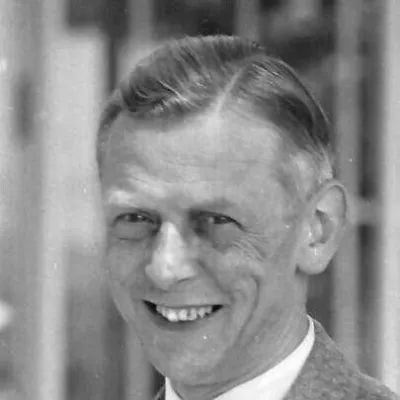
Adolf Butenandt
Human Design Chart
Biography
Adolf Butenandt died on 18 January 1995 in Munich, Germany at age 91, following "a long illness."
Adolf Butenandt — Generator with Profile 6/2
Generator 6/2 — Design at a Glance
Adolf Butenandt possessed an enormous and enduring sacral energy. His design indicated that he did not initiate action through initiation but rather by reacting to internal impulses – “from the gut.” The central dynamic of his character was waiting for the signal: Only when he responded with a clear inner yes to a life impulse, his full power unfolded leading to deep fulfillment. As a Generator, he had plenty of energy to materialize things, yet this worked differently than for other types. The motto was: Not initiate but react.
His most successful strategy was waiting for a signal from life and then, when the sacral center confirmed it, acting upon it. Living in accordance with this principle no one could stop him; deep satisfaction rewarded him for doing so. Ignoring this principle – such as through forced initiation or performing tasks without inner desire – led sooner or later to persistent frustration and energy loss. Two stumbling blocks shaped his potential: Wasting power on things that did not bring joy, leading towards burnout, and holding back from heart projects despite full power. His endurance was thus directly linked to the quality of his reaction to internal signals.
Sacral Authority
Adolf Butenandt showed himself as someone whose decision-making relied on direct physical resonance. His sacral authority functioned as a primary instance, where the Generator strategy – waiting for inner answers to external stimuli – matched this inner guidance. This simplified his process: He did not react through intellectual deliberation but with an immediate physical reaction.
This mechanism expressed itself in a “gut feeling” or a noticeable surge of energy. Adolf Butenandt learned to pay attention to bodily signals like grunting, humming, or an affirming “Mhm.” As long as his emotional center remained open, this sacral reaction was reliable. When his inner motor responded to a stimulus, a phase of great vitality and inexhaustible energy ensued. During these moments he tackled his work with great enthusiasm.
His design predisposed him to go through life with joy and satisfaction. He could immerse himself in activities without them needing to be strictly goal-oriented. The energy arose from the act itself, not an abstract aim. This ability to stay in the flow of life and let immediate physical confirmation guide him formed the foundation of his capacity for action and well-being.
The 6/2 Profile — Role Model / Hermit
Adolf Butenandt revealed through his Profile 6/2 as someone whose development took place in two clearly distinct phases. In his youth, Line 3 energy dominated: Experiments, trial and error shaped his path. He learned through direct life experience, often accompanied by ignorance or inappropriate action, which served as a driving force. This phase was characterized by high vulnerability to mistakes, yet necessary for later understanding.
After the age of thirty, his attitude fundamentally changed. Line 6 became active, leading to withdrawal and distancing. Adolf Butenandt metaphorically retreated into a “cave” to intensively reflect on past experiments. This period served healing and deep self-knowledge. Through introspection he developed spiritual wisdom and judgment. He transformed earlier error sources into a grounded stance.
The mechanics of Profile 6/2 describe precisely this transition: from an experimenting natural talent learning through ignorance, to a wise role model. Adolf Butenandt used his ability to distance himself to recognize and evaluate patterns. His later wisdom became visible for others; they could partake in his introspection. Line 25-6 enabled him to transform ignorance into spiritual stance, while Line 58-2 prepared him to deal with the unusual and re-evaluate authorities. His design indicated that true insight only arises through withdrawal and reflection on earlier mistakes.
Single Definition — Defined & Open Centers
Adolf Butenandt showed himself through massive inner stability and clear self-assurance. His defined G Center gave him a firm identity and an unshakable sense of his life direction, while the defined Heart Center provided him with the willpower to keep promises and express his ego. This energy was released as vital force by his defined Sacral Center, which responded to stimuli, and through his defined Spleen Center, which offered a strong survival instinct and body awareness. The constant pressure of his defined Root Center drove him towards material existence security.
In contrast, Head, Ajna, Throat, and Solar Plexus were open. This meant that he did not possess consistent mental or emotional processing. His open Head tended to be confused when trying to find answers to questions that were not his own; he often wondered where inspiration came from rather than generating it internally. The open Ajna Center allowed him to absorb opinions and concepts without solidifying them as personal truth, which could lead to appearing unsure or attempting to appear logical in order to be accepted. His open Throat Center made him vulnerable to the pressure of demanding attention through speaking instead of waiting for an invitation to express himself. The open Solar Plexus Center let him take on and amplify the emotions of his surroundings; he tended to feel emotionally unstable or avoid confrontations out of fear of rejection by maintaining a facade of niceness to avoid conflict. This openness, however, allowed him to be a sensitive barometer for the emotional and mental climate of his environment as long as he did not identify with the absorbed feelings.
Channels for pioneering spirit, change, rhythm and logic.
Adolf Butenandt showed a fundamental attitude that was characterized by a deep, mystical search for individual mastery. His design featured the Initiation Channel 51-25, connecting the Heart Center with the Ego Circuit. This configuration created a natural competitiveness and the drive to be "first," not out of superficial arrogance but as an expression of Higher Self (Gate 25), which saw the beauty in both animate and inanimate objects equally. The channel conveyed the art of individualization through "shock." Butenandt lived this mechanism by enduring the impulse from his heart and acting authentically, thereby strengthening others through his example. Initiation happened for him only upon invitation; forced processes would have led to bitterness. Instead, initiation became a byproduct of his lifestyle, a process of mastering himself and the world.
Alongside this central dynamic, the Mutation Channel 60-3, connecting Root and Sacral Centers, was at work. It brought about evolutionary change through acceptance of limitation (Gate 60) and reordering in new beginnings (Gate 3). This energy was melancholic and pulsating; it required patience in chaos until new mutations became apparent. The Rhythm Channel 5-15 connected the Sacral with G Center, uniting fixed habits (Gate 5) with love for extremes (Gate 15). This created a biological life flow that magnetically integrated him into the universal rhythm and naturally guided his timing. The Judgment Channel 58-18 linked Root to Spleen Center, driven by the Gate of Vitality (58) and the Gate of Correction (18). This nurtured the art of mastery through an insatiable drive to perfect patterns. Butenandt wisely used this judgment only when asked to correct, conserving energy and finding solutions applicable to the collective. These channels together formed a structure that united change, rhythm, and precise judgment in an authentic, individual expression.
Individual Circuitry — Circuit Signature
Adolf Butenandt revealed himself as someone whose inner strength and self-worth were supported by a quiet, individual confirmation. His design connected the Identity Center with the Heart Center through Channel 25-51 (Initiation) in the Projected circuit. This configuration promoted solid convictions and a strong "I am" feeling that did not rely on external validation or verbal expression. Since there was no connection to the Throat Center, these inner truths remained centered and individualistic, less outwardly oriented than inwardly directed.
Parallel to this, the Knowledge circuit worked through Channel 3-60 (Mutation), which connected the Sacral with the Root Center. This drove the search for new paths and supported the transformation of old knowledge into personal insight, paired with a pulsing energy of being in the present moment.
Furthermore, the Understanding circuit shaped his actions. Here there were two separate parts: On one hand, Channel 15-5 (Rhythm) connected the Identity Center with the Sacral Center, creating a natural rhythm in aligning energy and identity. On the other hand, Channel 18-58 (Judgment) linked the Spleen and Root Centers, leading to strategic decisions based on visual, future-oriented logic, free from emotional coloring. As an Ego Defined person, these energies flowed from the connected Sacral, Root, Spleen, Identity, and Heart centers as a cohesive stream that united intuitive boldness with rational structure.
Left Angle Cross of Healing 1
Adolf Butenandt carried the left healing cross. This configuration marked him with a profound and often unspoken mission: to heal wounds and return systems or relationships to a state of wholeness. It was not about superficial repair but rather restoring integrity on a fundamental level. His design indicated that he was called to connect what was broken and restore an original unity where it had been lost. This energy worked as a quiet force in the background of his actions, driving him to close gaps and reassemble fragmented pieces so that a functioning whole could emerge. The task involved restoring structural soundness without always being at the forefront. It was a work of subtle correction and inner alignment with the essential. Adolf Butenandt lived this dynamic by focusing on what was necessary to restore stability and cohesion. His focus lay on the result of healing itself – returning to wholeness – rather than on the public display of the process. This approach allowed him to recognize complex damages and take targeted measures for restoring order, thereby playing a central role in stabilizing his environment.
Saturn Return · Uranus Opposition · Chiron Return · 2nd Saturn Return — Life Cycles
Adolf Butenandt's life path followed a clear cyclical structure marked by four significant planetary points, showing progression from professional establishment to institutional leadership within his scientific community.
The first Saturn return around the age of 28 signaled anchoring in practical work. This was reflected when Adolf Butenandt became head of the organic and biochemical department at Göttingen in 1931 – a step that solidified his professional competence.
The Uranus opposition around the age of 40 marked public breakthrough and wider visibility. In 1943, he received the Carus Medal from the Leopoldina, confirming recognition by professional societies and strengthening his position in scientific discourse.
The Chiron return between ages 48 and 50 was a fulfillment cycle where his incarnation purpose increasingly unfolded. Adolf Butenandt took on representative functions; he chaired the German Society for Natural Scientists and Physicians in 1951, underscoring his role as an intermediary within the scientific community.
The second Saturn return around age 57 crowned his career with highest institutional responsibility. In 1960, Adolf Butenandt became president of the Max Planck Society, a position he held until 1972. This concluding point showed the culmination of previous buildup through long-term leadership structures.
Generator · Sacral Authority — Synthesis
He lived as a Generator whose sacral energy and endurance were driving forces. This energy flowed freely when he engaged in tasks that truly attracted him – a life marked by recognizing and following this inner resonance (sacral authority). His ability to forge new paths and learn from experiences was evident in his profile, characterized early on by experimental enthusiasm followed by reflective withdrawal. Through recurring cycles – Saturn return, Uranus opposition, Chiron return – a way of life crystallized based on deep self-awareness and the transmission of wisdom.
A central paradox lay in the combination of his defined G Center (love, identity) and the Channel of Mutation. While the G Center gave him a firm sense of self, he seemed simultaneously destined by the energy of the mutation channel to break conventions and create new things – a tension between constancy and change that continually challenged him to accept limitations and transcend confusion. This dynamic was reflected in his career milestones (1931, 1943, 1951, 1960), where he both led established structures and pursued innovative paths.
4 Defined Channels
Incarnation Cross - Left Angle Cross of Healing 1
Solar Return
The Solar Return shows the moment when the sun returns to its exact birth position - your personal solar year.
Life Cycles
Discover the life cycles with a detailed triple view (birth chart, cycle chart, composite).
Human Design Profile
- Type
- Generator
- Strategy
- To respond - wait for something to respond to
- Authority
- Sacral Authority
- Profile
- 6/2 - Role Model / Hermit
- Definition
- Single Definition
- Incarnation Cross
- Left Angle Cross of Healing 1
- Date of Birth
- 24.03.1903 22:00
- Place of Birth
- Bremerhaven, Germany
Frequently Asked Questions
What is Adolf Butenandt's Human Design type?
What profile did Adolf Butenandt have in Human Design?
Which authority guided Adolf Butenandt?
What incarnation cross did Adolf Butenandt have?
When was Adolf Butenandt born?
Discover your own Human Design
Are you also a Generator? Find out in a personal reading how to use your sacral energy correctly and discover deep satisfaction.
More Personalities
Back to overviewAaliyah

Alexia

Angèle

Anne-Marie

Arcángel

Arno