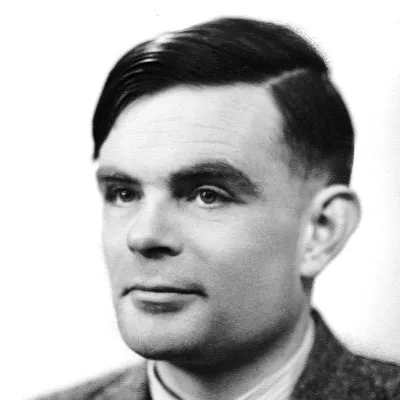
Alan Turing
Human Design Chart
Biography
Turing was the second-born of two sons to a member of the British civil service in India. His mother didn’t feel that was a suitable environment, and so the boys were both raised in foster households in England, separated from their parents. At 13, he enrolled at the Sherbourne School in Dorset where he showed a gift for mathematics. While at Sherbourne, Turing, who recognized his homosexuality, fell in love with another boy at the school who suddenly died of tuberculosis. The event drove him into atheism and the conviction that phenomena must all have materialistic explanations.
He failed twice to win a fellowship at the University of Cambridge’s Trinity College, but did receive one from King’s College in Cambridge. There he found a good environment in which to thrive. He was invited to remain at King’s as a tutor when he obtained his degree.
World War II intervened, and based on his published work, he was recruited to serve in the Government Code and Cypher School. The task there was to break the Nazis’ Enigma codes. It is now known that Turing played a crucial role in the effort by inventing a primitive machine that could decipher at high speed Nazi codes to ships in the North Atlantic.
At the end of the war, Turing hoped to pick up the academic career he had started, but the mathematics division of the British National Physical Laboratory asked him to create an actual Turing machine. He accepted, but found himself mired in bureaucracy, missing the wartime state of urgency that quickly bypassed obstacles.
Human Design Analysis: Alan Turing as Generator 4/6
Generator 4/6 — Design at a Glance
Alan Turing's design established a fundamental architecture of high endurance and productivity. As a Generator, he had a system with considerable sacral energy that made him a powerful 'workhorse' – provided this energy was used for the right tasks. However, his functioning did not rely on initiative but rather on reaction. The mechanics of his design required him to wait for impulses from his environment and respond to them instead of taking the first step himself.
This strategy of reacting was crucial for his energy balance. When Alan Turing responded to a signal and his sacral center confirmed with an inner 'yes' that he should act, he could use his energy efficiently and materialize things. In these moments of resonance, he experienced deep satisfaction and fulfillment. Conversely, ignoring this signal or constantly taking the initiative led to energetic loss.
Two main pitfalls shaped his potential: Either he wasted his strength on tasks that internally repelled him, making him prone to exhaustion, or he was held back from his true passion despite still being full of energy. If he did not live by this principle of reacting from the gut, he encountered frustration and a lack of drive. His design offered him immense power but only in harmony with the strategy of waiting and then responding forcefully.
Sacral Authority
Alan Turing's design established a tendency towards sacral authority. As a Generator, his strategy was also his inner decision-making instance, simplifying the process of choice. This configuration required an open emotional center and reacted to external stimuli through physical signals like grunting or a noticeable surge of power.
When his sacral motor kicked in, Alan Turing appeared vital and lively. He had seemingly inexhaustible energy and tackled tasks with great enthusiasm. His design predisposed him to go through life with joy and contentment, fully immersed in his activities without aimlessness. The necessity was to consistently listen to this 'gut feeling' and the physical noises to make decisions. This state of springing into action led to a vibrant presence and deep satisfaction in doing. Alan Turing's inner compass was thus directly linked to his physical reaction; he did not act out of abstract planning but from immediate confirmation by his body. This allowed him direct access to his well-being and instinctive perception, which he could trustfully rely on.
The 4/6 Profile — Opportunist / Role Model
Alan Turing's design established a life dynamics that clearly divided into two phases. In the first three decades, he was experimental and intensely sought belongingness. This corresponded to Line 4 of Profile 4/6, defining him as a 'wallflower': A person who used modesty as a protective mechanism against feelings of inadequacy and often found themselves in an outsider status. His heart was always cautious not to open up to the wrong people and get hurt.
After turning thirty, with Saturn's return, his focus fundamentally shifted. Line 6 became active and brought forth an inner conflict: the tension between emotional need for community (Heart/Line 4) and intellectual drive towards distance as well as isolated meaning-making (Head/Line 6). Alan Turing now showed less through mere experimentation but through growing judgment of others and a spiritual stance. The ignorance of youth gave way to the wisdom of age. He faced the challenge of meeting high standards of role modeling while constantly confronting feelings of inappropriate action – an influence that could cause spiritual fractures. His life henceforth revolved around balancing dedication to others and necessary personal development on the 'mountaintop'.
Single Definition — Defined & Open Centers
Alan Turing's design established an extremely stable inner foundation characterized by defined G-, Heart-, Sacral-, Spleen- and Root Centers. He had a reliable sense of self-identity and a clear direction in life, coupled with autonomous willpower for resource control. His defined Sacral Motor provided constant vital energy waiting to react, while his Spleen Center secured intuitive survival intelligence in the present moment. The controlled Root Center guided his specific handling of stress and pressure.
At the same time, Alan Turing showed high situational flexibility through open Head-, Ajna-, Throat- and Solar Plexus Centers. His open Head and Ajna Centers meant he did not have consistent personal concepts but was mentally inspired; he tended to question whether he must find answers rather than possessing them. His open Throat Center allowed spontaneous communication only upon invitation, instead of initiating independently. The open Solar Plexus Center led to absorption and reflection of the emotional environment due to a lack of stable emotions. This configuration described a person with firm energetic and instinctive grounding who remained mentally and emotionally permeable for their context.
Channels for focus, intuition, rhythm and pioneering spirit.
Alan Turing's design was marked by a permanent, magnetic life rhythm. The Rhythm Channel 5-15 connected his Sacral Center with the G-Center: Gate 5 held onto fixed habits while Gate 15 integrated the diversity of society into the flow of life. This impersonal magnetism drew others into his rhythm and guided them logically towards the future.
His focus was determined by the Concentration Channel 9-52. Here, the Focusing Gate (9) connected with the passive urge to refrain from action (52). This created a format energy that kept him still to precisely assess details and facts without being distracted.
Intuitive adaptability showed through the Perfect Form Channel 10-57. Gate 57 offered acoustic sensitivity for the environment, while Gate 10 steered self-behavior. This combination enabled spontaneous, appropriate actions in the here and now that secured his survival and promoted a unique, creative integration.
Competitive initiation was also marked through the Initiation Channel 25-51. The competing energy of shock (Gate 51) met with the universal love of Higher Self (Gate 25). This drove him to exceed boundaries and set an example for others through personal breakthroughs, experiencing initiation as a mystical process of individuation.
Additional Gates like the Leadership Gate (7) projected patterns for the future while the Experience Gate (46) demanded full commitment to the process. The Continuity Gate (32) sought material stability and evaluated situations based on their value. Alan Turing lived these configurations by integrating into his inner rhythm, concentrating on analyzing details, and intuitively reacting to his environment.
Collective Circuitry — Circuit Signature
Alan Turing's design inclined towards internal firmness and strong individuality. He was someone who possessed solid convictions that were often difficult to verbalize outwardly. This configuration resulted from the Centering Circuit, which in him connected Identity with Heart Center (Channel 25-51). This created a pulsating energy of self-worth and identity ('I am as I am'), which turned little towards the outside world. The absence of connection to Throat Center meant his firm standpoints often remained unspoken or hard to articulate.
Parallel to this, the Understanding Circuit linking Identity, Sacral, and Root Centers (Channels 15-5 and 9-52) showed a focused rational energy aimed at achieving improvements through logic and strategy. It was an 'emotionless ratio', driven by the desire to share insights free from conditioning and shape the future.
Additionally, the Integration Circuit shaped his orientation (Channel 10-57), connecting Identity with Spleen Center. This supported survival security through intuitive knowledge and the ability to draw strength from reacting to life. All these defined centers - Sacral, G, Spleen, Heart, and Root - formed a simple definition, meaning they worked as an interconnected energetic system without separate isolated fields in the chart.
Right Angle Cross of the Vessel of Love 2
Alan Turing's design included the configuration of the right cross of the Love Vessel 2. This specific arrangement shaped his inner disposition through a deep, often unspoken intensity in interpersonal bonds. It was an energy that did not seek external validation but rather worked in silent dedication and protection of the beloved.
In Human Design mechanics, the Love Vessel describes the ability to foster emotional security. The right cross of this configuration marks a person whose love is expressed less through words than through silent presence and unconditional support. Alan Turing often carried this burden of emotional responsibility alone as his design tends to put aside its own needs to give space to others. It was a kind of intimacy based on trust, without having to demand it.
This structure created an internal conflict between the desire for absolute connection and the necessity to keep that connection private and protected. Alan Turing's energy flowed into relationships he saw as sacred, often taking on the role of the silent protector. The mechanics show here a person whose love was deeply rooted but rarely stood in the spotlight. It worked in the background, stabilizing and supporting without seeking attention. This quiet dedication defined his way of connecting with others, far from superficial interaction.
Saturn Return · Uranus Opposition — Life Cycles
Alan Turing's design was marked by two defining planetary cycles that profoundly influenced his life structure. The first Saturn Return signified the transition from search to solid form. In 1938, at age 26, Turing earned his doctorate in Princeton. This time point corresponded with the first Saturn Return, a mechanism where years of internal groundwork condenses into a tangible external structure. For his design, this meant acquiring necessary authority and anchoring his career on solid ground.
The second crucial event was the Uranus Opposition, a cycle often causing existential breaks and identity crises when old structures no longer hold. In 1952, at age 40, Turing was convicted of homosexuality and began medical treatment with estrogen. This was not merely a biographical incident but the concrete effect of the Uranus Opposition: a sudden, violent collapse of his previous life order. While the Saturn Return in 1938 brought structure and validation, the Uranus Opposition in 1952 shattered this achieved stability and forced a painful realignment of identity under extreme pressure.
Generator · Sacral Authority — Synthesis
He lived as a Generator whose energy was deeply connected to the Rhythm Channel (Gate 5/15) with the flow of life. This sacred power, fueled by defined inner authority and strong sense of direction (G Center), shaped his ability to immerse in work and chart new paths – so long as the energy flowed. The Profile as Networker/Role Model points towards a development where early experimentation gave way later to a desire for stability and sharing insights. The connection between Sacral Center and Heart Center in the Authority Circuit reinforced this tendency toward inner firmness and individual convictions.
A central paradox lay in the tension between his need to connect with others (Line 4 in Profile) and the drive for independent thought and reflection (Line 6). This was particularly evident during crisis phases, as evidenced by the conviction which forced an imposed adaptation to societal expectations – a direct conflict with his inner identity. The Saturn Return in the year of his doctorate points to a time of solidifying professional goals, while the Uranus Opposition marked a period of radical upheavals and confrontation with social norms.
4 Defined Channels
Incarnation Cross - Right Angle Cross of the Vessel of Love 2
Solar Return
The Solar Return shows the moment when the sun returns to its exact birth position - your personal solar year.
Life Cycles
Discover the life cycles with a detailed triple view (birth chart, cycle chart, composite).
Human Design Profile
- Type
- Generator
- Strategy
- To respond - wait for something to respond to
- Authority
- Sacral Authority
- Profile
- 4/6 - Opportunist / Role Model
- Definition
- Single Definition
- Incarnation Cross
- Right Angle Cross of the Vessel of Love 2
- Date of Birth
- 23.06.1912 02:15
- Place of Birth
- London, UK
Frequently Asked Questions
What is Alan Turing's Human Design type?
Which Profile did Alan Turing have in Human Design?
What Authority guided Alan Turing's decisions?
What incarnation cross did Alan Turing have?
When was Alan Turing born?
Discover your own Human Design
Are you also a Generator? Find out in a personal reading how to use your sacral energy correctly and discover deep satisfaction.
More Personalities
Back to overviewAaliyah

Alexia

Angèle

Anne-Marie

Arcángel

Arno