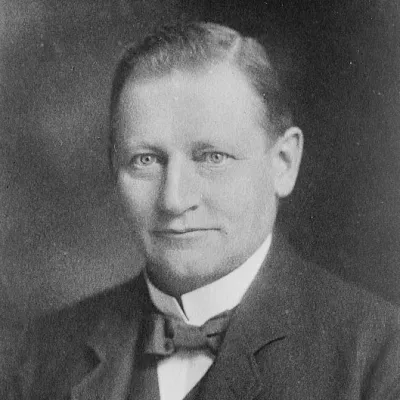
Albrecht Penck
Human Design Chart
Biography
Professor of geography at the University of Vienna (1885–1906), he conducted research in the valleys of the Bavarian Alps that confirmed the four periods of Pleistocene glaciation—Günz, Mindel, Riss, and Würm. Penck also originated and promoted the 1:1,000,000-scale map of the Earth and published a pioneer work on geomorphology (the study of the Earth’s surface features), a term he is believed to have introduced.
From 1906 to 1926 he held the chair in geography at Berlin, where he was also director of the Institute of Oceanography. His work there embraced classification of climates, regional ecology, and political geography, notably the extent of German culture in Europe, and the refinement of the German geographer Friedrich Ratzel’s concept of Lebensraum (“living space”).
He died 7 March 1945, Prague.
Albrecht Penck as a Projector 5/1 in Human Design
Projector 5/1 — Design at a Glance
Albrecht Penck appeared as someone who radiated with a dense, focused aura. His Human-Design type was Projektor, meaning he did not have a constant intrinsic source of life energy. Instead, he projected his energy onto the environment and functioned like a bright flashlight: He illuminated areas directly where others were in darkness or not functioning properly. This ability allowed him to immediately recognize errors in systems.
However, such direct addressing of weaknesses could be perceived as unpleasant, akin to shining light directly into someone's face. The more effective way for him to express his nature was by attracting others through his own harmonious behavior. People would then come to him on their own initiative seeking advice. His strategy lay in waiting for valuable and honest invitations from his surroundings.
Since his Sacral Center was undefined, he was subject to energy fluctuations. Phases of high productivity alternated with necessary rest periods to prevent burnout. Conventional work structures often did not take this need for recovery into account. When Albrecht Penck paid attention to this dynamic and waited for invitations, he was rewarded with success. Ignoring this mechanism eventually led to his non-self theme of bitterness.
Emotional Authority
Albrecht Penck showed a decision structure that did not solidify in moments of enthusiasm or rejection. His defined Solar Plexus Center carried his inner authority – a mechanism that always took precedence over all other defined centers. This meant that he was subject to emotional waves: His perception was always colored by the current mood. What appeared inspiring at one moment could become negative the next. These feelings were, however, only snapshots, not yet his truth. Quick, spontaneous decisions made in this heat often proved detrimental for him. Instead, his design required patience and conscious hesitation. He let decisions ripen, slept on them multiple times, and sought emotional distance. Only when the intense emotions subsided did the necessary clarity and calmness set in. This cooling-off process was essential for him to make long-term life decisions that would shape his path sustainably. Albrecht Penck learned to take his time and ask himself repeatedly before acting. Only this way could he ensure that his choice was not based on a fleeting impulse, but on a deeper, more comprehensive insight that only became visible after the emotional waves had subsided.
The 5/1 Profile — Heretic / Investigator
Albrecht Penck revealed himself as someone who accumulated deep knowledge to offer it to others for problem-solving. His 5/1 Profile marked him as a "Hero/Researcher" with the magnetic quality that made others feel compelled to know what treasures he had to offer. This led people to often seek solutions from him.
The Line 1 of his profile emphasized the need for a pause and thorough consideration before acting. There was an internal pressure to provide energy for this concentration process; releasing this energy too early would have resulted in wasted time and resources. Silence was essential to allow the consequences of his actions to unfold.
At the same time, Line 5 projected expectations and crisis solutions onto him. The right rhythm brought him success and serendipity through timing. In amplification, his instinctiveness was emphasized to maintain this successful rhythm. However, there also appeared an irrational rejection of this behavior in the second generation.
Without clear boundaries, he risked becoming like a master who answers questions for hours and is drained by evening, while his inbox overflows. Albrecht Penck had to learn to say no to maintain the beneficial balance between researching for himself (Line 1) and solving problems for others (Line 5). Only in this way could he optimally utilize his gifts without being exhausted by the expectations projected onto him by others. His design laid out this tendency: deepen knowledge, then share it purposefully, always aware of his energy capacity and the necessity of pauses for regeneration and reflection.
Split Definition — Defined & Open Centers
Albrecht Penck's design inclined towards a consequent, conceptual structuring. His defined Ajna Center ensured constant mental functioning; concepts and theories emerged in him reliably, unaffected by external mental noise. These thoughts flowed directly into his also defined Throat Center: He spoke what he thought. Communication was for him not an impulse act but the logical announcement of his inner conception.
His defined G Center gave him a firm self-identity and a clear sense of direction. He knew who he was and where he belonged, without having to give this identity away to others. Parallel to that stood his defined Heart Center: It offered him the willpower to fulfill promises and control resources autonomously. He enjoyed working independently, controlled his engagement, and expected recognition for his contribution.
Yet this inner firmness met a complex emotional landscape. His defined Solar Plexus Center was his inner authority. Decisions were not made in the head but after running through an emotional wave. He needed time to gain clarity; spontaneous judgments were misleading for him. The truth only revealed itself at the end of the emotional cycle.
At the same time, he was vulnerable to external influences in his open centers. His open Head Center let him absorb mental pressure from others, which could lead to doubts that did not belong to him. His open Sacral Center had no constant energy flow; he tended to overexert himself through 'borrowed' energy of others and exhausted himself when ignoring boundaries. The open Spleen Center made him sensitive to well-being or illness in the environment, leading to the risk of unhealthy dependencies. And his open Root Center absorbed external stress that could drive him into hectic to escape the pressure. His challenge lay in connecting his mental and willful strength with the patience of his emotional authority without falling into the conditioning traps of his open centers.
Channels for presence, curious search and genuine connection.
Albrecht Penck showed himself through a deeply rooted presence in the here and now. The Awakening Channel 10-20 connected his G Center to the Throat Center, living the wisdom that self-love and acceptance are keys to survival. He spoke for himself simply by being himself; this inner clarity unconsciously inspired others to accept their own nature without generating resistance or taking criticism personally.
Parallel to this, he worked as a storyteller and seeker. The Curiosity Channel 11-56 connected his Ajna Center with the Throat Center. Instead of searching for dry facts, he used his curiosity to transform ideas into captivating narratives. He shared insights not as absolute truths but as parables that appealed to the imagination and feelings of his listeners. These stories served to give others the opportunity to evaluate and integrate new perspectives on their own lives.
In interpersonal relationships, Albrecht Penck sought genuine connection and mutual benefit. The Community Channel 37-40 connected his Solar Plexus Center with the Heart Center. He waited for personal invitations to become part of a group and understood the necessity of carefully negotiated agreements. For him, loyalty was not a hierarchy but a harmonious coexistence where everyone contributed to strengthen the collective and support each other.
Additionally, further energies shaped his essence: Gate 46 promoted his dedication to the physical process and love for the body as a temple. Gate 25 brought mystical innocence and centeredness while Gate 52 gave him the ability for focused pattern correction through self-imposed pauses. Gate 58 in the Root Center drove him towards experiments and perfecting life processes, always with the aim of securing a safe future.
Individual Circuitry — Circuit Signature
Albrecht Penck's design inclined towards separate, parallel existing energetic centers. Through Split Definition, two independent energy fields existed: A flow connected Ajna to Throat Center and following this the Identity Center, while Heart and Solar Plexus Centers acted as a second, isolated unit. This separation prevented a continuous energy flow between thinking, speaking, and emotional reaction.
In the Perception Circuit, the Channel 'Curiosity' (Gates 11-56) worked. It directly connected Ajna with Throat Center. This promoted a cyclical, wave-like processing of past experiences. Albrecht Penck showed himself in visually and emotionally structuring felt insights to share them with others – a process of learning together from history.
The Ego Circuit activated the Channel 'Community' (Gates 37-40) between Heart and Solar Plexus Centers. This area concerned cooperation and mutual giving and taking within a group. As no connection existed to Sacral Center, this configuration required necessary rest pauses for resource regeneration. The energy here was conservative and tradition-influenced, focused on support without constant life force input.
Finally, the Integration Circuit worked through the Channel 'Awakening' (Gates 20-10), connecting Throat with Identity Center. This served to secure his own survival through self-reinforcement. Power from reacting to life was guided by proper behavior and intuitive knowledge in the now. This connection underscored highest individuality, linking verbal expressions directly with the core of identity, independent of other separate energy groups.
Left Angle Cross of Healing 2
Albrecht Pencks design carried the signature of the left healing cross. This configuration set an inner orientation towards the inevitable and the natural flow of things. In Human Design, this cross marks a specific energetic focus: It is not about actively repairing in the traditional sense but rather about creating space for natural renewal through acceptance and letting go of resistance.
Albrecht Penck showed himself to be someone who recognized deeper connections by allowing processes to unfold naturally instead of forcing them. The energy of this cross often works subtly; it supports the integration of experiences and fosters an understanding that healing is a process requiring time and patience. Instead of fighting against resistances, Albrecht Penck used this structure to dissolve internal tensions through yielding and trusting his own rhythm.
This attitude shaped his way of dealing with challenges: By letting go of control, he gained clarity and encouraged others to rediscover their inner order as well. The left healing cross always emphasized the importance of proper timing – not intervening too early but waiting until the energy is ready to regulate itself. For Albrecht Penck, this meant a lifelong practice in patience and deep self-reflection that helped him approach complex situations with calmness.
Saturn Return · Uranus Opposition · Chiron Return · 2nd Saturn Return — Life Cycles
Albrecht Pencks design indicated a tendency towards structural anchoring through partnership as well as later professional blooming. In 1886, at the age of 28, he married Ida Ganghofer. This marked his first Saturn return, a cycle in which years of inner preparation often condense into a tangible external result and lay the foundation for fundamental life structures.
Another characteristic pattern emerged in 1906 when he was appointed to Berlin at the age of 48 and took over the direction of the Geographical Institute at Friedrich-Wilhelms-University. This time coincided with his Chiron return. In Human Design mechanics, this is not a healing process but an achievement cycle: If one has lived according to their strategy and authority before, here the own incarnation cross unfolds increasingly in life. Purpose and meaningful orientation become experiential, which was visible for Albrecht Penck in this specific career development. His design thus shaped a life path stabilized by early commitments and crowned by late professional realization of personal purpose.
Projector · Emotional Authority — Synthesis
Albrecht Penck lived a process of continuous deepening and knowledge dissemination. As a projector with emotional authority (and the 5/1 profile), he was oriented towards recognizing patterns (defined Ajna Center) and making these insights accessible to others. This urge for recognition and sharing was strengthened by the awakening channel, which propelled him to understand principles and translate them into concrete action. The recurring cycles – both the Saturn return (relationship) as well as the Chiron return (career) – indicated that he continually re-evaluated and transformed significant life phases in search of deeper understanding and a refined expression.
Simultaneously, a tension field revealed itself between his need to generate profound knowledge (Line 1) and his ability to make this knowledge accessible to others (Line 5). Emotional authority required time for the maturation of insights while the projector aura and profile invited him to quickly respond to the needs of others. This interplay between inner deepening and outer engagement shaped his path, always striving to convey his insights in a way that was understandable and useful for others.
3 Defined Channels
Incarnation Cross - Left Angle Cross of Healing 2
Solar Return
The Solar Return shows the moment when the sun returns to its exact birth position - your personal solar year.
Life Cycles
Discover the life cycles with a detailed triple view (birth chart, cycle chart, composite).
Human Design Profile
- Type
- Projector
- Strategy
- Wait for the respectful invitation
- Authority
- Emotional Authority
- Profile
- 5/1 - Heretic / Investigator
- Definition
- Split Definition
- Incarnation Cross
- Left Angle Cross of Healing 2
- Date of Birth
- 25.09.1858 16:15
- Place of Birth
- Leipzig, GER
Frequently Asked Questions
What was Albrecht Penck's Human Design type?
What profile did Albrecht Penck have?
What authority did Albrecht Penck have?
What incarnation cross was assigned to Albrecht Penck?
When was Albrecht Penck born?
Discover your own Human Design
Are you also a Projector? Find out in a personal reading how to unfold your leadership qualities and recognize the right invitations.
More Personalities
Back to overviewSissy Spacek

Alain-Fournier

Anémone

Ann-Margret

Bourvil
Hergé