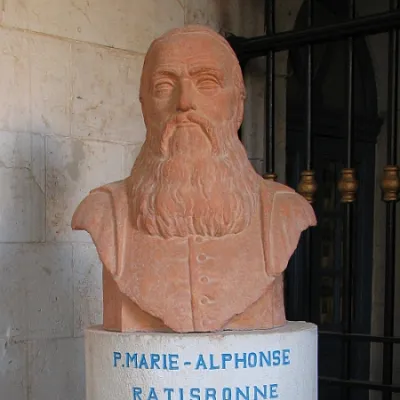
Alphonse Ratisbonne
Human Design Chart
Biography
He later was a co-founder of the Congregation of Our Lady of Sion, a religious congregation dedicated to the conversion of Jews to the Catholic faith.
In 1858, Ratisbonne established the Convent of Ecce Homo in the Old City of Jerusalem for the Sisters of Sion. In 1860, he built the Convent of St. John on a hilltop in Ein Karem, then a village on the outskirts of Jerusalem. In 1874, he founded the Ratisbonne Monastery for the priests of the congregation.
Ratisbonne died in Ein Karem on 6 May 1884.
Alphonse Ratisbonne — Manifestor with Profile 3/5
Manifestor 3/5 — Design at a Glance
Alphonse Ratisbonne's design inclined him towards pioneering action, characterized by the role of a leader and visionary. As a Manifestor, he was destined to lead the world into a new future, much like an emperor in ancient Rome who had a vision of a great empire but did not wage the necessary wars himself but delegated them to others. This configuration often led to misunderstandings as he thought ahead of others and polarized as a result. Some loved and followed him for his great dreams, while others disliked or even hated him because of these visions. To find the right followers, it was crucial for him to inform others timely and accurately about his visions. This strategy of informing was the key to his inner peace. Living according to this design rewarded him with a feeling of inner calm. If he could not follow this strategy, he instead felt a persistent, deep anger. His design thus required clear communication of his intentions to minimize resistance and gain support, which made the difference between peace and inner conflict.
Emotional Authority
Alphonse Ratisbonne's inner compass was defined by the Emotional Center, fundamentally shaping his decision-making. His inner authority followed an emotional wave that showed in the constant ups and downs of his feelings. He saw the world colored by his current mood; at one moment full of enthusiasm, in the next marked by a negative tint. His immediate feeling was, however, only a snapshot, not a final judgment. Quick, spontaneous decisions from this emotional heat often risked negative consequences, as the first impression did not yet represent his true insight.
The mechanics of his emotional authority required patience. The more time he took to let a decision mature, the deeper and more comprehensive he could perceive the situation. This meant that he had to reconsider and sleep on decisions multiple times. Through this hesitation and questioning of his initial impulses, the intense feelings subsided. He gained emotional distance, leading to clarity and calmness. Only then was the process complete and the true direction recognizable. This rule applied regardless of other defined centers in his design: The Emotional Center always took precedence in orientation. Long-term, life-defining steps required this conscious process of emotional distancing to avoid being misled by passing moods.
The 3/5 Profile — Martyr / Heretic
Alphonse Ratisbonne emerged as someone who gathered knowledge through his own, often painful experimentation to offer it later as a solution to others. His 3/5 Profile defined this path: Line 3 of the Experimenter drove him to test everything himself, while Line 5 of the Hero made him present these experiences as treasure. He learned from mistakes and then tried to solve other people's problems with his practical know-how.
This process, however, was ambivalent. The third line in Gate 24 promoted a tendency towards trial and error, coupled with the risk of falling back into irrational patterns or exposing false knowledge. At the same time, Line 5 of Gate 19 demanded readiness to sacrifice in times of crisis. Alphonse Ratisbonne was under pressure to sacrifice himself for a greater cause, a need that was highly praised in traditional contexts. Yet, without a clear strategy, this could lead to blind sacrifices, especially since Gate 49 brought emotional instability. His design created a strong attraction to others who wanted to learn from his experiences, flattering his heroic role but also increasing the risk of public failure in his experiments.
Split Definition — Defined & Open Centers
Alphonse Ratisbonne was someone who often found himself under constant mental pressure to ask questions and understand connections. His defined Head and Ajna Centers created a trustworthy, specific way of thinking, but lacked the direct energy to implement it. This constant state of inspiration and questioning could lead to mental anxiety when he tried to immediately resolve unanswered questions. Instead, he served as an inspiration to others by structuring the mental space for them.
His defined Throat Center allowed him to translate these conceptual thoughts into clear communication, while his defined Heart Center gave him a strong will and the desire to control his life and keep promises. He tended to actively use his ego and resources, which gave him a sense of control and value. At the same time, he experienced a defined emotional wave in the Solar Plexus Center, which served as his inner authority. This meant that he needed patience to gain emotional clarity before making important decisions, as otherwise he would act impulsively and later regret it.
In contrast, his G Center was open, which did not give him a fixed identity or direction. He tended to blend with the environment and often sought a 'borrowed' identity or direction to feel secure. The question of who he was and where to find love could preoccupy him if he did not wait for initiation by others. His open Sacral Center made him vulnerable to the energy of the environment; he could overextend himself by amplifying the vital energy of others instead of listening to his own, fluctuating energy cycles. Additionally, his open Root Center absorbed stress from the environment, leading to a feeling of adrenal pressure that he did not generate himself but merely reflected. This configuration challenged him to recognize external pressure and not mistake it for his own drive.
Channels for willpower, emotional depth, clarity and instinct.
Alphonse Ratisbonne's social interaction was strongly determined by his emotional wave. The Channel of Openness 22-12 connected his Solar Plexus to the Throat Center. This meant that his ability to express himself openly and passionately depended on his current mood. He needed time to get into the right mood before he could use his voice as a tool for emotional influence. A forced situation often led to harshness, while patience allowed him to deeply touch and transform others.
His handling of material resources and willpower was shaped by the Channel of the Money Line 21-45. This channel between Heart and Throat Centers gave him the need to maintain control over his work environment. He sought independence to maintain his natural rhythm between hard work and necessary rest. Gate 45 demanded authority and the final word, while Gate 21 felt the urge to control to protect his heart from overload. He achieved success when he steered this balance himself.
Mentally, Alphonse Ratisbonne was marked by the Channel of Awareness 61-24. This channel between Head and Ajna Centers generated a process of waiting for inspiration. His mind did not actively seek answers but prepared the ground for sudden insights. Gate 61 brought the 'white noise' of inspiration, which Gate 24 of rational processing transformed into concrete, transformative knowledge. He had to accept that knowledge came in his own time, not through logical deduction.
Additionally, the Channel of Devotion 44-26, connecting Spleen and Heart, gave him an instinctive sense of the needs of his environment and the ability to serve or sell these needs through willpower. He could intuitively recognize what a group needed and used this perception to mobilize resources.
Individual Gates like Gate 19 emphasize the search for security and spirituality in the community, while Gate 33 underscores the need for reflection and withdrawal. Gate 62 promoted precise analysis of details, Gate 56 abstract storytelling. Gate 40 expected recognition for work done, and Gate 36 processed crises as cyclical development. These elements formed a complex picture of a person who relied on emotional, mental, and instinctive signals to fulfill his role in the world.
Tribal Circuitry — Circuit Signature
Alphonse Ratisbonne had a split definition, meaning two parallel existing but not directly connected energy blocks in his design. The first block connected the Throat Center with the Solar Plexus, Heart, and Spleen. Here, the Knowledge Circuit operated over the Channel of Awareness (24-61), leading creative mental sparks from the Ajna Center into the Head Center block – separate from the rest. Simultaneously, emotional intelligence flowed from the Solar Plexus to the Throat. The Ego Circuit also connected Throat, Heart, and Spleen: The Channel of the Money Line (21-45) promoted material resources, while the Channel of Devotion (26-44) offered communicative mediation skills. These centers formed a closed unit without direct connection to the second group. The second block included only Head and Ajna Centers. Here, inspired intuition and innovative ideas emerged but remained energetically isolated from the expression and resource channels. Alphonse Ratisbonne therefore had to consciously bridge the clear impulses of the Head-Ajna block into the action-oriented power of the Throat-Heart-Spleen block. Without this active integration, the creative visions remained trapped in the mind while the body acted through other channels. The separation required discipline to align both worlds – the purely spiritual and the emotional, material action – in harmony.
Right Angle Cross of the Four Ways 1
Alphonse Ratisbonne lived in a structure that placed him at the center of a complex, multi-layered destiny. His design was marked by the right cross of the four paths, a configuration that did not allow for a simple, linear development but rather demanded an intensive engagement with conflicting forces and perspectives. This mechanism means that his life was determined by four central, often competing themes or paths that he had to carry and integrate simultaneously, not sequentially.
For Alphonse Ratisbonne, this was not a state of rest but a constant inner dynamism. The right cross of the four paths created a situation in which he had to navigate between different, sometimes incompatible demands or truths. It was not a choice between good and evil, but rather the handling of complexity, where various aspects of his identity or environment intersected. This structure suggested that his path was defined through a continuous synthesis of these four elements. He could not simply close himself off to one path without ignoring the others, which led to a deep, often challenging inner work. His character was shaped by this necessity of integration, giving him a special depth but also a constant tension. Life did not offer him simple answers but demanded that he endure the contradictions and bring them into a higher unity.
Saturn Return · Uranus Opposition · Chiron Return · 2nd Saturn Return — Life Cycles
Alphonse Ratisbonne's design laid a tendency towards profound, structural life changes triggered by planetary cycles. His chart showed a configuration where external events served as catalysts for inner alignment.
The first Saturn return often marked the transition from searching to a firm commitment. In 1842, at the age of 28, Alphonse Ratisbonne converted to Christianity and entered the Society of Jesus as a novice. This aligned with the mechanics of the Saturn return: years of preparatory work condensed into a solid, binding step that determined his further career path.
Later, the Uranus opposition, a cycle requiring sudden changes and breaking free from old structures, came into play. In 1855, at the age of 41, Alphonse Ratisbonne moved to Jerusalem with the Congregation of the Sisters of Zion. This move was not a capricious change but the implementation of a necessary realignment demanded by the Uranus cycle.
The Chiron return, a fulfillment cycle in which one's incarnation cross unfolds, marked the period around 1860. At 46 years old, Alphonse Ratisbonne established an orphanage and another church. These actions showed that he increasingly made his life purpose tangible and translated meaning into concrete, lasting structures, typical of the peak phase of the Chiron return.
Manifestor · Emotional Authority — Synthesis
Alphonse Ratisbonne was a Manifestor whose life was marked by a constant inner pressure to question and open up new perspectives (defined Head Center). This quest for knowledge, fueled by the energy of the Knowledge Circuit, repeatedly led him to turning points and changes – both in his inner experience and in his external actions. The Profile of the Explorer and Helper indicates that he gained knowledge through personal experiences and then made it available to others, reinforcing his role as a pioneer and potential leader. Emotional authority strengthened this process by forcing him to let decisions mature and to examine the depth of his insights.
The core of his design lay in a paradox between the drive to initiate and transform new things (Manifestor, Knowledge Circuit) and the necessity to surrender to the emotional wave and wait for its course (emotional authority). The openness in Channel 22-12 pointed to a pronounced ability to express emotions and touch others, yet this expressive power was always bound to the quality of his own emotional experience. The documented career cycles show that he repeatedly embarked on new paths, pursuing both personal and communal goals.
4 Defined Channels
Incarnation Cross - Right Angle Cross of the Four Ways 1
Solar Return
The Solar Return shows the moment when the sun returns to its exact birth position - your personal solar year.
Life Cycles
Discover the life cycles with a detailed triple view (birth chart, cycle chart, composite).
Human Design Profile
- Type
- Manifestor
- Strategy
- To inform others before acting
- Authority
- Emotional Authority
- Profile
- 3/5 - Martyr / Heretic
- Definition
- Split Definition
- Incarnation Cross
- Right Angle Cross of the Four Ways 1
- Date of Birth
- 01.05.1814 02:00
- Place of Birth
- Strasbourg, France
Frequently Asked Questions
What was Alphonse Ratisbonne's Human Design type?
What Profile did Alphonse Ratisbonne have in Human Design?
What Authority guided Alphonse Ratisbonne's decisions?
Which incarnation cross characterized Alphonse Ratisbonne?
When was Alphonse Ratisbonne born?
Discover your own Human Design
Are you also a Manifestor? Find out in a personal reading how to use your initiation power peacefully and dissolve resistance.
More Personalities
Back to overviewChristian-Jaque
Kesha

Lucebert
Masaccio
Papus
Petrarch