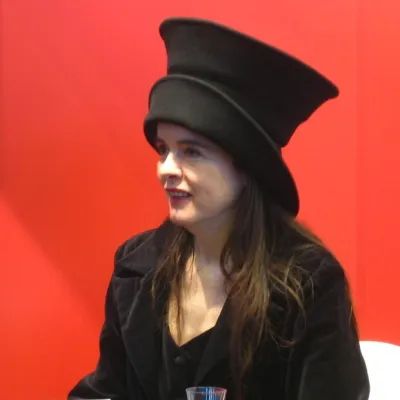
Amélie Nothomb
Human Design Chart
Biography
Nothomb's first novel, Hygiène de l'assassin, was published in 1992. Since then, she has published approximately one novel per year, including Les Catilinaires (1995), Fear and Trembling (1999) and Métaphysique des tubes (2000, published in English as The Character of Rain). She has been awarded numerous prizes, including the 1999 Grand Prix du roman de l'Académie française, the Prix René-Fallet, and the 1993 Prix Alain-Fournier.
While in Japan, Nothomb attended a local school and learned Japanese. When she was five, the family moved to China. "Quitter le Japon fut pour moi un arrachement" ("Leaving Japan was a wrenching separation for me"), she wrote in Fear and Trembling. Nothomb moved often, and she did not live in Europe until she was 17, when she moved to Brussels. There, she felt as much a stranger as everywhere else. She studied philology at the Université Libre de Bruxelles. After some family tensions, she returned to Japan to work in a Japanese company in Tokyo. Her experience of this time is told in Fear and Trembling (she won the Grand Prix de l'Académie Française in 1999).
On 3 November 2021, she won the Renaudot Prize for "Premier Sang", a tribute to his father.
She wrote a romanticized biography (The Book of Proper Names) for the French female singer Robert in 2002 and during the period 2000-2002 she wrote the lyrics for nine tracks of the same artist.
The Human Design of Amélie Nothomb: Manifesting Generator 2/5
Manifesting Generator 2/5 — Design at a Glance
Amélie Nothomb's Human Design shows a tendency towards hybrid dynamics: She possesses the constant energy of a Generator combined with the ability to skip steps and quickly draw results into her life. This configuration of an expressing Generator means that she does not just react to impulses but follows these reactions at a speed that bypasses traditional processes.
However, this speed carries specific risks. If Amélie Nothomb moves too fast, she often skips necessary intermediate steps, leading her to have to return later and fill in gaps – a process that can fuel her inner frustration. Additionally, her system tends to handle multiple projects simultaneously as she reacts to many different impulses at once. Without strict adherence to her strategy – waiting for the sacral "yes" before acting and regularly checking internal agreement – her creative enthusiasm risks turning into overload.
However, when the strategy is followed, that is, if she acts only after her Sacral Center clearly agrees, Amélie Nothomb can draw deep satisfaction from her work. In this state, parallel working is not a hindrance but a source of vitality. Her design promotes a "play mode" where variety and fun are driving forces. Then, her ability to quickly manifest things does not act as a disturbance but as an efficient tool that allows her to move in a state of sustained satisfaction so long as she respects the rhythm of her own energy and does not work against it.
Emotional Authority
Amélie Nothomb exhibited a basic attitude of the emotional wave: Her perception was always colored by her current feeling tone. In one moment, she could be totally enthusiastic, in the next view the same situation negatively. This shift is not a mistake but rather the nature of her inner authority.
Since the Solar Plexus Center is defined, it functions as an emotional authority – independent of which other centers are active. This configuration is subject to constant ups and downs of emotions. The first impression is merely a snapshot, not yet the truth. Quick decisions based on such emotion can therefore have negative consequences since they rely on transient states.
The strategy lies in timing. The longer Amélie Nothomb let a decision mature, the deeper her understanding became. This required patience and repeatedly sleeping on important questions. She should allow herself to be persuaded and not immediately commit. Over time, intense feelings subsided, emotional distance emerged, and clarity set in. Only then had she gone through the process. This mechanism is particularly relevant for long-term decisions that significantly influence her life course. By waiting, she gained composure and made decisions on a more grounded level than in the moment of initial emotional reaction.
The 2/5 Profile — Hermit / Heretic
Amélie Nothomb's Human Design suggests a tension between a deep need for withdrawal and external expectations. The Profile 2/5, known as the "Natural Talent" or "Hero and Saviour," projects an ability to solve problems outwardly while her inner experience is strongly marked by a need for isolation. Others instinctively seek solutions from her and see her in the role of helper, corresponding to Line 5. At the same time, Line 2, the Hermit Line, requires significant alone time to regenerate energy and gain clarity.
This configuration demands conscious selection: Amélie Nothomb had to decide for what she wanted to use her strength before saying "yes." Without this boundary, there is a risk of being overwhelmed by others' expectations, as her design is quickly judged as either hero or failure. Line 2 also brings with it a lifelong development line based on patience and the right timing – success often follows only after an external call, not through constant initiative.
The challenge lay in developing inner knowledge in the "cave" without blindly giving in to outer shocks or demands. The energy of Mars in these lines can lead to impatience if natural developmental speed is interrupted. Therefore, it was crucial to strategically use alone time to determine which support measures are truly sustainable and when a "no" is necessary to not lose one's balance. This created a dynamic where authenticity was preserved through restraint and targeted presence simultaneously.
Split Definition — Defined & Open Centers
Amélie Nothomb's Human Design profile indicated a tendency towards a constant, specific mental function: Her mind was a permanently active engine for data processing and creativity. The defined Ajna Center ensured that she consistently created concepts in a trustworthy manner, resistant to external pressure influencing her thoughts. This mental energy flowed directly into her defined Throat Center, enabling her to express what her mind conceptualized - a reliable yet limited form of communication and manifestation.
Her internal structure was further shaped by a defined G Center with a fixed sense of self-identity and direction, as well as a defined Heart Center providing willpower and control over personal resources. The defined Sacral Center generated a constant vital energy source waiting for reactions to sustain its effect. Additionally, the defined Solar Plexus Center with its emotional wave and the defined Root Center with its specific stress pressure were integral parts of her system.
In contrast, her vulnerability was evident in the open centers. The open Head Center tended to absorb mental pressure from the environment; she could easily get entangled in questions and doubts that weren't hers or seek inspiration to relieve this pressure. The open Spleen Center made her sensitive to well-being and fears from the surroundings. She had a tendency to cling to people with defined spleens for a sense of security, increasing the risk of unhealthy dependencies if she didn’t follow her inner authority. Spontaneous decisions were risky for this center as it could easily be misled by conditioned impulses.
Channels for insight, pioneering spirit, change, emotion and maturation.
Amélie Nothomb's Human Design profile indicated a tendency towards innovative, structuring thought that often felt light-years ahead of its time. This attitude was shaped by the Channel of Structuring 43-23: Spontaneous insights (Gate 43) were assimilated and clearly expressed (Gate 23), creating a unique perspective that promoted efficiency. Success required patience; without proper timing, she risked rejection as her genius needed time to be understood by the collective.
Parallel to this was the Channel of Initiation 51-25. Here, competitive ego energy (Gate 51) merged with universal love and higher self (Gate 25). This drove her to transcend boundaries and set a mutative example through personal triumphs. Initiation did not occur through control but as a mystical process when she lived authentically; forced initiations led to bitterness.
Her emotional landscape was influenced by the Channel of Transience 36-35. Driven by the search for new experiences (Gate 35) and perceiving unfamiliarity as crisis (Gate 36), she constantly sought the “New”. This made her unstable but also endowed her with wisdom to seize moments and gain emotional depth through lived adventures.
The Channel of Emotional Release 39-55 guided her moodiness. Through provocation (Gate 39) and emotional mind (Gate 55), she could elicit the nature of others and find resonant responses. Authenticity in her moods was crucial to transmit spiritual passion rather than manipulation.
Additionally, the Channel of Maturation 42-53 shaped her approach to cycles. From beginning (Gate 53) to growth (Gate 42), each experience had to be fully traversed and reflected upon to gain wisdom. Premature endings only led to repetitions; complete closures enabled her to make lessons useful for others.
Individual Gates complemented this: Gate 54 linked worldly success with mystical insight, Gate 57 offered intuitive clarity in the present moment, while Gate 33 required reflection and withdrawal for integration.
Individual Circuitry — Circuit Signature
Amélie Nothomb's Human Design profile indicated a tendency towards pulsating, acoustic creativity paired with deep individual constancy. This configuration shows someone who pioneers new paths and initiates changes without losing inner stability.
The Knowledge Circuit in her connected two separate segments: The Ajna Center (spiritual clarity) with the Throat Center (expression) enabled innovative ideas to be directly translated into words or actions. Simultaneously, the link between Solar Plexus (emotions) and Root Center (survival energy) channeled felt impulses into immediate readiness for action. This created an emotional wave that rapidly discharged in expression.
At the same time, the Centering Circuit acted as isolated power: The connection between Identity Center (self-worth) and Heart Center (willpower) fostered solid convictions and courage. Since this energy did not flow directly to the Throat Center, these deep convictions often remained internally anchored rather than loudly proclaimed. They strengthened her individuality.
The Purpose Circuit complemented this through two additional strands: The Throat Center was linked with Solar Plexus, allowing the expression of emotional waves and past experiences. Additionally, the connection between Sacral (life force) and Root energy facilitated a cyclical maturation process that allowed learning from past events and sharing these insights with others. Together, these separate but parallel streams shaped a profile that was both creatively transformative and emotionally reflective while being internally centered.
Right Angle Cross of Penetration 2
Amélie Nothomb's Human Design suggests a tendency towards intense, often painful internal processing. The right intersection of Crossing 2 does not describe an external action power but rather a deep inner process: the necessity to consciously acknowledge one's own wounds and injuries in order to gain clarity and healing from them. This mechanism does not demand ignoring pain but its direct confrontation as a path to self-discovery.
For Amélie Nothomb, this meant an internal stance characterized by readiness to face personal crises head-on rather than avoiding them, using these transformative forces. The energy of this cross acts like an inner catalyst: while others might superficially overlook difficulties, Amélie Nothomb's design reveals a depth that can only be reached through honest confrontation with one's own suffering. It is about penetrating one's weaknesses rather than avoiding them.
This configuration shaped her internal landscape as a space where pain was not seen as an end but the beginning of new insight. The challenge lies in allowing the healing process its necessary time and attention, not accelerating or suppressing it. Thus, from the penetration of personal suffering emerges authentic strength that does not rely on external success but on inner integrity and the ability to transform one's own suffering into meaning.
Saturn Return · Uranus Opposition · Chiron Return · 2nd Saturn Return — Life Cycles
Amélie Nothomb's Human Design shows a tendency towards recurring phases of confirmation where internal structure aligns with external recognition. This was visible in 1993 when she received the Prix René-Fallet and Prix Alain-Fournier at age 27 - a classic moment of the first Saturn Return, often condensing years of groundwork into tangible results.
This dynamic of structural consolidation repeated itself during her second Saturn Return in 2022: At 56, her novel “Premier sang” won the Premio Strega Europeo, indicating a continuous ability to cast creative impulses into recognized forms.
Between these poles of confirmation, the Uranus Opposition occurred in 2007. At age 41, “Ni d'Ève, ni d'Adam” was awarded the Prix de Flore. This cycle often marks a phase of breaking free from old patterns to embrace new forms of expression; here it manifested as success through innovative literary positioning.
The Chiron Return in 2015 then brought the experience of fulfillment. At age 49, Amélie Nothomb was granted the title of Baroness by King Philippe. In this cycle of fulfillment, her personal Inkarnation Cross increasingly unfolds in life; meaning and purpose become experiential not as healing old wounds but as blooming of one's life task in social recognition.
Manifesting Generator · Emotional Authority — Synthesis
A central red thread in this design is the dynamic interaction between inner perception and external expression. The defined Sacral Center provides a constant energy source, connected to the Manifesting Generator Design with a capacity for rapid initiation (Design View). However, this energetic foundation is modulated by the Emotional Authority Center, which requires time for maturation and deeper understanding (Authority), leading to an internal process that counters impulsive action. The Knowledge Circuit reinforces this process by promoting the transformation of new knowledge into expression through the Throat Center - often innovative and unique.
The central paradox lies in the tension between the drive for rapid implementation (Manifesting Generator) and the need for emotional clarity (emotional authority). The profile as a natural talent and Hero/Rescuer (Profile Role) intensifies this conflict: others' expectations of quick help clash with the deep need for withdrawal and inner orientation. This ambivalence, between the desire to give and the necessity of self-care, seems to manifest in recurring successes (cycles), often associated with awards - an expression of transformative potential when internal processes align with external expression.
5 Defined Channels
Incarnation Cross - Right Angle Cross of Penetration 2
Solar Return
The Solar Return shows the moment when the sun returns to its exact birth position - your personal solar year.
Life Cycles
Discover the life cycles with a detailed triple view (birth chart, cycle chart, composite).
Human Design Profile
- Strategy
- To respond - wait for something to respond to
- Authority
- Emotional Authority
- Profile
- 2/5 - Hermit / Heretic
- Definition
- Split Definition
- Incarnation Cross
- Right Angle Cross of Penetration 2
- Date of Birth
- 09.07.1966 17:22
- Place of Birth
- Etterbeek, BEL
Frequently Asked Questions
What is Amélie Nothomb's Human Design type?
What Profile does Amélie Nothomb have?
What Authority does Amélie Nothomb possess?
What incarnation cross is assigned to Amélie Nothomb?
When was Amélie Nothomb born?
Discover your own Human Design
Are you also a Manifesting Generator? Find out in a personal reading how to unfold your multi-talents and direct your energy wisely.
More Personalities
Back to overviewAlain-Fournier

Aldair

Alizée

Angeli

Arletty
Artus